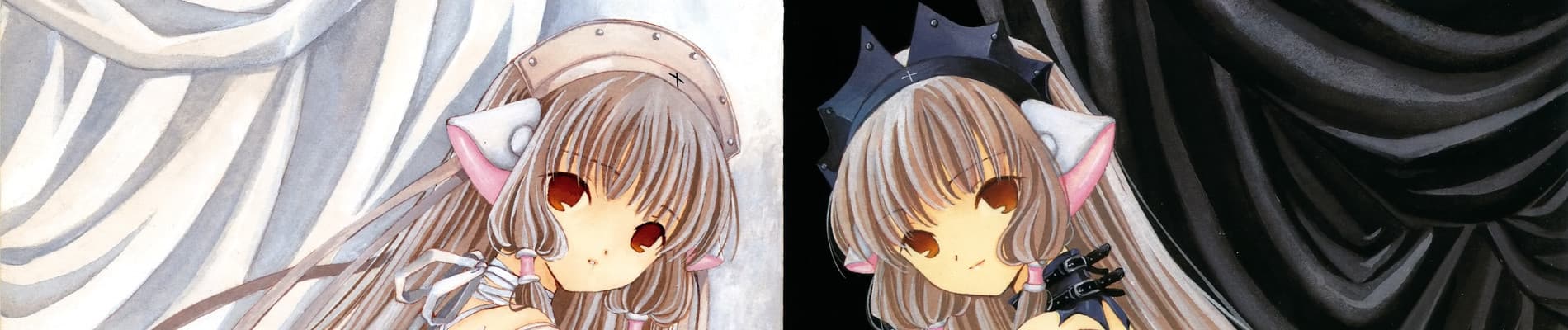
Chobits
a review by ninjamushi
a review by ninjamushi
Chobits is a classic manga/anime that has seemingly lost its popularity over the years. While still well known, it is not as revered as it once was in the mid to late-2000s nor are many new fans seeking it out. I believe this is the case in due part to the anime. Despite my own appreciation of the adaption, it suffers from meandering pacing and early digital animation. Regardless, I liked it when I watched it in 2016 (5 years ago as of writing). Still, I was curious as to how the original manga held up. For what it's worth, I was a big fan of the anime and wanted to see if the manga could do it even better. Having now read it, I can safely say that I thoroughly enjoyed the Chobits manga—even more than the anime.
Sci-fi was all the rage during the 1990s, in both halves of the world. In the Western hemisphere, The Matrix made a mainstream audience question the validity of their own existence, Jurassic Park bought dinosaurs back to life through genetic mutation, and the Japanese pop culture icon, Godzilla, was bastardized in the American self-titled Godzilla. The same was true in Japan; sci-fi had been booming. With the rise of Mobile Suit Gundam and Akira a decade prior, the 1990s' biggest titles were dominated by sci-fi themes. Perhaps the most notable—and most vital to Chobits—was Mamoru Oshii's 1995 film, Ghost in the Shell, which explored robotic augmentation, the human soul, and the ties between the two. The film is smothered in a dark and foreboding atmosphere, one that is quite uncomfortable.
In contrast, Chobits entered the scene five years later, at the tail end of the sci-fi craze, as a tonal departure from the cynical and somber sci-fi set by Ghost in the Shell and its contemporaries. While Chobits explores similar ideas, such as the existence of a human soul in a robotic body, it stands apart from the rest in its supporting genres: Slice of life, romance, drama, and comedy. Rather than a bleak examination of whether a character has a human soul, the story of Chobits follows the blossoming relationship between a human and his persocom, this world's version of a "robot." In tone, the story has blotches of darker plot points, but these moments often come across as tender, rather than oppressive. Reading Chobits is often fun, pleasant, and joyful, ways I would never describe most of the sci-fi that preceded it. Without abandoning the questions that make sci-fi (specifically about robots) compelling, Chobits is far more digestible. On the contrary, those questions are served in a way that is more fun to engage with. This is highlighted in the supporting cast, who manage to be fairly endearing in both characterization and their individual stories. Its goofy antics might be a might much for a reader that's looking for a more straight-faced take on sci-fi but, for other readers, Chobits' lighthearted nature might be the perfect way to experience these kinds of themes.
On the whole, Chobits is quite palatable in the ways it communicates its ideas to the reader. In that sense, I think that's why it was so successful at the time that it released. Compared to what came before, it was a breath of fresh air. It proved that this type of story can have different inflections. Since then, stories about robots and romance have become somewhat more available but, despite its declining uniqueness, I still think Chobits has a place in sci-fi manga.
One of my favorite things about Chobits, and something that sets it apart from a lot of other stories about robots, is the timeframe of its technology. It's fairly uncommon to find a story about robots that are far from perfection. Usually, robots are portrayed as near-perfect with maybe a single major flaw to create a narrative. Comparatively, the persocoms of Chobits are primitive. They seem human-like, but the manga often reminds us that their programming is far from a human mind. Their emotions, thoughts, and personalities are all programmed and, by extension, not real. A perfect example is the "laptop" persocom, Plum. Her personality is overtly energetic, but that is only because she was programmed that way by her owner. For as loud as her personality is, it is just as simple. She is devoid of complex emotion or thoughts—even more so than full-sized persocoms. She never expresses worry, sadness, or any other negative emotion because she wasn't programmed with those emotions in mind. Even the more complex persocoms only express an "emotion" in the sense that their programming determines how they "feel." Unlike similar stories, persocoms do not have emotion comparable to humans—that much is directly stated. It isn't a question that leaves room for interpretation; the emotions of persocoms, even Chobits, are mere programming. Instead of asking if the emotions of persocoms are real, the question is, "Is it okay to love a persocom even if they are fake?" The persocoms are limited to their devices and the human characters have to decide what that means to them.
While not as prevalent as the conversation of emotion, another aspect of the technology that I found interesting was the mechanical side of how the persocoms worked. It's clear that the bodies of the persocoms are not perfect. One arc in particular (my favorite of the entire manga) features a character who dealt with his persocom's failing systems, which begins to develop as memory problems (similar to alzheimer's in humans). Not unlike humans, persocoms are not immortal beings that will never falter. Each model is eventually outdated, their software will become unsupported, and their hardware can simply breakdown. Persocoms have an unspecified lifespan, just as all modern technology does. If anything, the persocoms feel more human than most fictional robots because of how flawed their bodies can be.
As I mentioned before, some of Chobits can come off as a little goofy and I can't deny it—some of it is a bit much. Obviously, comedy plays a part in that, but it's irrelevant to the larger problem. My one major problem with Chobits is its technology can be totally nonsensical. Ranging from persocoms seemingly replacing computers (for most people) to a startup button being in a vagina, some of the tech of this world is hard to take seriously. Of course, the manga was released in 2000, a different time from today, and should be taken with a grain of salt. However, there is still a handful of technological ideas that made little sense even when publishing. This does not mean much in the grand scheme of things, but it does occasionally pull me out of the reading experience.
The cast of Chobits is defined by the ways in which they develop the overarching purpose of the manga, which is to explore the validity of loving a persocom. Likewise, Chobits ventures into each character's perspective of what it means to love, their relationships with persocoms, and how that ties into the story of Hideki, the protagonist, and Chi, his persocom. Any character that has an active role in the story has a new point of view to add—a new way to understand the way we coexist with robots. Whether romantic or platonic, each character's arc tackles a different problem. One character may struggle with their inferiority complex towards persocoms while another may have to cope with the reality of their persocom's technological limitations. Because each character's feelings are fleshed out, the pros and cons of having relationships with persocoms are explored in a relatively satisfying way.
This extends beyond the relationships between humans and persocoms, however. The manga actively makes mention of the ways in which persocoms have changed relationships between people, some of which are relevant to the various characters. Hideki notices on multiple occasions just how few people are without persocoms in public; nearly everyone relies on a persocom to some extent. Although reliance on persocoms is becoming the social standard, there is a darker underbelly to the existence of persocoms in a human society. One character, for instance, had previously gone through a divorce because their husband had become obsessed with their persocom. Chobits actively makes the effort to showcase why persocoms are both helpful to society and their uses but never ignores why they could be potentially dangerous to the wellbeing of human relationships. Each character tells their own story, but the full picture comes across as cautiously optimistic towards robots becoming a part of their world.
Personally, I love Chobits. I see it as an underappreciated manga these days. Often forgotten about when discussing classic manga, I wanted to attempt to give it a little more love. Is it as deep and complex as Ghost in the Shell? Is it a perfect masterpiece? Is it timeless, unsubjected to changing technology? No, no, and no. Is it good? Absolutely. In the midst of its light fanservice and dumb comedy, I think a lot of readers fail to see how compelling it can be. From its heartwarming romance to its engaging themes, Chobits offers a multitude of reasons to read it even 21 years later.
66 out of 66 users liked this review
