Devil May Cry Season 2 Anime Review
 Synopsis:
It's the early 2000s, and American troops are invading Hell itself. Unfortunately, our hero, Dante, is trapped in a cryogenic prison after being betrayed by his only remaining friend, Lady. Meanwhile, Lady herself is on a mission to retrieve the artifacts needed to build a super weapon capable of ending the demonic threat once and for all.
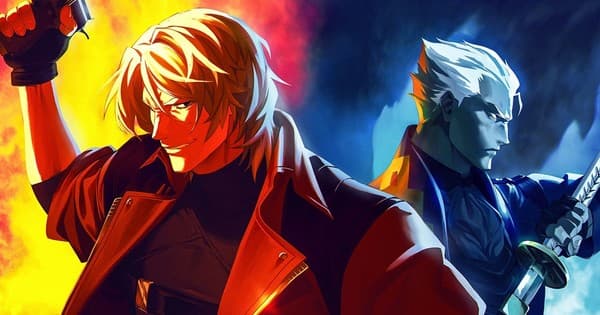
In the midst of all this chaos, Vergil, Dante's long-lost twin brother, returns to Earth on the hunt for those who killed his mother: Uroboros, a cult loyal to the previous ruler of Hell who is seeking his resurrection. From slaughtering US troops to revealing massive conspiracies to the public, Vergil is willing to do anything to get his revenge—even if he has to go through his brother to get it.
It's the early 2000s, and American troops are invading Hell itself. Unfortunately, our hero, Dante, is trapped in a cryogenic prison after being betrayed by his only remaining friend, Lady. Meanwhile, Lady herself is on a mission to retrieve the artifacts needed to build a super weapon capable of ending the demonic threat once and for all.
In the midst of all this chaos, Vergil, Dante's long-lost twin brother, returns to Earth on the hunt for those who killed his mother: Uroboros, a cult loyal to the previous ruler of Hell who is seeking his resurrection. From slaughtering US troops to revealing massive conspiracies to the public, Vergil is willing to do anything to get his revenge—even if he has to go through his brother to get it.
Beyond the action and adventure of the first season, Devil May Cry was largely an allegory for the war on terror. Refugees were persecuted for no other reason than their place of birth, and in the end, terrorist attacks were used as justification for a foreign invasion. While this aspect of the setting remains (and is occasionally revisited), this season is far more concerned with exploring its trio of main characters than it is with political commentary.
Dante, Vergil, and Lady all suffer from the same general trauma—demons killed their mothers in front of their very eyes. Each of the three has dealt with this in different ways—though none of these ways has been exactly healthy. Dante has spent his life running away from what he is—literally making a living killing demons despite being half-demon himself. He uses humor as a shield against the emotional pain he's never allowed himself to face and to keep others from getting too close.
Vergil, on the other hand, has done the opposite. He's used his mother's death and the pain that stems from it as fuel to gain power. It's only by becoming strong that he will never have to suffer something like that again. Instead of wandering aimlessly through life like Dante, Vergil is hyper-focused. He's constantly training, fighting, or studying. He's become hyper-competent and emotionally sterile—except for the rage he holds tightly inside.
As for Lady, she bounces between their extremes. She started like Dante, aimlessly killing any demon she could. Then she ended up like Vergil, taken in by an authority figure who taught her structure and gave her a sense of purpose. However, after the revelations of the series, she finds herself in between the two viewpoints—needing a purpose but not willing to be anyone's pawn—and is left following her own heart for better or worse.
It's not surprising that this leads to a bit of a whirlwind romance between Lady and Dante this season, as the two fully understand each other's pain. It feels completely natural for both characters, given where they are in their personal journeys. However, as their ways of handling their trauma vary so greatly, it's no surprise that no happy ending awaits—at least in this season anyway.
Fitting with the season's main theme, the villain of this season, Arius, also suffers from familial childhood trauma. However, in his case, the death of his parent came not at a demon's hands but his own. Arius is a man who was born in the wrong place and time. Brilliant and beaten down because of it (first by his father and later by the bureaucracy of society), he determined that only through tearing down the structure that we call society could his brilliance ever be given the freedom it needed to flourish.
Of course, the irony is that he is likely the most powerful person in the world by the time of the series. He owns the media, and his money decides the president. He has advanced human technology to the point where cloning, cybernetics, and advanced AI surgery are all available for his personal use. He doesn't need to resurrect a demon and reduce the world to chaos to become “free”: he already is (more so than anyone else). He just can't see beyond the eyes of the young boy once beaten by his drunk father or the inventor who couldn't get the patronage he desired.
The only sticking point with Arius as a villain is his lack of presence in the first season. He suddenly supplants Vice President William Banes as the true head of DARKCOM—the paramilitary organization that Lady works for—in this season, pushing Banes largely out of the picture. While that's not to say that Banes doesn't have some key moments in this season, it's not hard to wonder if the untimely death of Banes' original voice actor, Kevin Conroy, led to the role being truncated (despite being recast).
Speaking of voice acting, the English cast is fantastic all around (even if, admittedly, Ian James Corlett can't quite fill Kevin Conroy's shoes). Johnny Yong Bosch and Scout Taylor-Compton continue to deliver their own enjoyable versions of Dante and Lady, while Robbie Daymond and Graham McTavish do great work bringing Vergil and Arius to life.
But as good as the voice actors are, it's the soundtrack that steals the show on the aural front. It's got songs from Evanescence, Papa Roach, Korn, and even Avril Lavigne. If you're a kid from the 90s or early 2000s, you're in for a musical treat.
As for the animation, while most of it is on par or above, there is some stand-out animation from time to time (including a notable homage to TactiCOOL Reloads). The fights are bloody and brutal, and the choreography is both exciting and fun. It's exactly what you're looking for in an animated action series like this one.
When it comes down to it, the only major potential downside to this show stems from how attached the viewer may be to the original games. Neither this season nor the first is even close to 1:1 adaptations of the games. While characters, plot points, visual design, and the overall lore are heavily inspired by them, this is very much its own story being told. It feels like a show made by people who love the games but don't want to be beholden to them—people who want to tell their own tale within the framework of the original. On that level, Devil May Cry continues to succeed in its second season.
If you enjoyed the first season of Devil May Cry for its action, style, and characters, this second season won't disappoint. You will be more than entertained. However, if aspects of the first season like its political commentary or divergence from the games turned you off, this season won't do much to change your mind. This is a show determined to blaze its own path—for better or for worse.