Ghost in the Shell: The Human Algorithm Volumes 1-8 Manga Review
 Synopsis:
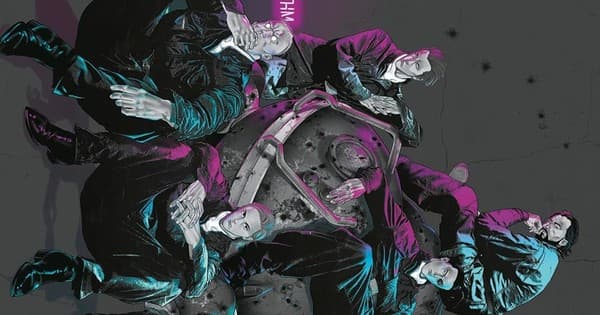
2030's Japan is a society in flux, as quantum leaps in cyberization technology grant most of the populace unprecedented access to direct neural interfaces and prosthetic bodies. With this unfettered human mental integration into the World Wide Web, new threats from terrorists and rogue government agencies. Public Security Section 9 was set up to tackle such newly emerging cybercriminality. Although original leader Major Motoko Kusanagi left to merge her ghost with an artificial lifeform, shedding the shackles of her physical body, that doesn't mean her former colleagues remain idle. Togusa, Batou, Aramaki, and the others continue their endless struggle to keep their country safe.
The Ghost in the Shell: The Human Algorithm is translated by Stephen Kohler and lettered by Paige Pumphrey.
2030's Japan is a society in flux, as quantum leaps in cyberization technology grant most of the populace unprecedented access to direct neural interfaces and prosthetic bodies. With this unfettered human mental integration into the World Wide Web, new threats from terrorists and rogue government agencies. Public Security Section 9 was set up to tackle such newly emerging cybercriminality. Although original leader Major Motoko Kusanagi left to merge her ghost with an artificial lifeform, shedding the shackles of her physical body, that doesn't mean her former colleagues remain idle. Togusa, Batou, Aramaki, and the others continue their endless struggle to keep their country safe.
The Ghost in the Shell: The Human Algorithm is translated by Stephen Kohler and lettered by Paige Pumphrey.
For anyone new to legendary manga creator Masamune Shirow's expansive Ghost in the Shell (GitS) franchise, The Human Algorithm (THA) is absolutely not the correct place to start. First, go check out the absurdly exhaustive guide I wrote for ANN back in 2024, and choose something more sensible. For those more familiar with either the original manga or any of its multitudinous animated adaptations (of which a new, apparently very faithful adaptation of the first manga volume by Science SARU starts streaming in July 2026), know that this is a sequel that barely even features franchise poster girl and usual protagonist Major Motoko Kusanagi.
If you've only seen the 1995 movie, you probably have enough knowledge to get by, but THA follows the original 1980s/90s manga continuity very closely and chronologically slips into the gap between 1.5: Human Error Processor (HEP) and 2: Man-Machine Interface (MMI). There are multiple nods and allusions to manga-only events, and the appearance of characters from both HEP and MMI, such as new Section 9 recruits Azuma and Proto, and Channelling Agency operative Tamaki Tamai. Tonally, THA is closest to HEP. It's a continuation of its serious police procedural drama, though it also introduces plot elements prominent in the later MMI. It may be helpful for new fans wading their way through Shirow's original trilogy of volumes to treat THA like “Ghost in the Shell 1.75,” as reading it in chronological story order will certainly ease readers' transition between HEP and MMI, whose content and style are starkly different from one another.
THA isn't written by Shirow himself, who, for all intents and purposes, gave up on producing manga following the publication of MMI, deciding to focus his energy on drawing very shiny-looking large-breasted women for a mountain of presumably more profitable art books. Instead, writing duties are placed in Junichi Fujisaku's safe hands. Fujisaku is a GitS veteran, who, counting his works as scriptwriter for GitS TV series Stand Alone Complex, its three associated spin-off novels, plus the GitS: Arise Border 5 OVA, the Arise manga, and an Arise VR video script, has written more about Section 9 over the years than Shirow himself. Fujisaku's work on Stand Alone Complex in particular really shines through, as he absolutely nails the interpersonal banter between the lead characters in a way reminiscent of what made that series so iconic.
Fujisaku's writing also isn't as esoteric as Shirow's. His stories have coherent beginnings, middles, and endings. Antagonists have motivations that are tangible, and dialogue isn't bogged down by endless paragraphs of arcane technobabble. This clarity of writing style means THA doesn't quite have that unique GitS/Shirow “flavor,” but what it sacrifices in quirkiness, it makes up for in intelligibility. That's not to mean this is a manga easy to breeze through. Fujisaku's plotting is intricate, the progression relentless, and it forces the reader to slow down and really ponder the story's events. I'd estimate it took me roughly twice as long per volume to read this, compared to most other manga of similar length. Yet I was never left baffled, unlike with MMI.
Familiarity with all three of Shirow's GitS volumes does help, especially when Fujisaku throws in a bunch of relatively obscure references (including to Batou's doomed relationship with his “girlfriend” Loffa. Poor guy.) Much like with HEP, the Major remains an influence in the lives of Section 9's staff, but her role in the manga, aside from a few pivotal scenes, is almost entirely off-page. This may frustrate fans more used to her prominence in other franchise iterations, but it's worth remembering that Shirow himself made two attempts to sequelize his original manga that ends with Kusanagi's transcendence, and arguably, he never succeeded in achieving a satisfactory balance in either. Fujisaku succeeds by making the world itself and the other characters interesting enough that the reader doesn't feel Kusanagi's absence too keenly.
Batou's essentially the same hulking soldier he always was, now with a punk-esque undercut hairstyle and more of a focus on sneaky ghost-hacking than physical brawling (though he still does plenty of the latter). He's not as brooding and miserable as he is in the movie sequel Innocence. Ishikawa doesn't appear often “in the flesh”, as he's taken to remotely piloting a teenage girl android body, complete with Kill Bill-style katana. Saito gets to snipe things now and then. Togusa's still one of the team's only human-bodied operatives, as he continues to resist the lure of prosthetics. He's most often paired up with new female recruit Tsunagi, transferred to Section 9 from Japan's Channelling Agency. As she values her innate psychic skills, she has also resisted cyberization, to the point that she doesn't even have cyberbrain implants and can't join the others for live online strategy meetings. Like the superficially similar Purin Ezaki from the most recent GitS anime SAC_2045, Tsunagi can be irritating to the point of evoking nails down a chalkboard, at least at the beginning. Her unrequited crush on Togusa leads to far too many repetitive jokes about marital infidelity, especially as they keep being sent undercover as a newlywed couple. Poor Togusa never gets to see his real wife or kids, so the last thing the guy needs is a clingy “work wife."
The entire eight-volume series is split into three main story arcs, with the first three volumes comprising a complex political thriller about the targeting of Newport City's pro-prosthetics mayoral candidate by a shadowy organization that uses vat-grown children with special powers as assassins. Volumes 4-6 comprise a fascinating tale, unusually for the franchise, set almost entirely in a fictional sub-Saharan country on the brink of civil war. It examines some hot-button topics about war profiteering, modern slavery, ethnic cleansing, cultural identity, and familial bonds. It's heady stuff and is by far the most impressive piece of storytelling in the whole series. Our characters spend much of the time completely out of their depth, while multiple antagonistic parties manipulate circumstances for their own corrupt gains.
The final arc, comprising volumes 7 and 8, ties together aspects from the previous arcs into a tight piece of speculative fiction exploring the concepts of how immortality could be achieved in the GitS world and the potential moral repercussions of this. There's a group of elderly nursing home resident antagonists who could be right at home in Katsuhiro Ōtomo's Roujin Z. In true GitS style, by the end, the reader does wonder if the “antagonists” had a point all along, as motivations become uncovered, along with the disturbing truth. The whole thing would make an excellent, if dense, animated series.
Art duties are inherited by Yuki Yoshimoto, whose detailed, clinical style is extremely reminiscent of Hiroya Oku (Gantz), complete with a frequent use of digital compositing of real-life photography for some backgrounds. It's a massive shift from Shirow's more organic pen-and-ink style and may take some getting used to for readers jumping straight from the original manga. His character designs, although recognisable for the most part, are heavily altered and much less cartoonish than Shirow's. In the very first chapter, we glimpse the empty shell that is Motoko Kusanagi's discarded prosthetic body, and it looks just like Scarlett Johansson, so make of that what you will. Togusa, in particular, has received a major glow-up to the point he now looks like a chiselled K-pop idol rather than a harried police officer.
Yoshimoto's art style certainly helps to lend an air of gravitas to proceedings; however, he struggles with more humorous scenes. The original GitS was often very goofy and silly, and although writer Fujisaku does what he can to insert a bit of levity into some exceedingly dark events, Yoshimoto's approach to these comedic scenes is to distort his very realistic character designs Boichi(Dr. Stone)-style, which looks disturbing rather than funny.
For several years, Junichi Fujisaku and Yuki Yoshimoto's The Human Algorithm was the only ongoing media in the Ghost in the Shell franchise. It concluded in 2025, with the final volume publishing in English in 2026. I wonder if Science SARU's upcoming adaptation will reignite wider interest in this otherwise evergreen property? Shirow himself was happy to hand over the reins to other creators over two decades ago, and there's a great variety of GitS manga, anime, novels, and more out there. Some concerns about tone and art style aside, The Human Algorithm has kept the GitS flame burning and is well worth a look for fans hankering for a further hit of serious, thought-provoking sci-fi police procedural drama in this already well-explored world.