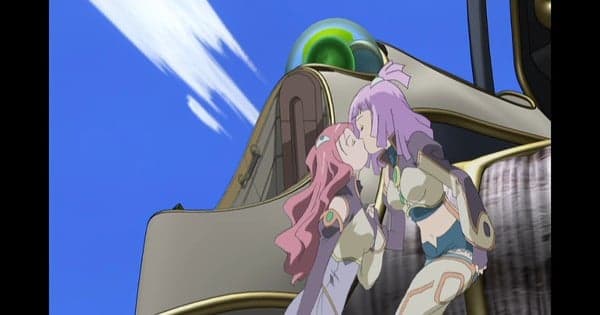
Sylvia and Chris revisit Simoun on its twentieth birthday to honor the power of girls kissing.
Disclaimer:The views and opinions expressed by the participants in this chatlog are not the views of Anime News Network. Spoiler Warning for discussion of the series ahead.
Certainly not gonna complain about getting two queer-friendly topics this Pride Month. And as Simoun shows, good things come in pairs.
Sylvia
Indeed, Chris! And trust me, after harnessing all of the energy from the showing of Adolescence of Utena on the silver screen yesterday evening, I could not be more ready to talk about magic fueled by the power of girls kissing.
Simoun, having just turned the respectable age of 20, is a certified queer classic and part of the Gender Anime Canon. And now it's streaming. On Darkroom! Surely you've heard of Darkroom?
Finding out that Darkroom had Simoun, a series I've been fiending to see streaming for decades, was in fact the first I'd heard of Darkroom. They've got an...eclectic mix of animation alongside Simoun, including a bunch of the Crusher Joe anime, Looking for the Full Moon, and Haré+Guu, which I know I saw some other people excited for when they announced it.
It's honestly not a bad selection for Darkroom's comparatively paltry entry price, even as it seems they're still working out some of the service's kinks.
This was the first I've heard of Darkroom, too, although I can hardly be surprised when I long ago realized it was futile to keep up with every new streaming platform. I'm still not sure what their "thing" is, besides somehow licensing Simoun. And you know what, maybe that's enough. But as you mentioned, licensing is only half the battle. We were supposed to cover this topic last week, but our efforts were stymied by every episode upload containing glitched audio and video. Not exactly the ideal anime viewing experience.
To Darkroom's credit, though, I contacted their support email about the issue, a representative got back to me within the day, and they began fixing the episodes one by one shortly thereafter. In other words, if you decide to watch Simoun on this service, you can thank me personally. Go on. I deserve it.
Thank you for delivering this Pride Month miracle! Here I was thinking I might have to kick it old-school there for a minute.
Photo by Christopher Farris
Also a valid option! I, too, am grateful I still have my DVDs to fall back on. Simoun is, quite simply, an all-timer. It's a series I often think about fondly. It's so weird, so rich, and so gender.
It's amazing how even as I'd forgotten some of the finer plot points of Simoun's run in the years before I sat down for this rewatch, there are still several scenes burned into my brain, hanging out rent-free in there forever.
But in the name of context, as we were spending time questioning "What the hell is Darkroom?" there are probably some baby viewers in here wondering "What the hell is Simoun?" The basic answer comes from its premise: "That fantasy/sci-fi yuri anime where everyone's born female, and they eventually have to choose whether they'll become a man or a woman." The more detailed answer, as you said, is a rich tapestry.
It's a dense series; there are lots of ways to describe it. One that jumped out to me this time, now that I have a bit more anime experience under my belt, is that Simoun is a Gundam. It's a war story about child soldiers that rarely pulls its punches, adorned in its fantasy/sci-fi dressings. The titular Simoun are mysterious flying craft that can only be piloted by special priestesses under the age of 17, at which point they have to choose their sex in a ritual that functions as their transition into adulthood. So among other things, these are child soldiers by necessity—there are many such cases in anime.
It's surprising how backgrounded the war element of Simoun can feel at times. Many of the priestesses participating in the effort are doing so for their own personal reasons—because their family pushed them to, because they want to stay with friends and loved ones they have on the team, and in several cases, specifically because they want to put off choosing a gender and advancing to adulthood!
The conflict is still a key component of the story, but whole episodes can go by without directly addressing it, focusing on the inter-group conflict of the priestesses and the religion and/or government that directs them. Hell, the way the war is resolved by the end of the series is extremely atypical of what I've seen in anime, and indicative of its use as a setting for the coming-of-age story.
I remember the fourth episode bowled me over the first time I saw it. Among other things, it's our first time seeing one of the enemy combatants up close, underneath their flight suit, which is both fascinating and harrowing, especially as his experiences clash against Aeru and Limone's.
But the real kicker is the episode's conclusion. The enemy dies trying to pilot the Simoun, and rigor mortis sets in while his hand is still gripping the controls. Which leaves Aeru only one option.
That's the moment when I knew Simoun wasn't playing around.
It's a show that can feel absolutely breezy and decompressed in its pacing at times—certainly not the kind of series that would get made today when even major productions struggle to get a full 26 episodes of breathing room. But all the time spent pontificating in bedrooms or hypnotically doing flight training in the sky pool just means it can hit harder in moments like Aaeru's hands-on experience there, or newly introduced rivals attempting murder in said sky pool.
That's just science.
Speaking of Utena, though, Simoun is another showcase of Shichirō Kobayashi's singularly stellar art direction. You could mistake many of these backgrounds for parts of Ohtori Academy.
Simoun is an earlier digital series with copious CGI elements, so the jump to streaming on HD screens hasn't been super-kind to parts of it. But dang are the backgrounds timeless!
They also future-proof some of the other artistic elements through copious use of the ol' Dezaki-style postcard memories. These rang as a bit of a budget consideration at the time, but now I respect them as one more element adding so much signature texture to Simoun.
For better or worse, this is from that transitional time in the 2000s, with a lot of CGI assets that were never rendered to look good at a higher resolution. No amount of remastering is going to "fix" that. But at this point, I think we can take a page out of Brian Eno's book and embrace that visual jank as a defining feature of that era. It's even appropriate for the Simoun craft, because it gives them an otherworldly aura befitting of their enigmatic origins.
Like, these are weaponized giant seashells that draw patterns in the sky, powered by lesbian libido. They should not look "normal."
I also like how each of the vehicles have their own unique details, with different...Well, I have no idea what the various components of these flying fantasy craft would be labeled, but they get different tops, bottoms, wing effects, etc, to make them seem equally distinctive and further mysterious.
They're iconic designs! Elegant and totally alien. I don't know what to compare them to either.
They're also purposefully emblematic of the mechanics the society is built around. No one knows how they work; disassembling the motors to figure out how is considered a grave sin, and looking in once they are disassembled can drive one to madness.
It's a variable black box that no one understands, yet they structured their whole society on it. It's much like gender, in that way.
Indeed. Here on Earth, we may not need to take a pilgrimage to a magic fountain overseen by an immortal priestess to settle on what gender we are, but it can feel that way sometimes. Metaphorically.
I do like that everyone starts female before settling into their final form in adulthood, which is literally how it works in the womb. Yet another angle to think about.
This also leads to cool stuff like two former Simoun pilot partners, now both leaders in the war effort, appearing via eyecatch in both their toxic GL and toxic BL forms. Simoun's brain is huge and deserves to be studied more closely.
Over the years, I have seen several people, presumably those who haven't actually watched Simoun, thinking the known premise of it is actually there to undercut the yuri. IE: each girl/girl couple is only predicated on the point that one of them will become a guy and straighten the pair out by the end. What actually happens, as already detailed, is it just makes the show more queer, with a lot of readings on gender and the transitioning thereof that seem salient today and felt light-years ahead back in 2006. As said, several of the characters don't even want to choose a gender. Which makes sense in a setting that has fully choice-based magical transitioning but still somehow also has rigid gender roles.
Exactly! It's a "what if" scenario along the lines of The Left Hand of Darkness. It's meant to make the audience turn a critical eye to how we think about gender daily. How do we compel each other to stay within predefined outlines? And how that doesn't have to be the case. That's progressive as heck for a 2006 anime, and yet another reason why it deserves to hang with peers like Utena.
Simoun is so much gender. It's your parents catching you with gender and making you smoke a whole pack of gender to teach you a lesson.
Like rent-free scene #1 comes from just the second episode, which drives home the inherent horror of the premise (and the real-life social construct overall). Erii forces herself to make her choice, is unable to decide, and is only able to realize what her decision would be once she's made the wrong one. It's a harrowing moment that refutes Simoun from being just another gender-flip anime. Another instance of it meaning business.
That scene definitely hit me differently this time around, now that I have an extremely concrete understanding of what being the wrong gender feels like.
It's worth noting here that Simoun's director, Junji Nishimura, also directed the first anime adaptation of Ranma ½. So they definitely got the right guy for the job.
As well, a huge portion of episodes from the show's second half were written by an earlier-career Mari Okada, so you know she dials up the necessary messiness appropriately.
She has earlier credits writing for anime, but I believe Simoun is where Mari Okada truly became Mari Okada. Full-on sicko mode. I mean, she began her tenure on Simoun with that lesbian incest episode. That's an entrance right there.
Also, you might be tickled to know that the lesbian incest episode debuted almost exactly 20 years ago on 6/20/06. I forgot to celebrate : (
I'm going to celebrate it from now on, knowing that Mari Okada Lesbian Incest Day falls neatly in Pride Month. A day before Utena drove back into theaters. What timing.
It's worth noting that, as mentioned for Okada and expected for lesbian incest, it's a subject handled messily in the show. As in "characters questioning who was consenting or leading the other on." It's contestable (but also reflective of how Aaeru is pretty relationship-illiterate) and fits with how so much queer art necessarily comes with "problematic" elements. Simoun's got that, with issues of consent, power dynamics, and some good old age gap.
Unfortunately, I can see that hurting Simoun's appeal for a significant portion of the modern audience. This is not a "tidy" series. These girls are not okay. In fact, given that they are all tools of the state in an ongoing war, maybe they have good reasons not to be okay. Maybe they have even better reasons to be reckless and seek solace among themselves, despite how that might look to an outside observer seated in a more comfortable position. Thankfully, I am also well aware of the contingent of viewers who are open to openly messy queer narratives, and Simoun contains many riches for them to mine. For gay reasons.
I can't overstate the sheer amount Simoun has that's worth coming at both from the perspective of what it was doing in 2006 and how it hits in 2026. Like, just from my personal experience, I'm pretty sure Wapourif was the first character I'd seen who was an in-transition trans man, still very femme-presenting at this stage, but regardless, regarded and referred to by everyone as a man! Not to get all up on the "representation and perspective matter" soapbox, but that did wonders for my understanding of presentation as a young adult.
For all of its fantastical elements, Simoun also deconstructs gender norms in a very easy-to-follow fashion. And you could argue that Simoun still stands alone in that regard. Yuri and BL works are thankfully more common than ever, but stuff that honestly and directly engages with the trans experience, in any direction, is still quite rare in the anime sphere. Maybe we get a good trans supporting character once in a while. Maybe we still see less-than-stellar representation more often. Occasionally, we get an Onimai. But Simoun was loud and proud with its gender transgressions.
Exactly! It was marketed primarily as a yuri series back in the day, but as time has gone on and more people have become familiar with trans experiences (both through society and their own), I can feel that audiences are ready to resonate with the gender interrogations Simoun is exploring. Especially as it does actually underscore the yuri element with that—several late developments for characters are predicated on the fact that you shouldn't let the gender you want to be define who you want to love, and vice versa.
They even make time for arguable explorations of asexual and agender characters. How the treatment of them comes across in the narrative, I don't know that I'm fully positioned to evaluate. But it's key, and I think worth it for others to see and decide how they reflect on it.
I will keep using this word: it's such a rich anime. Gender notwithstanding, there are a bunch of plot twists and thematic developments I do not wish to spoil for potential new viewers. Simoun is a classically compelling anime yarn on top of everything else, with plenty of scenes and character beats burned into my brain. I think the main reason it feels more obscure than it should be is that it threw down a ton of the aforementioned material that people in 2006, by and large, were not ready for. But we've come a long way as a species (in some regards). In the Year of Our Lord 2026, I think we're ready for a Simoun Summer.
That's a good point. I've alluded to enough parts myself, but given this anime hasn't been easily available for over a decade and change, it's probably best to let a new audience experience it on their own. Discovering and deciding on things on your own terms is a key theme of Simoun after all.
So go on. There's still a week of Pride Month left, and a subscription to Darkroom is only a few bucks! Plus, they've got other thematically appropriate stuff on there, like iconic gay couple Sam & Max. Something for everyone!
 @RiderStrike
 @BWProwl
 @LucasDeRuyter
 @vestenet