Alien Nine Blu-ray Review
 Synopsis:
Anime OVAs can feel like a lost art nowadays. Gone is the era of many lavishly animated, often ultraviolent indulgences funded by dubious sources. So, too, are the subsequent times of esoteric direct-to-video experiments largely comprised of vibes. Thankfully, the back catalogue of weird stuff from the before times still runs deep, and refreshed releases from publishers like AnimEigo offer the chance to discover something like Alien Nine if it passed you by back in the day.
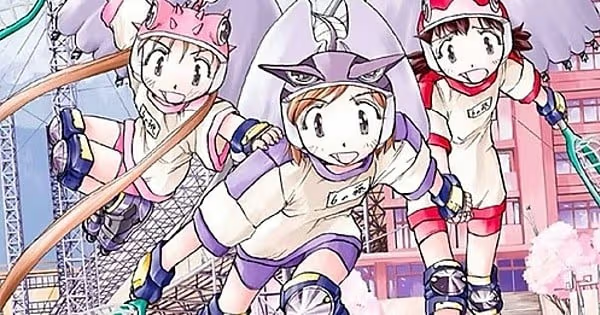
Alien Nine is one of those series where about the only thing I'd heard about it is that fans didn't want to tell people much about it until they'd watched it for themselves—one of those kinds of shows. The cute grade-schoolers up front with a peppy theme song and flashes of visceral alien gore certainly point to the possibilities therein. Said girls getting saddled with symbiotic alien helmets at the outset raises even more alarm bells. However, the real trick with Alien Nine is that it never truly flips over its hand. There's no Madoka-esque moment where the story instantly confirms how dark it actually is. Alien Nine simply establishes its setup and lets the questions about how messed up it must be to make grade-schoolers hunt aliens speak for themselves, then depicts the natural (and extremely unnatural) occurrences that come with that situation.
Part of this approach is down to the format, of course. Adapting only the first half of an already short manga series, Alien Nine does actually have concrete explanations for itself lurking backstage. But across the four episodes of anime here, only ominous clues are teased out as to the true nature of the aliens, the symbiotic Borg, and the school officials running the whole show. There are enough details that attentive viewers should generally be able to guess at what's "really" going on, but with a confirmation never arriving in its run-time, those watching are left squirming in the same position as its naive protagonists. You won't get a full explanation of what's really going on in this show, but the show will get you thinking about it. I get it now why this series has lived rent-free in the minds of those who caught it back in the day.
What there is of the beginning of this story, admittedly, won't satisfy in terms of traditional arcs. The main character, Yuri Ohtani, is the most obvious example of this limitation. Her being a stressed-out wreck is central to all the conflicts throughout the story, as she hampers her team's alien-capturing efforts and stymies supervising teacher Hisakawa's nebulous, pseudo-nefarious agenda. But while the runway is there for Yuri to grow confidence in herself and learn to trust her friends, she doesn't really get anywhere near there in these four episodes. She's a perpetually sobbing mess throughout, which some would argue is the most accurate and appropriate response for a grade-schooler to have in the situations she's thrust into. But it does manifest in a lot of weepy line repetition from her that might move past empathy and into irritation for some viewers. There's one moment at the very end of the series where Yuri does manage to propel herself to the barest bit of initiative action—it feels like an obligate move to gesture at her having undergone any development through this ordeal.
The other characters are similarly limited. Kumi is potentially intriguing but gets the least to do as a character, instead serving as a source of tension and reflection for Yuri, depending on where they are in developing their working relationship. Kasumi is an amusing enigma, a meowing weirdo who's frightfully on board for facing these dangerous horrors. She's compelled into an intense swerve of her own developments in the final episode, which ends seemingly on the precipice of even bigger shifts for her, as well as the team. Hisakawa, the teacher, feels like the most effective use of the show's less-is-more approach to characterization and information. For one thing, the realization that, as a morally ambiguous mentor type often seen in this kind of story, she actually isn't very good at that role is pretty funny to come to as the show goes on. And through Hisakawa's aside conversations and reactions, audiences can start to piece together the bigger picture of what's going on, even if it's never outright stated. It's the most fascinatingly engaging element of the story part of this story, and it's all built on that purposeful ambiguity.
Instead, the discomfort inherent in Alien Nine naturally leads to the question of what else it's about. Are these agendas of pairing kids with symbiotic aliens and chanting dreams about turning people into aliens literal, or is it simply evoking the frightful awkwardness that comes with starting to grow up? Porqué no los dos? This kind of consideration is where the storytelling of the series actually thrives, prompting audiences to question the propriety of adults in positions of authority raising kids and what they actually intend for them. Yuri's not just scared by all the alien violence; she's afraid of growing, changing, and taking on any responsibilities as necessary. She's as adrift as anyone at that awkward age by the time the show ends, itself perhaps unintentionally meta-commenting on the perpetual nature of that growth. We never truly finish growing and changing, and even as adults, we don't have all the answers. That can be more tantalizingly terrifying than any scary alien monsters.
Freed from the need to build its arc on offering actual answers, Alien Nine instead thrives on sheer atmosphere. We didn't have the word for "vibes" back then, but it works for what this is. Yuri, the trauma-prone tyke, is pressed by her classmates into alien-wrangling duty; she's paired with a living hat that licks dead skin off her back, and everyone's mental state starts getting collectively overwhelmed. The vibes, as they say, are atrocious. Madoka was an obvious comparison earlier, but with its imagery of having horrible things happen to and around cute little character designs as they teeter on the edge of dark secrets, Made in Abyss might be another apt point of comparison for Alien Nine.
Of course, that oppressive atmosphere defines Alien Nine before any of those comparative series could be conceived, and it executes it so well on its own that it ought to be recognized as an effective ancestor of them. Alien Nine's palette is defined by washed-out shades that convey equally the banal everyday school life this alien violence is dissonantly transplanted onto, as well as the sense of spiritual drain inflicted on its heroine. It doesn't always stay that way. That color scheme is a canvas for the series to paint on, regularly setting things awash in colorful tones from light shining oppressively through massive windows or an inspiring sunset bursting through. And of course, the splattering of alien viscera getting all over everything. The everyday backing occasionally gives way to fantastical flourishes in Yuri's surreal dream interludes, or hallucinatory elements in the final episode (which also features some of the most outright disturbing imagery of the whole series). All this surrounding the atypical character designs lends Alien Nine a calculated dissonance that lets it feel like nothing else before or since.
AnimEigo has done well preserving those powerful visual qualities of the show. The upscaling job on this Blu-ray is shockingly crisp, serving the thin lines and meticulous details of everything well. It means the CGI on the extending drills of the alien hats stands out more by comparison, but that too is a charm of the era's animation, I'd argue. The disc also includes a litany of extras, including the kinds of behind-the-scenes looks that are themselves a lost art when it comes to home video releases. It includes a "Dubbing Diary" detailing the days of Central Park Media adapting the series. It's an interesting peek at the crew and actors in their element, including the tribulations of Kelly Ray in what was apparently her debut dub role as Yuri. The Japanese interviews also offer insight, though they come with odd omissions: the names and roles of those being interviewed aren't actually shown! You can quickly grasp who the voice actresses are (and it's funny to learn that Hisakawa's actress Aya Hisakawa herself couldn't fully grasp her character's intentions), but the staff members are frustratingly unclear. A separate interview with producer Tarō Maki is properly notated and offers more detailed insight. And a music clip and "Steps to Alien Fighters" behind-the-scenes reel make for an interesting look into how Alien Nine was produced and promoted at the time. It's a little bittersweet to see the people behind the show wonder about the possibility of a sequel series to adapt the back half of the manga, knowing it never happened. This type of limitation, too, is part of the resonance of anime OVAs of yesteryear.
Those that Alien Nine got its hooks into back in the day likely have already picked this release up. But for those who haven't, who had perhaps heard of this series but not yet committed to checking it out, I can confirm it's worth a look. It's undoubtedly a unique experience: a little cute, a little off-putting, a little horrifying, and more focused on being intriguing rather than satisfying. That's complimentary. We can always use more stories that compel the audience to consider, to interpret, to speculate. Alien Nine, if not the greatest OVA ever, is still a very good OVA, and a great example of the appeal of the lost art of the format. They simply don't make them like this anymore.