The Adventures of Huckleberry Finn by Mark Twain is almost universally regarded as one of the most influential American novels of all time. Since its publication in the late 19th century, however, it has been the subject of constant criticism, controversy, and even bans due to problematic language and crass themes, but still the book’s relevance has persevered; most readers are able to compartmentalize the problematic aspects of Huckleberry Finn and take a holistic view of the novel. Yes, individual aspects may be problematic, but those individual aspects don’t ruin the entire novel. Mushoku Tensei: Jobless Reincarnation can be viewed in a similar light, as to call certain aspects of its characters “problematic” would honestly be an understatement – however that doesn’t erase how fantastic everything outside of the problematic bits is.
Basically every isekai has a “twist” that sets it apart from others in the genre. In the case of Jobless Reincarnation, that twist is that our protagonist, Rudeus (Rudy) Greyrat, is reincarnated into his new world as… an infant. This is a story about a 34 year old shut-in (who dies essentially the minute he is kicked out of the house) and his very literal second chance at life. In this new world, which is heavily influenced by medieval Europe and where magic and monsters are commonplace, Rudy’s parents are two former adventurers who now live in a quiet rural farming village. Over the roughly 10 years covered in the first season, Rudy will discover his aptitude for magic with his tutor Roxy, learn to have a happy childhood and make friends with another village resident Sylphiette, and finally get a job tutoring his cousin, Eris (and develop crushes on all three). In short, Rudy goes from a talentless, friendless, jobless reject to the opposite.

This is also where Jobless Reincarnation’s problematic element begins to show. While it is true that Rudy, in his adolescent body, does develop crushes on basically every girl he interacts with in any capacity, it’s also true that mentally Rudy is a guy in his thirties. It’s incredibly easy to construe some of what Rudy does as grooming (especially when he basically straight up says that’s kind of his plan with Sylphiette), and there are other moments where his actions are just sexual harassment that’s bordering on sexual assault. For many, these moments are incredibly uncomfortable and detract significantly from the show, especially because on the surface it does appear as though many of these moments are played as comedic. It’s impossible to say people who can’t tolerate that in any degree are wrong for dropping, disliking or outright hating the show. I will say this though – as inexcusable as those moments are, it’s fairly apparent that those moments aren’t being played for laughs. Jobless Reincarnation is about Rudy’s second chance, and he’s written as an incredibly flawed character so that his redemption will be all the more pronounced.

Rudy is also more than a one-dimensional walking pile of sexual misconduct. While it’s not a justification for his behavior, Rudy is dealing with immense trauma from the formative years of his past life, trauma which halted his emotional development then and held him back initially in his new life. In the later episodes of the show, Rudy (in a dream sequence) appears in the form of his old body; even though he had been living in the new world for over ten years, he is still being shackled by his past life. Rudy also has to work through fairly interesting dilemmas that anyone in his situation would need to confront, like his feelings towards his new parents (who he weirdly feels older than) and a moral code that is totally different than what he has experienced previously. In later episodes it's even clear how unadjusted to this world he is in general; he understands the people are real and their life has value, he just doesn't understand the consequences certain actions have or how to weigh risk. It’s difficult to like Rudy, as providing context to his misdeeds doesn’t absolve him whatsoever, but it’s really easy to be interested in Rudy and to want to see how he grows.

There are plenty of secondary characters Rudy encounters on his journey, and they’re basically all fantastically written. From his parents Paul and Zenith to Eris’ family bodyguard Ghislaine, each character is unique with their own way of thinking and acting that governs everything they do. There isn’t a better example of Jobless Reincarnation’s ability to make a side character feel real than with Philip Greyrat. When Philip, Eris’ father, is introduced, the initial impression he gives off is either “future villain” or “totally irrelevant”, and there isn’t much inbetween. Every time he is on screen, however, you learn a little bit more about Philip and what drives him; everything he does is motivated by his family. He could have been written as a pompous feudal lord who thinks his daughter is perfect, instead he’s written as a troubled father who understands what kind of natural disaster his daughter is. He’s also a dutiful son and understanding husband who makes sacrifices to maintain the family image. As the story progresses, Philip ends up explaining to Rudy that he isn’t the head of the Greyrat house; his sons are being raised by the head and he basically has no role in their life. Although Rudy turns down his invitation to help Philip seize power, this is the first moment where the audience sees the more serious side of Philip – a man who is willing to risk his life to try and win his family back. And here’s the thing: Philip is a minor character without significant screen time or lines. Jobless Reincarnation’s ability to take a character like that and make them not only memorable, but straight up consistent, explainable and interesting, is incredibly impressive.

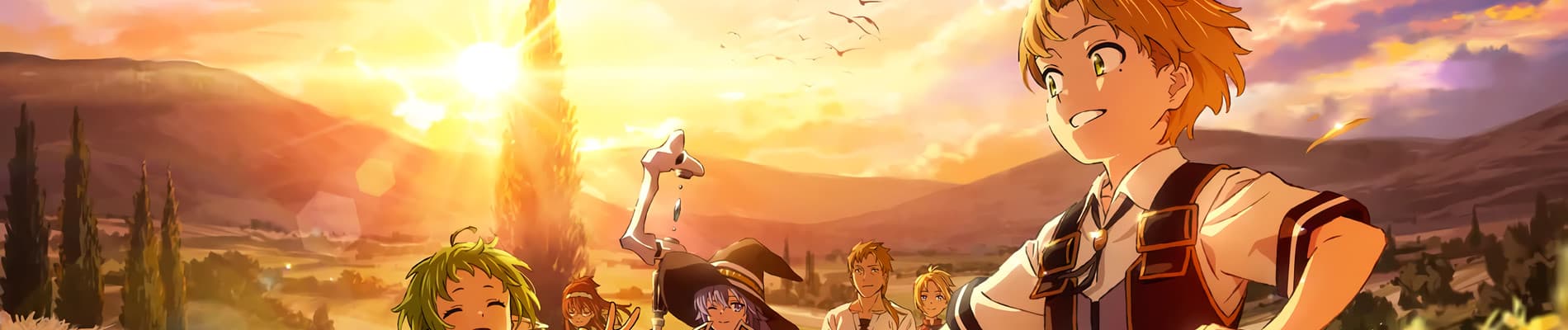
As far as production values go, Jobless Reincarnation is really beyond reproach. While its kind of unclear whether or not Studio Bind (which branched off from White Fox) was formed exclusively for this adaptation, it was formed with this show in mind, and it shows. The animation is gorgeous, with a digitally applied grain effect that instantly reminds the audience of older classics. Although its kind of a weird choice to give a recent isekai a unique, pre-2000’s aesthetic, it works wonderfully. And while the action in the show may be relatively sparse, it is so energetic. More “realistic” swordplay is fast paced, hectic and technique heavy, with the “fantastical” sword play literally involving characters breaking rules of physics (pretty standard for anime but is still so awesome to see animated). The magic is animated in the same way – basic spells are small and controlled, but higher tier magic is literally weather changing phenomenon with gale force winds. The fights are short and often brutal with the more powerful fighter giving no quarter, as opposed to long, drawn out affairs between evenly matched opponents; Jobless Reincarnation tries to ground its combat in reality.

Perhaps more interesting, especially because it might actually have implications for future light novel adaptations, is the animation of the opening sequence – or rather the lack of an opening animation entirely. Don’t be fooled – there is an opening song (two in fact). The decision was made, however, to forgo the traditional opening sequence entirely, instead using that 90 second period basically just for panning shots of the world, landscape and climate. It is one of the best decisions this show could have made, passively contributing to the world building, showing the passage of time, and just making the world feel so much more real. It must be incredibly time consuming to essentially make a new opening sequence every episode, but it works so well that I imagine other light novel adaptations will be looking to try something like this in the future.

The music and sound design of Jobless Reincarnation are honestly just as good as any aspect of the animation. As far as music goes both openings and the ending are pretty great (though I will say introducing a new opening song for just two episodes was a little unexpected), with really upbeat and adventurous sound, and insert music that again passively contributes to the world building and just feels perfect for any given setting. The show does not shy away from using instruments that aren’t really conventional for anime, drawing influence from medieval Europe as well as South America; really the music is just another element of the show that is unique and perfectly executed. The actual sound design of the show also needs to keep up with the fantastical power levels and abilities, and it does. The crackle of electricity with lighting, the wooden clacking of training swords against one another – these are really great. But also the understated moments, like the sound of dancing or other little noises that you would expect to hear are there, obviously, but they’re mixed properly so that you need to be listening for them; background noise is kept to background noise levels, staying unobtrusive but remaining present.

I’d be lying if I said that I thought Jobless Reincarnation needs the main character to be as deplorable as they are to work. At times, especially in the first few episodes, Rudy makes the show genuinely difficult to enjoy, and again I can’t fault people who felt the need to drop the show because of him. I will say, however, that I feel like dismissing Jobless Reincarnation as nothing more than an average isekai power fantasy (as many have been doing) is more than a tad reductionist. A work of art isn’t awful just because of one thing, and art should be allowed to be controversial and push boundaries. There is being offensive and crass for the sake of being offensive and crass, and then there is being offensive and crass for the sake of exploring complex themes – this show honestly falls into the latter category.
108 out of 127 users liked this review
