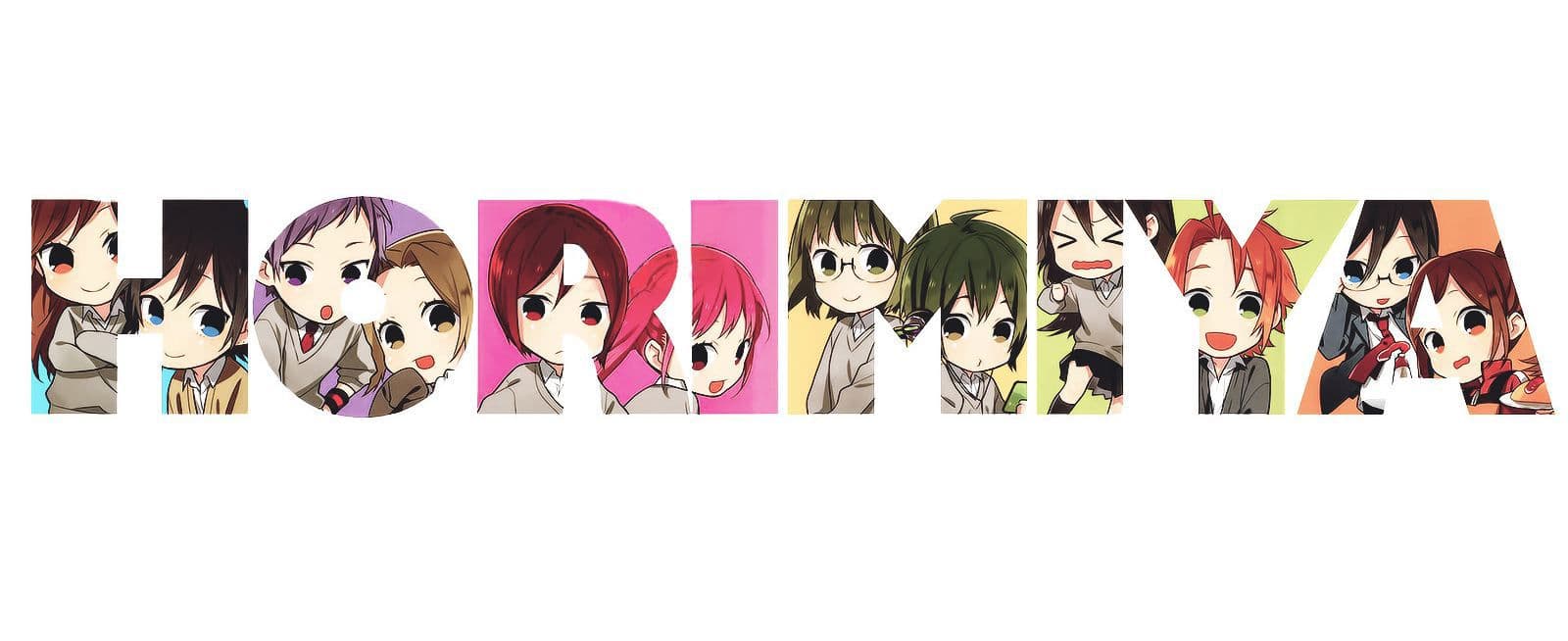
Horimiya
a review by sushiisawesome
a review by sushiisawesome
If someone were to strictly define Horimiya by the conventions it follows, there's very little to mention that hasn't been tackled in other romance series; the series is a romantic comedy with increasing emphasis on comedy over the romance as the series goes on. There are various typical themes revolving around the characters and their ability (or lack thereof) to connect, resulting in miscommunications as they struggle to empathize with one another, usually resulting in various shades of drama that take up portions of the manga. What sets Horimiya apart from its competition - and is the main reason for its massive success and popularity - is the casualness through which the series manages to tackle these themes, consistently develop a gigantic cast of characters - including a noteworthy and memorable side cast - and somehow consistently improve from start to finish, without ever missing a beat or sliding into stagnation.
Horimiya's story beats generally follow Hori, an upbeat, somewhat crude jerk with a heart of gold whose core character flaws revolve around her possessiveness and desire to mean something substantial in someone's life beyond being materially beneficial to her family and selflessly being the caretaker of their house. This changes when Miyamura - someone she assumed to be nothing other than a generic geek - drops by her door, laden in piercings and tattoos, starting a pattern of both characters meeting at Hori's house, where their acquaintanceship turns to friendship before blossoming into a romance. The series follows this general structure for much of its first half, with the focus being largely focused on Hori and Miyamura, loosely but not entirely following its webcomic equivalent before deviating from it entirely in the second half.
The heart of Horimiya as a story is showing the uniformity of everyone having some level of distance between one another, and that much of what people ascribe involving friendships and romance as destiny are often just, well, coincidences and nothing more than that. This helps emphasize the humanity of these characters instead of portraying their meetings in a rose colored manner, with love at first sight being something that's interestingly not ever the subject of essentially any of the various romantic pairings.
There is one noteworthy exception to this rule in Miyamura, a former social outcast who has gone out of his way to change his image to break away from his former self as hard as possible - Hori's unconditional acceptance of his character flaws, ranging from everything from his lack of understanding of social norms, awkwardness and often misreading people's intentions as overly negative. The narrative's main focus on Hori is to emphasize that as possessive she is, she is a person who does all she could to bring the best out of people, her missteps and failings aside, and that despite it all there is an earnest, well-meaning and kindhearted person who goes out of her way to help others. There are countless times when Hori does things that are questionable, ranging from her questioning if Miyamura's male friends are a danger to her relationship with him to often letting her pride get in the way when fighting with others - Miyamura and Yuki being standout examples - yet there's no possible way to misinterpret her intent as either malicious or harmful due to her behavior being incredibly convincing in swaying the audience to liking her even when she's being comically stupid.
Back to Miyamura, his role as a former social outcast has deeply scarred him, yet his character arc is about overcoming said scars, inch by inch, while accepting that the person he once was still had positive traits worth loving, as Hori emphasizes to him numerous times over the course of the story. Much of the narrative involving various characters is introspective, and this is especially true with Miyamura, who spends the entire story wondering if he even deserves such happiness at all. The answer to this is obvious; people should be loved for who they are, and past scars may or may not fade, but that is irrelevant to how much a given person even deserves happiness, as if something like that is even in the hands of the person in question. Miyamura's character arc is beyond a shadow of doubt the most important one in the series, and the emphasis placed on how much Hori broke him out of his shell is beyond heartwarming.
Horimiya's standout accomplishment is that much of its side characters are every bit as well-developed as the two central leads; Yuki and Ishikawa are noteworthy examples of this, being my favorite pair in the whole series. Yuki's apathy to the world around her coincides with her being similar to Hori insofar as she sacrifices her day to day life to please others and allow them to take anything she wants; where she differs is that in her case, this leads to a cycle of inward hatred both towards herself and others. Her character arc is about becoming a more cheerful person and letting herself become more selfish about what she wants while turning her otherwise well-intentioned feelings towards others into empathy as opposed to an excuse for self-hatred. Ishikawa is key to this character arc himself, being someone who gets rejected by Hori early into the story before moving on and becoming the heart of his social group; his empathy acts as a positive influence on various characters, Yuki and Miyamura included, and despite the immaturity and straightforwardness of his feelings towards others - a character flaw he slowly grows out of as the series progresses - his acceptance of Yuki's flaws help morph her increasingly into a better person. And while their relationship is intentionally left inconclusive, it is not a question of if but when, due to Ishikawa's own understanding of Yuki's hesitation in how to approach him. Yuki's closeness to Ishikawa as opposed to Hori is emphasized in two scenes - one early into the manga, and one during the Christmas date later on in the series - when she asks who Hori was, with the second time coming off as less ignorance and more an intentional self-reflection on how far she has come in understanding her friends compared to the beginning of the series.
There's other noteworthy character arcs and dynamics at play, and what I've said about Hori and Miyamura as well as Yuki and Ishikawa can be said for every pairing and character in the series. Remi and Sengoku are both tryhards who desperately struggle in fitting into a given social role - Remi's over her supposed flirtatiousness and Sengoku as being the rigid student council president. Yet both are masks betraying something more substantial to one another - Remi legitimately is unfairly labeled due to her often speaking casually to men in a society where conservative values reign dominant, and Sengoku has a fear of insects and based on his interactions with Hori and other characters is a legitimate goofball who struggles with his own self-confidence. Yet both characters play these personae up, while at the same time their attractions to one another are initially based on the weaknesses within those personae. This increasingly materializes into a genuinely sweet relationship between the two, where both relax considerably around both their classmates and each other.
Sakura and Yanagi have characters arcs about both of them getting rejected, yet their arcs are a positive look into how such a negative matter can be seen as a tool for self-betterment and empathy. Sawada's arc is about her breaking out of her loneliness while ironically benefiting from her unrequited love's boyfriend Miyamura, whose kindness and compassion towards her as two people who struggle greatly in interacting with the world around them due to a history of isolation that has brought both of them trauma. Shuu, Shindou and Motoko all have well-developed arcs involving their connections to people who are dear to them, with Shuu and Shindou being clowns who otherwise take their interpersonal relationships seriously, and Motoko's arc being more about her being defined by her scores instead of her effort in an overly grade obsessed society.
All of these characters are worthy of - and can be - analyzed for hours and hours on end, and it's a testament to how amazing Horimiya is as a story that this is done seamlessly and with no real pacing issues.
By no means does this mean that Horimiya is devoid of flaws; certain jokes - like Shin, who definitely shouldn't be a teacher in normal society - can come off as culturally dissonant if not straight up tasteless. People into the series strictly for Hori and Miyamura's dynamic and who don't care for the side cast often dislike the manga's second half for feeling - although they are wrong - like it is padding up time, instead of approaching it as being characterization-rich in a more interwoven way, where characters and dynamics often spring up everywhere, many being unexpected. A legitimate web can be made of all these characters and their relationships with one another, emphasizing this connection; one point the series makes is by making sure that every chapter in some way surrounds high school students, and while this can be easy to dismiss due to the proliferation of high school animanga everywhere, here it's an intentional thematic point emphasizing that regardless of who you are, it's not too late to form connections with others. And, come the ending, this point wraps up in a manner I can only describe as poetic, with one phase of life ending and another beginning.
There's even more to praise about Horimiya; the artwork courtesy of Daisuke Hagiwara is gorgeous, with evenly spaced pages that make reading dialogue heavy scenes easy, complimented by simplistic yet increasingly beautifully drawn distinct and memorable character designs. The fact that the artwork only continues improving over the course of Horimiya's run is insanely impressive, and worthy of serious praise; it goes without saying that I wish both HERO and Hagiwara the best of luck in their future endeavors.
Horimiya is a proud, new classic of the romance genre in manga, and one whose marks will be felt for years to come. The story and characters crafted here is a memorable one, one that audiences can easily remember long after they're done with this journey. The series is a must read for any and all romance fans, with plenty of appeal regardless of taste.
I cannot recommend this highly enough.
Thank you for reading my review, any and all feedback is welcome.
149 out of 178 users liked this review
