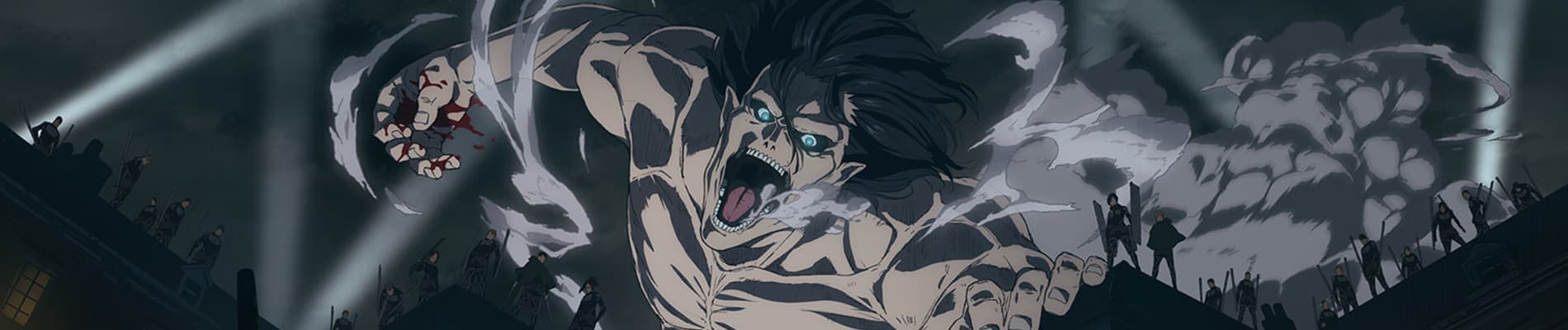

#Walls have long been synonymous with the cruel world of Attack on Titan (AoT).
▶ Video
From the series' opening moments, these monolithic structures tower over a civilization fighting for survival. On its last legs, mankind makes a final stand with aspirations as high as the barriers themselves: to defeat the enemy and claim the freedom that they rightfully deserve. But in almost 60 episodes of high-octane television, the franchise's trademark bravado gives way to a sinister realization. Perhaps the Walls were never meant to keep the devils out, but to trap them in.
With the secrets of the Basement uncovered, the stakes have been reinvented. Just as freedom seemed ever so tangible for Eren, Mikasa and Armin; S4 places yet another obstacle in their path - one which will take them far beyond the shores of Paradis, and one which will irrevocably tear down the lines between hero and villain. There is no longer Right or Wrong on the battlefield; only Fear persists. To quote George R. R. Martin: "War makes monsters of us all." This review is spoiler-free for plot details in S4, but will refer to all prior seasons. Feel free to skip ahead to my Tl;Dr if you're short on time. As for everyone else: "Susume."
#To understand how AoT's latest chapter succeeds, we first need to discuss the game-changing Basement reveal.
▶ Video
Naturally, I was skeptical of whether author Hajime Isayama could address the many questions dating back to his story's beginning. The secrets of Grisha's household was always a big driving force for Eren's journey, and it'd be difficult to look back on past episodes fondly if Isayama dropped the ball with his big twist. Thankfully, the Basement reveal proved to be a masterclass in mystery-box storytelling. Providing satisfying answers without the use of plotholes or retcons is a big achievement, but alone isn't what makes these revelations so stellar. Rather, the genius of this premeditated twist lies in how it introduces a new perspective from which we can experience this grand saga unfold. Once the truth came to light, AoT would be changed forever.
S4's introductory arc hits the ground running on uncharted territory. It doesn't take long for the show to make us realise we're a long way from Paradis. Aerodynamic ODM hijinks are traded for conventional trench warfare, monsters from millenia past make way for modern weapons of destruction, and familiar war-torn faces are replaced by new ones - those of young, sprightly children on a siege battlefront. S4's opening salvo boldly thrusts its audience onto enemy soil; but make no mistake, this is AoT through-and-through. While the context has changed dramatically, the same themes and ideas introduced since the very beginning are being expanded upon and reimagined.
#AoT reinvents the wheel and finds sympathy for the devil.
▶ Video
#Eldia is a house divided,
▶ Video
with neither half fully able to stand against their Marleyan masters. Both groups are products of mass subjugation, and S4 claims that the internment Eldians may have received the short end of the stick. In spite of the King's Vow and a vicious fight for survival against the Titans, Paradis is Paradise, because its human inhabitants are spared from ever doubting their place as the good guys. Contrast them with the marginalized Eldians of Marley, whose dehumanized existence is defined by sins of the past. It's an uphill battle, as they are cast down the lower rungs of a merciless social ladder and conditioned to accept self-hatred as a necessity of life. Breaking out of this systematic oppression is what motivates the Warrior candidates, Eldian militants devoted to proving their Marleyan allegiance on the battlefield. With false anti-Eldian propaganda forced down their throats, these soldiers can only repress their humanity as they vie for the coveted Warrior status. Even this best-case scenario confines the "lucky" few to 13 years of relentless battle, perpetuating a vicious cycle as one Titan Shifter makes way for the next. It's sad to take in the imagery of child soldiers Gabi and Falco, as they cling onto their flimsy rhetoric in a vain attempt to find order in the sick chaos that surrounds them. While Gabi's abrasive actions drew the ire of countless seething fans^, the script's portrayal of these tragic figures is commendable, especially given the risks involved in fleshing out antagonists so late into the narrative.
While the sinful children turn to their history books for solace, that comforting illusion of being in the right has begun to show its cracks for some. The battle-hardened Reiner finds himself caught in an ideological crossfire. His cryptic origins are finally explored in-full during this season, detailing the misfortune of having to fight alongside both his motherland and his foes. His split-personality disorder emerged as a result of his time spent behind enemy lines, and coming to terms with Marley's subjugation of Paradis pushed our Armored Titan to his psychological breaking point. Reiner, Gabi and Falco are all forced to confront the suffering dealt by their war cause. No longer is there any comforting doctrine to absolve them from their sins. Warrior Commander Magath says it best, in what is probably my new favorite line in all of AoT:
"There is no doubt that Eldians are the spawn of the devil. And there is no doubt that we are devils ourselves."
Marley's generational sins are coming back to haunt the nation. It's no coincidence that S4's opening arc closely mirrors the invasion that kicked off the franchise. Much like that first battle in Shiganshina, S4 uses its own powerful moments of despair as a launchpad for the ensuing conflict. This time around, the parallel is recontextualized, as S4 turns the invaders into the invaded. We're presented injustices without innocence, as Marley reap what they sow. At the same time we're shown an enemy coerced into violence as a means of escaping a system of oppression. It's not enough to absolve the internment Eldians of their wrongdoing, but speaks volumes about how Isayama has chosen this new phase of his story. S4 pulls the curtain on everything we thought we knew, finding tragic ambiguity in a conflict that was once simple. AoT achieves this not only through finding sympathy for the devil, but also by smashing its façade of heroism.
#The franchise's identity has long been rooted in these soldiers' self-sacrificial blazes of gory glory.
▶ Video
Adrenaline-pumping hype was all but guaranteed, as badass scouts sliced-and-diced their way through hordes of giants to the beat of Sawano's steampunk OST. Laying their lives on the line and giving their hearts, mankind would stop at nothing to keep moving forward. Eren and his comrades were fighting for freedom, and as massive manga sales figures (of over 100 million!) would indicate, us passionate fans were rooting for 'em. As I mentioned before, Paradis' place as the good guys was always certain. Rarely were we asked to call our heroes' past actions into question, because their goals were clear and good - kill Titans and claim freedom. But what happens when that fleeting freedom gives way to an unforgiving destiny?
#S4 is a sobering deconstruction of its own winning formula.
▶ Video
As a Marleyan insider makes the full extent of Eren's powers public, all of Paradis face a dilemma regarding their fate. The mysterious plan could finally secure freedom for the Eldians, deterring the world from annihilating the devils' island. In this new context, old trends make a resurgence. The military remains suspicious of the insider's true motivations, and their inaction seeds distrust among the masses. While us audience members may know that Paradis' government is working for the nation's best interest, it's hard to ignore that their puppet monarchy was achieved through a fascist takeover of the old system. How is their inefficiency that much better than the conspiratory ways of the Reiss reign? Their weak attempts at diplomatic relations are insufficient at appeasing the people, resulting in the emergence of a cult. Dubbed the Jaegerists, this secret society enacts a coordinated strike on the military government. The cult hails Eren and the insider's scheme as divine salvation, and their near-deranged devotion bears strong resemblance to the Wall Priests from past seasons. A chilling demonstration of their desperate faith cemented itself as one of my favorite moments in the entire franchise; as an anti-militant mob chants the ever-familiar "Shinzo Sasageyo" back at their opponents, turning a noble call to action into a bloodthirsty mantra. As the domestic chaos ensues, we're moved to wonder just what Paradis stood to gain from "giving their hearts."
#Glorified in the past, AoT's heroes are rebuked in the present.
▶ Video
Hange, starting out with hopes of changing the old ways that preceded her, now finds herself caged in Commander Erwin's shadow. Armin is forced to accept that diplomacy with other nations will prove ineffective in securing safety for Paradis, as he harnesses the Colossal Titan's destructive power. His loyalty is called into question, with his connection to Bertholdt's memories drawing distrust. Isayama also doesn't spare Mikasa from his scrutiny, as her formidable character comes apart in decisive fashion. Meanwhile, Levi is forced to eat his own words as he laments over the vain loss of countless comrades over the years, because he could never have determined whether trusting in Eren's power was right or wrong until he arrived at the bleak outcome of the present. And as for Eren himself, the strong-willed fighter has been overhauled and nearly unrecognizable. He has emerged as the most resolute figure out of the entire cast, as well as the most inhuman. Eren represents a naive wish for freedom taken to its ideological extreme, and the revelation of his true intentions takes the franchise to the darkest it's ever been.
#What is right has become unclear, what is wrong has proven necessary.
▶ Video
And it's in the death of those moral constructs that we are able to observe a world driven by fear and hatred above all else. Marley and Paradis are nations trapped in a realist zero-sum game; even though Armin's hopes for diplomacy and cooperation yield the optimal solution for both sides' concerns, fear of the unknown dictates their decisions, leaving them with no other outcome than mutually-assured destruction. Just as lost children stumble their way around a forest, so do soldiers struggle to make the right choice in the heat of battle. All we have are our instincts, the greatest of which being fear.
#AoT's consistency appears to be a double-edged sword in some aspects.

AoT's weaknesses are just as present as its strengths, although that's not necessarily a bad thing. Flaws that I'd attribute to the series don't feel like mistakes, but rather a natural consequence of the kind of story Isayama intends to tell. None of these really need changing, but none of these are gonna convince AoT detractors to side with the show 4 seasons in. For example, the show's characters are still mostly one-note and thinly-written, but act as superb vehicles for AoT themes as a result. The worldbuilding and narrow political thesis behind the Marleyan-Paradis conflict only functions off unrealistic conditions, but it's because fabricated reality that we're able to witness this truly epic thought experiment. Even though former AoT director Tetsuro isn't on-board this season, it seems that his over-the-top facial reactions and melodrama still found their way into S4. While AoT certainly handles most of its large-scale battle sequences more effectively than its smaller confrontations, it's in these unnerving expressions that showcase our suffering characters giving into their inhuman instincts. For a "battle shounen," the amount of action in S4 is surprisingly lacking, but I'm pleased to see that myself and many others have grown so invested in the painstaking depiction of Isayama's twisted world. The few action sequences we do get do fall ever so slightly short of the gold standard we've grown to expect, but MAPPA have done a mostly remarkable job in handling its animation. CGI usage isn't as rampant here as Twitter makes it out to be, with its infrequent recurrences still blowing the industry standard out of the water. Plus, the change in art direction serves the show incredibly well, capturing a more modern time period while still facilitating Isayama's distinct style.
#Tl;Dr:
▶ Video
AoT S4 interrogates its own past, proving to audiences just why this giant deserves to stay relevant, 7 years after its premiere. Using the Basement reveal to great effect, S4 opens our eyes to more perspectives in this miserable conflict. Constantly drawing parallels to precedents from past seasons, AoT isn't afraid to recontextualize its formula and challenge ideas that were once accepted without second thought. It's not the strongest AoT has ever been, but has every opportunity to achieve those peaks in a sequel as inevitable as the incoming war. 8/10~
#STRAY RAMBLINGS (SPOILERS):
- ^Real talk, Gabi gets too much hate. It's definitely justifiable to hate her actions and character, but she holds up as a great vehicle for expressing Isayama's message about the dangers of basing your life around political rhetoric and propaganda. Observing audience reactions surrounding her character reminds me of Skyler White from Breaking Bad. I'm no Gabi fanboi, but the vitriol unjustly targeted at antagonists that are doing their job as, well, antagonists - that just baffles me. The memes are admittedly fire tho, I'll give ya' that.
- Scene of Connie and Sasha realizing their mutual stupidity is basically me and my last two brain cells in college.
- The entire Hizuru plotline didn't click for me. The foreign ambassador is probably the least friendly diplomat I've ever seen, going as far as to lick her lips at the mention of "national resources." Anyways, the real issue is that it straight-up doesn't work for Mikasa at all. Like, maybe it's a female-empowerment thingy where our girl is revealed to be some badass princess or whatnot, but Mikasa is never given a reason to care about their proposition, so the whole thread just feels kinda awkward.
- Totally get what the Niccolo motif was going for (he's a chef, Sasha eats his food, etc.,) but associating dinner with her death wasn't really cool when Connie did it the first time, nor was it any less cringe when it gets rehashed in later episodes.
- Floch is a dumbass. 'Nuff said.
- Remember when everyone was malding over "My War?" Me neither, that song is a certified banger! For me, "Guren no Yumiya" is still gonna be the song I'd associate with the series, but Shinsei Kamattechan's track is the bop I'd put on loop.
- THANK GOD IT'S NOT A MOVIE SEQUEL. Simulcast is a godsend for people that actually enjoy watching stuff without getting spoiled, and I'm already struggling to keep myself safe. Imagine having to go months without the internet before a theatrical release… yeesh.
- BEST GIRL: Enjoy your meats and potatoes in Heaven, Sasha. Fly high.

Oof, this season really made me grateful for taking up an intro course on Political Studies. I've been relatively late to the AoT hype train, but I don't regret not picking up sooner, as there's so much that I likely wouldn't have appreciated back when I was younger. In any case, I'm well-aboard seeing this massive saga conclude. If you happen to like my verbose rants, feel free to check out my other reviews for seasons past and present. I also frequently post writeups under my list updates, so definitely take a peek if you'd like to see me mald over anime as they hit the airwaves. Peace~