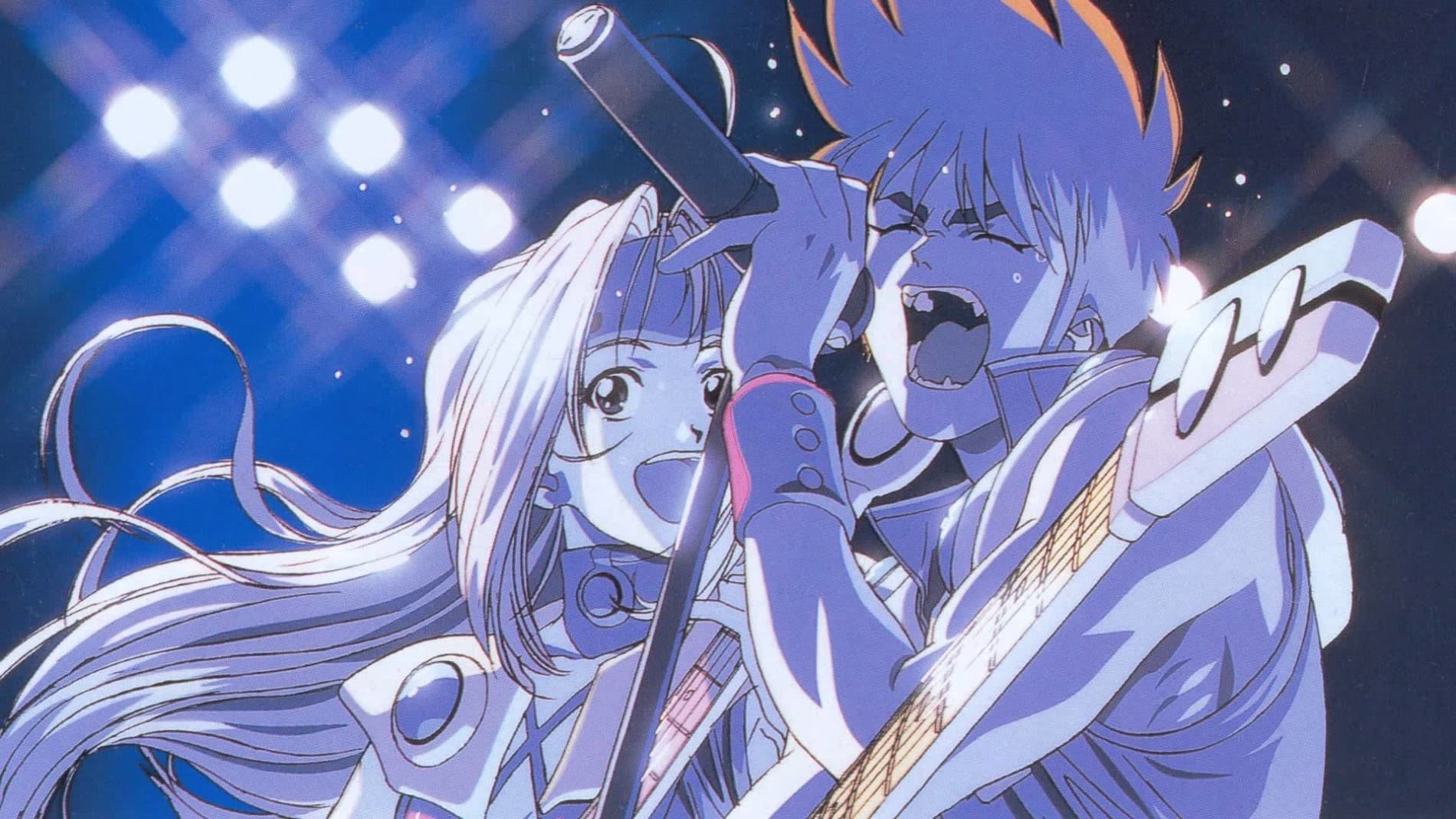
Macross 7
a review by Pockeyramune919
a review by Pockeyramune919



“LISTEN TO MY ~~SONG~~ REVIEW ANILIST!”
If you couldn’t tell from me opening my review with an oft-used quote from Macross 7, I had a lot of fun with this show and I had a lot of fun reviewing it, too. It’s the same the same type of fun I had watching Mobile Fighter G Gundam. Compared to other entries in their respective series, both shows are silly, dare I say dumb, even. Yet they take themselves seriously enough to ground them. They’re goofy, yes, but endearingly so. They’re just so earnest and exciting that it’s hard to not love them despite how radically different they are from the rest of their series. Your mileage obviously will vary a lot based on what you’re looking for in mecha - it’s essentially the difference between real robot and super robot. That said, despite how much it departs from what we’ve seen before, it still feels like a Macross show, still ultimately committing to the same themes and aesthetics established in Super Dimensional Fortress Macross, just changing how they’re conveyed. For what it’s worth, this very well may be my favorite Macross show thus far.
But enough of the warm up, let’s get this concert rolling!
The story of Macross 7 takes place thirty-six years after the events of the original series (and five years after Plus, though 7 is definitely more of a sequel to SDF than Plus) and its Zentraedi War, which culminated in the coexistence between humans and Zentraedi. Two years later, of course, during the finale of the original series, humanity decides to take to the stars in order to ensure their survival by creating colonies throughout the galaxy. Macross 7 takes place on one of these colony fleets, the 37th Long Distance Colony Fleet, led by the eponymous Macross 7 which is comprised of the residential "City 7" and the battle carrier "Battle 7." Macross 7 follows Nekki Basara, the leader of an up-and-coming rock band known as Fire Bomber. Macross 7 begins when their concert is interrupted as sirens blare. The fleet is being attacked by an unknown force and Macross 7's elite special force unit, Diamond Force, is sent out to repel the enemy. However, in an act that shocks the military (most notably the deuteragonist, the straight-laced Gamlin Kizaki) and new enemy alike, Basara, a citizen with apparently no military training, also sorties to battle in an unregistered, ruby red custom Excalibur variable-fighter (astute viewers might notice that the VF-Excalibur Custom is derived from the YF-19, the variable-fighter that Isamu piloted in Plus). In an act that will soon become nothing short of iconic, Nekki Basara commands the enemy to listen to his song before he begins singing and playing guitar in the middle of an active battlezone. Thankfully Macross 7 doesn't suffer heavy casualties and the enemy retreats. The military is obviously confused at the rocker's actions, but he flees the area before they can question him. As the story of Macross 7 unfolds, we follow the career of Fire Bomber as well as Gamlin, discover the identity of the new, alien force, and find out why in the cosmos Nekki Basara keeps flying into battle to sing at the enemy.
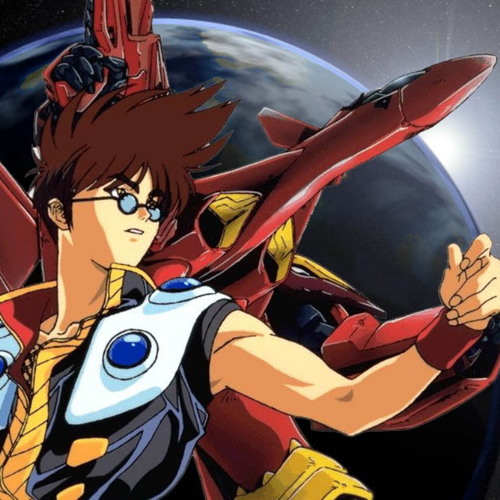
You can probably tell by the synopsis how wild this show is. Very quickly we learn that in Macross 7, battles may be waged with bullets and reaction weaponry, they're won by the immortal, unadulterated power of rock. I can see how some could be annoyed by this. While it's better in some episodes than others, as a whole the power of music doesn't supplement the power of actual weaponry but instead completely replaces it — in Macross 7 the fearsome reaction weaponry are rendered a complete joke in the face of the new enemy, the Protodeviln. What does work wonders is Fire Bomber flying out to give the enemy a show and rock them into absolute submission. If you still need an example of what type of show this is, the villains are revealed to be what essentially amounts to space vampires, draining other species of their "spiritia" (essentially "spirit" with an "ia" attached to the end) to get stronger, leaving the victims in a comatose state. And want to know how spiritia-drained individuals get better? If you guessed "through the power of Fire Bomber's singing," then congratulations! Give yourself a~~n easily-earned~~ treat. Apparently, Macross 7 is an extremely contentious show within the fandom and I can definitely see why. Most of the time, Macross 7 reads less as a serious war drama and more like a Saturday Morning Cartoon. But I absolutely revel in Macross 7's more silly elements; it's a fun show, one of the more outlandish I've seen in recent years, yet it never really feels like it's dipping into "joke show" territory.

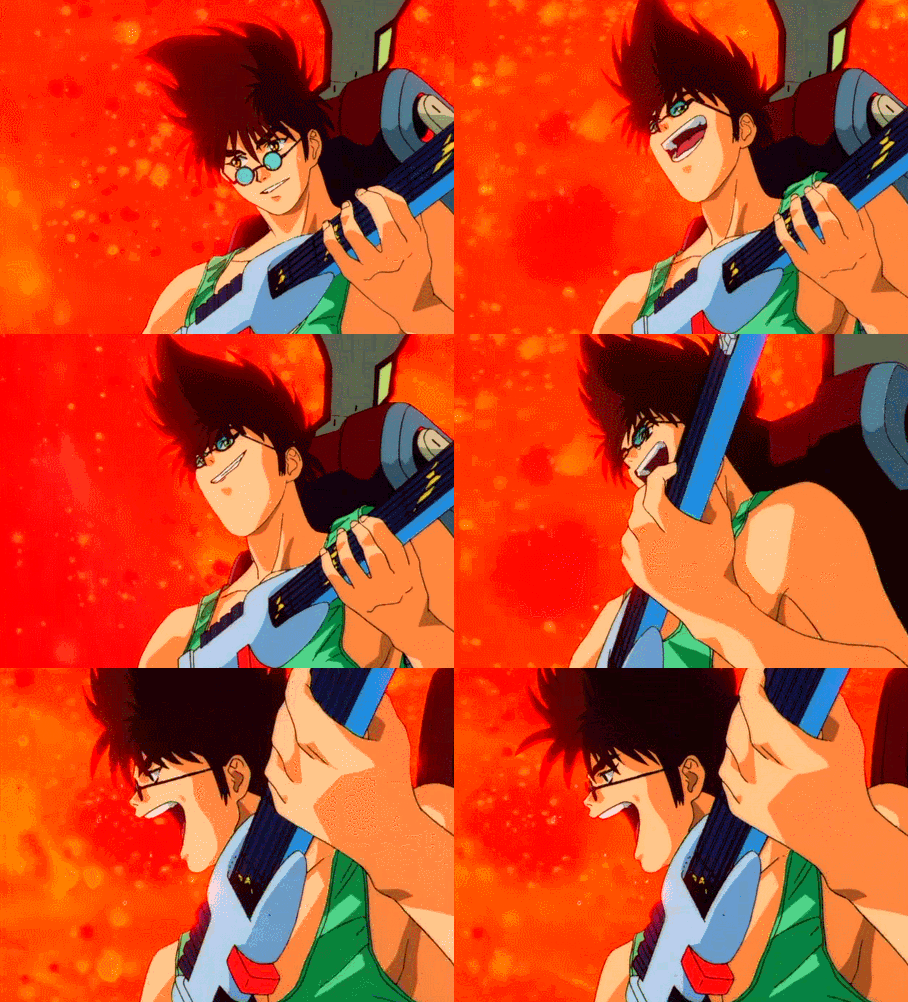
The show works in large part due to it's treat of a main character, Nekki Basara. As you can begin to see in my synopsis, Nekki Basara is a very ridiculous character, but he works, because he's a ridiculous character for a ridiculous, very fun show. I wouldn't say he "carries" the show because there are many great elements that carry the load, but I would say he's a great character to carry us into the show. He's a young man with a very one-track mind — if there was a telepathic character, they'd go deaf the moment they tried getting into Basara's mind because they'd find themselves blasted with "Planet Dance" at ungodly decibels. What you see is largely what you get — just a guy that believes in the power of music and wants to spread his shredding guitar-backed message of love throughout the galaxy. There's not much in terms of development, but we certainly get a bit of it. He begins a devout pacifist and still largely is by the end, but he's more willing to accept weaponry if it's used to save others, even if it still pisses him off. In the series proper, we don't even get much of a backstory besides the fact that, as a child, Basara would sing at a mountain, believing that if he did it enough, it would move, which is in parts ridiculous, parts naively charming, and parts so goddamned on-brand that it actually starts to hurt a bit. The chaotic energy that radiates from this guy is such that this is probably the only thing a given anime fan will know of him:

As someone who's watched the series, I'm pleased to tell you that's as much context as you're going to get. I've seen two theories as to the meaning of this scene (yes, I know).
Reading this, it might seem like Basara's a bit generic — after all, having a dense protagonist with a one-track mind is a pretty big staple of shounen. Just replace "music" with "fighting," "becoming hokage," or whatever have you. I still think Basara ends up being more unique than not, though. For one, he's not really dense, at least when it comes to relationships. He might come across as this way, but I think it's moreso than he's just a really chill person who takes things in stride. It's not that he doesn't grasp things, it's just that he doesn't particularly acknowledge them. Furthermore, he has a surprising amount of attitude. There's a certain edge, a "bite" to Basara that you might not expect. He can be a bit of an ass to his bandmates, most notably Mylene and in general is often rude and brusque when it comes to...well, anything that doesn't involve music.
And, hey, if Basara isn't quite your cup of tea, Macross 7's got you covered through Gamlin, who balances out Basara excellently, essentially serving as his Javert. Gamlin's the salt to Basara's spice and his role in the love triangle that I'll get into further contrasts him with Basara, as he's the Betty to Basara's Veronica. Even if you like Basara, if you're dumbfounded at his antics, you'll no doubt empathize with the military-man Gamlin, who just wants to ensure that no one gets hurt from Basara's reckless actions. There's just something endearing about how awkward he is when he's not on a battlefield and I kind of saw myself in him in ways. He quickly and easily became my favorite character of the show as one of my favorites overall. He has some pretty good character development wherein he's brought closer to Basara's point-of-view. Mylene also serves as a good foil to Basara, getting her own bit of positive development. I can't stress how well she plays off as him. In another series, her complaining might make viewers annoyed, but in the face of Basara, nearly everything she says is justified. I liked the supporting cast in general. While it's a shame that no one else is quite as fleshed out as Mylene, Gamlin, or Basara, the cast is at least pretty colorful and I liked the other bandmates, [Rey] and [Veffidas]. It was also nice to see Max and Millia again and see how they changed. Take notes *Yashahime, this is how you satisfyingly utilize your existing characters while still focusing on the next generation.

The character designs themselves also inform the tone of the show, in ways. Haruhiko Mikimoto returns as character designer following his absence in Plus. As always his designs are stylized, but they're particularly striking here. They're quite "loud" for a lack of better word, like the music this anime rocks and they fit in with some of the more out-there elements. Hair is notable for its wildness— Mylene's is bright pink, Gamlin rocks a haircut that's either "Wolverine" or "Devil Horns," and Exedol is pretty much a giant head of broccoli. Fire Bomber's outfits are a mix between "glam rock" and "cyberpunk" — Basara has a wild spiky mane, thigh-high white boots sleeveless rubber vest with...lights, a leaf...zipper, and a fishnet vest beneath. It's the little things that Haruhiko does, too. I love Basara's glasses; they're just another thing that makes him distinct. There aren't a terrible amount of main characters with glasses in the first place, and Basara's don't pigeonhole him into a "nerd" role.
The mech designs are also great. They're extremely distinct. At times, I have trouble remembering the valkyries from previous series, but that's not a problem for Basara's very striking Excalibur Custom. When the entire band of Fire Bomber gets mechs, the designs are all very colorful, team-based, and in general, super robot-esque. I loved seeing the evolution of designs we first saw in Plus such as the Strumvel and the aforementioned Excalibur.
I feel like I'm beating around the bush the longer I hold off on talking about Macross 7's music. In short, I absolutely adore its rock songs. If rock isn't your thing, this show might not be for you because not an episode goes by where Fire Bomber isn't rocking. Furthermore, Basara will sing the same song a lot (Planet Dance is sung thirty-eight times), so if you don't particularly like the songs, it will get grating really quickly. But I guess I'm the perfect viewer (listener?) for this show because I never got tired of the songs. It's no surprise I love the music as much as I do — after all, rock is one of my favorite genres of music and the electric guitar is my favorite instrument along with the synth. Rock always has a way to get my blood-pumping in a way that makes it hard for me to acknowledge how formulaic Macross 7 probably is. None of the songs are particularly intricate, perhaps they're not even "objectively good," but they always bring a smile on my face. Macross 7 handles its OST in a pretty cool way. Save for the (awesome) OPs and EDs, Macross 7 features no non-diegetic sound; everything you hear will have a source that exists in the show itself. If no one is singing or a radio isn't playing (in-show radios have played the [Torch Song as well as songs from II, apparently, so I'm going to say it's canon and no one can stop me), then the audio track will be completely silent. This does a good job of pushing the importance of music. Another cool thing is Mylene's voice as a backing vocal gets more prominent as the series goes on. You can definitely hear the difference when you compare "Planet Dance)" to the later "Try Again." Speaking of which just a few great tracks are "Planet Dance," "Seventh Moon," "Pillow Dream," "Holy Lonely Night," "Power to the Dream," "My Friends," "Remember Sixteen," and "My Soul For You."

I just realized. The Macross 7 fleet fights the Protodeviln force in space. Basara sings at them. How the hell can they hear him? You can't say "radio" because he primarily will use speakers to amplify his sound waves. Which you can't hear because space is a vacuum, thus a piss-poor medium for—
You know what, it's Macross 7; thinking about it takes away from the fun.
While some might decry Macross 7 as a departure from the Super Dimensional Fortress Macross, which is fair, it's definitely more in style and tone and not in themes and preoccupations. The original Macross was all about the intersection between the power war has to alienate people and the power music has to bring people together. In using music to pacify the enemy, Macross 7 simply heightens a theme we've seen before and the ending is peak optimistic Macross 7 as opposed to the night-eternally pessimistic Gundam.
Speaking of continuing the original's themes, Macross 7, like SDF, Plus and technically II, has a love triangle. There's actually two, with Basara-Mylene-Gamlin and Sivil-Basara-Mylene. I'm pleased to say I enjoyed it this time around. I think it's mainly because it never quite dominates the plot in ways that most love stories do (I guess it's mainly because Basara is part of them). It's to the point where neither is quite resolved, which is admittedly a bit of a con. Unlike the original, there's no payoff for this plotpoint, but hey, I suppose it's better than being annoyed over who "wins."

While I've praised the show to high-heaven for its silliness, the show isn't afraid to tone it down and be serious at times. There's still death even though it's not in spades and it does depict war even if it's not quite "War is Hell"[tv tropes]. Some of the highlights of the series are its more somber and mature moments, such as dealing with the loss of a friend or having to grapple with divorce.
Fortunately, for me, at least, there really aren't many glaring flaws to Macross 7. Sure, there are things that aren't great, but none of them impede my enjoyment too much.
One of the most common complaints I've heard levied against the show is its length. At 49 episodes, it's the longest Macross show, beating out the original, SDF Macross by thirteen episodes. I didn't really balk at the episode count; Gundam prepared me for shows of this length and I assumed every Macross show from this point on would be around ~50 episodes. While I agree that it didn't "need" to be this long, it doesn't feel artificially extended, which is a lot more than I can say for SDF Macross. Many will point to this show's "filler" that doesn't advance the plot, but for better and for worse, this largely is the show, so it really doesn't feel like it's at odds with what the show's trying to achieve. The length more becomes a problem if you're not completely into how the show does things. The show certainly would feel like a slog past a certain point if you dislike how formulaic it can be. Macross 7 is certainly a dog that can be taught new tricks, but it's also a dog that will get its money's worth out of said tricks, doing them again and again before moving on. Episodes can really begin to blend together; something could be said about the fact that I struggled to remember when this show actually starts. The first episode, at least from what I can remember, isn't notably distinct from other early episodes other than the simple fact that it was the first. Finally the show can feel a bit long due to the pacing, or rather sort of lack thereof. You already know my deal — I never found Macross 7 boring but given its pacing, I can see how some might. Again, it's a show that takes its sweet time, not just in plot but in the medium of said plot. Episodes are generally self-contained, without much incentive to immediately watch the next one. My sporadic viewing methods actually helped me here. My heart goes out to whoever tries to binge this their first go because it really wasn't made for it. Hell, watching an episode a day, as mandated by rewatch threads is still pushing it. The ideal way to watch this is an episode or few per week.

A critique I can get behind more is Basara's character. He's a hard character to get into, as he doesn't change that much and throughout, we're not very privy to his thoughts. I've heard Basara defended as a "force of nature" rather than a character, but I never found those types of characters satisfying, at least not in the face of actual people. Don't get me wrong, Basara's still fun as hell, I just wish they made more of an effort to explore him as a person and not a setpiece. Many characters in general feel a bit bare — Veffidas and to a lesser extent Ray come to mind. A deep character dive, this ain't. If you're a character in Macross 7 and your name isn't Mylene or Gamlin, you're probably getting the short end of the stick.
Another complaint I have is with Mylene's age. Mylene is a fourteen year old girl and the anime states this fact several times. The show proper does a pretty good job of not-sexualizing her (and bear in mind that's not praise, as having decency shouldn't be celebrated; it should be expected) but the EDs are weird in that they depict her in the shower (thankfully we don't see anything). It might make some viewers uncomfortable and I really wasn't a fan of these depictions. It's especially weird because, again, they do a good job of not sexualizing her in the show itself. Then we have the love triangle. We're reminded of Mylene's age often but we're never told of anyone else's age, so I had to look it up. Gamlin is 17, which is weird. Basara is 21 which is weird as shit. My rooting for Gamlin and Mylene to get together instead of her and Basara quickly went from being due to personality preference to being about moral obligation. I really, really don't know why the had to make Basara 21 and makes the entire love triangle angle very weird.
And again, the love triangle is a bit frustrating because it never resolves. Syvil notably yeets off to another galaxy, leaving Basara-Gamlin-Mylene as the primary triangle. My headcanon is that Basara will eventually go to find her or vice-versa and Gamlin and Mylene get together. (Or Basara and Gamlin both decide not to pursue Mylene and decide to be bibros.)
At the end of the day, though, I still enjoyed Macross 7. It has some of Plus' competence and the charm and heart of II, making for a very fun show, overall.

From my cursory look at the discussion surrounding this show, I was initially surprised to see that Macross 7 is contentious (in the West, anyway. From what I can tell, it was an absolute smash hit in Japan, being the Macross show with the most spin-offs). While I now can see how this show is contentious, I'm still surprised at what's not considered contentious: Plus. When I watched Plus, I assumed that would be the black sheep of the franchise. It's a bit unfair to single out Macross 7 as being different. Both sequels are remarkably different from the original, just in their own unique ways, highlighting certain aspects of SDF and downplaying others. Both existing is a form of divergent evolution of the franchise and makes me appreciate how different each entry is.
While I'm still convinced that Plus is the best the franchise has to offer so far, I think I like 7 more. More than the original, too. It's just, again, a very fun, unique show that affirms part of why I liked the original, but expands upon it. There's several spin-offs to 7 that I can check out. If I get around to them, I may-or-may not review them, depending on if I can say anything different about them compared to the parent show.
I might look back and think I scored this too high, similar to G Gundam. I suspect that, much like G Gundam, when I think about changing it, I ultimately won't be able to. Maybe it's not an objective masterpiece but goddamn if it isn't awesome.
9.0/10
A-
16.5 out of 17 users liked this review
