

Head-tilts, symmetry and vectors, exaggerated character animation that defy human anatomy; the visual peculiarities defining Shinbou and Studio SHAFT have long been well-established, and the Monogatari series stands out as their magnus opus. All the aforementioned stylization quirks, the minimalist style, unique imagery, love letter to typography, are just some of its repertoire. Though, let me be honest, I've only particularly enjoyed Bakemonogatari, Nisemonogatari and the Kizu films, the latter which are my favorite installments of the series.
Spoilers ahead. Skip to the end for a short, spoiler-free review.

Was it coup de théâtre or coup de foudre?
As much as the Monogatari series is an anomaly among anime, Kizumonogatari is an anomaly within the series. Famous for its loquacious nature, the Monogatari series takes a back seat from the conversational jamboree here. Namely, the utter lack of Araragi's recounting narration. Monogatari's superb atmosphere, my favorite detail being the disconnect between the characters and the outside world, is something immensely elevated by the rampant dialogue. Strangely enough, though, even with just a fraction of the usual oral festivities present in Kizumonogatari, the atmosphere is still as superlative as ever, though strikingly contrastive from the rest of the series. Perhaps, because Kizumonogatari is a tale of tragedy. Or rather, tragedie is more fitting, considering how film noir mildly bleeds into this film. Pun intended.

Noir is known for its use of low-key lighting to accentuate shadows and darkness to visually depict an eerie unease. Though certainly not unique to noir, but cinema as a whole, color scheming is an additional visual cue/motif that can supplement and reinforce certain ideas, themes, etc. In the case of Kizumonogatari, the lighting effects and color scheme are brilliant. The scene that best exemplifies, is perhaps the subway station sequence.

Please stand behind the yellow line
Though the light novel and Bakemonogatari depict Araragi and Kiss-Shot's initial meeting in a dark alley-way, which would've been excellent use of low-key lighting, Oishi made a fantastic choice to set their meeting in Kizumonogatari under blindingly bright subway lights to bring out the stark contrast between bloody red against white. Kiss-shot's perfusing blood against the freakishly white floor tiles. An abjection contrasted against moral purity and normality. Despite the dichotomy, there's a freakish, harmonous beauty to this sequence. Conversation is a homely staple of Monogatari, but the lack of it accentuates the otherworldly, horrific nature of this chance-encounter. Hiroshi Kamiya and Maaya Sakamoto spend a generous minute screaming and crying their hearts out, accompanied by a shrieking orchestra. The hard cuts and anachronistic editing further point out the noir influence, which if it wasn't obvious at that point, they flash a literal noir text screen towards the end. This all falls under an umbrella, though. The boggling exaggeration of this sequence points to remind how this is all from the perspective of Araragi. A perspective of his descent into the abnormal, unfathomed and supernatural, and ultimately, a tragic prologue to the Monogatari series.
Compared to Kizumonogatari's slapstick comedy of immorality and taboo, there's a subtle irony in this sequence; how heavenly the lighting makes the environment out to be, despite Araragi descending into hell as the escalator takes him down the station.
More ironically, though, despite the hyperbolic profusion of blood, maddened eyes, gorgeously monstrous face and horrific howls, this murderous vampire is the femme fetale and the helpless damsel-in-distress. A monstrous anomaly turned into a literal baby soon after, punctuated by her horrific-howls-turned-infantile-cries as Araragi voraciously tries to run out of the subway station, a wildly comedic deterrent from the horrifying nature of the scene. Despite the sexual undertones associated with vampires, oft outing them as femme fetales, this scene is less of, instead rather, more maternal. Given how Araragi is figuratively reborn here by the hands —err, teeth— of Kiss-Shot, as a quasi-vampire, as he muzzles warmly against her bosom. Conversely, Araragi is Kiss-Shot's prince-in-shining-armor who saves this dismembered, limbless living corpse of an anomaly, furthermore ironically a princess in her past life. As the sequence closes with a melancholic orchestra playing, a strange equilibrium of allegiance is born out of this blood oath between the two. One inescapable, inseparable and enjoyably elucidated in the later films and the main staple series.
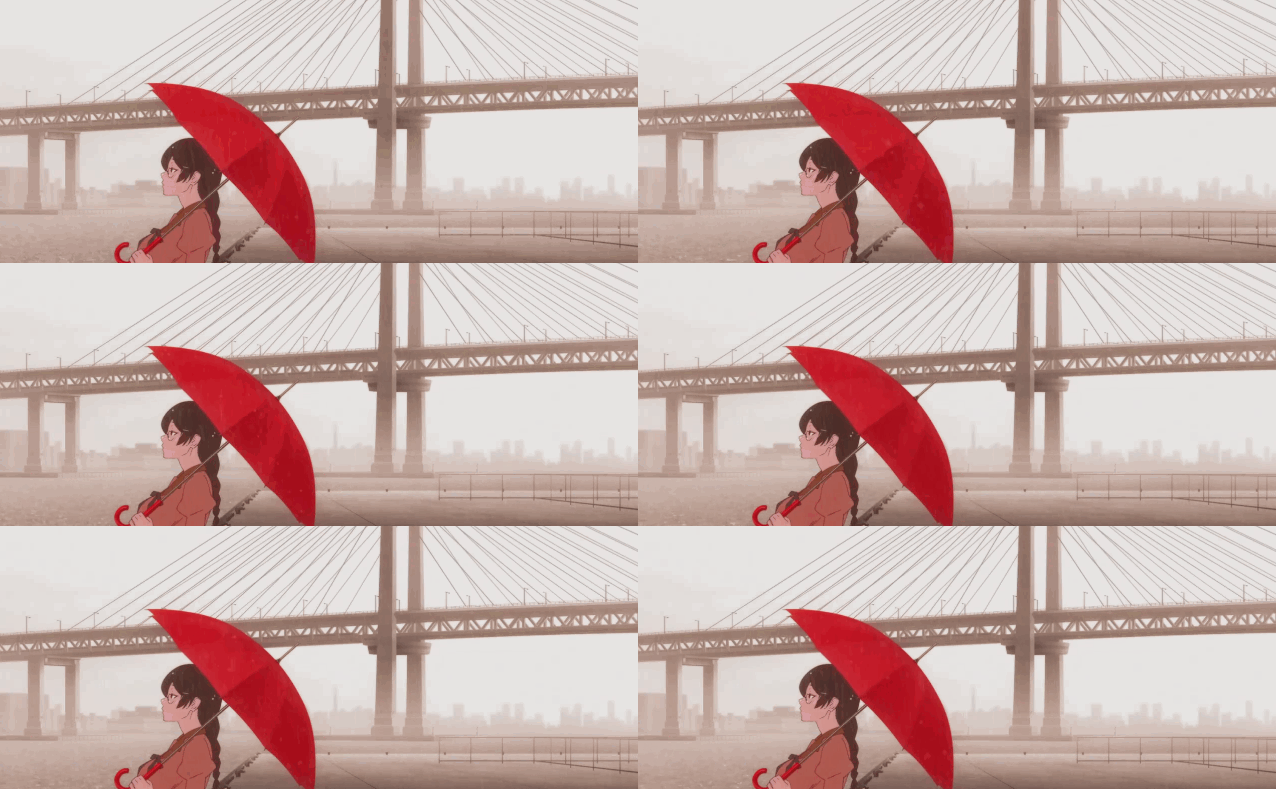
I don't know everything. I just know what I know.
I've always found Hanekawa an especially interesting character in the main series, but her intrigue is all the more in Kizumonogatari in regards to Araragi's character. The latter whose character refreshingly differs from his savior-complex character in the main series, instead imbedded with a deep sense of cynicism and self-isolation. Preceding his meeting with Kiss-Shot, is an innocent boy-meets-girl encounter between Araragi and Hanekawa's panty-flash, another statistic of the flamboyant fanservice. Though their intimacy borders risqué; Hideyuki Morioka's outstanding character designs imbued with sensuality certainly lent a hand in this; Araragi and Hanekawa's dynamic is warmly showered in friendship, otherwise new to the lonesome Araragi, who will teeter-and-totter in breaking out of his vulnerable, cynic shell. Despite her lack of appearances in Kizumonogatari: Part 1, her presence was nonetheless made apparent for the future films.
#
Akiyuki Shinbou's influence on Studio SHAFT is transparent, given the interchangeable nature of the "SHAFT style" and the 'Shinbou style". To which I don't bear much of an issue with, yet it unfortunately deters attention from other talented SHAFT staff, such as Tatsuya Oishi.
▶ VideoReiterating myself once more, Kizumonogatari is an anomaly within an anomaly. The unconventional cinematography and editing normalized in Monogatari are all there, of course, but Oishi's footprints are deeply imprinted within the striking visual cues. The opening sequence spells everything out more than sufficiently. Choosing to remove Araragi's monologue from the light novel scene, Oishi procures an ominous, eerie tone. The camera waltzes in a disoriented manner around a pacing, already-disoriented-enough Araragi in the abandoned school building. The disorientation continues, with anachronistic editing and more explicitly, the hard contrast between the CG realistic background and 2D-lighted character designs. Araragi's colorfully exaggerated expressions, akin to horrific Looney Tunes faces, and his flailing around in flames are personal favorites. As absurd as Monogatari is, Oishi takes it up a notch and two in Kizumonogatari in his fantastic visual cues and framing, entirely appropriate considering the nature of this comedic tragedy and a personal prologue from the eyes of Araragi.
Conclusion
And now for the epilogue, or rather, the punch-line of this review. Kizumonogatari is a faceted tale. A tale of tragedy, a tale of irony, a tale of chance encounters, a tale of viscera. Ultimately, though, it's a prologue to a particular ahoge-bearing bystander.
Entering Tatsyua Oishi, he brings beautifully-crafted, eccentric twists on the visual cues entirely reminiscent of noir films. Being, the focused red color palette, the hard and jarring editing, sense of eeriness and cynicism and, of course, a blatant text screen flashing the single word "noir". Disorientation dominates the visuals, as well, with eccentric camerawork, ominous orchestras, the hard contrast of CG background against the 2D characters and specifically chaotic sakuga animation.
Almost as much as Kiss-Shot herself, Kizumonogatari is a visual monster, bordering on a sense of live-action. Despite its vague context, the film is filthy with rich character subtext regarding the mere three main characters. Alongside the visual orgy, Monogatari fans will surely enjoy this prologue. However, Kizumonogatari is simultaneously a phenomenal standalone film for Monogatari fans and curious newcomers both, requiring no previous knowledge of the series.