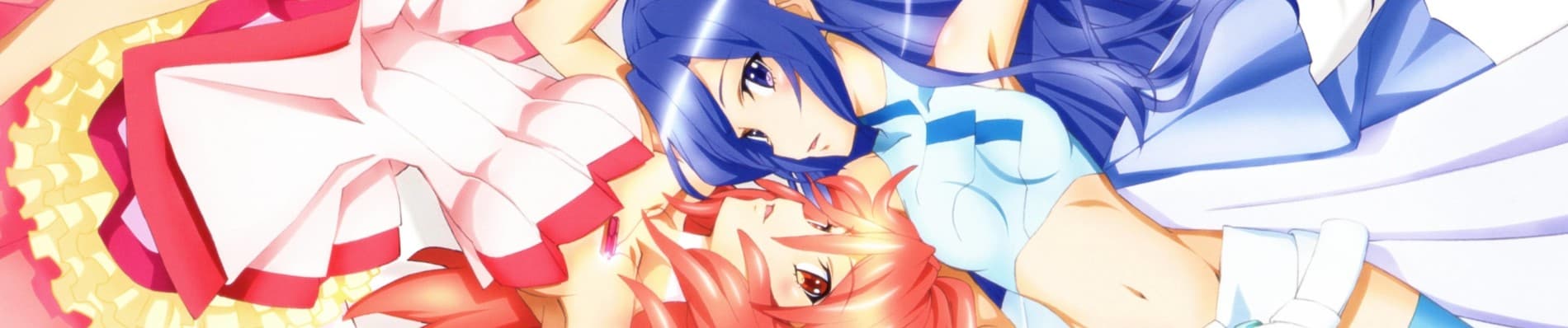
Symphogear
a review by Pockeyramune919
a review by Pockeyramune919


'Magical girl' or 'mahou shoujo' is among the most notable genres of anime. It has a rich history that stretches back to the sixties. Thanks to the success of Sailor Moon in the 90s, it defined anime for a generation. For many a nineties kid, anime was either high-school girls transforming into uniformed heroines of justice or buff dudes beating the snot out of each other for eight episodes straight. While the proliferation of anime (especially in the West) means there are more genres and shows to choose from, magical girl anime hasn't gone away: Little Witch Academia is both popular and recent enough that I've heard of it, Madoka is a somber take on the genre with massive crossover appeal, and Pretty Cure, while an anime I'm only familiar with in passing, has been going strong since 2004, with new seasons produced annually. From this, it should be clear that magical girl shows remain a staple in anime. Given its prevalence and influence, it should be a genre I'm familiar with. That, however, wouldn't be the case. I'm thankfully now confident enough in my masculinity to not balk at the idea of watching a magical girl show, but it's still not a genre that I go for. Magical Girl shows just never particularly caught my eye and I'd worry that I wouldn't get a lot out of them. Before Symphogear, I had only watched three magical girl anime. First, there's Puella Magi Madoka Magica. Many see Madoka as a deconstruction of the genre instead of playing it straight. While I haven't watched enough of the genre to say whether or not this is true, either through the show's marketing or through fan word-of-mouth, Madoka certainly has a reputation for being distinct from other mahou shoujo and that's part of what got me through the door. Then there was its spin-off, Magica Record. Finally, there's Cutie Honey Universe which I genuinely forgot even was a magical girl anime until I filtered for "magical girl" on my anime list (to be fair, though, I think this was mainly because forgot about Cutie Honey Universe in general). From what I can tell, this is an ur-example more than anything, lacking many of the tropes and aesthetic sensibilities that make the genre what it is. From the trio of magical girl anime that I've watched, it should be clear that I only go for mahou shoujo that seem to significantly play with the genre.
That's part of the reason I decided to try out 2012's Senki Zesshō Symphogear or Superb Song of the Valkyries: Symphogear, though mostly referred to simply as Symphogear. Parts magical girl anime, parts idol anime, parts sentai show, parts a mecha, Symphogear is a show that catches your attention just due to how many things it juggles. An anime writer better than I even coined a term for Symphogear and similar shows — ‘battle girl’ as opposed to the more familiar magical girl moniker.

To tell you the truth, I'm not sure quite how Symphogear ended up on my radar. It's certainly not because a certain moderator of Anilist aggressively advertises this show like he made the damn thing, often highlighting their favorite character from the show, Yuukine Chris. That would be preposterous. The earliest I can recall hearing about this show was via a review of its final season. As I was on the fence about watching this show, I held off from reading the review. Regardless of how it got on my radar, Symphogear landed on it, against all odds. No matter what fancy subgenres you place it under, no matter how many other genres it takes inspiration from, at the end of the day, Symphogear is a type of magical girl anime, a genre I normally don't go for. This introduction has been a long-winded (Alas! My poorly-kept secret is out once more — I am nothing but a windbag!) way of highlighting just how marvel Symphogear is in concept. Regardless of my opinion on its execution, as a fan of genre-blending, slicing, and dicing, I think Symphogear deserves to be a show on people's radars.
You may be wondering what made me decide to finally get off the fence, take the plunge, and watch Symphogear. Well, you see, dear reader, like many great things, it starts with a 90s J-Rock star from outer space singing his goddamn heart out. Yes, my friends, it is thanks to the great Macross 7 As I said in my review, I had a tremendous amount of fun with the show. It wonderfully mixed mecha action with song. I was hungry for more anime like Macross 7, so I decided to give Symphogear a shot. As it turns out, Symphogear's studio, Satelite, is the very same studio responsible for every Macross show that released after 7.
I'm pleased to say that I enjoyed my time with Symphogear. I won't lie to you and say that I had nearly as much fun as I did with Macross 7 — while still out there in concept, in general, Symphogear feels quite a bit more grounded than Macross 7. In ways, this makes it easier to take seriously (although, Symphogear can still be silly), makes it easier to believe in its genuineness. The con for me was that this made Symphogear feel a bit less energized than Macross 7, which can get quite hot-blooded in its passion; in comparison, it feels like Symphogear doesn't have enough wind in its sails. Symphogear never reaches the heights that 7 did for me, but that's all right. In and of itself, Symphogear is a fun show. Not quite a "marvel to behold," but something exciting all the same. It's really impressive not just how it juggles several genres and influences, but how it makes them work. More impressive still is the fact that this is just the beginning; there are four more seasons for this series to improve. Even if it doesn't do away with the things I dislike, the noise of the things that I do like could grow loud enough to drown them out.

In the world of Symphogear, mysterious, dangerous beings known as Noise (no, not those) terrorize the planet. The power of noise is terrifying, with humans normally unable to harm them, turning into stone upon contact with the beings. But you know they say — fight fire with fire. Or in this case, fight noise with more pleasant-sounding noise — music. Using the power of song, a select few women wield powerful armor and weaponry known as Symphogear — the only material capable of repelling and protecting against the noise. In Japan, Kanade Amou and Tsubasa Kazanari were part of the Symphogear-clad duo known as [Zwei Wing]. Two years ago, disaster struck as noise suddenly attacked the concert. Kanade sacrificed herself to save a civilian in attendance, Hibiki Tachibana. In the process, a piece of Kanade's Symphogear lodged itself in Hibiki. Now, two years later, the powers granted to her by Kanade's Symphogear have awakened and Hibiki must work with the jaded Tsubasa to protect the innocent from the noise and those who wish to use the noise for their nefarious gain, all the while juggling keeping her double-life secret and discovering what it means to be a hero.
To get it out of the way early, let's talk about one of the most notable aspects of the anime — the music. Much like the aforementioned Macross 7, Symphogear features insert songs every episode. Like 7, said insert songs generally play during the central fight scenes of the episode. However, don't go thinking that Symphogear completely apes from its spiritual predecessor. I'm pleased to say that, in function, Symphogear handles the music better than Macross 7. A big part of this is because, unlike Macross 7, Symphogear features a healthy rotation of songs. Before double-checking (thanks, Symphogear Wiki) I swore that each episode featured unique songs, but no, most of the songs appear in multiple episodes (and episode one, as the introduction, is fittingly armed to the teeth with musical numbers). It's just that songs aren't reused ad nauseam. You'd also swear that the songs aren't reused as often as they are because they always seem to fit really well with the scenes that they're in. Symphogear is practically a musical in how context-sensitive the songs tend to be. When the characters sing their songs, they'll be singing about what's going on in their head at the time, making the songs all the more satisfying to hear. Part of why these songs work even in different episodes is because they're tied to the characters. The main heroines get two unique songs to their name, the second one usually relating to a recent character development. I love how music is tied to their powers, thus it makes sense for them to sing in battle.

As for a downside to the music, there's something to be said about the fact that I couldn't remember a number of the tracks. At first, I thought this was because the songs were a bit bland. But upon relistening to them, the memories flood back. They're all quite good; not my favorite songs ever, but good enough to recommend. There's genuinely a case to be made for repetition — a decent handful of songs spread across only 13 episodes means that, as good as they are, they have a hard time shining.
When they do shine, though, they shine quite bright. The most memorable song and my personal favorite is Yuukine Chris' initial character theme, Makyū Ichaival. With the guitars and dark and strange techno downbeat, the song is very distinct. The instruments combined with Ayahi Takagaki's angry vocals fit Chris' mysterious aura and rough personality quite well. It's always sure to get me pumped. I can't help but bang my head during the repetition of "motto" and "zenbu." It's absolutely marvelous. The OP and ED are also pretty darn good, though I'm sure I remember them more due to the simple virtue of them being in every episode.
The action of Symphogear works in tandem with the music to create very striking fight scenes. If I had to describe Symphogear in a word, it would be "flashy." Animation is delightfully fluid during fights, attacks are big and complex. For signature attacks, the show will often pause the action and display of the attack, like so:

As I said in my last review, I appreciate stylization, so the action of Symphogear was right up my alley. Along with the action, costuming helps add to Symphogear's sense of identity. The designs of the costumes, the eponymous Symphogears, are quite striking, but I wouldn't say they slip into garish or loud territory. The designs appear more like futuristic battle suits rather than what you might expect from a magical girl show. This design choice also reflects the general aesthetic and sensibilities of the show at large — it's much more sciency than magical. A potential criticism is that the outfits might be a bit fanservicey, particularly Chris and Finé's. Honestly, though, as someone who typically dislikes fanservice, I thought they were fine in this regard. Granted, that's coming from someone who likes the outfits overall. If I was the type of guy to get humanoid figures, I might get some of the main trio. Actually, the Nendoroids look pretty good...
The designs of the Symphogears also lead us to the sentai elements of the show. Each Symphogear is distinct from one another yet sharing key elements. The designs really go a long way in making the girls feel like a part of a team like the Power Rangers/Super Sentai. Each has their niche when it comes to battling, with Tsubasa using swords, Hibiki utilizing her fists, and Chris utilizing long-range artillery. A lot of it.

But what good would the team be without the characters that make up said team? I'm pleased to say that I enjoyed the characters overall. They're not very deep; what you see is largely what you get and their personalities can be explained fairly quickly, but I think it works decently enough for the show. Hibiki is a friendly genki girl who seems to have a heart of steel, Tsubasa is an aloof, skilled fighter whose icy disposition thaws the more she works with Hibiki, and Chris is a fiery, anti-social tsundere [with a chip on her shoulder]. While I stand by the characters' essences being distilled very easily, I don't want you walking away thinking they're a trio of static tropes. Hibiki's mood does falter at times, whether it's due to having to juggle her double life or because she's getting overwhelmed by the enemy. I describe Chris as a tsundere, but seeing that I quite like her, it's a bit understated. She's not abrasive to her allies, and she's slow to make friends due to her abandonment issues. If she is a tsundere, she's definitely one of the more rounded, tolerable examples. Tsubasa is...okay, Tsubasa's probably a Defrosting Ice Queen played pretty straight, but she's probably my favorite character (if you notice her similarities to White Album 2's Kitahara, you might realize that I have A Type™) But then again, Yuukine Chris is really, really cool, so Tsubasa has some stiff competition. And that's not even getting into the interesting supporting cast such as Kazanari and Ryoko. This is all to say that even if the characters aren't terribly deep, they're not super shallow, either. They're defined and interesting enough that you'll probably have a favorite.

Fortunately, there aren't that many downsides to Symphogear and the ones that exist aren't that glaring. I already mentioned the downside to the music and the possible objection to the fanservice. Besides those, there are times when Symphogear can feel a bit by the numbers, which is weird due to how crazy the general concept of the show is. One such time is the double-life plot. Throughout the show, Hibiki grows distant from her best friend Miku because of her duty to protect the city with her Symphogear. Hibiki is forced to routinely blow off arrangements with Miku and has to leave her into the dark due to her vow of secrecy. Miku grows increasingly despondent before she sees Hibiki utilize her powers. Hibiki then tells everything to Miku, promises to be more open, and the two make up. Now, this plot thread isn't bad; in fact, it could have been a lot worse — for one, there aren't a lot of the unavoidable misunderstandings that seem to plague other renditions of this thread. That said, this plot thread is a bit tired. It's doubtless something you've seen before and I can't help but feel it a bit cliche. It works perfectly fine in context, but its presence seems to make the show that much less fresh. I only single out this plot point because it jumps out at me — rest assured, there are other instances of things like this happening. While I praised the characters, they still can add to this feeling of the show feeling a bit trope-y. It didn't detract from my enjoyment too much, but I think there's definitely a disconnect between how unique the concept is and some of the execution of said concept. The show does retain unique elements and twists but when it falls back on heavily established character archetypes and plot threads, you notice it.
Finally, if I'm being honest, and I know this sounds harsh, the show just wasn't as "fun" as I hoped? I think the tone can leave a bit to be desired. I wouldn't call the show "serious" persé (a bit dark, and surprisingly bloody, sure, which are characteristics that drew me in), but if I bring in my friend comparison, ever the thief of joy, I find Symphogear a bit lacking compared to Macross 7. The show is a bit less goofy, a bit more competent, but I feel that takes away from the charm a bit, given the concept. And I know I'm not just making this up because I've heard others describe the first season of Symphogear as taking itself a bit too seriously.
That said, there are definitely parts of the show that lean into more fun elements, such as Hibiki's training montage. Overall, while the show isn't perfect, it's a (mostly) unique show that manages to take elements from various genres I enjoy to create an entertaining viewing experience. My score is ultimately because Symphogear did little to wow me while not doing much wrong. And much like the last show, I know there's a lot of room for *Symphogear to improve. Ultimately, I'm sticking with Symphogear, excited to see what's in store for me.


29 out of 33 users liked this review
