This review contains spoilers for the first half of Stardust Crusaders
Another long review by that Pockey guy? Yare yare daze...



Hello and welcome back to my series review of JoJo's Bizarre Adventure! Last time, I tackled 2012's JoJo's Bizarre Adventure which adapted both Parts 1 and 2 of the manga, Phantom Blood and Battle Tendency, respectively. While the show wasn't perfect, it was a lot of fun. I found myself hooked and knew I'd be sticking with JoJo's Bizarre Adventure for the long haul. I've heard that some suggest skipping Parts 1 and 2. After having watched them, I vehemently disagree with this advice, as the first two parts are great in their own right and from what I can tell, your enjoyment of subsequent parts is enhanced by watching the parts that came before it. Newcomers to JoJo's Bizarre Adventure absolutely should not feel the need to skip Phantom Blood or Battle Tendency.
That said, I kind of get why someone would want to jump straight into Part 3, Stardust Crusaders. Part 3 seems like the epitome of JoJo's Bizarre Adventure. More than Phantom Blood, Battle Tendency, Diamond is Unbreakable, and Golden Wind, when I think JoJo’s Bizarre Adventure, I think Stardust Crusaders and I'm sure many feel the same. There are a few reasons for this. Stardust Crusaders is the first part featuring Stands (a few months ago, if you asked me what I Hamon was, I would have shot you a blank stare), Jotaro is perhaps one of the most iconic and recognizable JoJos (I probably wouldn't have recognized Jonathan or Joseph), and it seems to have the most memes (I think it's telling that the JoJo meme subreddit is called r/shitpostcrusaders). While there are debates over which part’s the best, I'm going to go on a limb in saying that Part 3 is the most popular/most iconic part. It was the first part with an adaption (releasing in the 90s, 14 years before the movie, and 19 years before the 2012 adaption) and it appears to be the most referenced part, whether that be in other media or among fans when discussing the series. I'll avoid getting too attached to the idea that Stardust Crusaders is the most popular, because I'm not an expert on the series, and I could be very wrong (again). Even if it isn’t true that Stardust Crusaders is the most popular part, it’s certainly my truth. Most of my passing exposure to the series has been through Stardust Crusaders. Even though I enjoyed my time with Parts 1 and 2, I'd be lying if I said that I wasn't absolutely itching to get to Part 3, to see what all the real hubbub was about. More than Parts 1 and 2, this was the one I had been waiting for.
With that in mind, did it live up to my expectations? Is it much better than Parts 1 and 2?

Once again, I'm pleased to say that JoJo's Bizarre Adventure delivered. As I've only seen two-and-a-half of the five animated parts, I can't say whether or not this part is the best, but I can certainly say that it’s my favorite so far. Stardust Crusaders took everything that was great about the previous show and improved upon it — from the music, to the fights, to the characters. Stardust Crusaders isn't perfect, of course, but its flaws are so minor to that they don't really hamper my enjoyment. JoJo's Bizarre Adventure really earns its moniker come Stardust Crusaders. This isn't to say that the 2012 show was bland, but the insanity of the previous show is kicked up a notch, the dial cranked up to eleven. I'm left with the sense that now JoJo features fights, scenarios, and characters that absolutely could only be found in JoJo, that could only come from the mind of its awesome creator, Hirohiko Araki.
Before I go on, I should briefly touch on how I'm tackling this show. Mind the fact that I specifically stated that I'd seen "two-and-a-half" JoJo parts. That's because Stardust Crusaders has another weird adaption situation. Parts 4 and 5 are both contained in one show each (and 6 will most likely follow suit, as far as I can tell). Parts 1 and 2 share one show, most likely due to their comparatively short lengths, while Part 3 is split across two differing seasons/shows. The first is simply titled Stardust Crusaders and details Jotaro and co.'s perilous journey to Egypt, while the aptly named Stardust Crusaders — Battle in Egypt chronicles what you can guess more succinctly than I can describe. As this is one continuous story (there's no "Battle in Egypt" distinction in the manga), it might make more sense to write one review for Battle in Egypt covering both parts. I concede that my reasoning for reviewing both is kind of arbitrary — I write a review for every anime I watch, and as both halves have different list entries, for the purposes of data entry and review writing, I'm treating them as separate entities. That said, there are benefits to reviewing it this way. If Battle in Egypt somehow drops the ball, then my opinion on Stardust Crusaders will largely remain unaffected.
But with that out the way, let's delve into what exactly this bizarre adventure is this go-around.
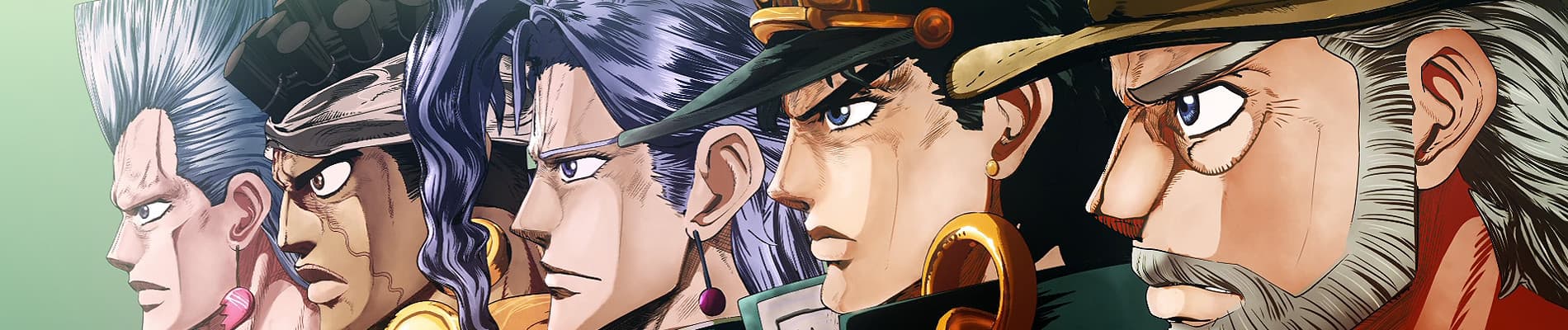
95 years after his defeat at the hands of Jonathan Joestar, DIO returns! His emergence coincides with the appearance of Stands — mysterious, powerful beings that give their users frightening abilities. One of the Stand users is main character Jotaro Kujo, a seventeen-year-old delinquent in Japan and the grandson of Joseph Joestar. DIO survived by attaching his severed head to Jonathan's body, taking it as his own. This gave him a connection to his rival's descendants, a connection he wishes to use to destroy them once and for all. Three years after DIO's return, Jotaro Kujo finds himself in a prison cell. He has turned himself in to the police and remains in jail for the safety of others. He says he's been possessed by an "evil spirit," but in truth, he has awakened the power of his Stand. As Stands are invisible to those without them, no one knows what's going on until Joseph Joestar and his friend, Mohammad Avdol arrive to investigate. Jotaro is only beginning to understand his powers once tragedy strikes and his mother manifests a stand of her own, one that's slowly killing her. The only way to save her is by killing DIO in fifty days. Jotaro, Avdol, Joseph, and a growing motley crew make their way to Egypt, where DIO is hiding. But the journey will be anything but easy. A bevy of strange assassins with Stands of their own is sicced on the group at every turn. If they want to arrive in Egypt in one piece, they're going to have to give it everything they've got. The journey will be a full-on adventure, a bizarre adventure, if you will.

My first bit of praise pertains to something that's pretty central to the show — the adventure aspect. Moreso than Battle Tendency and Phantom Blood, Stardust Crusaders really feels like a journey, an epic quest. Perhaps it's because we have a concrete destination in mind. Perhaps it’s because we track the group making their way from Japan all the way to Egypt. Perhaps it’s because we really get a sense of the group's trials and tribulations — as this is set in the 80s, the group could logically reach Egypt in less than a day. For Jotaro's crew, everything that can go wrong does go wrong. Thanks to the Stand-wielding assassins DIO tosses their way, it takes them thirty-six days to reach Egypt, and they still need to find and beat DIO after arriving. There's a real movement to this show and it makes it very satisfying to watch. Progress is quite tangible here, for with every enemy beaten, the group moves closer to Egypt. This is a bonafide globe-trotter and I love it. Again, my praise of Stardust Crusaders isn't meant to put down its predecessors. While Part 1 and 2 both feature journeys, Part 3 improves upon them, blending on the strengths of each. Phantom Blood's journey was quite short and was contained entirely within England. While Battle Tendency takes place across three continents, clashes with the antagonists generally occurred after reaching destinations, meaning that the destination mattered much more than the journey. Stardust Crusaders makes progress feel earned like Phantom Blood while covering a lot of ground like Battle Tendency. Given how built-up the battle with DIO is, it’s clear that both the journey and destination of Stardust Crusaders matter.
The fights are also improved, mostly thanks to the Varied Stand powers. I'd never call the fights of the 2012 anime boring; most of them were pretty imaginative. I do think it’s fair to say that some of the excitement could come from how the fights are conveyed rather than the fights themselves. Santana and the initial appearances of the Pillar Men generally weren't topped by anything else in the show save for the insanity that was ultimate Kars; now, thanks to Stands, this chaos is in every fight. As much as I love Hamon, Araki must have realized there was only so much more he could do with it, and as a result, he introduced the Stands, which are limitless in their potential. Every fight is different from the last and thanks to their unique skillsets, most fights require a level of strategy that was seldom seen in Parts 1 and 2. The feeling of sitting on the edge of my seat is increased. And, of course, the stylization I loved from the initial show returns here. Once again, it makes for some striking scenes — one that sticks out to me is Kakyoin revealing his trump card to Death 13, with his hair suddenly turning white. It was cool as all get out.

Another way that Araki seems to have improved upon the formula he created in Parts 1 and 2 is by having a bonafide team of protagonists that are all on equal footing with one another in terms of strength and spotlight. I enjoyed Jotaro and co. the most out of the protagonists so far. While Joseph circa Part 2 is my favorite JoJo, the individual parts of this group create an entertaining whole that I love seeing time and time again. The members of the crew are defined enough that each could be the sole main character of their own show, but they really shine when they bounce off of one another. It might be a bit of a hot take, but Jotaro in-and-of-himself is kind of boring — he's a delinquent, albeit a very stoic, eternally annoyed ("yare yare daze") one. He works well as the center of the team, anchoring their antics as the straight man and bailing them out of trouble — when Jotaro and Star Platinum show up, you know shit's about to go down. Polraneff is a comedic character and his more dumb/rash moments are tempered by the fact that they're either funny/lead to interesting battles or they have serious ramifications for other characters that lead to growth. Joseph makes for a surprisingly cool team dad, Kakyoin meshes well with the rest for being the most calm and collected (Araki has stated that Kakyoin is supposed to invoke an honor student to contrast with Jotaro's delinquent), and Avdol is the strategist. My reaction to an apparent character death is a mark of just how much I enjoy these characters. Towards the middle of the show's run, Avdol apparently dies at the hands of antagonists Hol Horse and Centerfold. I absolutely refused to believe in his death. I held hope that somehow, miraculously, he'd come back. Then, much to my utter joy, he returned in episode twenty-two. Normally, I despise death fakeouts because they create emotional reactions that creators are too afraid to commit to and only serve to rob a show of stakes. But through Parts 1 and 2, Araki had earned my trust when it came to stakes. Because of the prior deaths of main characters Zepelli, Caesar, and Jonathan Joestar himself, I know that main characters can die in JoJo. Araki has proven himself to such an extent that instead of feeling cheated when Avdol showed up, I felt rewarded.

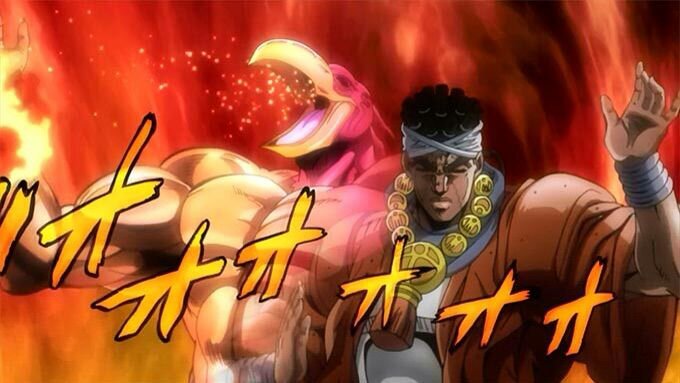
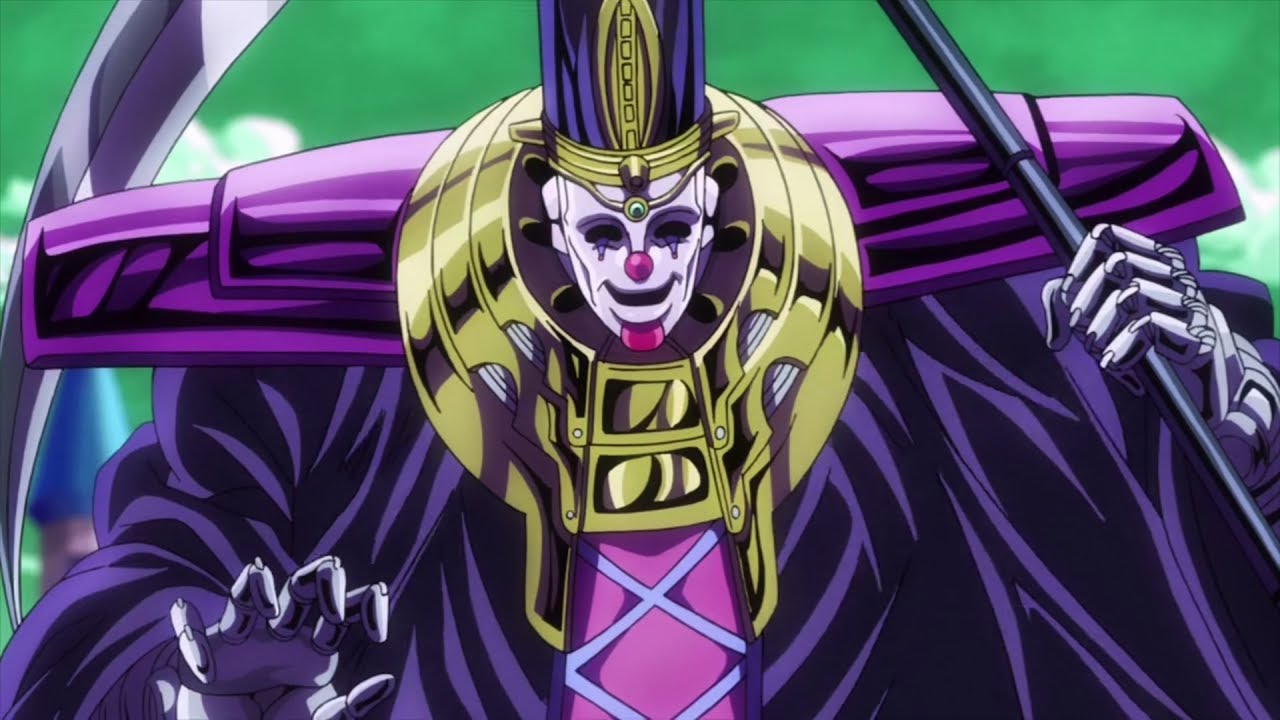
But don't go thinking that only the protagonists are noteworthy — the villains are no slouches in this department. They're even odder and more colorful than our protagonists. If you told me after I had finished the 2012 anime that DIO seldom appears in the first half of Stardust Crusaders, I'd have been pretty disappointed. Fortunately, the villains pick up the slack in his absence, being extremely hammy and memorable. Most of the memes and exploitable from Stardust Crusaders come from the baddies — from goo man that shouts "DO YOU UNDERSTAND," a creepy orangutang, an eerie double left-handed monster of a man, an overly maternal hag, a malicious genie that shouts "HAIL 2 U," a punchable weasel of a man, to an unassuming yet deadly baby, the villains of "Stardust Crusaders" are a joy to watch. I'm looking forward to seeing DIO again, but until that faithful day, I know I'm in good hands.
The music is also really good. The OP definitely takes a hit, being nowhere near as good as JoJo ~Sono Chi no Sadame~ or Bloody Stream, but the ED picks up the slack with the catchy 80s classic, Walk Like an Egyptian by the Bangles. I remember being disappointed when I learned that I was mistaken in thinking "the JoJo theme" was from Stardust Crusaders (it's so iconic that it tries stealing other parts' stuff, apparently). However, I quickly found that I loved Jotaro's theme, which is parts groovy, triumphant, and epic. Virtuous Pope is also worth mentioning as another really great triumphant theme.
As I arrive at the obligatory "criticism" section, I must admit that there really isn't much I find wrong with Stardust Crusaders. I don't really have "gripes" as much as things I wish were there. Let's call this section "hopes for the future," considering we're only halfway done with Stardust Crusaders and it's feasible that these things will be in the second half.

First, there's the monster of the week format. Stardust Crusaders might be the most oppressively monster of the week anime I've watched in recent memory. After the first episode, the formula is as such: Jotaro and co. attempt to progress in their journey to Egypt, they're attacked by a new Stand whose powers they don't *under*stand, figure out the enemy's ability, defeat them, then continue on their journey. There is very little variation to this formula. If an episode doesn't follow this format, it’s most likely because it's the second half of a two-parter confrontation. The thing is that the monster of the week format works — the characters and enemies are both so interesting that it never wears thin. That said, it definitely could grow a bit old in the future. Even if we don't like to admit it, we can have too much of something good. The taste of your favorite food, the sound of your favorite song can both grow bitter if you're exposed too much to it. Dynamism is the name of the game. It's a bit of a conundrum due to the fact that the direness of the gang's situation kind of invites the format. That said, I hope they can manage to switch things up, even as much as I like the villains. After all, the two-parters were the highlight of the show for me; we can stand to stick with some of these characters a bit more.
I praise the character and their dynamics, so I hope they can be used in fights a lot more. In the beginning, it felt like Jotaro was somewhat stealing the spotlight, always swooping in to save the day or being the one to engage in the enemy while the rest of the crew could do nothing. Admittedly, this got a bit better. Every character eventually gets what is essentially a day in the limelight. But I'd like to see this taken a step further. The characters have good social dynamics, so why not also show their fighting dynamics. Some of the Stands seem woefully underutilized, most notably Kakyoins. I'd like to see their powers interact with one another more in order to create even more insane fights. Despite being Star Platinum, Jotaro's Stand seems to be held as a gold standard in terms of strength. When he's employed, he's usually a win button. I enjoy when this is toyed with, such as when Jotaro couldn't hurt Steely Dan due to him essentially holding Joseph hostage. What I'd like even more, however, is if Jotaro needed to rely on his allies more, fighting side by side to beat a stand. If he's the guy who beats DIO, fine, that feels inevitable, but in that case, make him rely on his friends to get to that point.

And
that's really about it.
JoJo is still not what I'd call "deep," but it doesn't need to be. I can't deny it still does elicit real emotion in me, whether that's excitement, laughter, comedy, dread, or sadness. If a work can make you feel something and is enjoyable, that's a mark of art, no matter what the picture looks like. The picture happens to be a very funny, action-filled show that makes me marvel at the bizarreness on display. It's not a show for everyone, but for the ones that it is for, it's probably the best option out there. I can't wait to see how this bizarre adventure concludes in Egypt.


63.5 out of 67 users liked this review
