
Section One: An Introduction to Studio Ghibli and Gorō Miyazaki
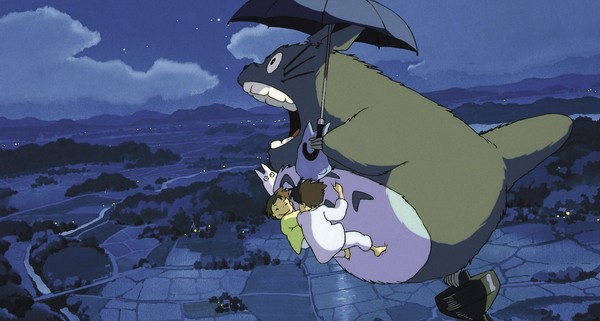 Studio Ghibli is a studio that needs no introduction. Since you're currently using an anime site, the overwhelming odds are that you've heard of Studio Ghibli. Beyond being recognizable, Studio Ghibli commands immense respect and acceptance, almost reverence. You'll commonly hear that anime is or is becoming mainstream; Studio Ghibli has been ahead of the curve in this regard. Studio Ghibli movies aren't painted with the same brush as other anime, there's not as much a "stigma", not as much the sense of being strange, or "other." A person who might not consider themselves an anime fan might be enamored with the works of Ghibli, might sport a Kiki's Delivery Service phone charm, might wear a Totoro enamel pin. The layman might not really think of a given Studio Ghibli film as an anime so much of a cartoon akin to Disney. Part of this is undoubtedly because, for the entirety of the noughties, in America, it was Disney. Thanks to Disney distributing, dubbing, and marketing Ghibli movies internationally, Studio Ghibli saw the success it wouldn't have gained otherwise, most notably, its 2001 classic, Spirited Away earning both an oscar and the distinction of a highest-grossing anime movie. Culturally, the 2000s saw Ghibli gain a close association with Disney and the prestige that comes with it. The association remains to this day — when Disney's streaming service, Disney Plus, launched six years after Disney ended its relationship with Ghibli, "will Ghibli movies be on Disney+" was a frequently Googled term.
While the Disney association definitely helps with Studio Ghibli's perception, another, more vital reason is that Ghibli makes damn good movies. Since its founding in 1985, Studio Ghibli has been dedicated to lovingly crafting quality films that hold the respect of audiences and critics alike — of the 22 Ghibli movies listed on Rotten Tomatoes, only two have a critic score less than 78%. Studio Ghibli movies are distinguished by their gorgeous art including vivid character expressions, distinct character designs, and beautiful, painting-like backgrounds depicting locales so iconic that a trope has been named after it. It certainly helps that many Studio Ghibli moves have a wide appeal, often being a great watch regardless of age and incorporating genres that don't feel exclusionary. Demon Slayer The Movie — Infinity Train may have handily dethroned Spirited Away as the highest-grossing anime movie, but its status as a shonen anime bars it from having the same broad appeal as Spirited Away. Your Name might be the anime movie of the 2010s with a box office receipt that's just under Spirited Away, but it's a movie that wears its country on its sleeve more than most Ghibli fare and has a distinct age group that it seems to cater to. There's a whimsy to many Studio Ghibli movies, a whimsy that brings people together. These traits are thanks to Ghibli's skilled staff — most notably its directors. While Ghibli has several directors, the one most associated with the studio is Hayao Miyazaki. Miyazaki and the rest of Studio Ghibli believe in their films' status as art and don't take kindly to edits made solely for profit. After seeing an early, botched localization of Nausicaa the studio made it known that Ghibli's partnership with Disney would be predicated on not cutting the films for international release. When Harvey Weinstein wanted to cut Miyazaki's Princess Mononoke, Miyazaki's producer sent a katana to the disgraced movie mogul with a simple message — "no cuts." Thanks to many movies worth of goodwill and an association with one of the biggest animation studios on the planet, audiences have come to immensely respect Ghibli and its directors.

Yet even the most prestigious of families have a black sheep. In Studio Ghibli's case, that would be Gorō Miyazaki, the son of Hayao Miyazaki. Gorō knew at a young age that he would never quite measure up to his father's titanic success. As such, he decided to turn his sights not to animation, but to architecture. After graduating, he designed various parks and gardens. Being Miyazaki's son, however, it was hard to escape from his father's orbit. In 1998, Gorō helped design the Ghibli Museum before going on to serve as its director from 2001 to 2005. By this time, the gravitational pull of Ghibli was too great. Gorō, almost inexplicably, found himself seated in the director's chair. He was brought onto production of Tales From Earthsea as nothing more than a consultant. However, after producer Toshio Suzuki saw Gorō’s storyboards, he was appointed director of the movie, a decision that Hayao Miyazaki railed against given his son's lack of experience. The elder Miyazaki's attitude towards the movie wouldn't soften. During its premiere, he walked out to smoke a cigarette, stating the one hour he sat through felt like three. He later would say that Gorō Miyazaki "hadn't become an adult" and that he should "stop making movies." The harsh reception didn't just end at Hayao Miyazaki. Tales From Earthsea was lambasted for its dense plot and dark atmosphere, among other reasons. It remains one of the lowest-rated Studio Ghibli films with a Rotten Tomatoes critic score of 43%. It earned the prestigious awards of "Worst Director" and "Worst Movie" from Japan's equivalent of the Razzies. To fans, the movie serves as a blemish on Ghibli's otherwise squeaky-clean track record.
 Studio Ghibli really didn't suffer for Earthsea's poor critical reception, but Gorō Miyazaki certainly did. The movie remains a black stain on his reputation that he just can't seem to scrub. He went on to direct 2011's acclaimed From Up on Poppy Hill which won Animation of the year at the 35th Japan Academy Prize. Despite the movie's success, Ghibli fans remained icy towards Gorō Miyazaki — many attribute the film's success to Hayao Miyazaki co-writing the script. It seems like Gorō Miyazaki just can't catch a break. Many see the 54-year old director as nothing more than a talentless hack who got where he is through nepotism. Recently, when asked what makes a Ghibli movie what it is, Gorō replied, "I wish someone could give me an answer." In short, Gorō Miyazaki ranks high on lists of "directors who desperately need a hug." Part of his problem is doubtless due to his proximity to his father. He has big shoes to fill — it's one thing if Hayao Miyazaki had passed, but it's another entirely to be faced with living proof you don't measure up — two years after Earthsea released, Hayao Miyazaki would release the critically-acclaimed Ponyo. While Gorō Miyazaki was poorly received, it was easy enough to ignore him. He was able to fade into the background since people could focus on the plethora of upcoming Ghibli movies headed by other directors.
In the 2010s, Studio Ghibli stopped making movies.
Since its inception in the 1980s, Studio Ghibli had released movies like clockwork — at longest, movies would be released two years apart. It wasn't rare to have periods with annual Ghibli movies, nor was it strange to have years where multiple Ghibli movies were released. However, this bountiful well dried up in 2014 following the release of When Marnie Was There. That year, the studio announced that they were undergoing a hiatus of film production. The decision to freeze production was almost certainly due to Hayao Miyazaki announcing his retirement the year prior, with 2013's The Wind Rises set to be his swan song. In 2015, several Studio Ghibli alums would go on to found and work for Studio Ponoc, including director Hiromasa Yonebayashi (Arietty, When Marnie was There) and producer Yoshiaki Nishimura (Howl's Moving Castle, Tale of Princess Kaguya, When Marnie Was There). Before his untimely death, prolific Ghibli Director, Isao Takahata, was set to direct a segment of Studio Ponoc’s anthology film. With Studio Ghibli on a hiatus and a number of its talent having flown the coop, the fate of the studio that many held dear was uncertain.

The odds were not at all in Earwig in the Witch's favor when it released. All of these factors worked against it. Audiences had been waiting for almost seven years for a new Studio Ghibli film, so their expectations had reached a fever pitch. Audiences had come to love Studio Ghibli for its beautiful, hand-drawn animation, so a seven-year wait leading to the studio's first CG film felt like a slap to the face, a betrayal. The moldy icing on the cake for many was the fact that the film was directed by none other than Gorō Miyazaki.
The reception of the trailer was poor and the reception of the movie was worse, still. Worst, actually; Gorō Miyazaki had outdone himself. With a critic score of 38% and an audience score of 68% (though it should be noted that there are much fewer audience ratings than other Ghibli films) Earwig and the Witch holds the distinction of being the lowest-rated Ghibli movie on Rotten Tomatoes.
With this review, I'm hoping to find out what went wrong, what went right, and what it all means, both in terms of Studio Ghibli and its legacy and my own relationship with the studio. The ~~bloated~~ extended intro isn't just important in understanding the initial reaction towards the movie — it’s vital in understanding the film itself. Earwig and the Witch has a life of its own. It's deceptively important and it's a great way to think about Studio Ghibli's past and future. This unassuming movie is also a great way to look at my own thoughts about the studio.
Section Two: The Movie Itself - The Review
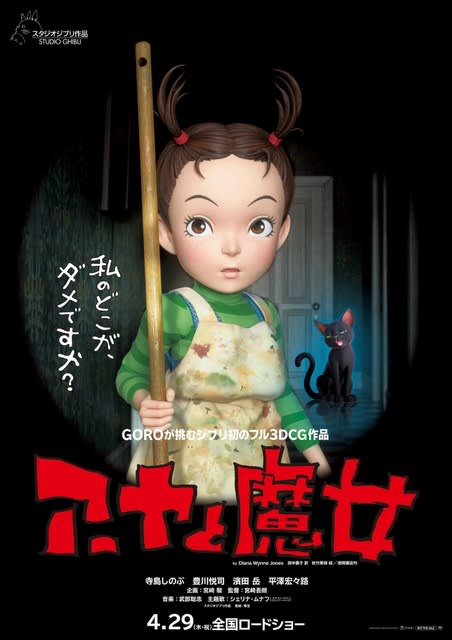
Earwig and the Witch opens with a woman on a motorcycle being trailed by unseen pursuers in a car. We are shown the woman's magical powers when she makes a strand of her crimson hair bubble and turn into a gaggle of worms that she throws at the windshield of the car, the distraction giving her the lead she needs to escape. The rider then goes to an orphanage in the English countryside, reassuring the baby she's holding that everything will be alright. Once the matron and her assistant show up at the door, they only see a crying baby at their feet with a note. In the note, the woman reveals that she's a witch being chased by the twelve other witches in her coven and that the baby's name is "Earwig." The head matron refuses to believe in the existence of witches and decides to give the baby a more standard name — Erica Wigg. We flash forward ten years to see that Erica has grown up to be a rambunctious child who always gets her way. She loves living at the orphanage because everyone there, child and adult alike, is wrapped around her finger. She loves the orphanage so much that she hates the thought of being adopted. Her perfect life at the orphanage comes to an end when she finds herself adopted by an ominous man and woman. When she arrives at their home, the woman introduces herself as Bella Yaga and the man simply as the Mandrake. Bella Yaga tells Earwig that she's a witch and that she adopted Erica to have an extra set of hands around the house. Earwig then follows Erica as she lives in the mysterious house, trying to learn more about magic while navigating around the domineering Bella Yaga, with a little help from her new talking cat friend, Thomas.
Let's address the obvious and talk about the models. Whether the director's name was Hayao or Gorō, fans would doubtless raise an eyebrow or two over the use of CG in a Ghibli film. This might be a bit of a hot take, but I'm actually fine with the models. I've heard them often criticized as being "plastic-y," but given Ghibli's usual style, I don't find they look all that strange. They're no Pixar (who've had decades to perfect their models, mind you) whether in terms of texture, minute details, or shading, but they don't look terrible by any measure. The character designs look fittingly Ghibli-esque and I can easily picture them in 2D — from the cute Erica, to the severe-looking Bella Yaga, to the imposing Mandrake. Despite some criticisms I've seen lodged at the movie, I really cannot honestly say these don't look like Ghibli characters. The cast is fittingly colorful, with the type of exaggeration I've come to know Ghibli movies for.
The OST is pretty hit-or-miss. The music often doesn't mesh really well, sounding haphazardly inserted instead of the track being built around a scene. I say "track" but they're more often than not simple riffs that don't really add much before making themselves scarce. If this makes any sense, the score reminds me of a cheap after-school special or a Disney Channel-esque live-action sitcom, more than anything. I don't think the problem is a question of style — in fact, I like some of the music. A prog-rock-inspired soundtrack definitely can work and it would have made Earwig stand out more. The problem is that this feels more like a collection of short clips and not an integrated, flowing soundtrack. Listening to Earwig and the Witch made me really miss longtime Studio Ghibli composer, Joe Heihashi. At the very least, the opening track, ending track, and the insert song, Don't Disturb Me sung by Kacey Musgraves are all quite good.
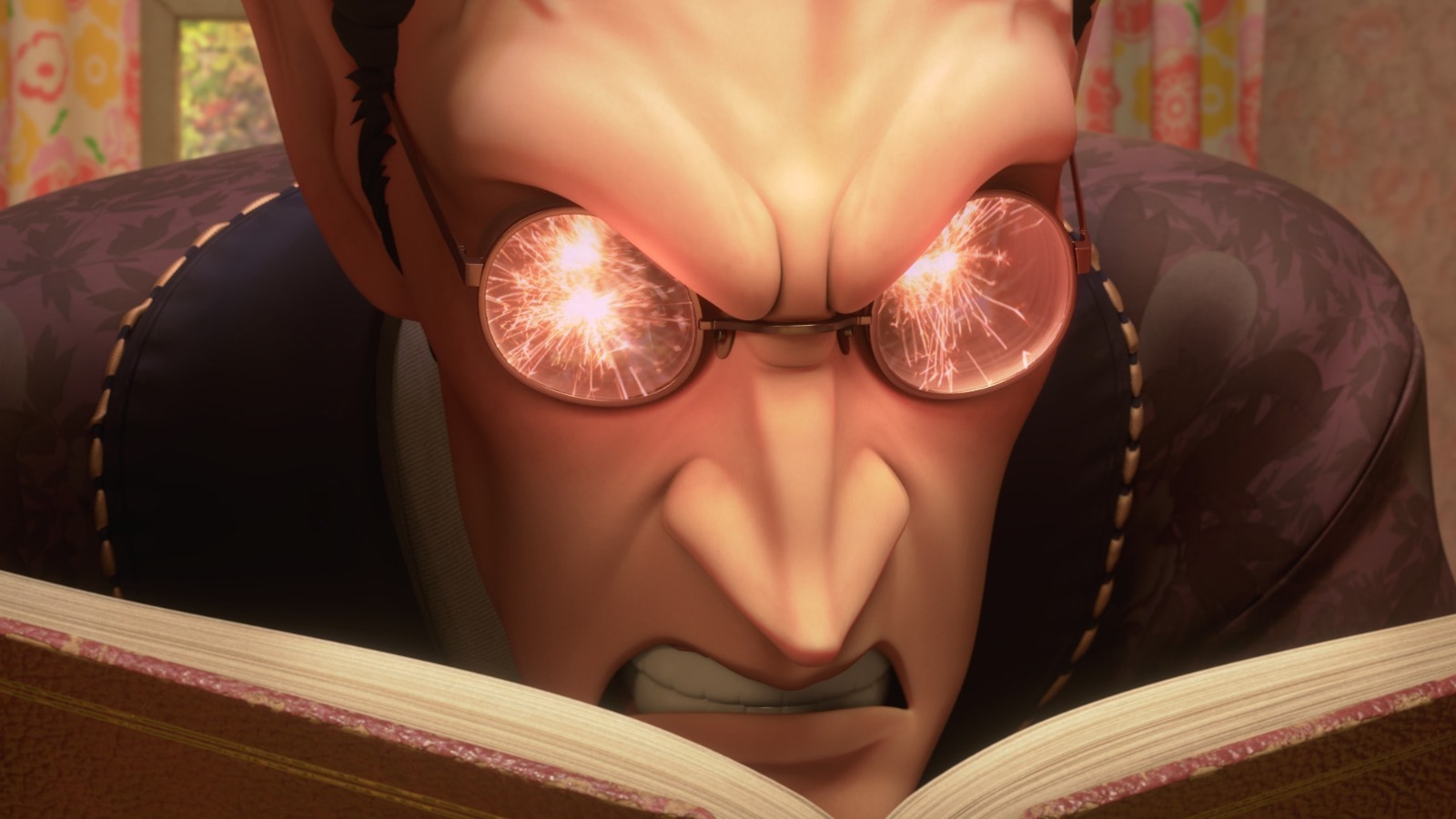
Then there's the characters. Giving credit where credit's due, I have to give Erica's character points for uniqueness. Unlike most Ghibli leads, Erica isn't a paragon of pure purity of pureness and it's refreshing to see. That said, this uniqueness is achieved by her being a bit of a brat, which is annoying. Her primary goal is to have everything go her way and she achieves this mostly by manipulating adults and picking on kids her age. This goal isn't really analyzed — for example, she doesn't do this because of some underlying issue, she does it just because she can. The goal isn't challenged or modified — Erica ends the movie with everyone wrapped around her finger, making her a fairly static character. We don't even see Erica really earn her ending — instead of her wits being what warms her foster family towards her, they essentially just decide to change without much prompting. I'm fine with Erica being a brat, but nothing is really done with this trait and so it comes across as annoying. Again, though, I give Erica points for being a very unique Ghibli kid protagonist. She might have been a favorite if they actually did something interesting with her unique traits. Bella Yaga makes for an interesting villain, especially as she's the first adult that doesn't bend to Erica's will. But all that is squandered when she has a sudden shift in personality towards the end of the movie, with the conflict between her and Erica ultimately feeling like a waste of time. There's not much to say about the cat, Thomas. He pretty much acts just like Kiki's cat, Jiji, and his English voice actor, Dan Stevens, sounds similar to Phil Hartman's rendition of Jiji. Mandrake is the most visually striking and interesting character. He stole the movie for me and there seems to be a lot of depth in the little that we see. He's still prickly, but not as vindicative of Bella Yaga. The sudden shift towards liking Earwig doesn't hurt Mandrake as much as Bella Yaga since he was never an out-and-out antagonist like Yaga. Thus, when he changes, it doesn't feel as jarring. While Mandrake isn't an amazing character by any means, he's certainly an interesting one, which is more than I can say for the rest of the cast.
 /cdn.vox-cdn.com/uploads/chorus_asset/file/22271119/EarwigEw.jpg)
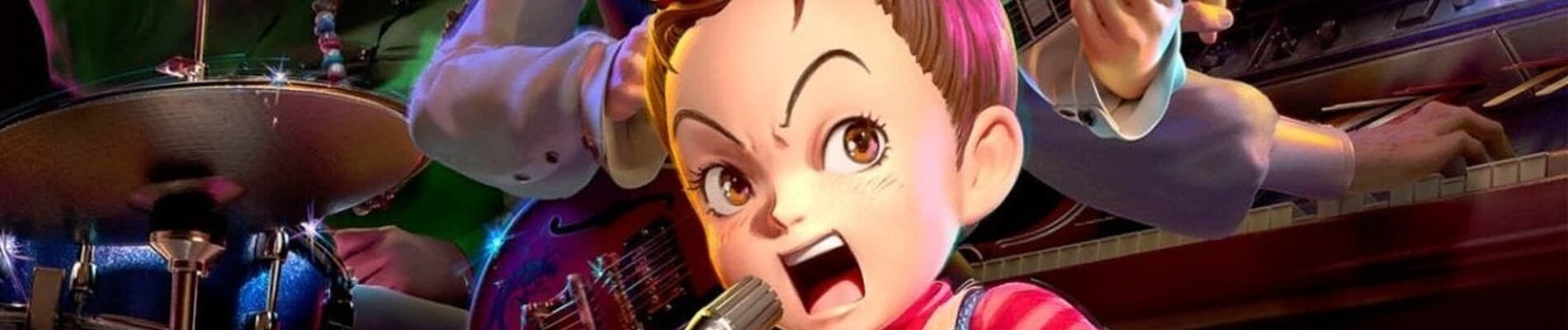
With character designs that are fine, characters themselves that are half-baked, and music that's largely underused, the score for Earwig and the Witch isn’t looking good. However, what largely saves the movie for me and serves as its biggest strength is its atmosphere that goes a long way in making this feel like a Studio Ghibli movie despite its shortcomings. Even if people take offense to the CGI, I don't think that anyone can honestly say that this movie feels completely alien. Rising above the faults of this film is the whimsy that many come to expect from a Ghibli movie. The magic and its eye-catching visual effects are there as well as the childlike sense of wonder. While it's animated in a way that many have objected to, despite everything, this feels like a Ghibli movie. An argument could be made that it’s perhaps too Ghibli, with the movie being everything you'd expect from a Ghibli movie. Some might even go so far as to call this generically Ghibli. Call it what you want, but given how hard the CGI Ghibli pill has been to swallow for many, I think playing it safe for Earwig and the Witch was a good call. It makes the change in style feel just a bit more smooth, helps viewers ease into it. Earwig is a bit like Mary and the Witch’s Flower like in this regard — both wished to emulate the classic Ghibli formula in order to ease fans into a change — a change in studio in Mary's case and a change in animation style in Earwig's case. I'll touch upon this again, but I think that Earwig actually handles this better, emulating the aesthetics and tones of quintessential Ghibli while still having an identity of its own.
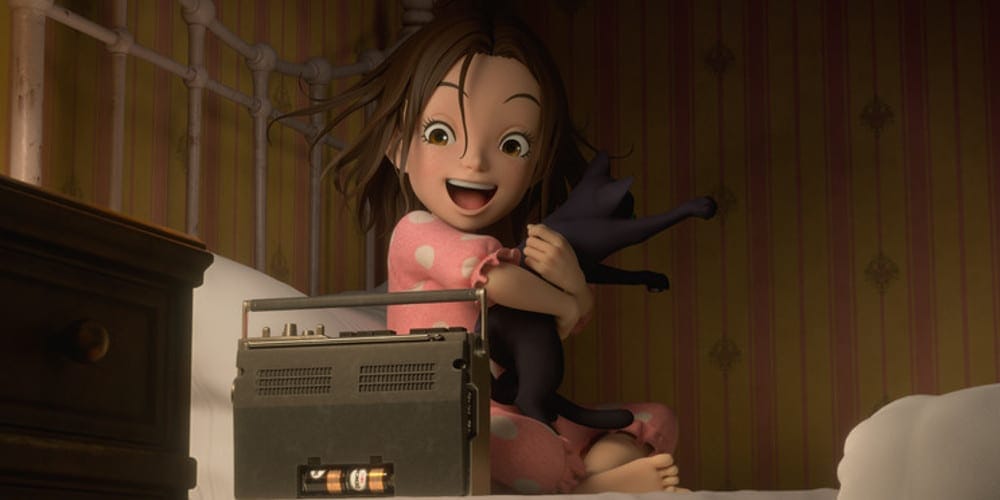
But there's only so much you can do to ease the blow; just one look at this film shows that it is different than previous Ghibli films. Many love Ghibli due to the beautiful, hand-drawn animation and that's obviously missing. I'd like to say that the CGI is simply different from what we're used to, but unfortunately, it's just plain worse. As I said before, the models are fine on paper, but when they move is where things begin to falter. The characters move stiffly and there's very little in the way of hair physics. Earwig and the Witch definitely tries its best to continue the tradition of vibrant facial expressions, but they fall short. The facial expressions are a touch stiff, linger a bit too long and there aren’t many frames going from the "neutral" expression to the exaggerated one. Worst of all, they really like the reuse the same few expressions. These all make it so these seem less like living characters and more like Nendoroids with swappable faces. It's an admirable attempt, but a mere attempt, nonetheless. The mouth movements also don't look the best, but I can't really put my finger on why, so I won't belabor that point too much. The biggest blow comes from the environments. Ghibli movies are known for their lush backgrounds, their painting-like shots, and that's sorely missing in Earwig and the Witch. It doesn't help that we're relegated to a few, mostly indoor locales. Bella Yaga's workshop begins to approach the level of detail I expect in a Ghibli movie, but it's still not quite there. It feels like a trite criticism at this point, but I can't think of a better word than saying Earwig and the Witch feels lifeless compared to its 2D predecessors.

I could forgive the animation if the story held up, as I favor plot over all else. Unfortunately, the plot doesn't hold the film up after it’s been kicked down, instead, it joins the ring to deliver another punch to the gut. As I outlined in the plot synopsis, the movie begins on a high note with a magical chase scene. Viewers are naturally drawn into this world and want to know more about Erica's mother and the coven of witches at her tail. At the very least, I was excited to see more imaginative spells like the one Erica’s mother showcases. When we jump ten years into the future, the plot slows down and the movie mostly becomes Erica navigating her way through her new, hostile home. She wants to learn magic, but her requests are constantly brushed aside by Bella Yaga. I watched the movie with a friend who described the movie as not having much in the way of plot. And that’s true — for a good portion of its runtime, Earwig and the Witch is more akin to a magical slice-of-life. And this is perfectly fine — after all, Earwig's very own elder witch sister, Kiki's Delivery Service has a similar feel. It would be fine if the movie took its time focusing on the evolution of Erica, Bella Yaga, and the Mandrake's relationships, with a few answers to the mystery of Erica's past sprinkled in. What we got, however, was far from fine.
My friend had started the movie earlier than me, so when I got a text from her saying that she was done, I assumed I was far behind.
The credits started rolling five minutes later.
 /cdn.vox-cdn.com/uploads/chorus_asset/file/22273121/EATW_Select_02.jpg)
The movie ends extremely abruptly. Bella Yaga and Erica are in conflict one moment, but everything's hunky-dory the next as the film rushes to a cliffhanger ending that's largely unsatisfying. If the movie wanted to go with a slower, SOL feel, then, again, that's fine, but a slice-of-life lives and dies by its characters and I'm sad to say that the movie really let them down. I hear that the book also ends very abruptly, but I don't care for that as an excuse. What's the point of an adaption that doesn't improve upon the source material? Perhaps with at least twenty more minutes or so, the ending could have been salvaged, but as is, the movie feels unfinished. Like the music, the plot presents a lot of missed opportunities.
Earwig and the Witch should be an easy film to score. The character designs and aesthetics are the only things that rise above the lackluster plot characters, OST, and animation. Looking at Earwig and the Witch in and of itself, I'm confident in saying that it’s not a great movie. It's hardly a good movie, either. If it's not out-and-out bad, then Earwig and the Witch is mediocre, at best and I'd normally be fine with slapping an F on it and calling it a day. But my feelings towards the movie are complex, messy. Again, the movie has an importance bigger than itself. As silly as it may sound, scoring this says more than just how I feel about it movie — it also shows how I feel about the circumstances surrounding the movie.
Section Three: What it Means to Me; What it Means for Ghibli
 :no_upscale()/cdn.vox-cdn.com/uploads/chorus_image/image/66869633/jbareham_200520_1021_ghibli_week_0001b.0.jpg)
Now that I'm delving more into my Feelings™, let me just take the cat out of the bag and say that I not only have immense sympathy for Gorō Miyazaki but also that I have immense respect for him as well. I can't help but be proud of someone who says they have no idea what they're doing, yet feels a duty and drive to try anyway, to improve despite the insurmountable odds stacked against them. Call it love for the underdog, call it seeing myself in someone who's drowning in expectations, but I look forward to seeing what Gorō Miyazaki is trying next. Hayao Miyazaki is a genius, yes, but what fun is rooting for a genius? It helps that, as much as people drag his name through the mud, as much as some would like to pretend its success cannot be attributed to him, From Up On Poppy Hill shows that he can make as good films as the rest of 'em. In creating a CG movie, in utilizing a heroine that's not so sweet, in attempting a rock-inspired OST, it's clear that Gorō Miyazaki forges his own path while still working through the confines of the empire his father built and there's something very admirable about that.
:no_upscale()/cdn.vox-cdn.com/uploads/chorus_image/image/66869633/jbareham_200520_1021_ghibli_week_0001b.0.jpg)
Now that I'm delving more into my Feelings™, let me just take the cat out of the bag and say that I not only have immense sympathy for Gorō Miyazaki but also that I have immense respect for him as well. I can't help but be proud of someone who says they have no idea what they're doing, yet feels a duty and drive to try anyway, to improve despite the insurmountable odds stacked against them. Call it love for the underdog, call it seeing myself in someone who's drowning in expectations, but I look forward to seeing what Gorō Miyazaki is trying next. Hayao Miyazaki is a genius, yes, but what fun is rooting for a genius? It helps that, as much as people drag his name through the mud, as much as some would like to pretend its success cannot be attributed to him, From Up On Poppy Hill shows that he can make as good films as the rest of 'em. In creating a CG movie, in utilizing a heroine that's not so sweet, in attempting a rock-inspired OST, it's clear that Gorō Miyazaki forges his own path while still working through the confines of the empire his father built and there's something very admirable about that.And it's not like I dislike Hayao Miyazaki as a director. Quite the opposite in fact — years ago, I stated that Hayao Miyazaki was my favorite director and that probably remains true. I love the breathtakingly beautiful worlds he puts to film. I love the timeless, universal stories he tells. My favorite movie of all time, Castle in the Sky was directed by Miyazaki. When I go up to bat for Earwig in the Witch and advocate for its legitimacy as a movie, it's not because I don't care about Miyazaki as a director.
It's because I care about Ghibli as a studio.

If Miyazaki is probably my favorite director, then Ghibli is definitely my favorite studio. Studio Ghibli is more than just Hayao Miyazaki — it's also Isao Takahata, Hiromasa Yonebayashi, Yoshifumi Kondo, Tomomi Mochizuki, Hiroyuki Morita, and yes, Gorō Miyazaki. Two of my favorite Ghibli movies, The Tale of Princess Kaguya and Whisper of the Heart, aren't directed by Miyazaki. The most financially successful Ghibli film in the states, The Secret World of Arietty, wasn't directed by Miyazaki either. The point is that Studio Ghibli is more than Hayao Miyazaki's legacy.
During the first half of The New Tens, I was sad to hear that Miyazaki was retiring. While I was disappointed, I looked forward to the works of other directors, but much to my dismay, just as I was beginning to keep up with the releases, the news broke that the studio was going on hiatus. My disappointment turned to frustration when I realized the hiatus correlated with Hayao Miyazaki's retirement. Say what you will about Gorō Miyazaki, but you have to give him props for trying his damndest to breathe life into a company that everyone is content letting suffocate without Hayao. A big reason why I don't want to write off this film is because I care about the continued existence of Studio Ghibli. It shows in how I watched Earwig in the Witch. I usually watch anime by [REDACTED] them. I watch anime using sites like [REDACTED] and [REDACTED]. I could have easily [REDACTED] this, too, but I made a point to rent it on Amazon Prime Video even though I knew people didn't really like this movie. I bought it because Ghibli is a studio that I want to support, a studio that I'm not content with just letting die. I have mixed feelings about How Do You Live?, the upcoming movie that Hayao Miyazaki is directing. On one hand, given the elder Miyazaki's track record I know the movie will be absolutely amazing. On the other, it will most certainly net a better reception than Earwig and the Witch, confirming what many seem to imply when they write off Gorō Miyazaki out the gate: that Ghibli is Hayao's studio and his alone.

I focus so much on the father-son pair because I think your perception of each of them really informs how you view this movie, warts and all. I've seen people decry this movie as tarnishing the legacy that Hayao built, that it sullies his name. I've heard others accuse Gorō of hijacking the studio to get the prestige associated Ghibli attached to Earwig and the Witch. They’re entitled to their perspective, but here's another, one just as bitter as the other. First, and I'll say it loud for the people in the back, Ghibli has never been just Hayao Miyazaki's studio. To say that someone making a movie for the studio is "hijacking" it is juvenile and, to be frank, fucking insulting to all the other talented directors who gave their time, effort, and passion to the studio for over 35 years. Second of all, I wish the discourse that "this sequel/remake/continuation killed my childhood" would just fucking die already. No movie made in the future can retroactively tarnish your fond memories of what came before. The second we accept this is the second we can begin approaching continuations of established properties with an open mind. It's particularly ridiculous here because this isn't a goddamn series, it's a studio, meaning each entry isn't tied to another. People speak of a legacy, but I value a living legacy more. I think a more fitting legacy than "Hayao left and the studio died" is one in which movies continue to be made. Perhaps they might not be as amazing as the initial ones, but they'll still be lovely. Not to mention, the new generation will be inspired to watch the movies that came before. I think Earwig is important because it highlights that Ghibli, if nothing else, is a sprawling company with many different creative minds. It feels like writing off Earwig is making Ghibli be something that it's not, that it never was.
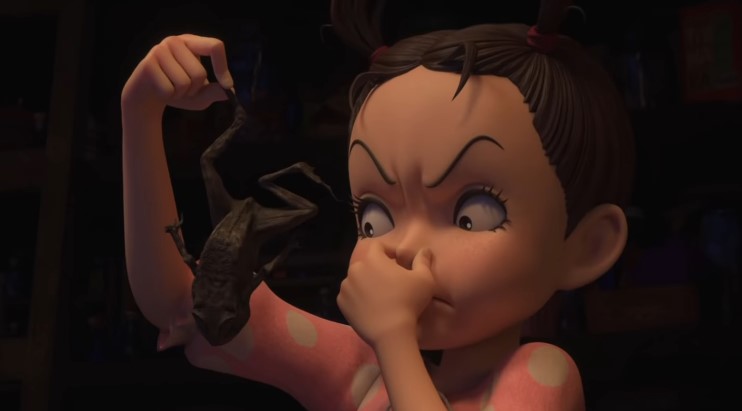
I'm also somewhat lenient to Earwig and the Witch because it's a special case in the Ghibli catalog. While it's a feature-length film, like 1993's Ocean Waves, it's a television film, with a lower budget. It was never meant to be the same caliber as theatrical films. Perhaps it couldn't have been. While Ocean Waves has the same sky-high critical reception as most Ghibli films, among fans, it’s more mixed. Another mitigating factor for criticism is the fact that, more than most other Ghibli films, it’s abundantly clear that this one has a particular audience in mind: children, younger ones, at that. While many say that children don't deserve to watch crap, this isn't crap by a little kid's standards. It's not good to someone like me with a bulging, veiny eye for structure, but it's never terrible and I think that translates to a movie that's perfectly A-okay for the tots. A movie that, again, might make them watch earlier Ghibli movies, down the line. As far as the animation goes, again, it's not good, but I think it's ultimately fine for a first attempt. Pixar and movies such as Into the Spider-Verse showcase great CGI, but CGI is new to Ghibli and I think it's okay to give them a bit of leeway, given the budget constraints coupled with the new medium.
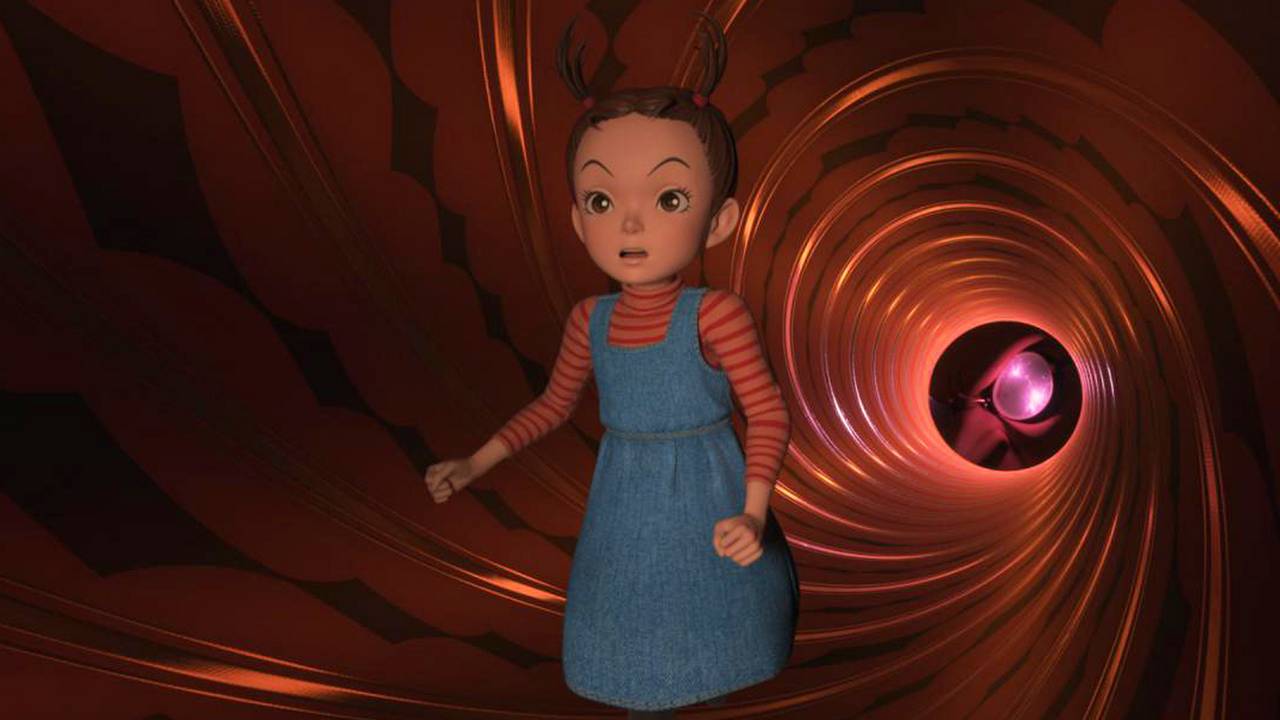
I should point out that I'm largely coming from the same place as other Ghibli fans — the loss of 2D animation is a blow to me, especially in the face of Disney having abandoned it for ten years now. I'd prefer the animation we're used to, but I understand that beauty can still be found in CGI. I'm open to a new style because one of my favorite Ghibli films, Tale of Princess Kaguya employs a unique art style. Even despite my misgivings, I defend Earwig in part because I want to see Ghibli live on. As hokey as it sounds, it's become a part of me and I don't want to see it die. Wanting to see Ghibli survive (or at least a part of it) is why I watched Mary and the Witch's Flower and why I watched Earwig and the Witch. Neither movie is great and I'm sure people give Mary as much leeway as they do simply because it's in the Ghibli style of animation. I don't think either movie will stand the test of time. I think both movies will largely be seen as mere novelties, proofs of concepts. But for the reasons I described, this probably was never meant to stand the test of time. This was a made-for-TV movie. It was a quick way to make money by creating this on the skinny to fuel future projects…
...
..
.
And after all of that, I'm forced to ask: "am I okay with that?" After saying that this was just made to make money, I feel like I need to take a shower. Ghibli seldom trades artistry for profit. Am I okay with a movie being bad as long as it maybe keeps the company afloat for a possibly better movie down the line? Ponyo and Totoro were made with children in mind, but unlike Earwig, that didn’t feel like a mitigating factor. How long am I willing to handwave quality in the name of demographics? I still stand by a living legacy being better than a dead one, but can I say that if the living legacy is poor? While, I still don't think this movie is as ruinous as some people make it out to be, all leeway I have for this it is predicated on the belief that future movies, CG or otherwise, will be better.
As flawed as the movie is, given how important it is to me in terms of Ghibli's future, I have to respect its existence.


As much as I love Ghibli, I have to acknowledge that its survival is seeming more like a crapshoot at this point — Gorō seems to be running a one-man ship as Hayao Miyazaki didn't do a great job of fostering new talent. The fresh blood that was injected into the company slipped out and into Studio Ponoc. For what it's worth, one of my favorite anime is Weathering With You, which is a non-Ghibli film. I'll keep my eyes open to Ponoc and other studios, hoping that one day someone will rise to the occasion, capturing the magic of the studio I love.