Sakura Quest
a review by RiPHopscotch
a review by RiPHopscotch
When I graduated high school I had no clue what I wanted to do with my life. I hated school but I hated the idea of getting lost in the normalcy of adulthood even more, so I did the natural thing: I went to college. After changing my major twice and mostly squandering five years of my life, I graduated with a degree in Political Science and, wanting to make full use of my education, the first job I got out of school was… on the tax team of a major investment bank. Life is weird like that. Even if you happen to know exactly what you want to do (or not do) any number of things could change your plans, and an increasing number of young people have no idea what they want out of life in general; whatever that may be, getting started can often feel like you’ve just been suckerpunched by unique blend of uncertainty and self-doubt. On the surface Sakura Quest may be about a dying town and the urbanization of Japan, but beneath that is a universal and very human story about overcoming the issues plaguing those on the precipice of modern adult life.
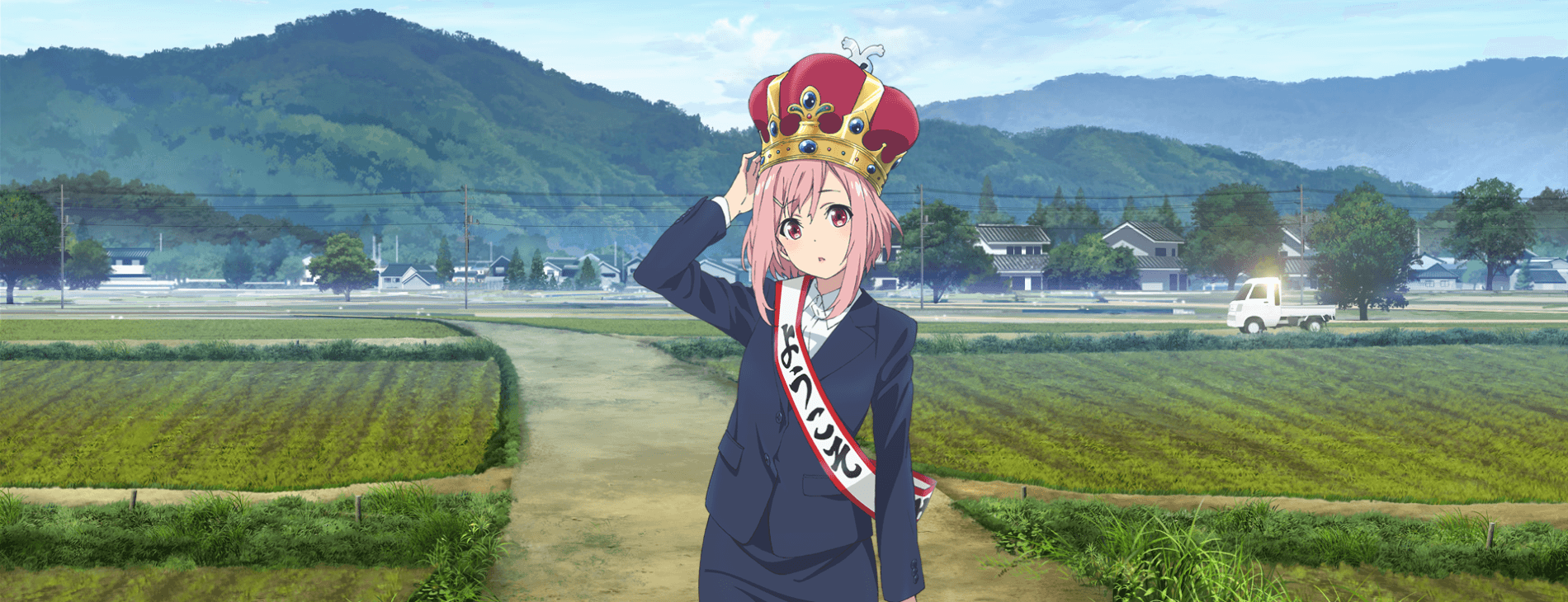
A recent graduate from a two-year junior college, twenty-year-old Yoshino Koharu is in a spot many people just out of school can relate to; despite her best efforts she has no job and is on the brink of just moving back in with her parents. That changes when, out of the blue, she gets call from a talent agency asking her to partake in a “coronation ceremony” as a tourism stunt for Manoyama, a small town in the countryside. Even though Yoshino is apprehensive about leaving Tokyo and the job prospects the city represents, the need for income is more immediate so she accepts. Upon arriving, however, she is gets hit by two bits of information. Not only was the reason for her selection illegible handwriting that was incorrectly relayed as her name, but the contract she accepted wasn’t a one-time gig, it would run for the duration of a year.

After a brief, and understandable, meltdown, Yoshino is convinced to lean into her new role by Shiori, Sanae, Ririko and Maki, four other young women who agree to help her as various “ministers” in Yoshino’s “court”. These five are the core at the heart of the show, who take on the task of helping to revitalize a rural town with an aging population and a bleak future. Over the course of the story they put on festivals and concerts, play politics with local leaders, and generally do their best to try and prop Manoyama back up – but they’re fighting a losing battle.
The modern world is not kind to rural communities. As it becomes more and more profitable to export labor to developing nations, young people increasingly see moving to a city as their primary way to find an education and job prospects, as well as start a family. What they leave behind are small towns, typically with aging populations, that essentially get slated to turn into ghost towns. Sakura Quest’s spin on this is interesting, as it’s about a group of young women, who decide the city isn’t for them, coming together to try and revitalize a rural town. But this part of the show also struck me as bleak; as the story progresses, it becomes abundantly clear that the girls are fighting a losing battle. Manoyama and towns like it are being ground down by the cogs of globalization, and the best efforts of these characters will not be enough to stop it. If this was all that the story had planned, it would be profoundly unsatisfying to simply watch as a small town dies over the course of a year. Luckily, it’s not.

While putting Manoyama back on the map keeps the plot moving, what ends up giving Sakura Quest the emotional weight it needs to not be depressing are the characters. The reason the girls standout isn’t solely due to the chemistry they share or their personal growth over the course of the series, however, but is instead because of how they serve as parallels to some of the most common struggles that people in their twenties deal with. While Shiori might be doing something she loves, Maki basically had her dreams crushed and returned home defeated, and Sanae was burned out by the stress of modern office jobs – I know a depressing amount of people who have had those things happen to them. Even Yoshino, who I related very strongly to, is dealing with her own set of issues; she has no idea what she wants to do with her life, and a deep inability to settle for “normal”.

Having every character but one be struggling and aimless doesn’t really sound like an initial recipe for an uplifting story, but it works for two reasons. The first is that these are believably written characters facing, as mentioned, real obstacles to overcome. They aren’t trying to do something as grand as become the Pirate Queen or create a utopian society, they’re just trying to create a future for themselves. More importantly though, the show has a message that many really do need to hear – failing initially in your early twenties isn’t the end of the line. Sometimes people, like Shiori, hit the jackpot right away and find something they love doing. Oftentimes, however, the thing someone wants to do for the rest of their life can be hidden in a truly bizarre place, and how they stumble across it can be a fantastic story in its own right. That’s exactly what the Manoyama revitalization project is; instead of a plan that is doomed to fail being the focal point of the story, it becomes a weird, unexpected way for the characters to explore what they want to do.

There are a couple of things that hold Sakura Quest back, with the most glaring of these issues being the early pacing of the story. Two cour shows like this have a lot of room to breathe, and oftentimes can feel like they’re too slow or just filling time. Instead of dragging, however, early episodes of Sakura Quest feel rushed. Tension that could be better as a slow burn is built up and then broken down, often over the span of just two or three episodes, making the drama feel contrived. I would also say I was somewhat letdown by Ririko. She’s funny, charming and a likable character, but unlike the others she never really seemed to “fit” the themes of the story. Her issue was that she was essentially a shut-in who had never left Manoyama, but she just kind of… stopped being a shut-in as soon as she decided to stop. It felt like, in a story about overcoming failure, there was this character who had never really failed or succeeded – she had just never tried in the first place.

After graduating college and entering the workforce, the most important lesson that I’ve learned so far… is that I’m pretty sure I don’t want to work in tax for the rest of my life. I don’t know for sure what the future holds, but I do want it to be unique, something that I can tell a story about decades down the line. That why, in spite of the issues, I think Sakura Quest is pretty great. The plot is engaging, the characters are charming, the topics it tackles are relevant, and everything is wrapped up neatly by a strong, established theme. As mentioned earlier, there is a unique blend of uncertainty and self-doubt that comes with taking that first jump into adulthood. Too often people take that jump, fall, and feel like they have no way to pick themselves back-up. Sakura Quest isn’t really a guide on how to do that, but it does present a strong argument that people should try, and that they don’t just need to settle for where they first land.
24 out of 24 users liked this review
