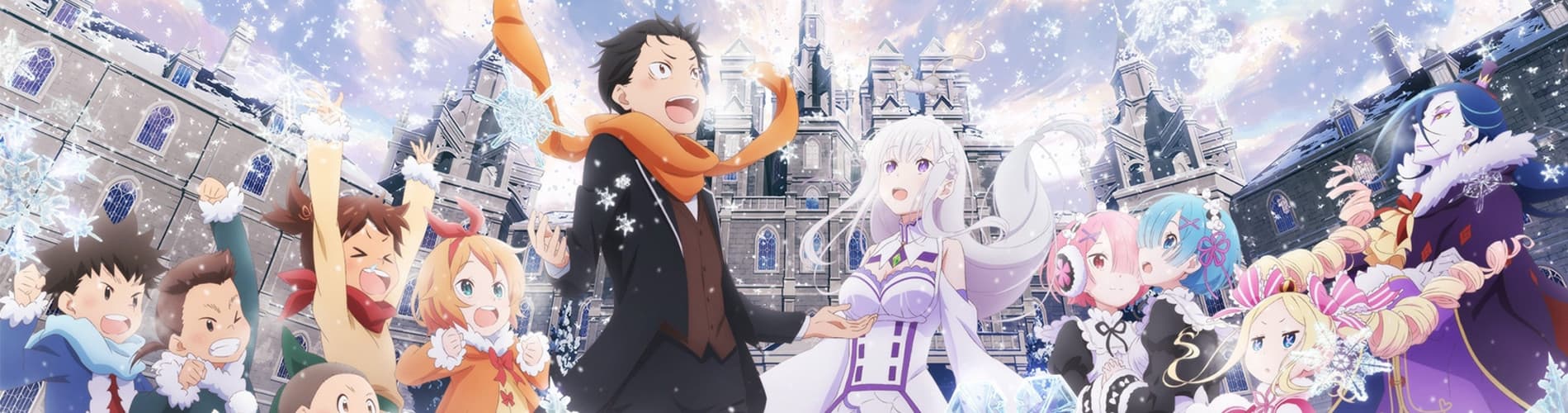

This review is part of an expanded post regarding Re:Zero's unusual viewership trends. However, the viewership analysis had to be removed per moderator request. The full post can be read on MAL if you happen to be interested in weird statistical quirks.
Offering a nice comedic break after the more serious climax of Arc 2, Memory Snow is a well-timed lighthearted departure from within Re:Zero’s first season. Granted, there were already a few in its original run (primarily in its first half as is typical for psychological thrillers) but the shift from the ultimately positive ending of Arc 2 into the darkest portion of season 1 was too drastic in the minds of some viewers. Originally premiering in theaters after season 1, sold as an OVA, and later aired on TV as a part of season 1’s director’s cut rebroadcast in 2020, there’s a good reason why it ended up becoming so prolific.
Taking place in between arcs 2 and 3, Memory Snow provides that much needed break with a light, comedy-oriented little story and some extra moments with many characters whose roles were mostly locked to Arc 2. Is it filler? Yes. Is it fanservicey? Fairly. While such terms often carry a negative connotation, they aren’t inherently bad traits. In this case, some lighthearted filler makes for an excellent buffer between serious portions, and that’s a sentiment that holds up if one were to watch it later than “intended” as well.
 Too much suffering in Arc 3? Try interspersing some silliness into the mix!
With a simple plot and a happy-go-lucky tone, Memory Snow delivers most of its humor by having the characters bounce off of each other in silly little interactions. This more character-oriented focus does some interesting things that the main anime struggles with, including adding little sprinkles of character definition via implied intent through their actions and putting them in situations where they can act looser (and therefore more honestly). The goofiness of the jokes and the ship-bait elements of some of the situations are not going to be everyone’s cup of tea, but as what is essentially a collection of connected skits, Memory Snow manages to have a fair share of slice-of-life-esque fuzzy moments thanks to its simplicity and delicacy.
The production values of this solitary episode don’t particularly stand out from the rest of the season, which isn’t a bad thing either. There isn’t a lot of action to encourage grand animation scenes or tense moments to put dramatic music into, yet there are scattered spurts of visual creativity at play and plenty of opportunities happily taken by the vocal cast to act out the characters in ways they rarely got to during the main anime. The whole package comes off as something of a fun process for the production crew and not just some tacked-on cash grab in the wake of Re:Zero’s popularity.
Overall, Memory Snow is good filler, the sort that holds its own and makes you appreciate the rest of the story more. Unless you seriously hate the characters or Re:Zero’s humor in general, it fits right into its spot in the director’s cut (i.e. after episode 11 of the original broadcast), though one doesn't need to watch it at any particular point after Arc 2 to get the intended effect either.
The Frozen Bond, a prequel project which appeared to promise some backstory and answers surrounding two of Re:Zero’s more ambiguous characters, is the serious side of this dual-story coin. However, when it struggles to do just that and doesn’t appear to serve much more purpose than as padding between seasons, it becomes challenging to justify it as anything other than a hollow holdover.
Framed as an inner reflection Emilia has after the events of Memory Snow, The Frozen Bond centers around the relationship between herself and her guardian spirit Puck, and how it came to be that way for Emilia. One wouldn’t be blamed for thinking this would go on to expand Emilia’s character, yet it doesn’t so much as attempt to. The Frozen Bond is unquestionably about Emilia, and yet refuses to answer any real questions about her, and the main series had left many by this point. Despite spending a lot of time beating around the bush on the circumstances surrounding Emilia’s isolation in the Elior Forest, none of it offers any new perspective on who exactly Emilia is. This orbiting issue wouldn’t be so disappointing if it wasn’t the event the entire story revolves around and continually brings up to offer as an explanation for most of the story’s other events. By displaying so little character when given the spotlight for so long, Emilia only ends up appearing shallower.
 It’s easy to predict how Emilia’s interactions with the town will play out the moment the very idea is pushed out. What makes it boring is how none of it ends up mattering.
The only other character to speak of is Puck, who does end up getting fleshed out over the course of this largely Emilia-centric story. The mystery surrounding him works much better not just because there’s some answers provided as payoff to the inevitable questions, but because of how much more dynamic Puck ends up being than anything else The Frozen Bond offers. His wit appears to be backed by experience, his motivations pondered over, and his side of the relationship with Emilia (unlike Emilia’s side which can be chalked up to pure circumstance) organically developed. Sadly, his role in all of this is treated as a secondary concern, often getting brushed aside and inevitably left much less complete than it could have been.
Instead, The Frozen Bond devotes much of the time it isn’t vaguely and fruitlessly hinting at Emilia’s backstory on attempting to make the antagonists look like actual characters. Chap is a one-dimensional thug whose ill-defined drive of “revenge” fails to justify why anger is his sole trait. Meanwhile, Melakuera is just a spirit automaton, yet there is an ample yet pointless attempt at making it seem to be more than that. It follows reasoning that falls apart with just a handful of questions and rules that Puck quickly dismantles the validity of (and yet it still follows them). Perhaps Melakuera exists to point to the unfairness of Emilia’s situation, but Chap already bumbled his way into proving that, as shallow as he is, long before Melakuera even became relevant.
The whole product suffers the effects of being stretched out much further than it had any right to be. The full extent of Emilia’s backstory that was covered could have been the side plot of a regular anime episode, yet it encompasses the majority of this feature-length entry. Chap & Melakuera’s situations add nothing substantial to the story as a whole either, and while more time could have been spent on Puck, that’s ultimately a separate story from the one being told here. Even the production quality takes a hit, with soundwork that (unusually for Re:Zero) struggles to even have one decent, memorable aspect, and visuals that slowly degrade from pretty, fluid, & clear to rough slideshows that can’t even bother to show (what would have been) the climatic final action scene. Why build up to it in the first place if the result is obvious and the production is too burnt out to do it justice anyhow? Unfortunately, it would only be fair to ask that of nearly every other element of The Frozen Bond, as none of it justifies itself any better.
Presented with an opportunity to build upon some of the lesser aspects of Re:Zero, The Frozen Bond instead dilutes them. Stretching this half-baked backstory to twice the length needed to tell it only serves to make its pointlessness more apparent, especially at the point of the main story it suggests itself to be relevant. Viewers who would level similar complaints towards season 1 are bound to be disappointed, and all but the most devoted of fans are unlikely to be amazed as well.
At a glance, these entries don’t appear to have much to do with each other aside from their parent series. One is silly & lighthearted, the other is serious & drab. However, what they both are is fanservice, released in the lengthy four-year gap between seasons 1 & 2. While Memory Snow’s goofy charm adds something to the anime experience, The Frozen Bond’s stagnant dreariness only manages to fruitlessly draw it out. Interestingly, only Memory Snow was included in the Director’s Cut rebroadcast, even though both titles are framed in a way such that they could seamlessly follow each other.
There happens to be a parallel between these side stories and the reception of the main series from those who have seen both seasons so far. Even a cursory glance at complaints for season 2 will pick up on a familiar trend: it’s slower, there’s less action, there’s less showing through present events and more telling through flashbacks… strangely similar to the contrasts between the two movies. Now this is all predictive of course, but if you primarily seek action, easy fun, and a fast pace, then many signs (reception, side story focus, and even the focus on psychological drama in general) point to Re:Zero moving away from those things in season 2. Plenty of people will and have enjoyed season 2 for its shifts of course, but it would not be the first time a long-running series changed what audience it most appeals to over time. That said, I still recommend doing as the Director's Cut did and only watch Memory Snow, preferably after Arc 2 in season 1. The Frozen Bond lacks in both psychology & drama and is unlikely to impress unless Re:Zero is a particular favorite of yours.
97.5 out of 160 users liked this review
