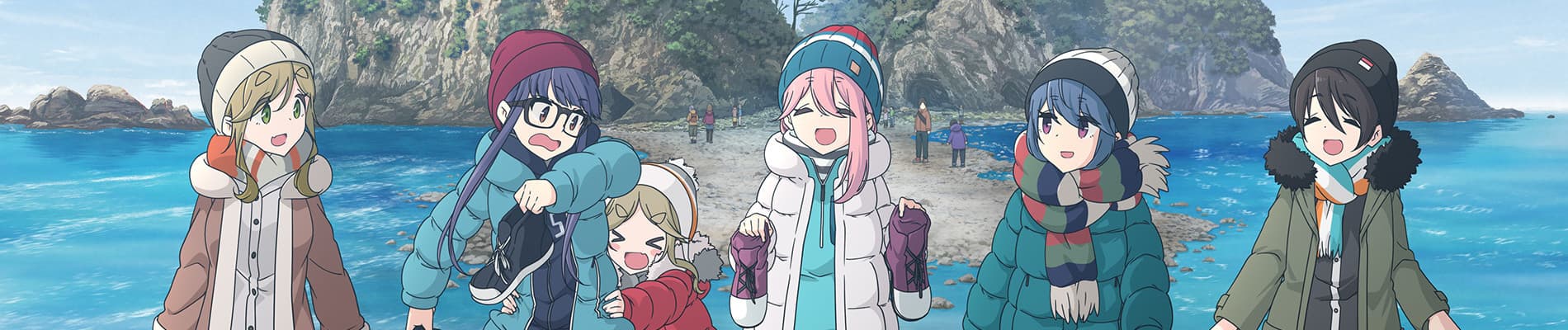

Following up on success can be difficult, so much so that in America we have a saying to describe it: “sophomore slump”. Whether its an athlete coming off an incredible rookie season, a band following up on a fantastic debut album, or, as the phrase alludes to, a rising sophomore in school, it’s fairly common for a second attempt to flounder a bit. Part of it may be complacency setting in, part of it may simply be that it’s hard to be successful every time, but I’ve always felt that it’s primarily optics. Nobody expects a rookie to play well or an unknown band’s debut album to blow them away, so if those things do happen that level of quality becomes the expectation for future work. This tends to happen with television shows as well. In 2018 Yuru Camp, an adaptation of a fairly niche manga done by C-Station, a relatively unknown studio, surprised a lot of people with its quality. The animation and original soundtrack were gorgeous, the characters were fun and had great chemistry, and the atmosphere of the show was nothing but relaxing and lovable. Because of the success of season one, expectations for many (myself included) were sky-high going into this second season, and I can confidently say that Yuru Camp not only avoided slumping entirely, but may even have improved from its first season.
It’s impossible for sequels to avoid comparisons to what came before, which is why one important, yet challenging, aspect of them is building off of the previously laid foundations. The goal should be keeping the “core” parts that provided the original success, while at the same time making enough changes so that the material doesn’t feel repetitive. Yuru Camp manages to balance those two things very well. Like the first season, the story remains pretty simple, and can still be summed up as “high school girls go camping”. What’s happening around the periphery, however, and what the plots explore differ significantly.

Season two is not simply about going camping and forming bonds – despite both still being major parts of the show – but instead is about the characters exploring and establishing what they like as individuals. That’s not to say there are no group activities, as there is still a progressive build up to the finale, which is a larger camping trip for the entire cast. We just aren’t seeing interpersonal bonds and a love of camping being established, as we’ve already seen that. What’s different is now, when Rin goes solo camping at the start of the season, she can’t help thinking about her friends and about camping in groups. She still loves the atmosphere of camping alone, but she’s also using that experience to try and figure out what exactly she enjoyed about group camping. A later on Nadeshiko, the textbook definition of a bubbly extrovert, tries solo camping, for basically the inverse reason as Rin. She knows she loves group camping, but wants to try going it alone, just to see the difference. Even Aoi, Chiaki and Ena, wanting to keep up with Rin and Nadeshiko, go on their own excursion. For them the drive to go camping was primarily about doing something fun with friends, and while they nearly freeze (because planning is hard), they also do stumble upon other reasons to love the activity. It’s honestly just refreshing to have a story that supports characters being individuals, doing different things, while at the same time still supporting their underlying friendship.

Generally speaking, slice of life shows live or die based off of the cast’s chemistry, which is something Yuru Camp’s cast has in spades. While the characters may be more separated physically than they were previously, the influence they have on one another is palpable, and is really what carries this season.
Rin and Nadeshiko were, without a doubt, my favorite characters in the first season, and that’s still definitely the case; watching the two hang out and seeing all of the ways they’ve rubbed off on each other is just a delight. Rin is so much more emotive and willing to jump in for group activities now, and Nadeshiko has quite a few moments where she’s more subdued and quiet. But I think, more so than last season, talking about the rest of the cast is also very warranted. Aoi and Chiaki may have founded the outclub but until Nadeshiko came along they had yet to go camping, and Ena honestly just wanted to lie in bed with her dog all day. Those three deciding, as previously mentioned, to go camping on their own was a major step forward for them as individual characters, but was also a result of Rin and Nadeshiko’s love of camping rubbing off on them. Each character is trying things their friends love and thinking about one another, staying in contact constantly, sending texts and pictures to a group chat – I honestly just love it. People intrinsically know this kind of thing happens with friend groups, but despite it being such a core part of growing up we never really think about it, much less put it to words. With Yuru Camp we, as the audience, get to see the impact of friendships on how individuals act, and it’s something I can’t help but smile at while watching.

The great characters might have gone to waste if not for the breathtaking visuals and soundtrack, however. Normally I don’t consider these aspects to be as important to a show’s success, but Yuru Camp is an exception. When dealing with a subject like camping, where a lot of the enjoyment derives from intangible factors, immersion is vital. You need to create a show that triggers memories and feelings from veteran campers, while at the same time finding a way to elicit the same feelings for people who have never been before – no easy feat. But, like the first season, that feat is accomplished here, seemingly with ease.
I’m lucky enough to live in a place with a high density of government protected parks – I can basically drive an hour or two in any direction and stumble across some gorgeous area. What never changes from place to place, however, is the way light works. While that does sound… obvious, watching the sun rise from behind a mountain or reflect off a lake in the early morning is pretty much a constant when camping. C-Station nailed not only this, but so much more. Whether it’s breathtaking background art or minute aspects like how grass moves with the wind, every single element of the visuals contributes to the atmosphere of the show. When I see the girl’s wake up from their tents in the morning, I can tell right away what the temperature is like, how windy it is, and what time it is. The art manages to instantly bring up memories that I have of camping, in many ways making me feel like I’m there.

The OST is also just superb. Asaka returns to do the opening song, this time with “Seize the Day”, and again manages to perfectly capture what it feels like to gear up and head out. Its lighthearted, fun and poppy, with great visuals behind it as well. Eri Sasaki also reprises her role doing the ending, “Haru no Tonari”. Bordering on a lullaby, this is a soft, acoustic song that sounds like the end of a long, absolutely packed day. And again, each campsite has a piece of music dedicated to it, a variation on a theme that serves to differentiate them all and make them more unique. These mini pieces help to just soothe the viewer, and honestly made me want to curl up in a sleeping bag and relax. That’s really one of the largest reasons Yuru Camp has atmosphere it does, in my opinion – it’s impossible to feel tension when listening to nothing but the most warm and mellow music out there.

Yuru Camp is pretty commonly just described as “Comfy: The Anime”. While that’s definitely not a bad way to describe it, it doesn’t quite tell the full picture. After all, there is a reason expectations for the second season were as high as they were. At twelve episodes the first season was the perfect length – could such a straightforward premise really support another thirteen episodes without overstaying its welcome? And if C-Station were to change some things to avoid repetition, how would they maintain the same lovable atmosphere and characters? These were the two questions at the forefront of my mind going into this season, and both needed to be addressed to avoid becoming another example of “sophomore slump”. And this season addressed both. Yes, Yuru Camp could support another thirteen episodes, and yes, the formula could be tweaked without losing its identity. The characters, art, OST and atmosphere all left me wanting even more, to the point where I have no reservations about calling this one of the best slice of life shows out there today.