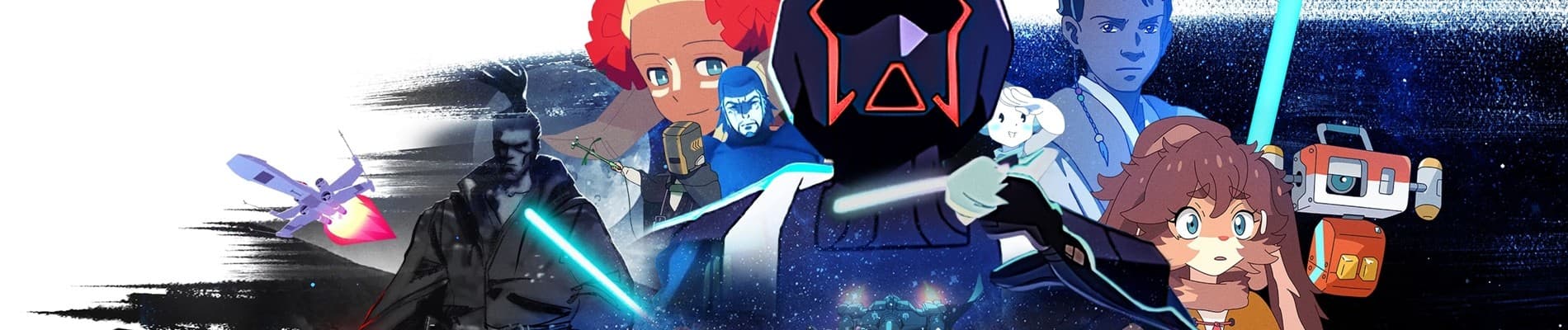

 The advent of streaming platforms such as Crunchyroll combined with breakout hits such as My Hero Academia mean that anime is more mainstream now than ever. You’d be forgiven if you couldn’t tell, however, as anime fans can be exclusive. This isn't too surprising — you see it in a lot of "nerd" communities, with people wanting to hold onto an identity that they feel is being encroached, typically by putting up barriers, keeping "casuals" out and "real fans" in. Fans of superheroes will usually make a distinction between the movies that make oodles of money and the comics that remain somewhat niche. Gamers™ will look down on people who play mobile games. Anime fans, wanting to pretend that anime merchandise can't be found easily at Hot Topic, will usually distinguish between "normie" anime (mostly shounen such as Demon Slayer, Jujutsu Kaisen, and My Hero Academia) and more "cultured" picks. Beyond this, however, the biggest distinction, one that most anime fans can agree on, is being made in Japan. Due to their artstyle, a layman might call Avatar: The Last Airbender, Code Lyoko, or The Boondocks anime, to which an anime fan will proceed to foam from their mouths. That's fine enough — "anime is an animation made in Japan" is a simple metric enough.
But then the goalposts move.
2021's Yasuke was indeed made in Japan — by the famous Studio MAPPA, no less. Yet many are pretty adamant that it's not anime. On this very site, it was an uphill battle just to get it added as a page. According to the mods, it was a question of how many members of the cast are from and live in Japan. LeSean Thomas worked as a director and executive producer, while Flying Lotus composed. Both talents are American. Yasuke was only allowed on the site once it was determined that a majority of its staff were Japanese. This reasoning for people questioning its anime status is annoying, to be sure, as it feels like splitting-hairs for the sake of nebulous purity (bear in mind that this is the site that readily lists manwha as well as comics from China and Taiwan), but ultimately something that's harmless enough. What's less harmless is when people openly deride the anime just for having American talent. Less harmless still is when people begin being either openly are subtly racist, but if I wanted to get into that, I'd review Yasuke.
What in the galaxy does this have to do with Star Wars: Visions you may ask? Well, being of an American property, Visions, when announced, received the same amount of scrutiny. With the credits being entirely Japanese as far as I can tell, "legitimate" arguments against this being considered an anime flew out the window, but you still have a few people grumbling. From what I can glean, this goes both ways — a number Star Wars fans don't accept Visions, either (hey, just because I said anime is more mainstream doesn't mean that I don't acknowledge that many still see anime as nothing but "cartoons for weirdoes").
Meanwhile, I was excited about Visions. I had been an anime fan since 2013 and a Star Wars since 2015. Finally, these two passions would meet. While Star Wars has had a few obscure manga adaptions, a bonafide Star Wars anime has been a pipe dream, relegated to (admittedly very well-done) "Star Wars Anime Opening" YouTube videos. But in 2021, the fantasy became reality in the form of a ten-episode anthology.
For this review, I decided to do something a little different and break away from my usual format. Since this is an anthology featuring wildly different and styles, people tend to engage with Visions by ranking the episodes. In the spirit of the anthology, I'll be ranking each Visions episode and giving my brief(?) thoughts on all of them.
One thing to keep in mind is that I enjoyed every episode. Sure, I liked some more than others, but I had a good time with each of them. To drive this point home, I won't be doing a tier list.
Without further adieu, let's take a gander at the Star Wars Visions episodes, ranked from least favorite to favorite!
- - - -
9)Studio Trigger’s “The Twins”
 Coming at dead last, we have “The Twins,” perhaps one of the two most polarizing episodes in the collection. Going off of stills, this was the episode I was most excited for — it looked like the titular twins were plucked straight out of Promare and Trigger has made a name for itself for its fluid animation and breathtaking fight scenes. I was ready to claim The Twins as my favorite, so I watched it first. And it was good! It has the best spectacle among the shorts. If you liked Holdo's maneuver in The Last Jedi, if you like the idea of supercharging lightsabers to become meters upon meters tall, then “The Twins” will be a good time. It's an episode that dares you to turn your brain off, to sit back and enjoy just how absolutely bonkers things will get. I can see myself watching a movie version of “The Twins” as a lovable, yet ultimately mindless popcorn flick. Even though I liked “The Twins”, I ended up liking every other episode more. While the spectacle is great, it's ultimately just spectacle, without much story or emotional weight to ground it. It doesn't help that Lop and Ochō feels like a better version of “The Twins,” as it actually does a better job of making me care about feuding siblings. As far as this episode's polarity goes, it seems that if you came to Star Wars: Visions as an anime fan, you'll love it, while if you came as a Star Wars fan, you'll probably just find it a bit too silly.
- - -
#
Coming at dead last, we have “The Twins,” perhaps one of the two most polarizing episodes in the collection. Going off of stills, this was the episode I was most excited for — it looked like the titular twins were plucked straight out of Promare and Trigger has made a name for itself for its fluid animation and breathtaking fight scenes. I was ready to claim The Twins as my favorite, so I watched it first. And it was good! It has the best spectacle among the shorts. If you liked Holdo's maneuver in The Last Jedi, if you like the idea of supercharging lightsabers to become meters upon meters tall, then “The Twins” will be a good time. It's an episode that dares you to turn your brain off, to sit back and enjoy just how absolutely bonkers things will get. I can see myself watching a movie version of “The Twins” as a lovable, yet ultimately mindless popcorn flick. Even though I liked “The Twins”, I ended up liking every other episode more. While the spectacle is great, it's ultimately just spectacle, without much story or emotional weight to ground it. It doesn't help that Lop and Ochō feels like a better version of “The Twins,” as it actually does a better job of making me care about feuding siblings. As far as this episode's polarity goes, it seems that if you came to Star Wars: Visions as an anime fan, you'll love it, while if you came as a Star Wars fan, you'll probably just find it a bit too silly.
- - -
#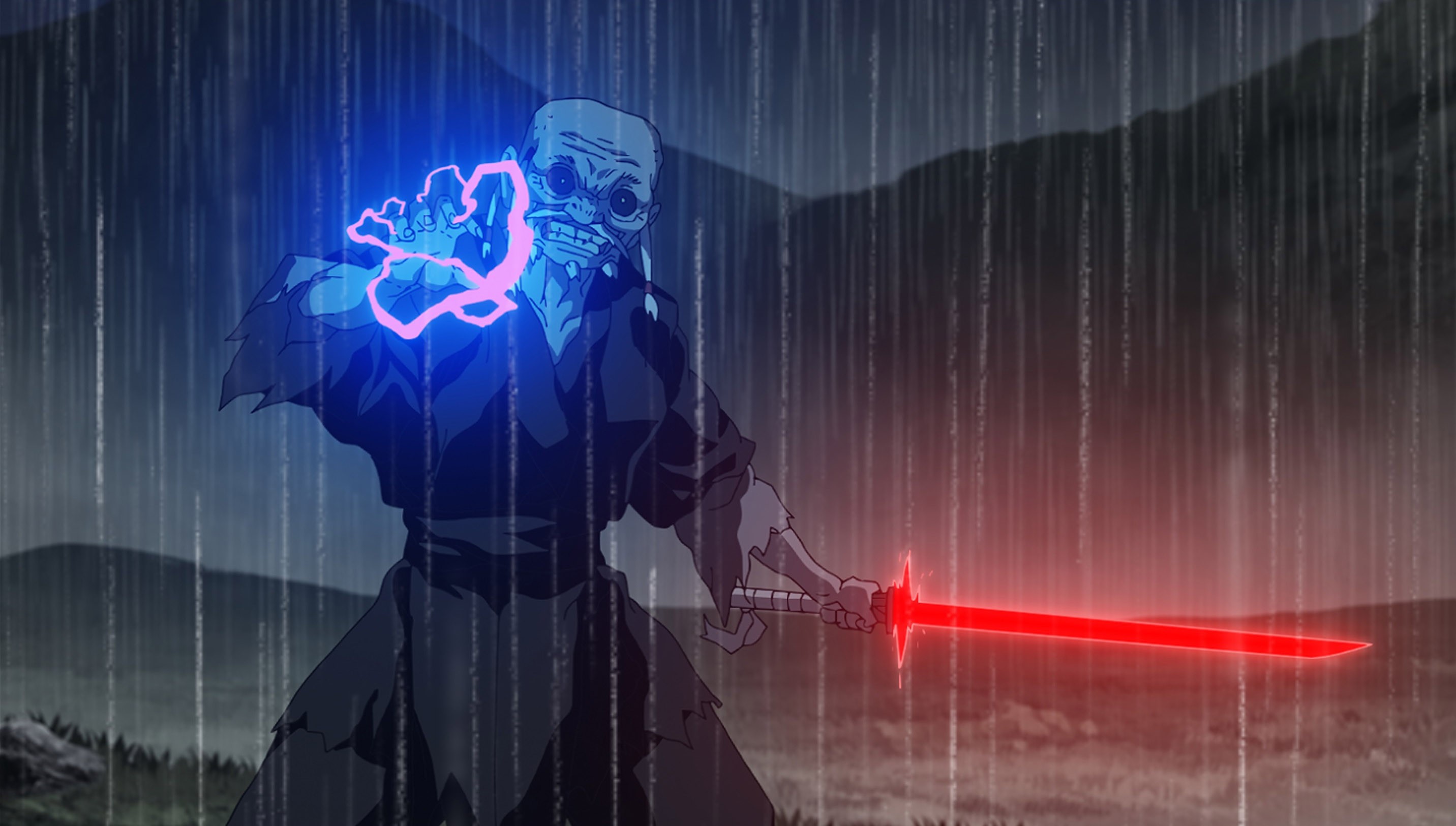 For the most part, Star Wars: Visions episodes seem to lean into the fact that they're anime, heavily utilizing 'anime' sensibilities (“The Twins,” “Tatooine Rhapsody”) or aesthetics (a great number of the locales feature traditional, Southeast Asian-inspired houses). This isn't a bad thing, but it's certainly noticeable and it makes The Elder notable in that it's one of the two episodes that feel like standard Star Wars. It approaches bog-standard territory, even. I still enjoyed it, with one of the highlights being the interactions between the collected Jedi and his headstrong Padawan. My enjoyment is tempered, however. “The Elder” certainly handles its various aspects well, but there's little excitement to be had, compared to every other episode in the anthology. It doesn't help that all the other episodes leave me yearning for more while “The Elder” is the least open-ended of the bunch by far. Still, I have to give “The Elder” a spot above “The Twins” for actually having some substance via the titular Elder and his plight of aging. The takeaway might feel simple, but I appreciate it due to its connection to Star Wars. Plus I have to give it points for having the maneuver wherein someone ignites a lightsaber through their opponent. I love that shit.
- - -
#
For the most part, Star Wars: Visions episodes seem to lean into the fact that they're anime, heavily utilizing 'anime' sensibilities (“The Twins,” “Tatooine Rhapsody”) or aesthetics (a great number of the locales feature traditional, Southeast Asian-inspired houses). This isn't a bad thing, but it's certainly noticeable and it makes The Elder notable in that it's one of the two episodes that feel like standard Star Wars. It approaches bog-standard territory, even. I still enjoyed it, with one of the highlights being the interactions between the collected Jedi and his headstrong Padawan. My enjoyment is tempered, however. “The Elder” certainly handles its various aspects well, but there's little excitement to be had, compared to every other episode in the anthology. It doesn't help that all the other episodes leave me yearning for more while “The Elder” is the least open-ended of the bunch by far. Still, I have to give “The Elder” a spot above “The Twins” for actually having some substance via the titular Elder and his plight of aging. The takeaway might feel simple, but I appreciate it due to its connection to Star Wars. Plus I have to give it points for having the maneuver wherein someone ignites a lightsaber through their opponent. I love that shit.
- - -
# The still that Disney+ used for this episode was a fucking crime. Swathed in red, it does a poor job of representing the episode. In reality, the entire episode is in black-and-white save for a key few objects like the ruby-red lightsabers. The grain marks on the image give the episode the feel of an old movie. Furthermore, this is one of the best examples of CG that I've seen in anime (which is to be suspected, the studio behind The Duel” is the one responsible for the amazing CG in the first three animated parts of JoJo's Bizarre Adventure), perhaps because the aesthetic works well with the models and animation. Earwig and the Witch can eat its heart out. It's the most stylistic episode and it's a visual treat. As the title implies, we're also treated to the best, most intricate duel of the anthology. Ultimately, beyond the flare, there's not much to the episode, but it's more exciting than “The Elder” and I found myself more invested in the action here than in the “The Twins.” Sometimes, flare is all you really need. “The Duel” featured a decent twist and there’s an intrigue that makes you want more. Luckily, there is more thanks to the Star Wars: Ronin novel. I've picked it up and I'm excited to see how it shakes out!
- - -
#
The still that Disney+ used for this episode was a fucking crime. Swathed in red, it does a poor job of representing the episode. In reality, the entire episode is in black-and-white save for a key few objects like the ruby-red lightsabers. The grain marks on the image give the episode the feel of an old movie. Furthermore, this is one of the best examples of CG that I've seen in anime (which is to be suspected, the studio behind The Duel” is the one responsible for the amazing CG in the first three animated parts of JoJo's Bizarre Adventure), perhaps because the aesthetic works well with the models and animation. Earwig and the Witch can eat its heart out. It's the most stylistic episode and it's a visual treat. As the title implies, we're also treated to the best, most intricate duel of the anthology. Ultimately, beyond the flare, there's not much to the episode, but it's more exciting than “The Elder” and I found myself more invested in the action here than in the “The Twins.” Sometimes, flare is all you really need. “The Duel” featured a decent twist and there’s an intrigue that makes you want more. Luckily, there is more thanks to the Star Wars: Ronin novel. I've picked it up and I'm excited to see how it shakes out!
- - -
# This is the other episode that feels the most like Star Wars. No complaints here, because this is where we really start getting into the good stuff. Unlike “The Elder”, this episode is exciting. Almost all of the episodes do a tremendous job of drawing us into their worlds despite a very short runtime, and “The Ninth Jedi” is no exception, investing viewers into a thrilling tale of Jedi on the losing side of their eternal war with the Sith, forcing a sabsersmith to distribute his creations in secret. The sabers that change color based on the user's affinity to the force made for a jaw-dropping twist and the use of a purple lightsaber shows how much the staff cares about the Star Wars universe. The crew behind “The Ninth Jedi” has apparently expressed a desire to continue their story and I'd really like to see it happen. Fingers crossed!
- - -
#
This is the other episode that feels the most like Star Wars. No complaints here, because this is where we really start getting into the good stuff. Unlike “The Elder”, this episode is exciting. Almost all of the episodes do a tremendous job of drawing us into their worlds despite a very short runtime, and “The Ninth Jedi” is no exception, investing viewers into a thrilling tale of Jedi on the losing side of their eternal war with the Sith, forcing a sabsersmith to distribute his creations in secret. The sabers that change color based on the user's affinity to the force made for a jaw-dropping twist and the use of a purple lightsaber shows how much the staff cares about the Star Wars universe. The crew behind “The Ninth Jedi” has apparently expressed a desire to continue their story and I'd really like to see it happen. Fingers crossed!
- - -
# :no_upscale()/cdn.vox-cdn.com/uploads/chorus_asset/file/22879267/tobi_mitaka_star_wars_visions.jpg)
Part Astro Boy, part Star Wars, all adorable. It's hard not to love an episode featuring a droid who dreams about being a Jedi. It's a very sweet episode and is poignant for Star Wars fans due to the fact that, in-cannon, droids aren't force-sensitive, and thus can't be Jedi. Beyond the lore, it's very hard not to love this when T0-B1 looks so adorable. He's not just the famed Tezuka character in role but in aesthetics; “T0-B1” looks like a modern take on the 1960s classic. The cuteness might be easier to swallow for viewers here than in “Tatooine Rhapsody,” as it doesn't step on the toes of canon too much.
- - -
#
:no_upscale()/cdn.vox-cdn.com/uploads/chorus_asset/file/22879267/tobi_mitaka_star_wars_visions.jpg)
Part Astro Boy, part Star Wars, all adorable. It's hard not to love an episode featuring a droid who dreams about being a Jedi. It's a very sweet episode and is poignant for Star Wars fans due to the fact that, in-cannon, droids aren't force-sensitive, and thus can't be Jedi. Beyond the lore, it's very hard not to love this when T0-B1 looks so adorable. He's not just the famed Tezuka character in role but in aesthetics; “T0-B1” looks like a modern take on the 1960s classic. The cuteness might be easier to swallow for viewers here than in “Tatooine Rhapsody,” as it doesn't step on the toes of canon too much.
- - -
#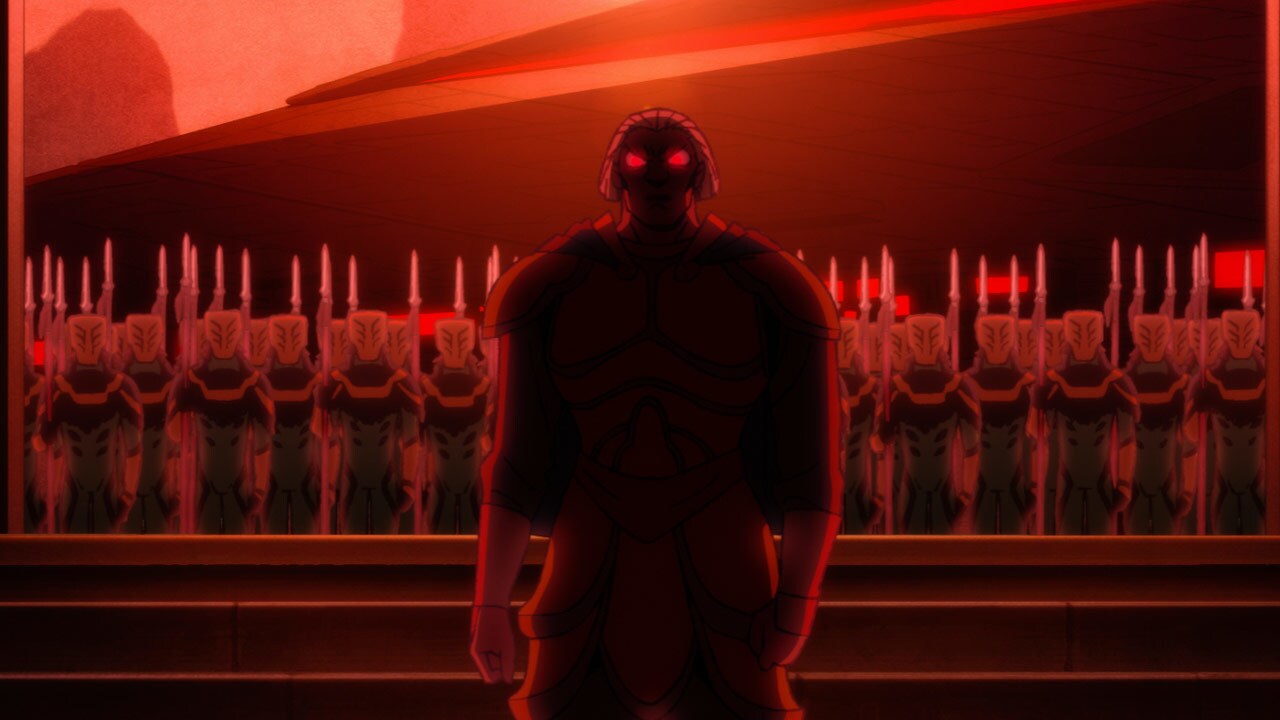 Now we're in 'favorite episodes' territory. It's really hard to rank the episodes here because they're all excellent in different ways. What “Akakiri" brings to the table are my favorite character designs of the anthology. They're cartoony and soft, for lack of a better word, yet they don't feel "kiddy". Maybe it's because they're part of the darkest episode of the bunch, with the main character making a Deal With the Devil in order to save the one they love. It's a great nod to the series' ethos and as Vision's last episode, it's a hell of a note to end on. The darkness is also carried through thanks to the aesthetics, with a somber color palette. Combined with the traditional Japanese-inspired, warlord-controlled-locale, it reminded me a lot of Calodanfrom The Mandalorian. The finale of the episode is swathed in a sinister, absolutely gorgeous sith-red. The only thing “Akakiri” fumbles is its backstory. The Visions vignettes do a pretty good job of working within the format of their short runtimes. “Akakiri” works well, for the most part, but at 14 minutes, it's tied with Tatooine Rhapsody as the shortest episode, and given how much the main characters' history with one another plays into the ending, it would have been more impactful if we got to explore this history a bit more.
- - -
#
Now we're in 'favorite episodes' territory. It's really hard to rank the episodes here because they're all excellent in different ways. What “Akakiri" brings to the table are my favorite character designs of the anthology. They're cartoony and soft, for lack of a better word, yet they don't feel "kiddy". Maybe it's because they're part of the darkest episode of the bunch, with the main character making a Deal With the Devil in order to save the one they love. It's a great nod to the series' ethos and as Vision's last episode, it's a hell of a note to end on. The darkness is also carried through thanks to the aesthetics, with a somber color palette. Combined with the traditional Japanese-inspired, warlord-controlled-locale, it reminded me a lot of Calodanfrom The Mandalorian. The finale of the episode is swathed in a sinister, absolutely gorgeous sith-red. The only thing “Akakiri” fumbles is its backstory. The Visions vignettes do a pretty good job of working within the format of their short runtimes. “Akakiri” works well, for the most part, but at 14 minutes, it's tied with Tatooine Rhapsody as the shortest episode, and given how much the main characters' history with one another plays into the ending, it would have been more impactful if we got to explore this history a bit more.
- - -
# With its bright colors and lush setting, “The Village Bride” is the most beautiful episode of Visions. Sure, the aesthetics of “Akakiri” or “The Duel” might be cooler and grittier, they might do a better job of taking your breath away, but the visuals of “The Village Bride” are more consistent and pleasant. You won't find establishing shots more beautiful anywhere else in the anthology. “The Village Bride” tells a very compelling story of a traditional village doing its best to survive oppression. All the while, we have a wandering padawan that must figure out what it means to be a Jedi. We're also treated to a breathtaking final action sequence. There might not be as much spectacle as “The Twins” but it really goes to show that sometimes, less is more. If “Akakiri's” bleak ending wasn't for you, “The Village Bride” might be more up your alley. It's perhaps the only entry that's uplifting while still feeling grounded, never at risk of dipping into "saccharine" territory.
- - -
#
With its bright colors and lush setting, “The Village Bride” is the most beautiful episode of Visions. Sure, the aesthetics of “Akakiri” or “The Duel” might be cooler and grittier, they might do a better job of taking your breath away, but the visuals of “The Village Bride” are more consistent and pleasant. You won't find establishing shots more beautiful anywhere else in the anthology. “The Village Bride” tells a very compelling story of a traditional village doing its best to survive oppression. All the while, we have a wandering padawan that must figure out what it means to be a Jedi. We're also treated to a breathtaking final action sequence. There might not be as much spectacle as “The Twins” but it really goes to show that sometimes, less is more. If “Akakiri's” bleak ending wasn't for you, “The Village Bride” might be more up your alley. It's perhaps the only entry that's uplifting while still feeling grounded, never at risk of dipping into "saccharine" territory.
- - -
# And here we have “The Twins,” but better. Jokes aside, it really goes a long way to show the breakdown of a relationship between two people who once saw eye-to-eye instead of just being told they were close before proceeding to show them clashing blades. I'm in awe that “Lop and Ochō” managed to not only pull off a time skip with only 21 minutes to its name, but pulled it off excellently, making Ochō's betrayal all the more heartbreaking. The episode's environmentalist, anti-imperialist message feels right at home in the Star Wars universe and really helped me care about the conflict. It's parts heartwarming, parts heartbreaking, and parts jaw-dropping. In “Lop and Ochō,” we have the most compelling characters in the entire anthology and thanks to the cliffhanger ending, I really, really hope the story is continued in some fashion. I also really liked Lop's design. It's nice to have a Star Wars protagonist that's not human. That's the only reason, I swear. What do you mean that's suspicious? Why the hell are you looking at me like that? Moving right along!
- - -
#
And here we have “The Twins,” but better. Jokes aside, it really goes a long way to show the breakdown of a relationship between two people who once saw eye-to-eye instead of just being told they were close before proceeding to show them clashing blades. I'm in awe that “Lop and Ochō” managed to not only pull off a time skip with only 21 minutes to its name, but pulled it off excellently, making Ochō's betrayal all the more heartbreaking. The episode's environmentalist, anti-imperialist message feels right at home in the Star Wars universe and really helped me care about the conflict. It's parts heartwarming, parts heartbreaking, and parts jaw-dropping. In “Lop and Ochō,” we have the most compelling characters in the entire anthology and thanks to the cliffhanger ending, I really, really hope the story is continued in some fashion. I also really liked Lop's design. It's nice to have a Star Wars protagonist that's not human. That's the only reason, I swear. What do you mean that's suspicious? Why the hell are you looking at me like that? Moving right along!
- - -
# While I really love “Lop and Ochō,” I ultimately had to give it to “Tatooine Rhapsody.” My experience with “Tatooine Rhapsody” is essentially the inverse of “The Twins.” When I was watching it, I didn't expect to enjoy something that was so silly, so lighthearted in a serious setting, but it was hard to dislike it by the end. I couldn't stay stone-faced in the face of such a feel-good episode. On paper, “Tatooine Rhapsody” would be far too silly for its own good, but in execution, it hits all the right notes. The reason it does so is because it has a lot of heart. It has a real genuineness to it that helps me swallow some of the more outlandish elements. It draws me into the episode. The Power of Friendship is an anime trope that can be tiring for me, but “Tatooine Rhapsody” has so much charm that it really hits hard, here. This is definitely a story that feels more like an anime than something that would happen in Star Wars, yet the message of the show feels right at home in the galaxy far, far away. The ragtag band of misfits captured my heart, which is very impressive given the runtime. It certainly helps that I'm a sucker for non-standard OST and “Tatooine Rhapsody” gives that in spade with its rock songs. “Tatooine Rhapsody’s” tone makes it polarizing. Jabba and Bib Fortuna are ruthless gangsters and Boba Fett is a cold-hearted mercenary. Jabba probably wouldn't be acquiesced by the prospect of sponsoring a rock band (or maybe he is, I'm not sure how much money people launder through the music industry). The three of them probably wouldn’t bob their heads nor tap their feet (or tail) to the beat of the song. It all boils down to your reaction towards this — do you find this really cute or really stupid?
- - -
And there you have it, folks. While I was able to rank all the episodes, it became harder and harder to do so as I climbed up the list. The bottom line is that these are some really great episodes. While some might hem and haw, this is Star Wars and it is anime, and a damn good example of both. I think its an example of just how much anime has "made it” that even as Ghibli exits stage left at the house of mouse, a whole score of studios were invited to work on one of the company's most cherished properties. Visions shows just how amazing both anime and Star Wars can be and I hope it can serve as a gateway for both.
While I really love “Lop and Ochō,” I ultimately had to give it to “Tatooine Rhapsody.” My experience with “Tatooine Rhapsody” is essentially the inverse of “The Twins.” When I was watching it, I didn't expect to enjoy something that was so silly, so lighthearted in a serious setting, but it was hard to dislike it by the end. I couldn't stay stone-faced in the face of such a feel-good episode. On paper, “Tatooine Rhapsody” would be far too silly for its own good, but in execution, it hits all the right notes. The reason it does so is because it has a lot of heart. It has a real genuineness to it that helps me swallow some of the more outlandish elements. It draws me into the episode. The Power of Friendship is an anime trope that can be tiring for me, but “Tatooine Rhapsody” has so much charm that it really hits hard, here. This is definitely a story that feels more like an anime than something that would happen in Star Wars, yet the message of the show feels right at home in the galaxy far, far away. The ragtag band of misfits captured my heart, which is very impressive given the runtime. It certainly helps that I'm a sucker for non-standard OST and “Tatooine Rhapsody” gives that in spade with its rock songs. “Tatooine Rhapsody’s” tone makes it polarizing. Jabba and Bib Fortuna are ruthless gangsters and Boba Fett is a cold-hearted mercenary. Jabba probably wouldn't be acquiesced by the prospect of sponsoring a rock band (or maybe he is, I'm not sure how much money people launder through the music industry). The three of them probably wouldn’t bob their heads nor tap their feet (or tail) to the beat of the song. It all boils down to your reaction towards this — do you find this really cute or really stupid?
- - -
And there you have it, folks. While I was able to rank all the episodes, it became harder and harder to do so as I climbed up the list. The bottom line is that these are some really great episodes. While some might hem and haw, this is Star Wars and it is anime, and a damn good example of both. I think its an example of just how much anime has "made it” that even as Ghibli exits stage left at the house of mouse, a whole score of studios were invited to work on one of the company's most cherished properties. Visions shows just how amazing both anime and Star Wars can be and I hope it can serve as a gateway for both.
