SPOILER-FREE!
This review was originally written in July 2021, published as a YouTube video on my channel.
Let’s talk for a minute about expectations: part of the reason why I like going into any entertainment knowing as little as possible is because that way, the show can happen to me as unobstructed or as organically as possible. That of course pertains to familiarity with the original source material. But there’s another kind of expectation that often comes with entertainment viewing sometimes, and that’s when you’re told point blank that something either is or is not worth it. It happens all the time – something comes up in conversation, you mention that you haven’t seen it yet, and then you get told that you MUST or MUST NOT see it.
Shiki was a series that a user in a Discord server pressed me to see numerous times, swearing that it was one of the best anime that he had ever seen. What was different about this particular time was that it wasn’t just being told that it was great; it’s another matter entirely to be told it persistently, as though the person made it their life’s calling or mission to make sure that, come hell or high water, you were going to see it. So, thanks -name redacted-, you piqued my curiosity to the point where I could no longer ignore it.
_____
In the Sotoba village during summertime, a high school girl named Megumi has a horribly one-sided crush on a boy named Natsuno. Both are fed up with life in their little village and long for somewhere else. After once again failing to get any substantial reactions or responses from Natsuno, Megumi tries leaving the village. She is later found lying in the forest, where she dies shortly afterwards. Her death only ends up being one of the first in a long line of other mysterious deaths that occur in the village, with both the old and the young falling victim to whatever is happening. Ozaki Toshio, the local doctor, Muroi Seishin, the local temple priest, and Natsuno find themselves struggling to determine the cause of these deaths, and whether it’s something akin to an epidemic or an overt malevolence.
Shiki relies on one of the classic literary devices as explained by famed British director Alfred Hitchcock. Imagine this for a minute if you will; two people are sitting at a dinner table, when suddenly a bomb goes off. You get a few seconds of intense shock. Now, try the scene again, but reveal to the audience that during that dinnertime conversation, a bomb will go off in five minutes. It’s a small change, but one that makes a world of difference in experiencing a scene. Shiki’s framing makes it plainly obvious to the audience what is going on throughout the story as far as why the villagers are dying, but keeps its characters in dark suspense so that they are trying to piece things together themselves. Information is fed to the audience and the characters both in violent bursts and quiet realizations, never keeping stagnant for too long.
As the mystery carries on for all three characters, we also begin to see the show work its psychological and moralistic magic. Though the story itself starts in the summer, it lasts over a period of several months. During that time, as more and more people continue dying, the wear and tear of trying to get at the heart of what’s going on begins to take its toll, moving with the careful intricacy of the finest Swiss clockmaker. Ozaki for instance has to constantly wrestle with an inability to find the cause for the deaths, and the fact that his own nursing staff is starting to get terrified that they themselves could be next. There also is an increasing unwillingness of the townspeople to seek medical aid from him, furthering his aggravation. He wants to save these people, just as Natsuno wants to take matters into his own hands and figure out why he is seeing visions of Megumi in his nightmares, and Muroi seeks to learn more about the attacks that don’t involve a medical explanation. Each protagonist’s agenda does not necessarily coincide with the other two despite their common goal. Their own methods, as well as their own ideologies about the town, its people, the moral questions that get thrown in, and its mythology, are at times diametrically-opposed; all three characters move along their paths in calculated measures to save the village.
But oddly enough, the villagers in their sequestered corner of the world aren’t necessarily the most-pleasant people you would want to see saved. I already mentioned their reluctance to seek medical aid, yet as seen early on in their treatment of Megumi, they have a penchant for gossiping, making fun of, or outright ostracizing those who are different from them. Such a collection of sour personalities makes the resulting death that’s sweeping through the village create not a cause for concern, but one that feels more akin to apathy. Even if you want to write off that this is a fictitious story and that you shouldn’t care too much about what’s happening, shouldn’t you at least feel something?
Yet despite all of that, there are some in the village that make their kindness or their pain known. We are shown throughout the series numerous funerals and death rite ceremonies, seeing families crying as they mourn their loved ones, including some who never moved into adulthood. The nurses who work for Ozaki likewise express their desire to keep the people alive despite their limited understanding of what’s happening. These people are scared and dying. It manages to elicit a rather conflicted response: I was caught between both wanting and not wanting the town to be saved, as the people there are largely such an unpleasant bunch.
But the more people die, the greater the chance that the other characters in the village who are kind will die as well. As the villagers eventually realize what’s causing the deaths and take a more proactive role in their own defense, I felt not apathy, but exhilaration. Shiki managed to tinker with my emotional response to what I was watching as if guided by a magician, keeping me sometimes on the edge of my seat, ecstatic during moments of triumph, and slumping as I sympathized with a character’s defeat even if I didn’t like them at first. The way its suspense carried over from episode to episode made me get invested in everyone and everything...except Murasako Masao. If you’ve seen the show, you know why.
I have not talked about the plot in significant detail here because the show’s tightly-woven writing makes such a feat nearly impossible. To discuss specific moments or show the wrong visual would necessitate talking about something else that transpires in the show, which then would necessitate talking about something else, and so on and so forth. The fact that certain seemingly-incidental details become a factor later on gives each scene a sense of deliberate importance, either in foreshadowing the future or for emphasizing the unsettling atmosphere of death or the village.
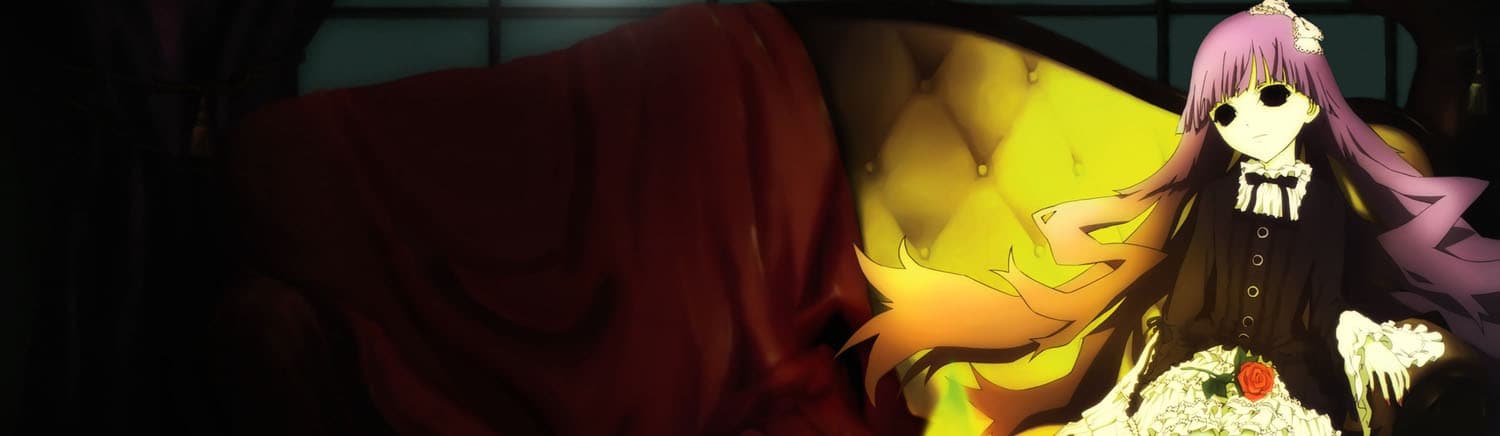
And that unsettling atmosphere is accompanied by an unusual aesthetic. It does not scream “horror” or “mystery,” but rather comes across as a strange conglomeration of both garish and calming, from the unusual hairstyles of the characters to the beautiful landscape backgrounds. For such a suspenseful story, it seemed only fitting that it would occupy a space in what could be thought of as an aesthetic twilight zone. But of all things in terms of presentation, the soundtrack operates on a sublime level, painting the town and the ensuing events in a whirl of gloomy sounds.
__________
Shiki is a masterclass in immersion, where the slow pace and the encroaching dread it wrought was completely arresting. With a lovely stylized look, a colorful roster of characters, moments that were phenomenally intense, a soundtrack and audio mixing that worked seamlessly, and an ending that left me completely satisfied, it was one of the most-engrossing anime viewing experiences I’ve had in a very long time. Combined with tightly-woven writing, it produced a mystery that had me longing to descend deeper into its dark corridors the further it went on. When it at last was over, I was filled with that sense of both exhaustion and fulfillment that only comes when you feel you’ve seen something truly worth your time. I certainly will not be forgetting it anytime soon.
38 out of 40 users liked this review
