
 In the Japanese History course I took during university, my professor decided to focus on the lives of commoners — the farmers, the merchants, the soldiers. She explained that when learning about history, people tend to only pay attention to the movers-and-shakers. I understood where she was coming from — history aficionados tend to gravitate toward larger-than-life figures. If not those, then they'll key in on big events like wars. I know why they do this: with an ocean as massive as human history, it's often necessary to use a central figure to moor yourself. Beyond that, there's the obvious: these people are cool. Yet, you lose something in focusing on them. You might not get a sense of what life was like for the average person — in 100 years, someone learning about the 2020s might not know how you or I lived. On focusing on battles and their commanders, you tend to see everything on a macro level and you lose that human element.
One of the most striking things about Heike Monogatari is how personal it is despite focusing on powerful figures. The Taira clan ("Heike" translating to "House of Taira") were about as powerful as they came in Heian Japan.They were the type of guys to wage wars over slights (that's "fuck you money" if I've ever seen it), sent their children to marry other nobles to secure ~~alliances~~ capital, and rubbed elbows with the emperor (until they disastrously didn't). Heike Monogatari has all the makings of a war epic, but that ultimately isn't where Naoko Yamada places her efforts. Yes, there's certainly political intrigue, there're certainly battles to be had, but this isn't the show's focus, and indeed, as I'll get into, it's not its strength. Instead, we key in on how these events affect the members of the Taira clan swept up by their leaders' greed. When watching Heike Monogatari, we see the Taira not as unapproachable leaders, but as real, suffering people. In class, my professor joked once that the nobility would spend their days in court writing poems about the beauty and impermanence of life. Heike Monogatari achieves this beautifully, showing that Yamada didn't aim to put a textbook to screen, but a poem, a tale. It's important to not just critique in terms of your goals for a work, but also in terms of the creator's goals. It's annoying to see reviews of this show criticize the show for not putting more emphasis on the historical battles when that was never its intention. In terms of being a poem, I think Heike Monogatari succeeds wonderfully. It’s the most beautiful anime I only kind of understood and it deserves more eyes on it.

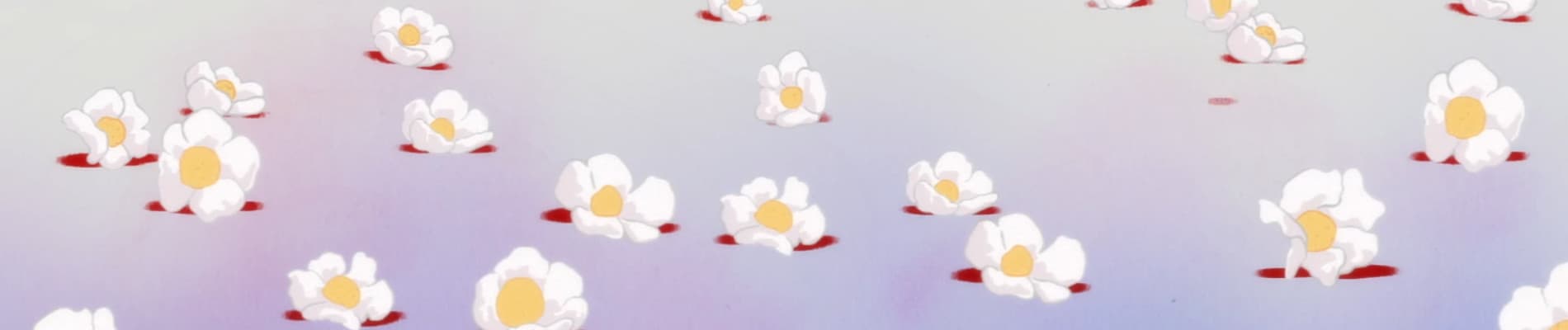
Heike Monogatari is beautiful in many ways, the most basic being that it's absolutely gorgeous to look at. The easiest way to make me like an anime is by giving it unique visuals and Heike Monogatari delivers. Some have said that every frame of Heike Monogatari is like a painting and I have to agree. The characters are "softer" looking than what you typically see. They strike a balance between "realistic" and "stylization" that most anime seem to forego in favor of one extreme or the other. It's a bit hard to explain; it's the type of thing that you can understand by just looking at screenshots. You just know it’s different from the standard fare. Heike shines with its character design but it blinds with its backgrounds. Whether our characters find themselves in a lush bamboo forest, a snowy garden, a sandy beach, or in front of a blossomed sakura tree, it's an absolute visual treat. This is what really makes this show look like a painting and I appreciate the care that Naoko Yamada put into making every frame pop. When watching, my eyes were constantly glued to the screen. For once, I'm going to be an elitist and demand you watch this on a TV or a computer instead of a phone.

The soundtrack is no slouch, either. While Heike Monogatari is a period piece, its music isn't constrained by its time period, heightening the uniqueness of the viewing experience. The OST features classically-minded music that fits the time period, including Biwa singing and playing the instrument she's named after. It's always a powerful moment when we see Biwa rendered with snow-white hair against a black background as her voice becomes much stronger. The OST also features EBM and rock music from Agraph. Perhaps the best examples of the eclectic OST are the OP and ED — the OP being a soothing alternative rock song, while the ED, my favorite song of the OST, is a brooding song featuring rap, cold horns, and electronic sounds that emulate breathing/wind.
Heike Monogatari's weakest link is its plot. Fortunately, this isn’t particularly damning.
I'm not being completely glib when I say that this is the most beautiful anime I only kind of understood. The list is bigger than you think — anime, hell, art in general, can be downright esoteric at times. Evangelion, Kaiba, Steins;Gate 0, Serial Experiments Lain, Tales from Earthsea, and every damn season of FLCL are anime I enjoy but found hard to parse for one reason or another. Heike Monogatari is one of those anime.

Giving credit where credit's due, Heike Monogatari is easier to understand than any other anime on that list. Unlike, say, Evangelion, you don't need to comb an encyclopedia to get what characters are saying — the tools to understand Heike Monogatari are in the anime itself. You just need to be very attentive when you watch. It's not a bad idea to rewind some scenes when watching this. Hell, you might want to bring a notepad. It might feel like a chore, but it is doable — in the watch threads I followed, a viewer was able to make an accurate relationship chart just by viewing (that increasingly looked like a kudzu vine after each episode). Discussion threads in general were a godsend for me. Heike Monogatari doesn't really do exposition. Sure, characters will discuss and explain things to one another, but it never feels like it's for the viewers' benefit.
This is because the Heike Monogatari doesn't aim to be a textbook, and there's a reason for this — it doesn't need to.
If you recall Heike Monogatari is an adaption — an adaption of a very well-known tale, at that. From what I hear, Japanese viewers would be very familiar with the events of Heike Monogatari. Japanese viewers would most likely find the story very accessible and they could fill in any gaps the anime left. Because of this, Yamada could give more focus to the characters.
Problem: I'm not a Japanese viewer.

I had a hard time deciding whether or not I wanted to continue watching blind or if I wanted to spend a few hours on Wikipedia reading about the Genpei War. The argument for the latter is that you'd be watching it how the director intended for it to be watched. After all, the native viewers would have known the story. My counterargument for that is that, paradoxically, because she knew viewers were familiar with the story beats, she didn't intend for viewers to pour over a textbook while watching it. If I did decide to immerse myself in the war, the show would ultimately stop being about the characters. Yet I couldn't shake the feeling that I was watching the show half-cocked.
It's a tough decision to make and it comes down to what you want from the show. I'd say it's best for a viewer to watch an episode or three before deciding how they want to press forward. While I decided to watch it blind, Heike Monogatari is an anime that really benefits from a rewatch and I might give it another go after reading up on the Genpei War. While watching the anime blind is doable, that doesn't stop it from being kind of annoying. I stand by the idea that shows shouldn't need supplementary material to be understood. Heike's need for it is more forgivable than, say, Evangelion’s, but it still impeded my enjoyment of the show. At 11 episodes, Heike is on the shorter end a single cour and I can't help but think that it would have benefited from two more episodes giving its plot a bit of breathing room.

That said, I did decide to finish it blind and there are two reasons for this.
For one, while the plot can be complex the outcome, the thing we're supposed to walk away with, is decidedly not. The Taira clan was on top of the world before crashing to Earth — it's a "Viva la Vida" story. You might not know the exact "how" of how they fell, you don't really need to.
Because two, once again, the plot, the events leading to the Heike's downfall isn't the anime's focus, its the characters. Their heartwrenching battles with duty, love, innocence, and guilt are much more poignant than any battle waged with swords could ever be.
There's no better example of Heike Monogatari's focus, its preoccupations with feelings instead of events, than its main character, Biwa. Biwa isn't a noblewoman nor a warrior. She's a musician, a storyteller. Her role generally isn't to play a part in the events surrounding her, but to feel them and to impart her feelings in her songs. She doesn't even seem to age — she doesn't change with the world, she's simply observing it. She's an audience surrogate for those who don't know the Tale of the Heike. She's swept up into their troubles without greater context. Thus, she doesn't latch on the battles nor the political wheeling and dealings, instead caring about the people she meets. She becomes increasingly frustrated by her inability to help those she cares about, which isn’t helped by her abilities. She can see the future, yet cannot act on it. She then finds herself haunted by the souls of the dead. By the show's end, she decides that her purpose is to tell the story of the Heike for future generations. Biwa is an interesting personification of history, telling us it's not just important to remember events, but to remember the names and the people behind those names. She tells us to remember how people lived and in a way, she reminds me of the philosophy my professor had.
And by God, the people behind the names are compelling. I know it can be hard to shed a tear for the elite, but even if you're an "eat the rich" type, you'll be hardpressed to not find the members of the Heike sympathetic. Many of them are controlled by the whims of their leader, wrapped up in duty and loyalty. Whether it's a mother having their child become a political token, a poet being forced to become a warrior, or a commander wracked with guilt after their soldiers burn a temple, viewers are drawn into the people that comprise the Heike and not the larger-than-life figures.

The final episode is really affecting. Biwa trills her instrument one final time and talks about the ephemeral beauty of life and the great equalizer that is death. The message rings powerful and I imagine it will stick with me for quite some time.
All in all, this should be a 10/10 anime, or at least pretty close to one. So why isn't it?
Well, because, as small as this niche is, I can't help but feel that there's another anime that does it better.
I couldn't help but compare this to The Tale of Princess Kaguya. As Kaguya is the top recommendation for Heike, it's clear I'm not alone. Their biggest similarity is perhaps their visual sensibilities, both aiming to emulate classic Japanese paintings. The main difference is that Heike invokes these paintings while Kaguya might as well be an link-wash painting. Heike's backgrounds are phenomenal and while the character designs are unique, they're still not mind-blowing, while Kaguya's art is most likely something you haven't seen in animation before. If you're looking for amazing, one-of-a-kind visuals, then Kaguya has Heike beat.
Meanwhile, their biggest difference is how they tell their stories. Heike Monogatari, as much as it focuses on its characters, is still a historical story while The Tale of Princess Kaguya is a fairy tale. Heike is bogged down by needing prior historical knowledge while Kaguya doesn't have this problem. Everything you need to know is in the movie itself, which makes for an easier watch. Both are stories about ancient Japan, but The Tale of Princess Kaguya can feel timeless and placeless in a way that Heike doesn't (even though the OST certainly helps). It's a lot more approachable than Heike.

As a movie (one that took many years to make, at that). Kaguya is a tighter story than Heike without much opportunity to get swept away. While Heike is only one-cour, it still can feel a bit sprawling.
Finally, while both have similarly dour endings, I can't help but find Kaguya a more tragic figure.
Bear in mind that none of this is to say that Heike Monogatari is bad, it's just that for all it does right, there's something Kaguya does better while inhabiting the same space as it. Heike scratched a Kaguya itch I didn't know I had, but it still isn't the best at what it does.
Still, it's very, very good, and it's become one of my favorite anime. It's a beautifully poignant take on history that I'm sure will stick with me. Yes, the plot is a bit unwieldy and could have been handled better, but that's ultimately not the point of Heike. Its actual focus, the characters and the themes they impart is where Heike shines bright, brighter than many anime out there.

