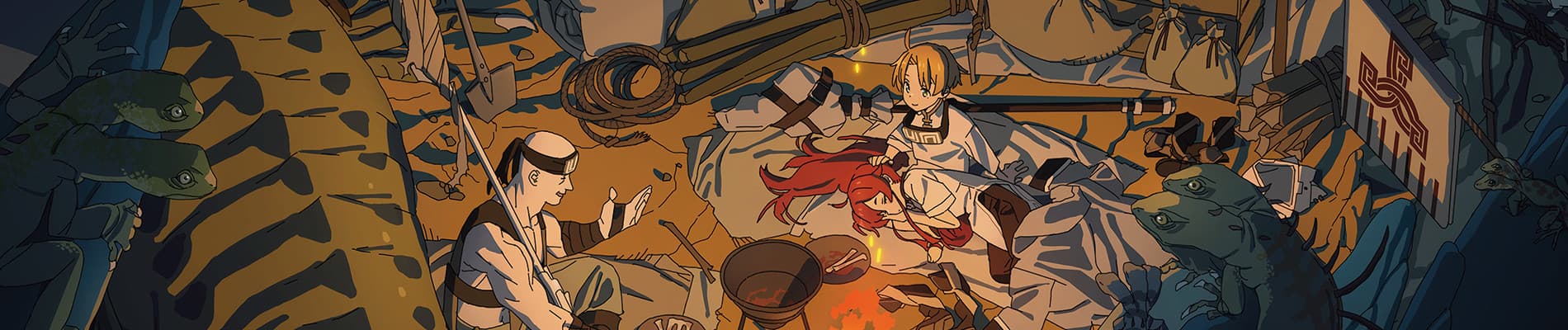
Despite the existence of countless, very cliché quotes about how “it’s all about the journey, not the destination”, there is more than just a kernel of truth to that saying when it comes to storytelling. The beginning should serve as a way to hook the audience and the ending needs to tie everything together with a nice bow, but the “meat” of the story is going to be what happens inbetween those two points. The journey needs to be compelling with a cohesive narrative, and should include characters that have clear goals that they’re trying to accomplish. These characters should also (the vast majority of the time) have personal arcs that can show how they’ve changed at the conclusion, helping the audience feel as though what they just saw had a real and lasting impact. When I watched Mushoku Tensei’s first cour, I thought the potential for all of this was apparent, even if it was a little rough around the edges. I just didn’t expect that potential to be realized so soon; this second cour delivers on the show’s earlier promise, while at the same time smoothing out those rough edges quite a bit. When everything was said and done, I came out of it totally blown away by the overall quality and passion put into this series, eagerly awaiting more.
When we last saw Dead End – a party comprised of Rudy, Eris and Ruijerd – they were just about to begin their travel in earnest, with two goals: return Rudy and Eris to their homeland, Fittoa, and repair the reputation of Ruijerd’s race, the Superd. Considering the distance between the Demon Continent and Fittoa, as well as the fact that the Superds were essentially known as boogeymen from one end of the world to the other, accomplishing either goal was not going to come quickly.

Rudy had just turned ten when he and Eris were teleported to the Demon Continent, and at the end of the first cour he’s a couple months older than that. By the time this leg of the journey is complete, three more years have passed and he’s thirteen. So what happens over the span of those three years? In short, quite a bit. Dead End travels across almost the entire world, so they encounter new people from all kinds of backgrounds and races, then subsequently deal with the surprises and twists that come with that. But the Teleport Incident was very wide reaching, and that gives them the opportunity to reunite with some familiar faces as well. The story is great, and has fantastic worldbuilding with some real emotional peaks and valleys. The writing never feels like we’re just getting a large block of exposition, but at the same time I was never confused as to what was happening on screen. The plot really shines, however, because it does such a good job of not only presenting the cast with opportunities to grow and bond, but also showing that these gradual processes are taking place before the audience’s eyes.
At the heart of Mushoku Tensei’s cast, and really at the heart of Mushoku Tensei itself, is Rudy. I don’t want to spend a lot of time rehashing lengthy arguments that everyone has heard a million times here, so I’m not going to. As this is ostensibly a review, however, I do feel obligated to say something brief: if you watch this show looking for some kind of karmic punishment to be meted out to Rudy for his transgressions, you’re going to be disappointed. I’ve said it before, but nobody is “wrong” for being disgusted by a character. With that being said, the message the character is being used to deliver should also be considered. Sometimes characters are disgusting for the sake of being disgusting, sometimes characters are disgusting in service of something a little more complex. I personally view this series, and Rudy, as examples of the latter. This is a story about how someone who is profoundly undeserving of a second chance gets one anyway, and about how Rudy seizes that opportunity and changes for the better – through both his own desire to improve and through the assistance of those around him. It’s a story about rehabilitation, not retribution, and to drive that home I’d like to share how the author, Rifujin na Magonote, replied when asked if he had gone too far with Rudy’s flaws in an interview.
“I think the balance was right. Because he's a controversial character, his mountain of regrets makes the act of redoing life more meaningful. Of course, I have no issue with criticizing Rudeus at the beginning stage, and it's up to you to decide whether you don't want to see the story because of that. With that said, if there's someone like Rudeus close to you and that person were to have even a slight change of heart and try to start over, I sincerely hope that you won't abandon them on the spot.”
When viewing the show through that lens, I think this cour does an absolutely phenomenal job of showcasing Rudy’s growth and the effort that he’s putting in. My favorite example of this starts with Dead End fighting a giant serpent, early on in their time together as a group. As a result of Rudy’s actions a young adventurer who could have been saved was killed, and at the time Ruijerd didn’t hold back on Rudy, didn’t let him rationalize anything away or absolve himself of blame; there was no possible way for Rudy to not take responsibility for his poor choices. We see his failure, as well as how his past life influenced him in making that decision, not to make what he did okay but simply to offer insight as to why he acted that way. But he did learn from the experience. A little over a year later, when presented again with the choice to be a bystander or to become an active participant, Rudy steps up. Even though he’s scared out of his mind and questioning why he’s forcing himself to get involved, this time his actions directly save quite a few lives at the risk of his own. Is he perfect? Far, far from it. But, while he still has a long way to go, tangible progress is being made. Rudy is putting forth genuine effort, and he has surrounded himself with people who help bring out the best in him.

One fairly common pitfall that some writers fall into is the creation of a character who has no reason for existence outside of the protagonist. When done in a more light-hearted or comedic setting this works fine, but in a dramatic character study like this someone existing solely to make the lead look good might spell disaster. What I really appreciate about all of the characters in Mushoku Tensei is the agency they have and the growth they exhibit. They have dreams, goals and aspirations totally separate from Rudy, even if they might be helping him along the way.
I know after talking about how I liked the characters for their agency and growth it’s weird to begin by discussing a connection to the lead character, but Ruijerd’s relationship with Rudy does a fantastic job of showing both these things. When we initially met Ruijerd in the first cour, he was an alien super-warrior with a draconian sense of justice. His moral code was absolute: crime is wrong and criminals should die. As extreme as this is, it allowed him to function as a foil to Rudy, who never had any morals in his past life, and certainly didn’t pick up any from Paul in this one. Ruijerd might not be the leader of the party, but he isn’t just getting dragged along for the ride, as he is constantly checking and challenging Rudy just to make sure he’s doing something for the right reason. And as the story progresses, Ruijerd also changes in subtle ways. He sees the effort Rudy is putting in to do the right thing and will bend his rules ever so slightly to help him out, and Eris’ genuine love for adventuring rekindles his own. The changes are subtle, but they are there, and they help keep the decisions Ruijerd makes over the course of the journey believable.

Eris’ development, on the other hand, is much more pronounced, which makes sense for a character that is so extreme in many other ways. She’s high energy and adventurous, two traits that make her a blast to watch and super likable. Eris is also from nobility though, so she’s spent her entire life getting her way; alongside her other traits, she’s selfish. As one might expect, “selfish” is not a particularly desirable quality to have when adventuring, and to her credit Eris changes. But what’s really fantastic about this growth is it’s done while staying true to the character’s roots. Eris doesn’t become a paragon of moral virtue, she just extends her circle of selfishness to include Ruijerd, Rudy and a few others she meets along the way. Her thinking goes from “how will this impact me” to “how will this impact us” – but even with her growth, Eris is unmistakably a brash noble who is going to fight to get what she wants. And a lot of the time what she wants isn’t really related to Rudy. Like Ruijerd there are things that she feels she needs to do in the future, but, unlike Ruijerd, by the end of this cour it becomes apparent that something Eris still has a major problem with is communication.

Even if the story and characters of Mushoku Tensei aren’t someone’s thing, I think many will agree that the production behind the show is outstanding and that Studio Bind outdid themselves with this series. Visually there is a lot to love, as the background art is gorgeous and the character designs feel so appropriate for the setting. What really stands out is the animation, however. This show isn’t super heavy on the action, but when it does happen it’s brilliant. Combat is fast paced with explosive amounts of energy, and seeing how insane power levels get portrayed is great, but my favorite aspect is how Rudy’s magic is animated. The reason anime characters tend to yell their attacks isn’t so their opponent knows what’s coming, but is instead a carryover from manga, where the author needs to let the reader know what attack is happening. However, since Rudy casts spells silently, Studio Bind can’t simply have him vocalize his magic and be done with it – instead they have to animate it. While other shows may be okay with just a bright ball of fire and some yelling, Mushoku Tensei will show a sharpened, red hot drill being formed from the earth, spinning thousands of times per minute, and then flying at someone, or will have a spell form swirling storm clouds that start a torrential downpour, drenching the entire area. It’s genuinely a joy to watch, and whenever there is action on screen I find myself glued to the edge of my chair.

It should go without saying, but production is more than just how pretty something looks – it’s also how pretty something sounds. Mushoku Tensei sounds very pretty. The insert music from the OST is fantastic, contributing to the fantasy atmosphere and setting the tone of the show effectively while also never crowding out what’s happening on screen. The sound effects themselves are also generally good, whether it’s something from combat, like the metallic clash of sword and spear, or it’s something more quotidian, like the sound of bread being torn. The audio does two things particularly well, however. The first is the voice acting. I’ve always been of the opinion that voice actors really only get to flex how good they are in dramatic or comedic roles, and this cour of Mushoku Tensei certainly had the drama I was referring to. Eris’ voice actress in particular, Ai Kakuma, stood out for her performance, and I have no qualms saying that without a portrayal on her level the character would be half as good. She brings so much emotion and energy to Eris, and really seems to understand on a fundamental level how she is feeling at any given moment; it’s really just great stuff.

The other thing I want to shout out is the openings, all five of them. Yes, this 12-episode cour of Mushoku Tensei has five openings, one for each region the characters visit. Every opening track is tailored by Yuiko Ohara to convey what the audience should expect going in: when Dead End is traveling through the Beast People’s territory the opening is up tempo, mysterious, and heavy on the strings, and when Dead End is traveling through a region where religion is a huge part of day-to-day life we get something much more akin to a hymn. The fact that it’s all the same artist performing the songs helps keep things cohesive, like it’s all the same world, even if the actual sound of the songs differs wildly from one to another.
I also had a lot of praise towards the first cour for how it used the opening sequence to do some world building. That’s still done here, but Studio Bind has definitely mixed it up a little bit as well. Sometimes the opening will be used to show characters doing something, especially traveling, as opposed to solely being used to make the world feel like it’s alive. So despite my high praise for how the first cour used openings for world building purposes, I actually really liked the change, and I think it made the pacing of the show so much better than it might have otherwise been. The impact of this can be felt on Dead End’s return to Fittoa when, since of course nothing can be easy, instead of just reusing the first opening it’s been remixed. Initially it was cheery with barely contained energy, but now it sounds tired, strained even. How it sounds and what it shows fits the narrative perfectly, and it’s dozens of little things like this that Mushoku Tensei does so well. Those little things add up, and create the fantastic end product that we get when everything is said and done.

People often call Mushoku Tensei the “grandfather of isekai”. As dubious as I am that it has a legitimate claim to that title, I’m equally certain that this isn’t just "good for an isekai", this is just great, with no qualifiers needed. The story is fresh and takes enough risks to keep me guessing at what will happen next, the characters are incredibly well written, even if they aren’t all incredibly good people, and the production and care put into the show is mind boggling. And look, I get it – the show isn’t for everyone. It’s controversial for good reason, and for some people Rudy legitimately ruins the entire thing. But my heart broke a little when I was watching Dead End finally arrive at their destination, and Rudy's story isn’t over. This was just the first leg in a long journey, and personally? I cannot wait to see what happens next.
89.5 out of 98 users liked this review
