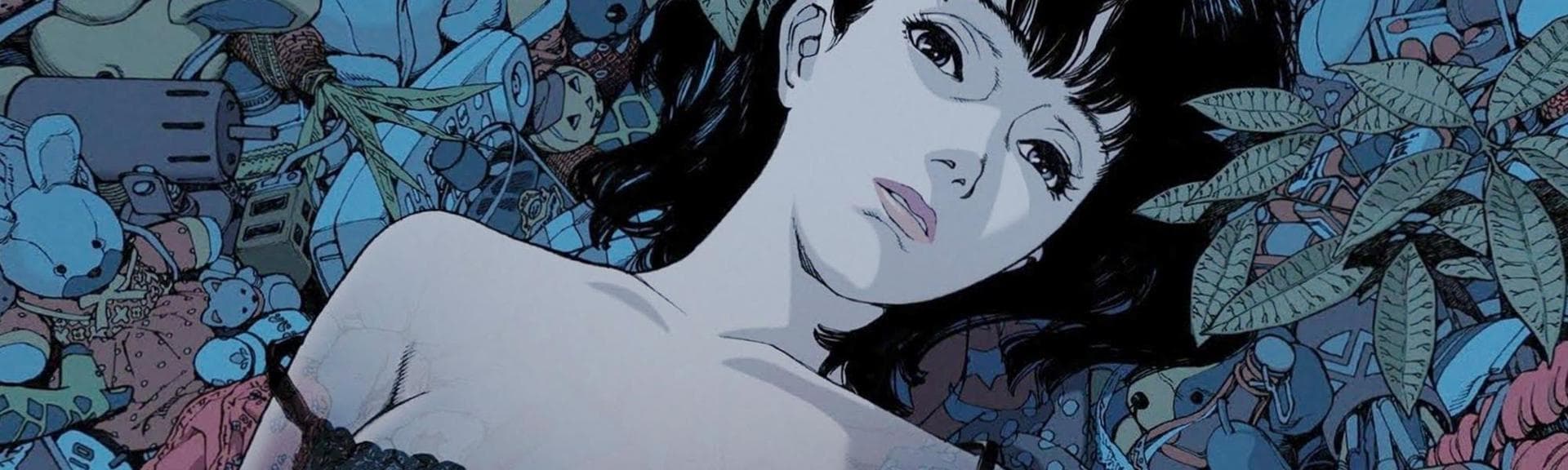
Perfect Blue
a review by Frozia
a review by Frozia
!!!WATCH THIS BLIND!!!
THE REVIEW DOESN’T CONTAIN SPOILERS BUT DISCUSSES STRUCTURE, WHICH COULD ALTER ENJOYMENT
The void between self and self-saught; the perception and awareness, or lack thereof, of one’s own character. Perfect Blue perfectly encapsulates the ever-present struggle of persona within the modern world.
When telling a story through film, I see it as 3 essential parts working together in harmony. The Earth we perceive, the lofty sky and space above/around us, and the underlying “true” Earth below; the auditory and visual, the theme(s), and the message or “true” theme. To have the ability to master all 3, weave them together, and have the end product be provocative and enjoyable is truly a work of art in itself. Satoshi Kon demonstrated this to the fullest extent here.
Kon constantly toys with you through his visual and audio cues, quite honestly driving you a little insane. There’s so much duality in every key moment. When Mima looks at her hands, is she referring to her dream or what happened last night? Which one was the dream? Were they both dreams? The film doesn’t give you much of a breather at any point to process every option for every detail. Though your gut reaction is exactly what Kon wants, which is to follow his surface-level illusion that is gripping in its own right. Let alone how he masterfully weaves in doubt and reason to doubt that doubt within a single scene. This draws your attention away from indicators of the true story, which are staring at you right in the face. It’s pure, cinematic brilliance!
As I was watching, about halfway through, I couldn’t help but notice this feeling that started to emerge and fester within me. The metaphorical ground was having a tremor. It went away as the movie reached its climax, but this was the first thing I wanted to tackle as soon as the credits started to roll. Eventually, I came to the realization that this was the same feeling I had when I watched Spirited Away; coming to terms with yourself, growing up, and moving on from microcosms. Admittedly, I confirmed my suspicions with a lengthy review/analysis, otherwise, I wouldn’t have known the word ‘microcosm’. The message hit me like a speeding truck (get it), as it did for many I assume, and oddly gave me comfort. Logically, I know my problem isn’t unique, and this movie’s depiction is rather extreme. Though, it was comforting to know that I’m not alone. Ironic and pleasant, as I write this alone in my apartment during my first holiday season away from loved ones.
After my viewing, I began watching “Kon’s lecture” in which he talks about certain elements that he considered deeply while he directed. I’ve only seen the first 2 of 5, but I can’t wait to watch this movie a few more times. The sheer amount of thought and care that went into each scene is astounding. His film-making philosophy seems so elementary, yet there’s this high level of elegance to it. I first thought the not-Power Rangers scene that kicks off the film was just to help set the time period. Instead, it was meant to frame your mind on the theme. Kon believes that the first scene of a movie is like the first page of a book and the abstract/thesis of a paper; it must hook the audience and allude to elements that will be divulged.
The first scene represents the dilemma Mima faces- the personas try to take down the “bugs” and their leader [for an audience that doesn’t care for the ‘real’ version]. The themes of reflection, masks, and perception. A fanfare of special FX and actors trying their best is met with disinterest and longing for the “fake” TV version. We then pan over to the general public right outside the event. No one cares, everyone’s focused on the idol group. All of this within the first minute.
Maybe this is a bit much, Kon himself recognizes this in the lecture and comments, (paraphrasing) “you need these kinds of hand-wavey explanations so, when people ask, you can answer with confidence, even if you made it up afterward”. He didn't really care if you caught this or not, nothing hinges on it. But, this is the stuff I love. Stuff like this plays a great part in what makes film, and art as a whole, so delightful to me.
To be able to spread messages evoked by personal strife and joy, so that the receiver of these messages may find solace with their own experiences and happenstance.
May you rest in peace, Satoshi
50.5 out of 55 users liked this review
