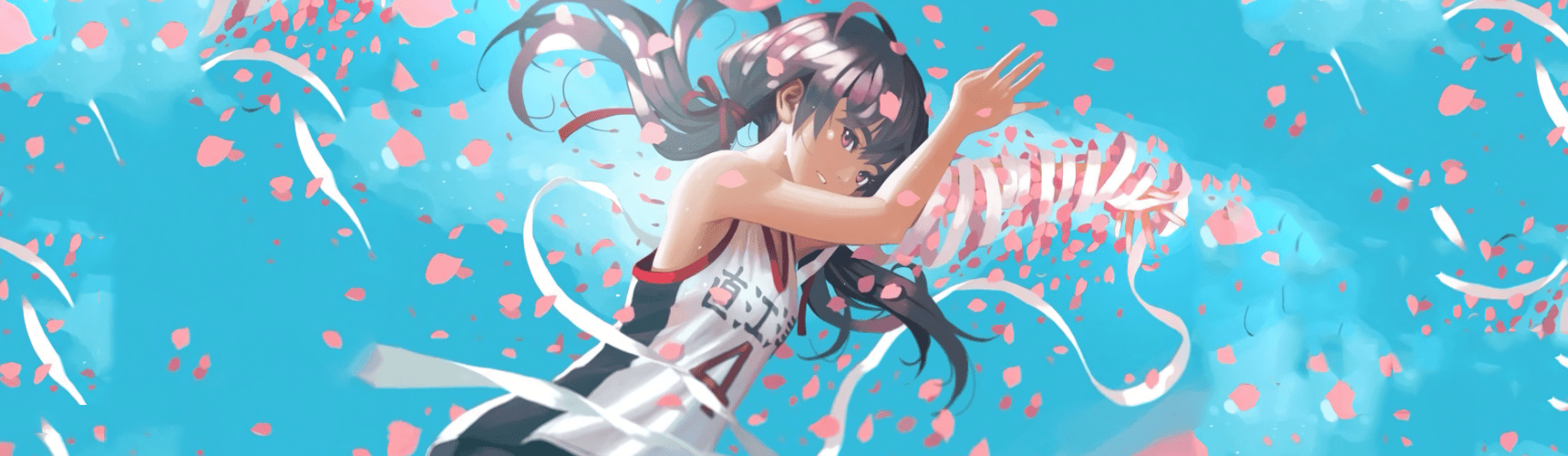
Hanamonogatari
a review by Wilza
a review by Wilza
Hanamonogatari presents a shorter, snappier and more relaxed follow up to Monogatari Series Second Season. There’s less complexity here than in Second Season, mainly due to the lack of an underlying continuous thread that can be established over multiple arcs. However, this more focused plot was a refreshing break from the very intense series the precedes it. The arc presented in Hanamonogatari works better as distinct and uninvolved from the complexities of Second Season.
Hanamonogatari, however, is by no means simple, merely its strength lies in a subtler plot. The stakes in Second Season always felt very high with the risks of every arc meaning life or death. Here, the story isn’t about that. Instead, it’s just about one character, her past and her present.
In Hanamonogatari we finally return to Suruga Kanburu, a character that hadn’t featured prominently since Bakemonogatari. Kanburu falls under the spotlight for the first time since Araragi met Kaiki in front of her house and the mysterious part of her history was first uprooted.
This series picks up following the (fortunate) graduation of Araragi, Senjougahara and Hanekawa. Of the original Bakemonogatari line-up, Kanburu is now the only familiar face left.
The show begins with words of wisdom told to Kanbaru by her late mother: ”If you can’t be a cure, be a poison. Otherwise you’re just plain old water”.
So we meet Rouka Numachi; a rival to Kanburu, the poison to Kanburu’s cure. While both are marked by bandages, they represent opposite things. For Kanburu, the bandages hide the reason she stopped running and started basketball (Devil → Bandage → Basketball). For Numachi the bandages are that of a real injury, one that ended her basketball career and crushed her talent. We learn, of course, that Numachi’s bandages also hide the limb of a devil (Basketball → Bandage → Devil).
Just as the bandages come to be worn for opposite reasons, the two characters motivations and attitudes towards the devils parts are opposed. While Kanburu wants to get rid of the arm, she also sees her carrying of it as necessary, as a punishment for her sins and an insurance against the evil it can cause. In this, she is selfless.
Numachi, on the other hand, collects the parts of the devil. Her enjoyment of the misery and problems of others leads her to collect the devil parts. She isn’t evil, but her reasons for doing so are purely selfish. Ultimately, Kanburu fears Numachi as a poison that will become twisted by the parts she is collecting.
As rivals, Numachi and Kanburu mirror each other. They are reflections of each other, rather than opposites. Kanburu wished upon the devil to solve her problems. And Numachi… well, as it is revealed, Numachi took her own life.
So, in the final episode, Kanburu stares down the twisted reflection of herself: a ghost unaware of its own death. An offensive player mirrored by a defensive player. And Kanburu defeats the apparition by playing cooperatively, rather than playing alone.
Just as the show begins, it ends with the same comment from Kanbaru’s mother. “If you can’t be a cure, be a poison. Otherwise you’re just plain old water”. Through Numachi we see what could have happened to Kanburu if she couldn’t have been a cure. And we see what happened to Numachi when she couldn’t be a poison. Her ghost, like water, washes away leaving only the parts of the devil.
Hanamonogatari once again showcases Shaft's adeptness for animation. The detached settings that have fast become the signature of Monogatari perfectly elevate the dialogue of each scene.
Some personal highlights would have to include Kanburu and Numachi’s first conversation, particularly the shots of them talking between the rows of excavators.
Another fantastic scene was the conversation that followed their second confrontation on the basketball court. Numachi is seen magically moving a basketball around, only for the room to be suddenly filled with basketballs. The whole scene was outstandingly creative. It’s a real treat to watch a show like this.
I also enjoyed this little easter egg in the final scene:

I noticed the letters in the circle, and it of course spells ‘Schadenfreude’, which refers to the joy derived from learning of the misery of others. Very clever.
Hanamonogatari has really captured a part of what made Second Season so outstanding. Following the same process of building upon the foundations of the first season, Hanamonogatari explores the complexities of Kanburu. It brings new challenges, while also asking us about what we already know. Why did Kanburu’s mother leave her the devil’s hand? The series posits one answer: that it was to prompt Kanburu to think about what she wished to be. I like that answer.
And I liked this series too. It’s a perfect follow up to Second Season. It’s not trying to compete, and it really doesn’t. It just provides yet another incredible story, but a more focused and contained one. It’s a neat little second part of the second season. A nice spot of desert after a delicious main meal.
28 out of 30 users liked this review
