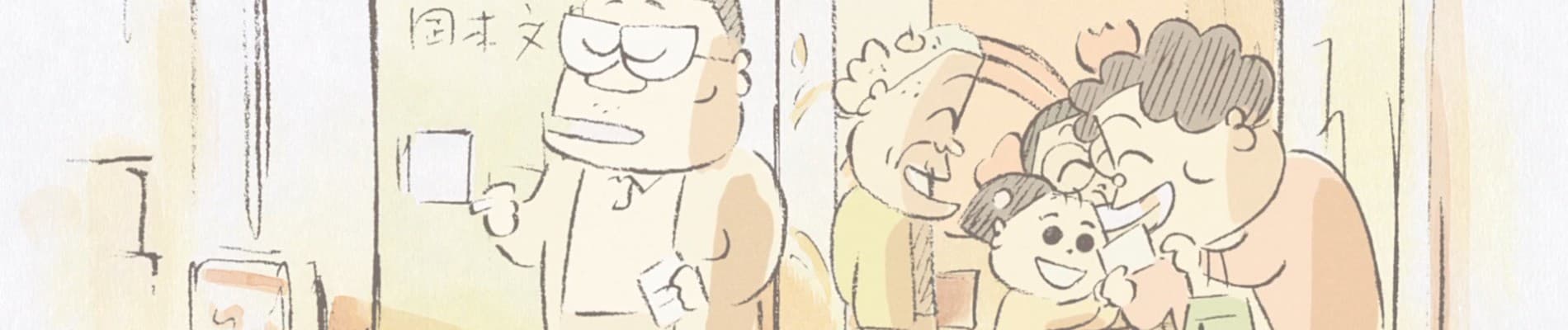
Hey there, welcome to town! This is a pretty closely knit neighborhood, play your cards right and I guarantee you’ll know everyone on a first name basis by the end of the week. Speaking of which, have you met the Yamadas? They’re this family of five up the street, and they’re always in the middle of something. Married couple, nice for the most part. Got one cute little girl... They also have an older boy who’s trying to get into college, but between you and me, I heard he isn’t doing too great. Guy’s got his mother-in-law living with him, too... Word is she owns their land, and with that attitude of hers, you’d think she owned everything on it as well. She’s a tough old broad, if you don’t mind her sillier moments. You know what I heard? We used to have this biker gang disturbing the peace most nights, right up until she chased them out. I don’t know how, but you really shouldn’t mess with the older generation, not with everything THEY lived through. Anyway, they’re a pretty normal family... Well, as normal as any family can be, am I right?
My Neighbors the Yamadas was produced by Studio Ghibli, a studio that requires no introduction, even if this movie kind of does. While Hayao Miyazaki is the brightest start of the studio, he’s not the only director who ever worked there, with director Isao Takahata being probably their second biggest name. You may not have heard of him, but if you’re into Ghibli on any level, you’ve probably seen at least one of his movies, most likely Grave of the Fireflies. He doesn’t really have an established visual style... At least not one that you’d notice right away... and The Yamadas was the second to last movie he ever directed before his death in 2018. Takahata is one of the names I usually bring up when people try to argue for their favorite American cartoon to be called an anime because “It’s in the anime style,” which both an infuriating argument in its transparency, and an objectively false argument that’s insultingly reductive to the medium. There are quite possibly a wider range of animation styles in Japan than there ever have been in America, and looking at this title in particular, The Yamadas has an entirely unique style all it’s own.
I think the closest thing I’ve personally seen to this particular style is Crayon Shin-Chan, just in how rudimentary and distorted everything is, but the proportions aren’t close enough to call it a match. Rather, The Yamadas seems to use an aesthetic that I can only really describe as a child’s drawings of their family come to life. Or, from another perspective, what a Japanese newspaper comic might look like, which is fitting because that's literally exactly what it is. It’s very clearly not for everyone, and while I personally like it quite a bit, I can see how it might throw off someone who’s looking for something a little more traditional and homogenous in design. It’s a matter of taste to be sure, but the animation itself is still top notch, high quality stuff, and despite the simplistic and archaic appearance, they clearly had a ton of money to poor into this project... Not surprising, considering this is Ghibli and all. Movement is fluid, characters move gracefully and with a deceptive sense of gravity, and their faces are highly expressive and capable of recognizably portraying the entire spectrum of human emotion, which is impressive for characters that barely look human. Klasky-Csupo, take some notes. Again, with the design itself being the only sticking point, it’s an incredibly good looking film.
The soundtrack is largely a mix of traditional style Japanese music mixed with western classical music pulled directly out of the public domain, creating a sound that could realistically appeal to both sides of the ocean. What’s more notable though is the use of the song Que Sera, Sera, a decidedly American song that they rewrote to better convey the themes of the movie, and I’m just going to say it now, I could easily see this pissing off some people. The Yamadas is by no means the first Ghibli movie to heavily feature an English language song on it’s soundtrack, what with Only Yesterday featuring The Rose and Whisper of the Heart featuring Country Roads, but neither song is rewritten to a point that many might call bastardization. Which is weird, because Whisper of the Heart literally featured a subplot about someone rewriting Country Roads. Que Sera, Sera is kind of a sensitive song... This isn’t a great comparison, but it’s kind of like the female version of Cats in the Cradle, a heartfelt song between a child and one of their parents that means a lot to some people... And was anybody happy when Cats in the Cradle received a racist parody song about Chinese food? I don’t know, I personally think the version in the movie is fine, it fits the material really well, but I can see how someone with a deep and personal connection to the original might be displeased.
The English dub, on the other hand, is quite frankly perfect. There are no real anime voice actors in the cast, I mean what are you expecting, this is Disney after all, but they did manage to get Tress McNeil as the voice of the grandmother, Shige. The only way you don’t know who Tress McNeil is would be if you’ve literally never checked the voice credits on any of your favorite cartoons growing up, and you just assumed that the only woman of a million voices in American animation is Tara Strong. See if some of these names ring a bell... Dot Warner? Babs Bunny? Daisy Duck? Probably like half the female characters on anything Matt Groening’s ever done? She plays Shige, and she is absolutely spell-binding. Jim Belushi and Molly Shannon, who are probably two of the last names you’ll ever see in the cast of an anime dub, are surprisingly just as good. It’s not surprising to see Disney cast real children as child characters for a sense of realism, and the two they picked to play the couples’ children are actually damn good in their roles, you probably wouldn’t recognize their names today... The girl has made a career off of small roles in family entertainment, with her biggest role ever probably being Leni Loud, and the boy’s done mostly the same, his biggest claim to fame being the Spy Kids films. In any case, the acting is great, the adaptive script is extremely accurate and respectful in it’s translation, and you can’t go wrong in either language, but if you’re a dub guy like me, this one is highly recommended.
So this movie has a pretty depressing reputation among Studio Ghibli fans. It’s not considered the worst Ghibli movie, or even the most boring, but it’s often considered the most forgettable. Now, every single Ghibli movie has it’s fanbase, no matter how small they may be, and the smaller they are, the more viciously defensive they are, protecting their precious baby with all the ferocity of a trained attack dog. I should know, because that is exactly how I am with Only Yesterday, and I am not ashamed of it. Still, positive reviews for this movie usually fall into one of two categories... They’re either lukewarm defenses that argue it’s not so bad, or that you have to be the right demographic to appreciate it, or they’re brief, flowery fluff pieces that claim how important simple and inoffensive family films are and how dare you question them! The weird thing is, I really like this movie, and I don’t fall into either of those camps, at least not entirely. It’s hard to explain my thoughts on the film without defaulting to cliches like "Hashtag relatable", so I’m instead going to go the more interesting route, and do what I usually do when my back’s against the wall... Make obscure references to completely unrelated pieces of media that make no sense in context until I explain them! Sorry, but I am who I am.
There are two movies that My Neighbors the Yamadas reminds me of, and they couldn’t possibly be more different from one another. The first one is Summer Magic, a live action Disney movie from the early sixties that’s so obscure, Doug Walker still hasn’t featured it on Disneycember yet. You might not have heard of it specifically, but if you’ve ever heard the old children’s song The Ugly Bug Ball, that was this movie. Much like The Yamadas, Summer Magic is a nearly two hour movie comprised of vignettes detailing the everyday lives of a small family interacting with both each other and the world around them. I’m not going to beat around the bush, it’s a pretty bad movie. There are parts of it that haven’t aged well, the ending is underwhelming to put it generously, and the only things that really stand out about it are a couple of catchy songs, and featuring roles by legendary actors Hayley Mills and one of my personal favorite musicians of all time, Burl Ives. Still, even though I recognize it as a bad movie now, I grew up with it, and it means a lot to me.
The other movie is a late seventies surrealist horror film called Eraserhead, by the legendary David Lynch. It’s pretty widely known among horror fans as a bizarre mindfuck of a film that goes to some very uncomfortable and unnerving places, but if you’re able to look past all of its shocking imagery, you might find some meaning in its fairly deep metaphorical subtext. The most common reading of the film is that it’s about a formerly single man dealing with the way fatherhood is changing his life. As the result of an unplanned pregnancy, he winds up being pressured into cohabiting with a woman he doesn’t particularly care for, at the behest of her creepy and off-putting parents who have a remarkably troubling relationship with her, only to find out he can’t stand living in closed quarters with her as her strange habits render him speechless, and she very quickly abandons him to take care of a baby that is a monster... Both as it’s shown to us in it’s literal form, and on a deeper level in the way it takes over his life with demands he can’t understand. Yeah, there’s some deep issues being addressed here, especially when you find out Lynch was expecting his first child during production.
My Neighbors the Yamadas bears some stark comparisons to both of these films, both in the similarities it has to them, and the ways it veers off into a different direction. Starting with Eraserhead, The Yamadas is more than happy to use metaphorical imagery to explore the dynamic of family. One of the biggest differences between Miyazaki and Takahata is that while Miyazaki normally uses the medium of animation to explore vast fantasy worlds full of imaginative creature, using animation to it’s fullest to make the impossible possible, Takahata prefers to tell smaller and more human stories, ones that really shouldn’t HAVE to be animated, but he uses animation to break reality whenever he wants to convey a heightened emotion. For example, just seeing Taeko flirt with a boy she liked in Only Yesterday isn’t that impressive, but seeing her become so overjoyed that she literally climbs an invisible set of stairs into the sky and start flying in carefree glee? That’s the kind of shit that warms my icy heart. The Yamadas is bookended by two distinct sequences like these.
I won’t reveal what the ending sequence is like, but the opening sees Takashi and Matsuko(the mom and dad) navigating what I can only describe as a magic carpet ride(even though the mode of transportation they use keeps changing throughout the journey) through their life together, starting with their wedding and progressing as the metaphorical rendition of a speech someone is making for them at the ceremony. My favorite part of this sequence is when they’re going through the process of procreation, and the narrator starts telling them to have children as soon as possible, and that parenthood is the key to a successful marriage, and it’s not as hard as everyone says, all while we witness artistic renderings of all the lies parents tell their kids about where babies come from... Storks, cabbage patches, freaking bamboo shoots... All of which can be interpreted as early parenthood being something that neither first time parents nor their children themselves are allowed to fully understand. There’s more, obviously, but that on its own is pretty genius, right?
And as far as it’s similarities to Summer Magic... Well, I’ll be honest, it’s a much better film than that one. Summer Magic is the kind of slice of life movie where every vignette you see is some kind of significant event. The Yamadas, on the other hand, presents you with totally mundane events and presents them as significant. Summer Magic is smarmy, saccharine and non-stop bright, with every problem being overcome as quickly as possible. The Yamadas isn’t afraid to get vaguely dark, albeit never in a way that’s beyond PG, acknowledging the concept of death in both the abstract and the future-tense. Both movies are almost exactly the same length, with maybe a three minute difference, yet The Yamadas somehow feels only half as long. The cast of Summer Magic may have more identifiable character traits, but they feel like gimmicks compared to how fleshed out and human the cast of The Yamadas feels, especially after everything you see them go through. You see them get along, you see them fight, you see conflict as well as warmth, and I do not mean the kind of quippy conflict you see in sitcoms. These characters don't just trade barbs, they bounce off of each other organically.
And I know I’m ragging on one of my childhood favorites, but Summer Magic isn’t a movie that’s intended to be critically analyzed. In a way, neither is My Neighbors the Yamadas. They’re both movies that you’re supposed to watch with your families, as they’re both safe for younger audiences(albeit with a bit of parental guidance) as well as lovingly nostalgic for the folks. They’re movies you’re meant to grow up with, at a time in your life where characters mean more to you than just fictional people, they feel like something between friends and family; They’re like your neighbors, and I wouldn’t be surprised if that was how The Yamadas and Totoro got their extended titles. I just happen to think, removed from the bias of my childhood, My Neighbors the Yamadas is better at this than Summer Magic in every single way. It’s honest, it’s relatable, It’s genuinely funny with a good sense of comedic timing, and as much as some people lament the animation, I think it works perfectly well for the material. I know most people in the west didn’t grow up with it... Hell, who among us grows up with any anime, unless it’s some popular trending series or we have otaku parents who want to indoctrinate us into the fandom? But at the very least, I think it’s worthy of being appreciated for what it is.
My Neighbors the Yamadas is available from Gkids, previously from Walt Disney. The original manga by Hisaichi Ishii, along with a TV adaptation that started airing a couple years after the film's release, are not available stateside.
I may not consider My Neighbors the Yamadas to be one of the best Studio Ghibli films, but I also don’t consider it one of the worst. I place it somewhere in the middle, a family film about families that was written for families, and despite its unfortunate obscurity, it does its job really well. I’ve never personally believed that a movie being “for kids” or “Family friendly” was enough of a reason to call it good or ignore its flaws, but in this case, the fact that it’s well paced and consistently funny without ever coming off as cheap or mean spirited definitely works in its favor. It’s not for everybody, and as with most of Takahata’s work I could honestly see people getting bored with it, especially seeing as this film is minimalist even by his standards, but speaking as someone who generally prefers Takahata’s films over Miyazaki’s, I really enjoy it. Check it out if you’re a completionist, if you’re looking for a wholesome family comedy, or if you just want something funny and relatable to watch with your kids.
I give My Neighbors the Yamadas a 7/10.
8 out of 9 users liked this review