Update: As of October 15th, 2023, this review was been completely rewritten.
Hey, wait a minute! Didn't I already review this almost a decade ago? I did, actually. I've been looking back on a lot of my older reviews and found that they're not up to par with how my reviews are now. One person reached out to me in regards to an old Digimon Adventure review I posted here AniList a while back, pointing out some things that I could have done better. I thought about it and was like "You know what? They make pretty fair points. Plus, I already redid my reviews for Anohana, Madoka Magica, and Digimon Xros Wars. What's stopping me from doing the same thing for Digimon Adventure?" Plus, now that Discotek Media re-released the series, both dub and sub, on Blu-Ray, I actually have an excuse to go back to the series and re-evaluate it! And I will admit, my original review is pretty old and rather overly fangirly, so I think it's high time I post a new review of the series. That being said, I do have a pretty sentimental connection to Digimon Adventure. It was one of the first anime I watched growing up, alongside Pokemon, and yes, I was a kid who loved both series equally, so I was never a part of the whole Pokemon VS Digimon debate that plagued the 90s and early 2000s.
A cursory summary of Digimon Adventure consists of the following: Seven young children find themselves magically swept away from their summer camp and into another world where mysterious monsters known as Digimon rule the roost. The kids find themselves bonding with their respective Digimon partners, but with only them and devices called Digivices for protection, they have to find a way home. But the Digital World is fraught with danger, and the kids will find themselves not only facing unknown evils that threaten both the Digital World and their own, but their own personal demons as they discover more about this mysterious world they fell into. So in essence, Digimon Adventure is basically an isekai before the term isekai entered the modern lexicon. Of course, back in the late 90s, isekai anime back then were much more varied than the typical stock light novel fare that saturate the anime/manga industry today, such as Magic Knight Rayearth, The Twelve Kingdoms, Fushigi Yuugi, and so on. But there are several things about Digimon Adventure in particular that really resonated with kids on both sides of the globe, me included, and became the pop cultural phenomenon that continues to be beloved and remembered to this day.
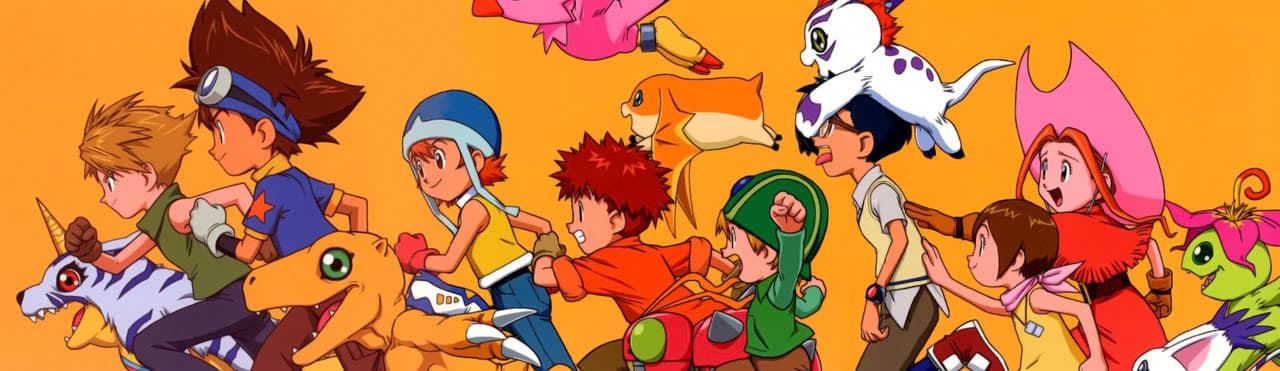
As far as the animation goes, it's not exactly one of Toei's better animated properties, but that doesn't mean it doesn't have its own unique charm to it. The human designs for the characters manage to toe the line between cartoony and realistic without going overboard, while the Digimon creatures all have fun, unique designs that still manage to look distinct even decades later. That being said, this was a show made in 1999, complete with all the foibles and corner cutting that comes with it. Stock footage of Digimon digivolving and using their attacks is repeated ad nauseum, action scenes are drawn using as little on-screen movement as possible (Usually in the form of Digimon grappling with one another), other times the series tries to simulate movement by rotating a still image of a Digimon in a circular motion, and there are even times when the characters' eyes are drawn either really close or too far apart from one another depending on who was brought on to animate that particular episode. Often times changing in between scenes! There are even times when the characters don't even look like they're on the same layer, with several scenes showing the characters in the immediate background having thicker lines than those in the foreground, who have thinner outlines (One example being the Piximon episode, where TK and Tokomon race to clean Piximon's house). Yeah, consistent animation is not really this series' strong point at times. The series does get points in regards to its background art, which consists of nice, dreamy watercolor backgrounds for the Digital World, and Toei did a great job at really making the Digimons' home world look as distinct and otherworldly as possible, complete with its own rules, history, and lore. Seriously, modern isekai anime should really take a page out of Digimon's playbook in terms of worldbuilding and fleshing out its setting.
The soundtrack by Sailor Moon veteran Takanori Arisawa is also a pretty major talking point because of just how different it is compared to the one provided by Saban. The music here, while parts of it can be heavy on the orchestras like Saban's can be, is much more subdued, and it knows when to pop off when a scene calls for it. Its also surprisingly versatile, dipping into genres such as rock, techno, pop, jazz, metal, and choral whenever a scene calls for it, with instruments such as saxophones, harmonicas, and woodwinds making the whole sound profile feel varied and whimsical without going over-the-top. And do I even need to mention all the songs by Kouji Wada, Ai Maeda, and Ayumi Miyazaki? What can I possibly say about those that haven't been said already? There are reasons why Butter-Fly and Brave Heart are beloved by the Digimon fanbase. In stark contrast, Saban's self-made soundtrack for the series, made by Udi Harpaz and sung by the late Paul Gordon, was all very heavy orchestras that were VERY firmly on the pulse of what was popular during the late nineties, and since execs decided that kids shows aren't allowed to have any moments of silence for some dumb reason, the music was EVERYWHERE, even when it would have been unnecessary and inappropriate to have it, oftentimes ruining the intended mood (Like the very peppy song Hey Digimon playing during really dramatic moments, like losing a battle or saying goodbye possibly permanently).
Most people who grew up watching Digimon as kids remember the characters, and for good reason. All of them are given the appropriate amount of development and each have their own unique strengths, weaknesses, idiosyncrasies, and quirks that make them actually feel like real kids rather than a bunch of stereotypes and caricatures. Now, in Japan, putting kids in frightening situations and having them actually face hardships and grow as people, and dealing with mature issues like adoption, divorce, abuse, illness, death, and so on is nothing new, as plenty of other children's anime such as everything in the World Masterpiece Theater have done it as far back as the seventies. Japan's lax broadcasting standards, even in that era, allowed for children's anime to tackle things that most countries, especially North America, wouldn't dare touch with a ten foot pole. Ironically, this is what would cement Digimon as a significant pop culture touchstone in North America because for all of Saban's attempts to water it down and make it more kid friendly, even removing stuff like guns and violence (Mainly because of execs not wanting to show cartoon kids engaging in "repeatable behaviors" and giving overzealous parents reason to riot, along with forcing them to adhere to strict broadcast standards), the team that adapted Digimon into English were given some free reign to keep a lot of the core themes in tact, which was extremely rare during the 90s and early 2000s, which this video from the Cartoon Cipher covers in more detail. Children's shows where kids were forced to own up to their own flaws and grow as people, and going through fairly realistic situations that are actually relateable, were extremely rare in North America, and while that's somewhat changed nowadays, American TV execs are still unfairly stringent when it comes to actually allowing kids' cartoons to be anything that's not sugary or saccharine because they're afraid the soccer moms will riot if they do. I'm glad Saban actually allowed the team working on Digimon's dub to keep the characters' core essence and nuances in tact, even if not every decision they made was the best, i.e. making Mimi much more of a stereotypically girly girl than she was in the Japanese version.
Rewatching it as an adult, I was surprised by how tight this series' storyline was. Mainly in that every episode progresses the plot in some way, whether it be the main narrative or giving the characters some time in the limelight and showing what they're like outside the central conflict. Yeah, the core premise itself is pretty cliche by modern standards, and the villains are all stock Saturday morning cartoon villains who want to take over the world, but hey, they're at the very least proactive and get stuff done rather than sit around in their lairs all day. But I think the main characters being as charming and well-developed as they are, along with the tight writing for the series as a whole more than make up for this...which makes the fact that the 2020 remake completely ditched all of this in favor of non-stop action and fighting all the more awful in hindsight. Good lord, I will never forgive the 2020 series for completely pissing on everything that made the original series so good. Even though I've grown up with the English dub, and even rewatched it when it aired on NickToons, my immediate memories of it are still fuzzy. But rather than just rehash a bunch of points others have made about the changes made to Digimon's English dub, I'm going to recommend that anyone interested in learning about the dub's history read Discotek's intensely detailed liner notes about it, and you can download PDFs of them here. Discotek was originally going to put these on the Blu-Ray they put out for Digimon, as they've done for other shows they released, but for undisclosed reasons they weren't allowed to put them on BR. To make up for this, they were given permission to put them on the internet, making them accessible for anybody who has a working computer. Seriously, I highly, HIGHLY recommend you download and read those liner notes, because they go into extensive detail about EVERYTHING in regards to the series, such as its history, its production on both the Japanese and English side, the real life locations used in the series, continuity errors in the dub, voice cast changes, reasonings behind significant changes and dates in the series, call backs to the original games, the meanings behind the Digimons' names, and even pop culture references. And trust me, the real explanation behind August 1st being significant in the series is wild.
Other than the animation goofs I mentioned above, the only other issues Digimon Adventure has are some things that are left unexplained (Which, ironically, do get explained in Japan-exclusive novels, which we Americans never got. Whelp) and the occasional Deus Ex Machina near the end. But even those are small potatoes compared to Digimon Adventure's strengths as a whole. Say what you will about how other shows have done similar premises since Digimon's conception, and how it's not much different from other stuff Japan has made before or since, but the fact that North America mostly left the series alone when bringing it over here might have been the best thing to happen to the series. Digimon Adventure as a series took its audience seriously and never talked down to them, with the staff behind the English localization realizing this and fighting to keep its core themes of friendship and overcoming hardship even within the ridiculous restrictions that American broadcasting standards tried to suffocate them with. This is why people who grew up with Digimon, myself included, still love and adore the series to this day. No, seriously, as of right now, Discotek is in the process of not only re-releasing the first three Digimon movies on blu-ray, but giving them brand new, uncut English dubs, bringing back as many of the English voice cast and staff as possible, all helmed by people who grew up with the series and want to give it the treatment it deserves. This would likely NEVER have happened if the Digimon series had been subjected to, say, the kind of treatment that 4Kids gave a lot of their shows back in the day. At this point its only a matter of time before Discotek licenses Tamers and onward. Now if only someone would give similar treatment to, say, Tokyo Mew Mew or the original Cardcaptor Sakura or Ojamajo Doremi. Those shows deserve uncut re-dubs too, dammit!!
Digimon Adventure may not exactly be the most original children's anime out there, but the fact that it remained such an important, beloved series even as its audience grew up cements its place in pop culture history no matter which side of the Pacific you're on. It certainly defined a good portion of my own childhood, as it did for many others. But for the love of God, STAY AWAY FROM THE 2020 REMAKE!!!! IT SUCKS!!!
12 out of 13 users liked this review