BanG Dream!
a review by ZNote
a review by ZNote
SPOILER-FREE!
There is just no predicting the life of a franchise. Seemingly for no reason whatsoever, a certain property can catch on like wildfire and take the anime community, or the larger media-consuming public, by storm. Other franchises peter out into oblivion before getting their chance to shine, and yet still there are some where their very existence is a jumbled mass of “What on Earth is going on?” Especially given the sometimes-erratic nature of anime production, there are some buses that keep starting and stopping.
BanG Dream! is one such show that falls into that category. Originally released in Winter 2017 to complement the video game, the animated franchise effectively underwent a period of dormancy for a few years before its second season was released in Winter 2019. The second season itself was more a functional reboot and re-writing of the rules, as it ultimately continued the series in a new kind of direction both tonally and character-wise. In the meanwhile, it’s worth taking a look at this first season since it stands apart as though it resides in its own universe, somewhat divorced from the whole that eventually formed from it.
______
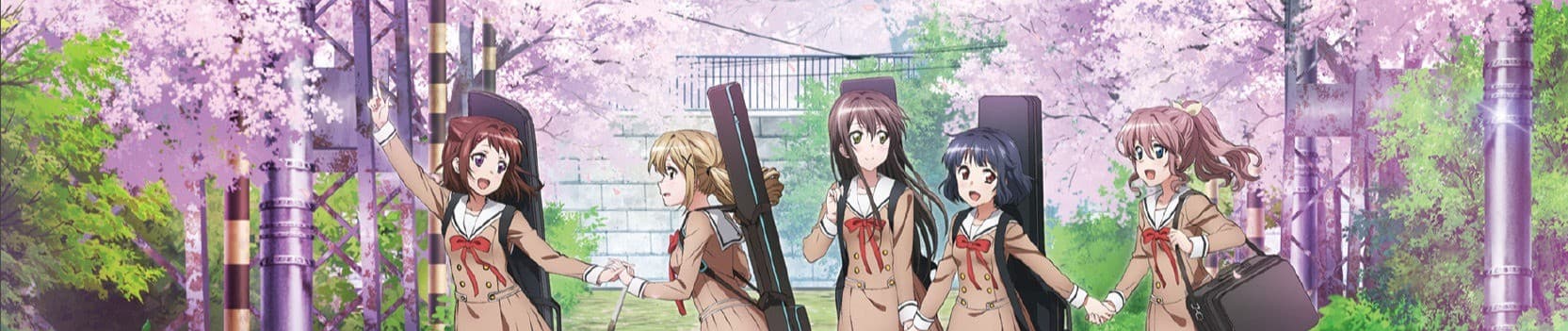
New high school student Toyama Kasumi is looking for something that will cause her heart to beat like it did when she gazed at the starry sky as a child. After following a trail of starry stickers to her classmate Ichigaya Arisa’s warehouse and fawning over the star-shaped guitar there, she and Arisa both attend a Glitter-Green girl band performance at the SPACE club. The performance ignites the fire that Kasumi has been looking for, and together with Arisa, a baking family’s daughter named Saya, the younger sister of a Glitter-Green member named Rimi, and SPACE club staff member Tae, they form their own girl band – Poppin’Party.
Despite the rather conventional setup, BanG Dream! early on demonstrates a narrative awareness of the genre and actively works to try and subvert it. Under normal circumstances, a show like this about making a group (be it for a sports club or an idol troupe) would introduce the various members one at a time, usually the result of being swept up by the main character’s charisma or presence. The series doesn’t completely divorce itself from those standards, but here though, all five Poppin’Party members are introduced and interact with one another early. The sense of familiarity with the various members is allowed to germinate sooner than most other shows would, so by the time the group begins to form, enough time has been taken to establish the dynamic. This holds true even though they are not all brought into the group at the same time. It makes the overall sense of character camaraderie tighter than it would be otherwise.
Though as far as the individual characters personality-wise are concerned, there is definitely a wide disparity between which ones resonate as far as an enjoyable presence. Two characters best exemplify this, with one being Arisa. She’s the group’s curmudgeonly character, and easily became one of my favorites to see. Her reactions and quasi-tsundere tendencies are thankfully over-the-top enough to get their comedic value without crossing the boundary into nauseating, and the fact that all of the group members seem to know exactly how to push her buttons makes poking fun at her fair game at any moment. The story also gives her enough moments to show that, despite all of that, she still has fun and will go those extra steps for her friends.
Kasumi’s character is unfortunately at the opposite end of that spectrum, at least at first. As could be expected from an overly-enthusiastic character which comes dangerously close to being a nuisance, she doesn’t necessarily have the greatest sense of personal space, and already wants to be on given-name bases with nearly everyone that she meets. Her presence produces the rather strange effect of both wanting to see her dream of Poppin’Party realized, while also seriously wishing that she would, at times, dial it back, and not just a little bit. It never got to the point where I didn’t want to see her on-screen, however the writing seemed to channel her energy in a hundred different directions that took too long to find its way. This does partially get rectified in the second half of the season when she faces a shift and can demonstrate restraint and unease.
Part of this shift is due to being at the mercy of the shift in narrative tone – at first, BanG Dream! tries to straddle the line between wanting to and not wanting to take itself seriously. Kasumi roping in the other members of Poppin’Party reads as light-hearted, yet cannot quite coalesce since the show’s anchor is teetering on the edge of being a frustration. Halfway through the season we come across the first genuine conflict of the show, but it does have the problem of being almost too serious in contrast with more or less everything else that came before. It’s one of those circumstances where juxtaposition works in theory, yet the actual impact feels more ham-fisted and artificial since the dissonance is so stark.
The end of the season, however, manages to settle into its proper rhythm – if the previous arc went a little bit far with its gravitas, the final few episodes manage to find a decent middle ground between them. The problem facing the group is serious to be sure, but feels more akin to an actual problem that a real band would be facing if they were trying to become known. By getting a cold dose of reality splashed in their faces, it allows the group to show their true mettle and tackle their challenge head-on. It therefore makes the season’s climax read as deserved.
The look of the show itself is not terrible, but it does leave something to be desired. Despite coming out in 2017, BanG Dream! season one feels as though it came out of the late-2000s with its character designs. The compositing however is its weakest element – there is an awful lot of sunshine in the course of the series, which unfortunately gives too many scenes a bit of a glare and whitish hue. Quite a few locations are recycled, which is perfectly fine, although certain things like the warehouse rehearsal space are rather blank.
Gratefully, if the visuals were lacking in some respect, the music does help to make up for a lot of these shortcomings. Though, given the Poppin’Party songs that were available at the time of the anime’s release, I do have to wonder why they chose “Tokimeki Experience” as the OP song. The track itself is not bad as a standalone piece of music, though it lacks the kind of exuberance that the story seemed to be striving for. That said, all the choices for insert songs within the thirteen episodes themselves were good picks, and the rare occasions where there was original material contributed to an earnestness that was pleasant.
And “earnest” more or less is what defines the first season. In the midst of its heavy-handedness and occasional times where it wasn’t that funny, this did feel like a group of five girls who cared about what they did and about each other. There’s a kindness in the series that made it seem like this band was worth following. Did I like this season? I can’t say that I did, but I was intrigued by it, which is more than I can say for a lot of other things I’ve seen in the course of my anime life.
___________
BanG Dream! season one is an odd duck. It seems to keep itself tied up when it wants to let loose, and when it does indeed let loose, it gets a little bit crazy. It manages to find some semblance of balance in the second half by introducing some rather practical conflicts and allowing the group as a whole to combine in a way that feels strong. It may be at times rather uneven, but it was fun when I wasn’t necessarily buying it or laughing with it. It’s kind of in its own quirky little corner of the anime music world…
15.5 out of 17 users liked this review
