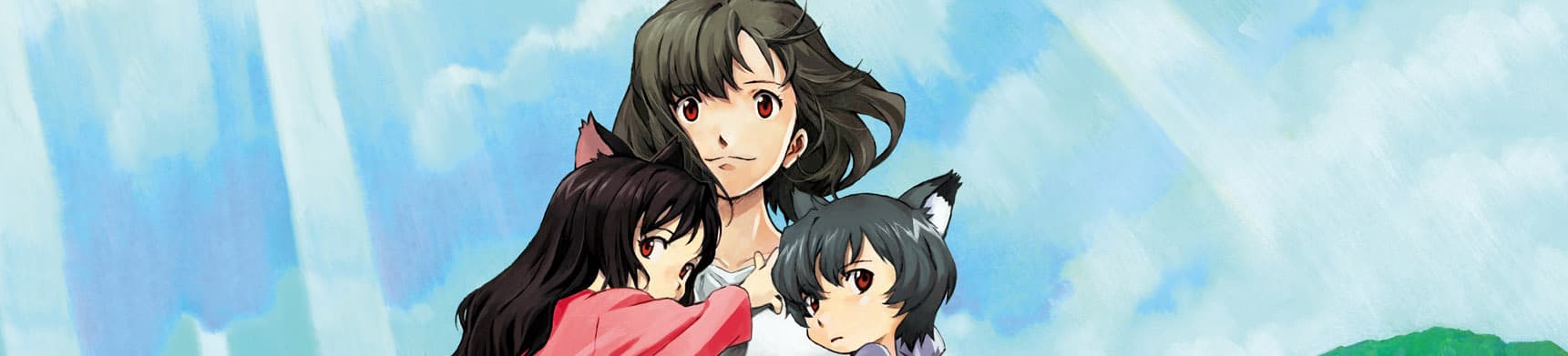
Wolf Children
a review by DoctorGlitch
a review by DoctorGlitch
"Attention, this review is composed exclusively of love and passion, we advise the bitter cynic and breakers of atmosphere of any sex and origin to leave the place while it is still time."
We are facing a complicated case because I have to say that The Wolf Children is a great movie in many aspects and categories but especially in what it has traumatized me so much that it ended up in number 1 of my top 10 movies; and that after about twenty viewings having engraved the movie in my DNA I still find myself crying at the end as if I had discovered it, taking into account that I am Autistic Asperger and therefore that my reactions and emotions are constantly amplified and "different from the norm" to say official terms, yeah it's not going to be easy but I'm giving myself the challenge because if you can review your number 1 movie you can review everything it's mathematical.
Wolf Children Ame & Yuki is the 3rd original film of Mamoru Hosoda without taking into account his commissioned films for the Toei, a director that I appreciate enormously because beyond finding myself in his themes I love his style and his aesthetics, When you see a film of Hosoda you do it without being told because even in his Digimon Adventure short film and film and his One Piece film he incorporates his artistic style not very detailed but conducive to living mobile animation and incorporated his fixette especially on the relationship of all kinds, Internet and anthropomorphism, and to put his touch in films as calibrated as One Piece at least to totally change the artistic direction is already the proof that Hosoda is a real author someone who appropriates all his projects to shape them to his image, After 2 successes that put him on the front of the stage to the point of having the famous nickname "new miyazaki" (which I always found stupid because their style is different in every way) this one puts aside the great story of time travel and internet war completely remade from Digimon: Our War Game and here he is on a more modest story: A mother and her therianthrope children.
The story of Hana falling in love with a wolf man, giving birth to two children, becoming a widow and moving back to the countryside to lead her life as an unusual mother in the best possible conditions is the most touching, poetic, beautiful and gripping thing I've ever seen as a moviegoer: Hana is a great character of a mother, she is devoted to her children and takes care of them with great care despite the many difficulties, she is so resourceful that she has completely renovated an old house in ruins and she is incredibly courageous, she never gives up, she is a model of a mother character, or better, she is THE mother.
The wolf man succeeds for the little screen time granted to us: it is a simple and motivated man, shown by its various small physical work and by the tragic destiny of which it will be victim it will leave hovered has its death an aura on the family, No mourning, no, Hana will do it early in the story, but as "the one who watches from the sky" when Hana sees him again in his coma in this luminous flower field, a kind of spiritual meeting point for the couple, he knows everything that has happened since his death and how good a mother Hana is, just as he knows that Ame is doing well at this precise moment in the story.
Ame and Yuki are also wonderful characters, I really appreciate that the movie with them shows us almost all the stages of a family life: birth, education, first word and step, moving, first worry and questioning, school, first love, adolescence, emancipation and "farewell", I know these characters by heart because the film shows me "all their life" until a certain stage, I know these characters by heart because the film shows me "all their lives" up to a certain point, and if I find that the children's characters are relatively complicated to put in the picture because they can quickly be annoying here I only have love for them because again the film draws up a portrait of the family and inevitably there are caprices of the disputes it is natural it would have been smoother and less authentic to zap its less glorious moments.
And I could talk like that about the whole gallery of characters so everyone sounds right and natural, from the many peasants who help Hana with her vegetable garden to Sohei, Yuki's classmate, but I'm going to say above all that we have a Clint Eastwood modelled on him physically and mentally, a grumpy but honest and altruistic old man underneath his shell, and that's worth all the gold in the Japanese Clint Eastwood.
The direction of Hosoda is of a great mastery as it has never been, his shots are laid millimetre and take their time, whether it is while Yuki tells us the origins of his father starting on a starry sky and ending with a beautiful sunrise, just to show the city and its atmosphere there is this naturalist side while we are in animation, for this tracking shot among the most beautiful of the cinema making us spend several years of school, or simply to show us the beauty and the greatness of the nature magnified by the animation, even the sex scene between Hana and the wolf man in fixed shot neither too prude nor too sexy just beautiful naked of the soft light of the moon, and the wolf man keeping his animal form during the act to represent even in his most intimate and natural moment the extraordinary of the couple, just brilliant, Hosoda embellishes his film with small details that we notice only after several viewings as the fact that the move to the countryside is pre-announced with a frame of Hana as a child and what I suppose to be her father in a field, field very similar to the one she will use with her toddlers later in the film, it offers us sequences of pure cinema such as the race in the snow or the ride with Ame and her master in the forest, these two sequences having for similarity to make us fully live what it is to be a wolf via the shot in subjective view where we see the speed at which they run and how much they are at ease
And if I speak about realization in an animated film, I have to speak about animation and this one is splendid, the sets are incredible of details of size and splendor, we wonder sometimes if it is not a real image shot slipped in the editing and the animation of the characters is typical of Hosoda, it's not very detailed and simple in the line but it's alive the "character acting" is constantly in movement never static, which is an advantage in the numerous long shots where the characters lose in detail because they are smaller but their body play makes pass all the emotion (and here I think directly to the death of the father when I say that)
The music of Takagi Masakatsu is great art, one of the most beautiful original composition of the cinema, whether it is to start the film, accompany the moment of life of the couple, amplified the joy and fun of the sequence of the snow, separated Ame and Hana or closed the film with the splendid voice of Ann Sally, the soundtrack sublimates the film, the notes of piano allied to the sweet voice of the song transmit as much emotion as the image.
So there you have it, The Wolf Children is a great movie, it's a love letter to the mother, to the nature and to the country life, it's a remarkable realization, a great music and a whirlwind of emotions, that was easy to say, now why is it my champion, my top 1?
I saw this movie when I was 13 years old, at that time I was still a novice in the world of manga and Japanese animation, and when I saw this movie it was a real shock, as I said I have Autism Spectrum Disorder so when you love something you have to imagine that you will automatically love it more than the biggest "normal" fan on this planet.
During 90 minutes I was attached to its characters as never I was attached to its characters I was happy when Hana got out of the shit after the death of the man, I was attentive and impatient for the fate of Ame and Yuki, both of them constantly hesitating between their wolf and human forms before one fully embraces the wolf and the other fully embraces the human, both of them being respectively shy and eccentric as children and then more sociable and wiser as pre-teens, I was marked by Ame's worries about her origins in the "why are all wolves so mean? "And like them, I have lived as a single parent all my life, which caused a lot of echoes in my life during the viewing.
Then comes the last 30 minutes when the rain beats its strength blocking Yuki in the school with Sohei and forcing Hana as a devoted mother against all odds to find Ame in the forest because even if he's in his element she can't help it, the love for her children prevails over everything, that's where the film has definitely traumatized me:
40 minutes, that's how long I cried and had a lump in my throat in front of this final, I'm not exaggerating.
The radical choice of Ame to fully embrace the wolf, Hana who finally lives her best life after so many ordeals or just the fact of leaving her characters that I love so much destroyed me and destroys me every time I watch it, I'm at about twenty viewings and this final puts me in emotions every time and it's in these moments that I'm proud to love Japanese animation, I love it in all its forms but I never love it as much as when it makes me vibrate to this point that when it makes me pass such powerful and striking emotions, at 22 years old I am used to have shocking experiences in art, but at 13 years old it was a punch in the jaw and I believe that this punch of Hosoda activated the cinephilia in me, I know what my life would look like without this film it would surely be less glorious.
I love the wolf children Ame and Yuki, I love Mamoru Hosoda, I love Japan and its cinema, long live cinema.
40.5 out of 43 users liked this review
