
Just a little imaginary analysis on the last pages (needless to say, it's spoilers)
Just Listen to the Song is a twenty-page manga written by Fujimoto (ChainSaw Man) about the developments of a high school love confession.
The main character posts a song on Youtube dedicated to the girl he likes, after which the boy is rejected and the video becomes a school meme; meanwhile, the Internet begins to find several strange things in those few minutes, such as ghostly apparitions and secret symbols in every little detail.
In between conspiracies about magic cats, prophecies against God, and anarchic hymns toward world politics, the simple video of a boy on camera with a guitar becomes a planetary phenomenon perhaps a little too over-analyzed.
The boy publishes a second video, driven by pressure from everyone, but the result does not meet the very high expectations.
The immediate reaction of many readers, upon finishing the story, was something like, "There! The author tells us not to analyze his work! These are stories of feeling written out of the blue, with no special discourse."
Then...
What if I pose another thought?
What happens in the last two pages?
The girl sits beside him on the train, plays him the songs, and says:
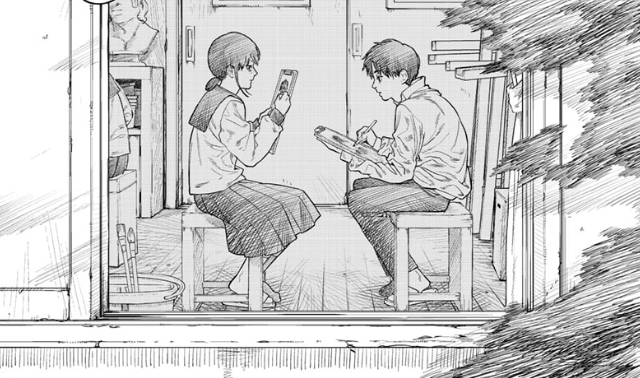
«They both talk about when we spent middle school drawing each other, right?»
The girl has not changed her mind about the confession, she knows very well how and why the main character fell in love with her, but the feeling is still not reciprocated.
Do we? Have we thought about these hows and whys?
Maybe because they spent so much time together alone, because he was genuinely passionate about portraying the girl, because they were young, in a minimum of intimacy.
But is this experience, experienced by both of them, perceived in the same way?
What He saw in it is not the same as what She saw in it, but should that detract from the value of one or the other?
Did the boy see too much in it? Did he over-analyze what was in front of him? Or is it the girl who lacked sensitivity for not adding value to that situation?
Because two people spending time together can be seen for what it is: two people spending time together, or one can create something over it, give it new meanings, with a passionate heart.
The truth is just one: everyone experiences things differently, there are those who are happy at the end of it all, those who are indifferent, and there are those who suffer.
Maybe this too is all over-analysis: "Just listen to the song," after all.
Perceived truth can generate a lot of emotions; when it comes to intangibility, it is easy to shout about the nonexistence of this and that, but the effects on a person's real life are always extremely real.
We joy and cry over things that only we see.