For everyone reading a review of mine for the first time, the Mahou Shoujo Madoka Magica series was the first anime I decided to write a full analysis on, and I wished to continue with the series' third movie, Hangyaku no Monogatari, shortly after. Instead of a few days, as initially intended, it took me four months to sit down and write this piece, partly because of real life obligations, but mostly because I found the movie extremely difficult to properly and fully break down, in the way I always approach my reviews, and make it justice. I mean, I did manage to find the time to compose a couple of things in between, but still needed time to properly face this one.
Even as I am currently typing, I do not think I will ever consider many anime or manga that I want to express my thoughts on, as demanding as Madoka's third movie. Be that as it may, it is finally time to re-examine the world of magical girls, Witches, deceivingly cute creatures and fancy ribbons. I would suggest you read my piece on the anime series first, before tackling this one. In any case, wish your way through the ride.

After the Madoka series' great success, the story was re-released in the format of two recap movies with minor adjustments and what followed was a sequel movie, the franchise's third one, Hangyaku no Monogatari, effectively continuing the original story. But did Madoka really need a sequel? The anime series had a clear plot, thematic and conflict, all of which was properly explored, presented and in the end resolved. The story seemed to reach its natural conclusion and not having a further continuation would have been a perfectly valid choice. However, the ending did leave a single part hinted as an open thread. Despite the establishment of the Law of the Cycle and the magical girls' fight having found salvation at the embrace of the forever forgotten Goddess Madoka, there is a single existence that remembers and longs for her smile as she keeps fighting against tragedy and hatred. The series did end with the Wraiths as the new adversary after all. And thus, Homura dreams.

Through an artistically flowing action sequence, a distinctive trait of studio Shaft's high quality works, we get acquainted with a weirdly childish adversary which is called Nightmare and resembles nothing of the Wraiths that should now be the main opponent replacing Witches. And the one fighting it is magical girl Madoka. Yes, Madoka, alongside Sayaka, Kyouko and Mami accompanied by a new oddly familiar mascot character tied to the blond magical girl's known fate. Right after that we have Madoka waking up, greeting an adorably sleeping Kyuubey that does not speak and having a peaceful morning with her family. Everything totally contradicts how we previously left the story and leaves the viewer in confusion.
The spotlight is passed to our familiar teacher who is just a little too ominously out there, Saotome sensei, introducing a braided, black haired girl wearing glasses, with a shy and reserved personality, magical girl Akemi Homura. We can now somewhat expect a certain link to the series and feel a sense of comfort for the first time as we witness the plot's progression.
With Homura joining the rest of the girls they form the Puella Magi Holy Quintet and fight Nightmares for a month, their origins lying in ill-intended wishes in the form of malicious dreams. Expressively fluid transformation scenes that fully utilize a movie budget and long awaited team-ups give fans a satisfactory vision of a fairytale like, overpowering image of what could have been all along. All of the above, excluding the cheese-loving Bebe that brings bad memories and discomfort while creating a mixed, ominous feeling regarding the viewing experience.

Everything seems almost perfect. Clear victories, peaceful times, not a shred of tragedy. Despite that, Homura experiences discomfort and other than the main cast, everyone seems foreign and out of place to her. Their reality feels artificial and unreal, and she first discusses the source of her worries with Kyouko, the one whose presence seems most out of place to her. Through a series of questions, gaps in Kyouko's memories and sequence of events are brought to the surface and the duo of black and red decide to visit Kyouko's city of origin, Kazamino City.
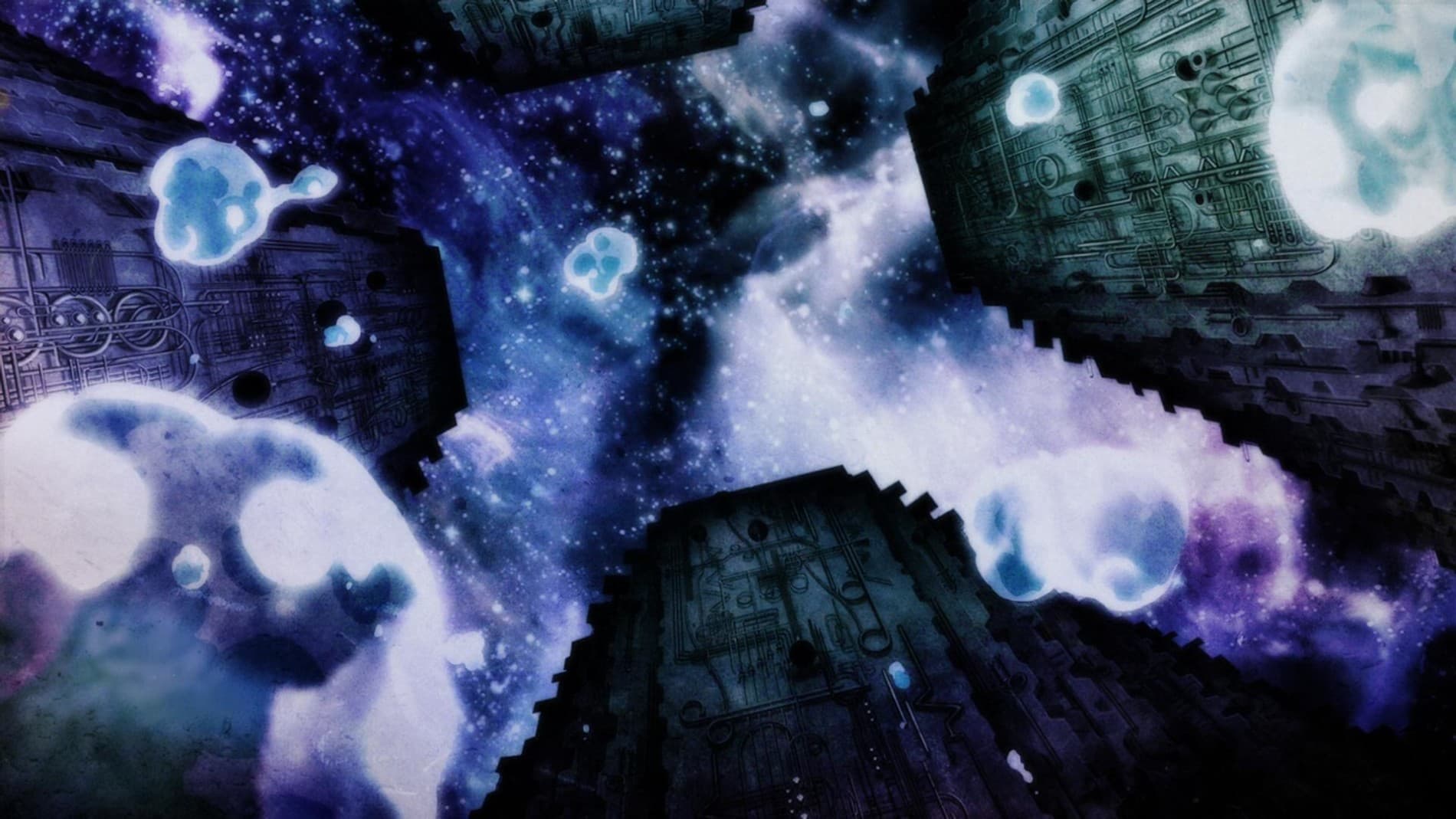
The trip is not meant to properly conclude. The girls try to take a bus with the above city as its destination, yet twice they return to their starting point. They even try to reach their goal on foot. Instead, we get atmospheric backgrounds, beautiful sequences, partly cartoonish, with a steadily escalating eerie side to them. The sequences are almost illusionary and serve to further evoke a sense of confusion. The deduction to be made is that the girls are trapped inside Mitakihara City and for a grand revelation Homura's soliloquy reveals it to be the work of a Witch's labyrith. We are now in tune with previous knowledge, that Homura also seems to be aware of.

Homura has awakened to her memories and searches for possible connections to the Witches. Bebe is first on her list, a logical approach from our point of view as well, and she tries to dispose of it. However, as an existence precious to the current Mami, it is also the recipient of her protection. Yellow and black are pitted against each other in a no holds barred conflict and exchange of attacks that is simply awe inducing and largely catastrophical. The psychological aspect of the conflict is of equal interest, as they are both aware of their opponent's strengths and weaknesses, are shown reluctant to go all out against their temporary adversary and refuse to deal with the situation decisively. The conflict ends with interference from a third party, a nut symbol in the sky and Bebe revealing its human form.
The one who interrupted Mami and Homura was Sayaka. Now blue and black discuss their current predicament, the Witch's trap and the problem they are facing. Except, Sayaka suggests that their current situation is not particularly problematic, since they mostly live a dreamlike routine where everyone is happy. Contradictions between Mami's remembrance of Wraiths and Sayaka's knowledge of Witches as well as her very own existence, paint her in shady colors and direct Homura's suspicions towards her.

With Homura trying to put her thoughts in order and figure out her feelings, she strongly self-affirms her seemingly immovable belief in Madoka, her sacrifice and the role she has bestowed upon magical girls, vowing to end the farce that is the current labyrinth they are trapped in. What follows is one of the most important exchanges in the entire story, in my opinion. She meets with Madoka herself, they have a conversation, and the pink haired magical girl declares her weakness of character, her strong attachment to her friends and family, her lack of inherent qualities that would have her detached from human pathos. Homura's entire image of Madoka shatters instantly as she realizes that the persona she idolizes is merely human, a girl that wishes to protect her beloved ones and chose to ascend to Godhood not out of firm purity of character and lack of self interest, but because of the circumstances at the time.

There are few revelations in anime that are as intricately woven, intriguingly explored and masterfully revealed as the one that follows. Having grasped the full picture, Homura distances herself from her Soul Gem without losing her bodily functions and is now facing the truth that she has become the very Witch she was searching for. And for the cherry on top Kyuubey takes the main stage and starts explaining how we got to this point.
A story born out of curiosity. Homura's previous recounting of the concept of Witches after Madoka's reality altering wish had the Incubators conduct an experiment in order to study the Law of the Cycle, a concept they should no longer be familiar with. They created an isolation field around Homura's Soul Gem to prevent outside interference to observe what would happen to a magical girl whose Soul Gem's capacity has maxed out. The entire movie took place inside a false Mitakihara City located inside Homura's Soul Gem and invitations to it were issued so that the karmic force that we know as Madoka rematerializes in it and leads Homura to the end of her journey. Madoka herself displayed none of her divine authority because of the labyrinth's power that rewrote its guests' memories.

The purpose of the Incubators was to observe the Law of the Cycle phenomenon through Homura's isolated Soul Gem and eventually manage to control it in order to restore the concept of the Witches believing the cycle of hope and despair to be the prime energy source for the universe's longevity. At the sound of their true endgame, Homura defies their expectations and raises a curse unable to be purified which completes her transformation to the Nutcracker Witch. She would even destroy herself without the option of salvation if it meant protecting the pink haired Goddess from Kyuubey's threat.
The rest of the magical girls are forced to fight against their black haired partner. Revelations regarding the identity of Sayaka and the cheese appreciator Momoe Nagisa, formerly known as Bebe, are being made as well as their role as the keepers of Madoka's memories. Following the triumph against both the Witch and Kyuubey, Madoka is now ready to lead Homura to her natural end and conclude the story on a high note. It was indeed an interesting character study of Homura, the one thing that was set up as open ended at the end of the series and the movie made it justice.

Beyond the salvation of oblivion lies obsession.
At the moment the story is about to conclude, the unthinkable happens. Homura's ultimate goal is revealed as she manages to separate Madoka from her divine state never to let her go. Beyond desire, despair, or everything sought out by the Incubators. A feeling exclusively for Madoka, births a new principle into the universe, rewriting it once more. A deeper emotion than those previously explored, a twisted love, an unending and unconditional obsession, elevates the black haired Witch to the status of a Demon, an existence capable of taking down a Goddess. Even the Incubators are seen genuinely scared, clearly trembling as they express emotion for the first time and try to run away yet the Demon will not let them.
The story ends in a seemingly peaceful reality but one that actually plays out according to the wishes of its creator. Homura will keep meddling with people's memories in order to secure her creation's stability.
A transfer student is introduced by Saotome sensei. A pink haired timid girl returning to Mitakihara City from abroad. Wearing not so flashy ribbons and feeling oddly nostalgic about the life she is now experiencing. Except there is something missing. Her role should be something beyond. Returning the flashy ribbons to their rightful owner the Demon keeps the Goddess in check once more, but the imminent conflict between order and stability against desire is seen as inevitable.

Nothing ever is.
Hangyaku no Monogatari not only has to be seen as an excellent story on its own, but also needs to prove itself worthy as a successful sequel to an already masterful series. And the movie not only succeeds but even manages to go beyond. It intelligently builds upon some threads that begged to be further explored, it also adds new elements and mashes them extremely well with everything that came before.
The viewing experience is one that plays with your understanding of the universe and the characters, confuses you purposefully, constantly has you thinking as you try to solve the problem and when the revelations start happening it is a constant unstoppable climax that goes well above what would constitute a satisfying ending.
For the most part the movie serves the role of a character study for Akemi Homura, how the numerous timeloops affected her psyche and what Madoka's sacrifice meant for her as she was left behind. Other characters and dynamics also benefited from the story's structure and its first part, where they had the time to be given extra layers and depth.
The movie's main thematic was explored in a mesmerising manner and was pushed to its limits.
A technical masterclass, both the art department and the use of sound were used in such a way that it enhanced the viewing experience and offered a level of immersion unique to the franchise.

There have been a few years since I first watched the Madoka franchise and even then it was one to remain in my thoughts for a long time. Having properly rewatched it with a better understanding of storytelling and my consuming tendencies and inclinations, I can confidently say that it is an unforgetable one no matter what one's sensitivities might be.
There is now a new sequel, a fourth movie, in the works. For a long time I used to think that even if we never got a new installment I would be content with Mahou Shoujo Madoka Magica as is. The idea of ending the saga on a tragic note with Homura finding comfort in her place as the antithesis to Madoka's divinity seemed intriguing to my younger self. My current opinion is that the sequel is, of course, more than welcome as the characters still have lots of room for growth both as individuals and in terms of their inbetween communication. Therefore I will be delighted to view it when it is released hoping for yet another immersive experience.
I appreciate everyone reading my analysis on the Hangyaku no Monogatari movie and I hope you found it interesting and worth your time. You may freely visit my profile for more about my anime and manga preferences and for a first look on how I view the industry as a whole. I would be more than happy to hear your thoughts. My next set of reviews will probably be centered around yet another beloved franchise of mine, so I am pretty excited to share my thoughts in text format with everyone. Until next time.
28 out of 29 users liked this review
