Before I go into my thoughts on Your Lie in April, I feel I should mention some tidbits about how I watch anime that I believe would give some needed context for my opinions.
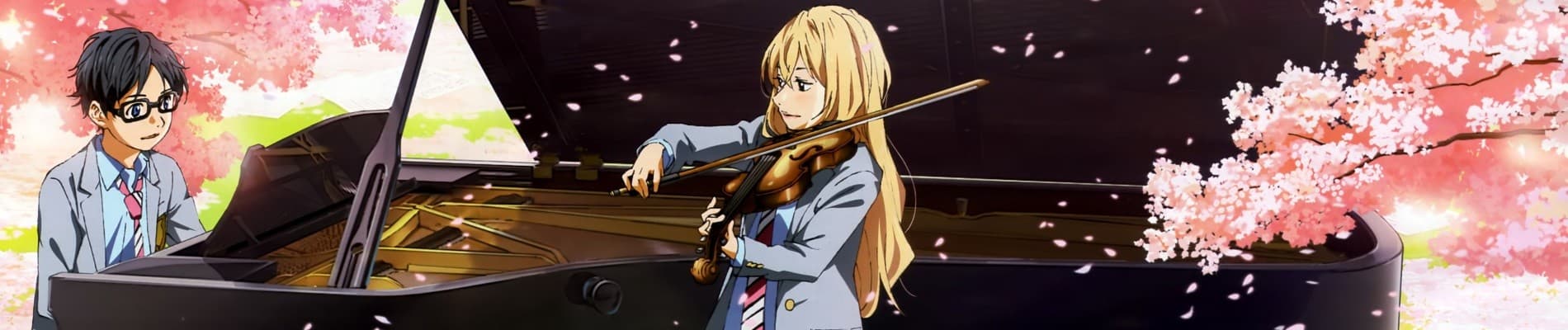
With that said, I want to start this review proper by talking about the visuals. Funnily enough, the first thing to stand out to me about this anime were the visuals. This anime is flat-out pretty, and frames a lot of scenes using unique and creative color schemes and animation. The original Japanese script frequently uses the word 「色付く」when describing the music Kousei plays, which, when directly translated, means "to change color". I think that's a perfect way of describing how the anime looks. It continually finds way to change colors in ways that adds to the theming for any given scene. Bright and vibrant colors for cheerful or hopeful moments, and drab, gray tones for scenes which are supposed to feel cold or depressing. I was enthralled with how well the visuals framed each scene, which is why I felt I needed to provide some context in the beginning of this review.
Music. There's no way I can talk about this anime without mentioning music. I’ve never really had an ear for classical music. I can recognize the complexity and skill with which they’re composed and played, but only from a surface level, not in any technical sense. Furthermore, since I usually can’t relate any kind of meaningful experience to them, they don’t stick out to me much when I hear them on their own. I can happily say that Your Lie in April has given me reason to listen to some compositions and thoroughly enjoy them. There are several scenes that exclusively use classical compositions to frame important and emotional scenes, which works excellently within the context of each scene. There’s something fun and unique about seeing the protagonist playing the music that's being used for the current scene. I was especially a fan of how Chopin’s “Wrong Note” etude was utilized, which in turn has made it one of my favorite pieces of classical music.
The story is honestly simple in scope, even pretty clichéd at various points, but I think it embraces these attributes to make something emotionally impactful. Chemistry between characters is the right amount of light-hearted and serious when it needs to be. I especially found that the internal conflict of Kousei and Kaori makes for really compelling character moments and dialogue.
It seems to me that the anime has three consistent themes: music as the musician’s expression of experiences and emotions, the desire to live life to the fullest, and the influences and impacts that stem from relationships. They aren’t the most profound themes, but I think all three work well together and are very suitable for the story that’s presented here.
I thought the ending somewhat weird. Spoilers ahead for those concerned.
(Note: in the middle of writing this review, I talked with a musician friend of mine, who explained that Kousei’s first performance would’ve been astounding, considering his age, and considering he played Chopin with such skill, hence why it has a profound effect on people; however, now I can't help but see Kaori’s crush on Kousei as similar to a parasocial relationship between a fan and a performer, which just makes it uncomfortable to me. At this point, I'll say that the final reveal of Kaori’s past, especially of her years-long crush on Kousei, soured Kaori’s character and her relationship with Kousei for me.)
Complaints aside, I still think this is worth a watch. It got my attention from the start with its visuals, and then hooked me with its characters and story. It managed to get me to really think about how it used visuals and music to set the tone for a scene, which is something I usually only pay attention to when I learn about them after the fact from other people.
57.5 out of 67 users liked this review