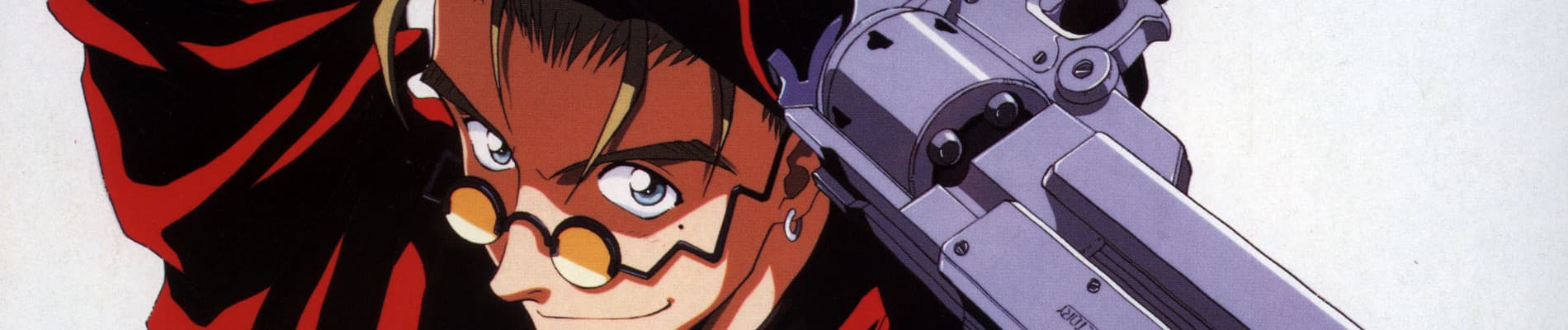
Trigun
a review by DrFlapJack
a review by DrFlapJack
Life is hard on the sun scorched world of Gunsmoke. People fight constantly over money and precious resources, and just like anywere else in human history, the strong rule over the weak. All that's between humanity and total extinction are the mysterious power sources known as the Plants. It isn't all doom and gloom, however. Even on a desolate, ruined planet like this one, humanity always finds a way to live on. Therefore, this is not a tale of death and desolation, but one of life and hope. A tale of angels, comically oversized firearms, and gunslingers. And donuts, lots and lots of donuts. Please join me on this look into the life and times of the biggest walking disaster area the galaxy has ever seen, Vash the Stampede.
For a limited adaptation attempting to capture the spirit of the original, Trigun is something of a miracle. The manga was cancelled when the magazine went under, so the grand story that Yasuhiro Nightow wanted to tell was a bit..... underdeveloped. In that most of it didn't really exist yet. However, with Nightow's amazing vision and careful planning, Trigun manages to encapsulate almost every theme and major plot point that the Maximum sequel would eventually contain. It's shorter and has less time for extensive development, but that doesn't hurt the show, as it takes the framework left by the original and builds upon it in its own unique way. It's rare that you can find an anime that so deftly compresses everything the original stands for into one neat little 26 episode package, without being a direct shot-for-shot adaptation.
Trigun is what I like to call a Trojan Horse show. It baits you in with a carrot on a stick consisting of wacky comedy hijinks, then slowly introduces little hints that all is not as it seems, until you're eventually left wondering whether you somehow ended up watching the wrong anime. The first half consists of mainly episodic filler, with the actual plot kicking in somewhat later. This uneven distribution of filler ends up working in its favor, in a weird way. Shows that start out fairly innocuous and evolve into something much more serious require a lot of patience from the viewer, but are in general very rewarding. Such is the case with Trigun. It lulls you into a false sense of security, making you think that it's just a cute little comedy, all the while planting the seeds of intrigue. "Perhaps there's more to this anime than meets the eye?" You think to yourself, as you watch Vash stumble into a bar and diffuse a hostage situation seemingly by accident. And once those seeds finally bloom, it's a sight to behold. As such, the second half of the show is undoubtedly the better part, but the first half's importance in establishing the characters and the world is indispensable.
One of the few areas where the anime version of Trigun is somewhat inferior to its manga counterpart is the antagonist characterization. One of Trigun's main missions is showing that everyone has reasons for the way they are, and that even the most vile of villains are capable of redemption. The slight differences in Knives and Vash's backstory, and Knives's limited screentime end up making him come off as less sympathetic than he does in the manga, which makes the idea that he can be redeemed a bit harder to swallow. Similarly, Legato's lack of any backstory or explanation for how he became a disciple of Knives makes the long shadow he casts over the story that much more sinister. However, this isn't necessarily a bad thing in Legato's case, as his portrayal in the anime is considerably more intimidating than his Maximum counterpart, thereby filling the void that was left when Knives's screentime was cut. All in all, Trigun's villains are not as compelling as Trigun Maximum's, but only by a smidge.

Lovable ditz Milly and the ever practical Meryl have a very important job to do. Like many others, they are on a mission to find the infamous Humanoid Typhoon. However, it's not the reward they're after. For an insurance company like Bernadelli, a natural disaster like Vash is a logistical nightmare! If they want to keep their job security, the intrepid office workers are going to have to prevent the plethora of disasters that always seem to pop up whenever Vash is around.
I find Meryl and Milly to be much more memorable in the anime than the manga, simply because Nightow actually remembered to give them something important to do this time. They still get somewhat overshadowed, but they play an important role in supporting both Vash and Wolfwood. After all, even Superman needs a shoulder to cry on every now and then.

For the commandments, "You shall not commit adultery, You shall not murder, You shall not steal, You shall not covet," and any other commandment, are summed up in this word: "You shall love your neighbor as yourself." - Romans 13:9
Vash may be the most wanted criminal in all of Gunsmoke, but you're more likely to find him waiting eagerly in line at a local donut shop than out committing heinous crimes. Protected only by his inhuman marksmanship and his frightening reputation, Vash drifts from settlement to settlement, dodging bounty hunters along the way through what he'd like you to believe is just an unholy amount of luck. And of course, he always leaves a respectable amount of mayhem behind him, whether he wants to or not. Despite Vash's vow of pacifism, his philosophy does not involve just sitting and taking whatever people throw at him. He doesn't believe in answering violence with violence, but that never stops him from protecting himself and others when it comes down to it.
Vash may make his job look absolutely effortless, but the twisted scars all over his body tell a different story. He's sacrificed his physical and emotional wellbeing many times over in order to abide by his no killing policy, to the point where he's almost literally falling apart. Guilt and doubt over the people he's failed to save dog his heels everyday. Yet even after all of that suffering, Vash's story is one of hope. For his great sacrifices end up paying off in the end, as Wolfwood, Meryl, and countless others all over Planet Gunsmoke learn peace and forgiveness through his steadfast example.

Anyone who injures their neighbor is to be injured in the same manner: fracture for fracture, eye for eye, tooth for tooth. The one who has inflicted the injury must suffer the same injury. Whoever kills an animal must make restitution, but whoever kills a human being is to be put to death. - Leviticus 24: 19-21
Charges money for confessions? Crack shot with a pistol? Chain-smoking and drinking habit? A shocking readiness to solve any and all confrontations with lead? Well, he ain't like any priest I've ever seen. But when you get past all his vices, he's a pretty cool fellow. A part-time gun for hire and self proclaimed man of the cloth, Wolfwood travels throughout Gunsmoke looking to make money to support the orphanage he oversees. He encounters Vash on numerous occasions, and the two never fail to butt heads over their irreconcilable approaches. Is he Vash's stalwart ally, or is he just waiting for his chance to take those sixty billion double dollars for himself?
Wolfwood was trapped by violence from a very young age. Raised by the notorious Chapel to be an assassin, he was taught that the only way to stay alive is through killing. Both Vash and Wolfwood took it upon themselves to rid the world of evil, but while Vash took the hard way, Wolfwood chose the easy way. He believes that in order to save the innocent, he has to make sacrifices of the wicked. Wolfwood projects an "I did what I had to do" attitude, but with just a little observation it's clear that the terrible things he's had to do have killed his spirit. By his definition of justice, the guiltiest one is himself, after all. He wants to save everyone, but he doesn't have faith that it's possible. That all changes when he meets Vash, who wastes no time in showing Wolfwood a better way. Once he finally realizes that it really can be done, he regains his trust in God and the human race. Anyone can be saved, if they're willing to reach out for it, and this realization shows him that he too could be saved.
Trigun has a very clear message to teach, and it does so with a firm hand. However, it's never satisfied just saying "killing is wrong" and calling it a day. It makes sure to show it like it is, rather than looking at the issue through rose-colored glasses. Pacifism is the right thing to do, but that doesn't make it easy or convenient, or even sensible, and the anime keeps the audience painfully aware of this fact. Trigun's examination of pacifism is surprisingly nuanced and balanced in its approach, making sure to show its goodness while also revealing its drawbacks.
Someone who has attempted murder is always capable of doing so again. When you refuse to kill someone in self defense, you put not only yourself, but others at risk. Many times over Vash lets someone go free when the world would have been a much safer place without them. Vash combats this issue with two different tactics: scare 'em straight by showing them that he could kill them at anytime if he wanted to, or shoot them in the legs so they can't do anything. These methods are not nearly as secure as just killing them. And if they do go on to hurt others again, that brings a whole new problem into the equation.
When Vash lets a criminal go that he could have killed, and they go on to hurt or kill someone else, does he bear some of the responsibility for that criminal's actions? Is it really enough for him to just keep his own hands clean? Even Legato points out that Vash has only succeeded in avoiding killing by his own hands, and this fact is often used against him by his enemies.
The biggest, most obvious flaw of the pacifist approach is how much harder it is than just putting a cap in the opponent's noggin. Taking a bad guy down nonlethally while bullets are whizzing past your head is not an easy task by any sense of the word. Even an unstoppable force of Nature like Vash has to train vigorously everyday, putting his life and health on the line constantly. There's no doubt that killing is wrong. On a ruthless world like Gunsmoke however, it would take a superhuman to avoid it.
Trigun acknowledges that sometimes, avoiding killing just isn't possible. So even with this in mind, why is killing those who do you wrong still considered to be bad by Trigun's standards? Well....
Life is about freedom of choice. It consists of a series of choices that lead to consequences, which lead to even more choices. Every person has an infinite amount of potential to influence the world around them and the people in it, both for the better and for the worse. When someone is killed, their freedom is taken away from them. Any contribution they could have made to the world is now cut off for good. You might say, "They were scum, the only thing they would have done was cause more pain." And that's certainly possible, maybe even likely. But how do we know for sure that's the case? Who are we to decide whether someone is or isn't capable of changing? Human beings can't exactly look into somebody's future and say without a shadow of a doubt that they're irredeemable. No matter what kind of person it is, the possibility for change is always there. It's a small possibility, but it's the smallest things that can make the biggest difference. After all, the ticket to the future is always blank.
I will forever be grateful to Yasuhiro Nightow for writing such a sensitive, compassionate story. A story about forgiveness, and kindness, and unending patience. It's about loving totally and unconditionally, even people that don't deserve it. Especially people that don't deserve it. Love is not an easy thing. It's messy, it's painful, it causes all sorts of problems and leaves you vunerable to the worst kinds of hurt. But if we can't love, if we can't forgive and forget, then we'll forever be stuck chasing our own tails in an endless cycle of pain and revenge. It has to end eventually, so why shouldn't it end with us?
71 out of 73 users liked this review
