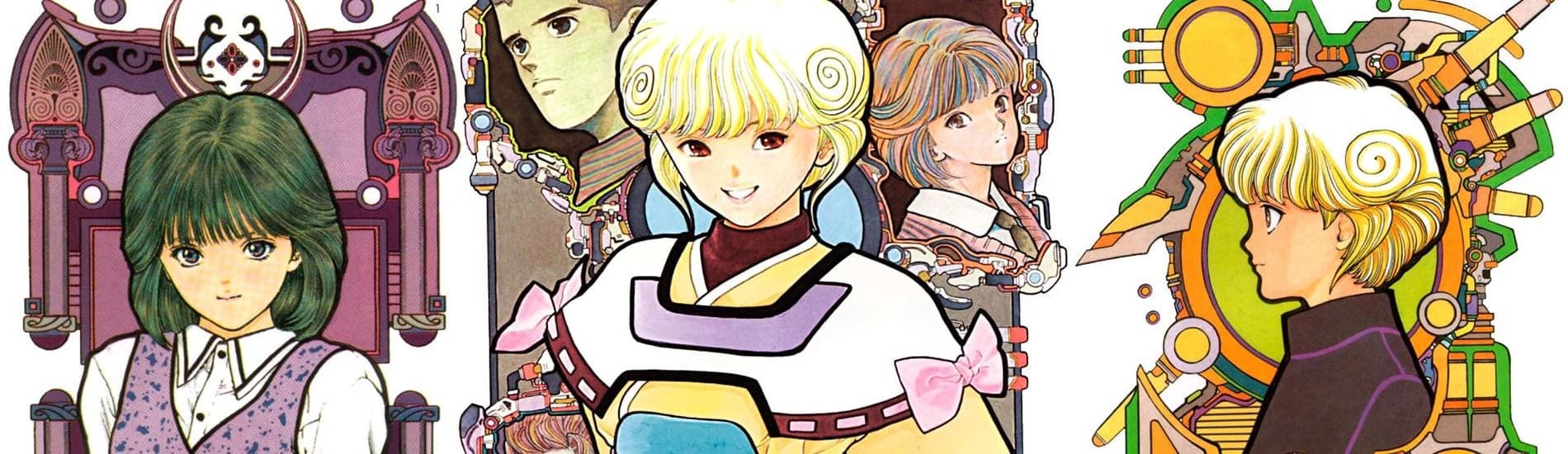


You’ve probably encountered the idea of anime just being advertisement for manga (when there is one). While there’s a bit more nuance to it, the basic idea is true. Nowadays, you see it most obviously in the single-cour seasonal anime that crop up each season. They’ll have endings, but they won’t feel conclusive. Since a second season was never intended, to experience more of the story you’ll have to read the manga. The most popular anime tend to hide it well but this isn’t always the case. Notably, there’s Attack on Titan’s first season and the manga reader/anime-only divide it popularized for a new generation.
This “demo” style of Anime-as-Advertisement is perhaps seen best in OVAs. The format’s shorter runtimes make the advertising aspect more blatant. With a single-cour anime, you can cover a solid arc or two of a given manga. Sure, there might be a cliffhanger, but any director with even a bit of skill can eke out an ending that’s satisfying even if it’s not conclusive. This isn’t the case with most OVAs. You might finish an arc if you’re lucky and to get there, details will have to be cut to reach an abrupt ending. Viewers essentially have to read the manga to get any sort of satisfaction. You see it in Junk Boy, you see it in Outlanders, you see it in Alice in Cyberland. What’s that, you have no idea what those are? Of course you haven’t! The economic boom at the time as well as the lower costs associated with making an OVA meant that any and anything of note (and sometimes not) at the time got one. Most fell through the cracks.
This isn’t to say that it all was unknown dreck. Enough funding, time, and care could lead to OVAs with superb animation and plots that were punchy through their conciseness. The endings could genuinely lead to intrigue while standing on their own as satisfying. The boom led to classics like Golden Boy, Please Save My Earth, Gunsmith Cats, and today’s subject, Video Girl AI.
I first encountered the OVA about twenty years after its release via an anime guide. It covered all manners of tropes and cultural concepts found in anime, often using examples from 90s anime such as Ranma ½ and Video Girl Ai.
While it might not be as popular today, the fact that it endures in the anime fandom’s consciousness thirty years later is a testament to how big it once was, how formative it was to anime watchers in the nineties and noughties. If it wasn’t a classic, it wouldn’t have had not one, but two television dramas debut in the late 2010s. Its legacy is no doubt felt in many romantic comedies and dramedies that have debuted since its release.
This review is not about that anime.
This is about its manga. Just as I first encountered the anime in an*anime* guidebook, I encountered the manga in an extensive (holy shit is it extensive) mangaguidebook by Jason Thompson. For years I wasn’t sure whether to dive into the manga or anime and I have no idea why I didn’t just say “por qué no los dos” like I did with Akira. Earlier this year, when this Emo Sadboi™ was in dire need to lift his spirits, he decided to finally pull the plug and read the manga. If the anime was so acclaimed, surely the manga was, too. Seeing as OVAs cut so much, I imagined the manga would be even better. I expected a classic. I expected a moving tale of romance.
What I got was a meandering mess of a manga that only the most hopeless of hopeless romantics could glean any satisfaction from. What I got was largely exhibit A of how an OVA can actually improve a story.
But first, we need to know what said story even is.

Video Girl Ai follows Moteuchi Yota, an unpopular high school boy. He’s a bit of a geek, with an obsession with Batman and trouble talking to girls that is only exacerbated by his use of male advice magazines. His awkwardness is to the point where he’s been given the nickname of “Dateless Yota.” he doesn’t think he has a chance with his crush, Moemi and any luck he may have had is all but dashed when she reveals she likes his best friend, the cool Takashi. He’s crushed, yet he’s not bitter. He’s a good person at heart. “Pure” one might say (whatever the hell that means), so he’s able to see a magical and mysterious video store called “Gokuraku” which offers tapes of “Video Girls” designed to cheer crestfallen young men up and help them find love. Yota believes a “Video Girl” is just a flowery name for a Gravure Idol#Gravure_idols), which is fine by him. But when he pops the tape into his home VCR. He finds that the woman behind the screen is talking to him. And it’s not just because he’s so desperate for the affection of another that he’ll see companionship in everything. No, the girl behind the screen, Ai, is actually addressing him. Then she comes out of the screen. This is what a Video Girl is, a physical program that helps young men find love. This is the story is how the spunky Ai attempts to help Yota ditch his “dateless” reputation and how their relationship complicates and evolves as the series progresses.
While I have a whole skeleton to pick with the story, giving credit where credit’s due, it’s not rotten to the core, quite opposite in fact. Video Girl Ai, for all its faults, sits atop a solid foundation.
This might be surprising to hear. At best, the story sounds cliché as all get out — a bland, socially awkward teenage boy with one defining interest (in Yota’s case, his desire to be a manga illustrator) is comforted by an energetic woman? At worst, the story about a woman who ostensibly has no agency and whose sole purpose is to “comfort” a heartbroken and awkward teenager sounds like “yikes on bikes” levels of problematic. Yet, to his credit, the mangaka, Masakazu Katsura puts in the work to make it not as boring nor creepy as it initially sounds. Perhaps because, as cliché as it might sound, it’s hard to deny that for many, it’s relatable to strike out and want someone to turn to. Not necessarily to be a rebound, but a soundboard and someone to talk to. Yota, for as basic as he sounds, can be interesting at times and his desire to be an artist is admittedly kind of endearing (if not self-insert-y to the nth degree; you’re not sly, Katsura). Beyond that, the plot isn’t as creepy as it sounds because at the end of the day, Ai does have agency and she doesn’t act as a glorified toy for Yota. A big (well, “big,” but we’ll get to that in due time) part of Video Girl Ai’s conflict is Ai resisting the powers that wish to control her and reduce her to a mindless program, the glorified toy she decidedly is not.
While I disliked the drama of Video Girl Ai for reasons I’ll get to shortly, in regards to that aspect of the manga, I have to give props for the characters being consistent. This is a bit of faint praise, to be sure, but it’s still something to note.. A lot of the time, I found the characters to be annoying at best, downright stupid at worst, but the consistency of their decision-making goes a long way in making the manga more tolerable even if not out-and-out enjoyable. If the characters made annoying decisions just to advance the plot, my intelligence would be insulted, but this thankfully isn’t the case.
My last bit of praise is the art, though it’s honestly a mixed bag. The art of Video Girl Ai is inconsistent, ranging from high to low detail. The low detailed art isn’t bad and it works for the comedy well. The problem is that the styles switch so often and the difference is so great that it ends up being jarring. On the other hand, the high detailed art goes harder than it has any right to. The detail edges towards realism while still maintaining a bit of stylistic flair. It’s honestly a bit breathtaking. That said, it’s a bit of a double-edged sword because there are so many panty shots and instances of bare-breasted nudity that Video Girl Ai may as well be ecchi. Bear in mind that these are teenagers. Also recall that the art is realistic? Seeing the problem yet? There were many instances where I was legitimately uncomfortable reading because, unlike a lot of animanga, these characters being sexualized don’t look like cartoon characters of nondescript ages, they look like real-ass teenage girls.
And with that, we move solidly to Video Girl’s Ai’s weaknesses. Broadly speaking, the manga is fine but the devil is in the details and when we start looking a bit closer, all hell breaks loose.

The early chapters feel like the best the manga has to offer. An entire story worth of possibilities is in front of us and it starts off well enough. We’re introduced to our core cast of characters and there’s the implicit promise that we’ll see how they interact with each other. Unfortunately, Katsura reneges on this promise, as the relationship between Ai and Yota progresses too quickly. It’s clear that Katsura wanted to get the ball rolling on the plot, but in pushing it too soon, I found it hard to muster care about what happens to these characters. Sure, there’s definitely chemistry between Ai and Yota and chemistry can do a lot of legwork when it comes to romantic stories. That said, when story-altering shit starts in happening to the characters of a low-stakes romance during volume one and two of a manga that has 15,I can’t help but check out.
Ai loses her memories fairly early on (and again, it’s a bit hard to care due to how quickly it happens in the manga’s run). As a result, the manga ditches a lot of its cute comedy, moving pretty solidly into drama from this point forward. And by fucking God is the teenage drama the most banal part of this goddamn manga.
Let me do my best to quickly summarize the relationship progression just to illustrate the main reason why I couldn’t care less about it.
When we begin the story, Yota has a crush on Moemi, unbeknownst to her. Moemi, meanwhile, has a crush on Yota’s friend, Takashi and begins dating him soon after. Yota and Ai meet, begin living together, and begin developing feelings for each other that they don’t act on. Ai’s memory is erased while Yota still has feelings for both her and Moemi. Noboku, a girl one year younger than Yota, has a crush on him and Yota decides to begin dating her. Soon after, Ai regains her memories. Yota and Noboku drift apart and they break up. Moemi and Takashi stop dating. Moemi and Yota begin dating. Yota realizes Ai has regained her memories. Ai begins living at Takashi’s house, as she doesn’t want to live with Yota since she fears it might jeopardize his relationship with Moemi. Moemi and Yota break up. Yota begins pursuing Ai.

Got all that? Cool. I didn’t care about the vast majority of it because I knew that Yota and Ai were endgame. And I was right! Because of course I was. While it’s easy to dismiss me as gloating over the fact that I essentially guessed correctly, I’d like to believe the writing was on the wall from the first volume. As solid as it might be, as I said, the plot, at its most basic, is cliché, so cliché rules apply. You’ve read or watched this story a million times, childhood friend never wins and childhood crush never wins. Now, if I’m being fair, the winner of the ship is either the person who’s seen first or the person who’s most prominent in the story. While Ai is solidly the latter, Moemi is the former, so even if I could wave off Noboku out of hand, it was still fifty-fifty. But as Yota continued to pine after Ai, I knew it was game over. Even if the relationship was tragically cut short, she was endgame. Thus all of the other relationship threads felt like busy work, like distractions from the inevitable. But hey, “the journey is more important than the destination” and all that jazz, so it still could have been worth it if it were entertaining. But it’s not, boy howdy is it ever not.
Let me do my best to quickly summarize the relationship conflicts.
Yota gets with X, the relationship is good until communication breaks down and they stop talking, sometimes due to jealousy over Yota’s perceived feelings for another, other times just due to general scheduling conflicts. A character will love someone. They’ll push them away and regret their decision. They’ll stay away even when said person tries to contact them. This happens again and again. For 100 chapters.
While Video Girl Ai has an unfitting, breakneck pace during its first two volumes, the pacing slows to a crawl for most of its run, only picking back up towards the end. The teen drama and lack of communication gets old very fast, yet it feels like it never ends. Basic conflicts are protracted for chapters due to this lack of communication. Any instance of characters making logical decisions and actually talking to each other isn’t met with me moving along. I invariably say “thank fuck” because they’re much more likely to drag things out.
I guess it’s a good time as any to go into the characters that wage said drama.

First off, we have our main character, Yota, so archetypical it borders on mind-numbing. I may have given him some slack earlier, but all my goodwill goes out the window when I have to read a basic character utilized in a dramatic context. He’s your cookie-cutter protagonist: somewhat wishy-washy, unpopular in-a-way-that-makes-them-relateable-and-not-a-way-that-actually-makes-them-distinct, but inexplicably good at attracting girls. Here’s the thing; as wishy-washy as he can be, as much as it seems like he can’t make up his mind, many instances where he does make up his mind are nullified by other characters disliking the decision. One of these characters is Moemi, whose character-defining trait is being “nice,” apparently. Though it’s more that she’s “agreeable,” being eager to please to a fault. Even with that, she can be pretty selfish and will try locking people into relationships even if it’s clear her partner is distant. There’s not much to say about Takashi — it seems like it’s a writing issue, but his aloofness just makes him come across as a boring dick most of the time. Then we have Ai, who is by far the most compelling of the principal cast members. Besides having a fun personality (that’s often neutered due to the shroud of drama that hangs over most of the manga), she has the most going on, with a Pinnochio syndrome that offers more to think about than Stereotypical Teenage BS. Her plight raises questions of what it means to be human and if being a person is worth the hurt that comes with it. It’s basic, but it’s still deeper than the puddle we’re dealing with otherwise. Instead of Moemi, I’d characterize Ai as the nicest character, as many of her actions, no matter how annoying they may be, are noble. She doesn’t want Yota to waste his time with her or fall in love with her, as she knows she’ll be gone soon thanks to having a finite “playtime.” Naturally, Ai’s plight shares focus with more pedestrian conflicts. It would be one thing to read the drama of characters I care about, but that’s not the case. Whether due to the pacing blitzing past these characters’ introductions or due to them just flat-out not being interesting, I don’t care about following most of these people.

One argument for having the drama is that it’s realistic, that as petty as this drama may seem, it’s something that actual teenagers go through. The argument goes that it’s more important to depict than more entertaining, fantastical drama. While this may be true, it doesn’t make it enjoyable for me as a 23-year-old man. Am I out of the demographic? Possibly, but I have the distinct feeling that I wouldn’t have enjoyed it ten years prior, either. It certainly doesn’t feel like my experience. And this isn’t me using my geekiness to say I wasn’t “Like the Other Guys.” No, Yota is established as not being great with women. That’s realistic enough, that’s something the audience can latch onto. Yet he has essentially three relationships in the span of, what, a year? So he’s an idiot who’s terrible with women yet simultaneously has the magnetism of Jupiter? Yeah, no, I’m calling bullshit. And it doesn’t feel like a change made to service character development, but instead to forward drama that wouldn’t be possible if Yota couldn’t gather women in his orbit.
A work I enjoy often uses teen drama — Cobra Kai, you might have heard of it. It’s a sequel show to the Karate Kid film series. As the original movie deals with teenage drama, Cobra Kai does as well, naturally drawing it out due to being a show instead of a move. Many viewers, including me, find it to be the weakest part of the show. Yet despite it making up a decent portion of the five current seasons, I still love Cobra Kai overall. For one, the characters are genuinely endearing and two, the teen drama is balanced out by copious amounts of ridiculous karate action. Video Girl Ai, meanwhile, expects me to care about all of its BS relationships that last two seconds without bothering to endear me to the characters at first. Beyond that, Video Girl Ai, like Cobra Kai has another genre that it could lean into.

And it does! At least at first. Video Girl Ai is a fantasy/sci-fi story, with word building aspects that delve into Gokuraku and the nature of video girls. In addition to this, we have an out-and-out villain in the form of Rolex, Ai’s creator who seeks to “fix” her. He also creates Video Girl Mai (nice naming, dork), an example of what he believes Ai should be. These are exciting elements of the manga that do a wonderful job of breaking up the monotony.
Naturally, these are all but dropped about 2/3rds in.

We never really get an explanation of how Rolex, the Gokuraku store owner, and Rolex’s superior are all connected. Rolex appears so sporadically and has so little attention given to him later on that I didn’t even know his name was Rolex — at least in the version I read, he was almost exclusively referred to as “that man.” We never get a clear motivation/reason for his actions. Mai, as genuinely interesting as she is, is dropped from the story far before its conclusion. Part of the reason why Video Girl Ai is so annoying is that it seems to actively shy away from the elements of the story that I enjoy the most. Given that these more fantastical elements are dropped entirely in the sequel stories, I have a distinct feeling that the mangaka never wanted them in the first place and it was only thanks to a shrewd editor that they’re here at all.
If I may ~~shamelessly steal~~ borrow an analogy from the other review, Video Girl Ai is like gum. But it doesn’t begin “godly,” it begins fine. So we begin with something like Spearmint and not Wrigley’s Big Red nor Hubba Bubba. We lose flavor fast, yet we have to keep chewing and chewing until it's just gruel that stretches and stretches without snapping.
The ending to the main story comes like a freight train. There is very little buildup and you can’t help but feel like it was rushed. Yet it ends up working in the manga’s favor because by the time the ending comes, you’re chewing gum that’s long since lost its flavor — spitting it out feels good, it feels great, in fact. Would I want a more fleshed out, exciting arc to finish the story? Sure, but Katsura spent the better part of 13 volumes proving that he doesn’t have the skills necessary to write it. I happily accepted the sweet embrace of FIN. For what it’s worth, the ending is genuinely cute.
There are two more volumes after this.
Now, to be fair, these are comprised of two short stories centered on new video girls, Len and Haruno. While there are certainly some bumps in the road, I overall enjoyed them a fair bit more than Video Girl Ai proper. This is mostly thanks to their length — they’re short and sweet.

I enjoyed the dynamic between the protagonists of Video Girl Len — while the main character’s friend is a creep, I liked that he actually felt like a friend who wanted the best for the lead, unlike Takashi. Video Girl Len also does a good job of characterizing the lead as being actually bad with women, unlike Yota before him. The concept itself was interesting as it essentially is Video Girl Ai if Ai actually helped Yota get with his crush instead of having the two fall in love with each other. Plus, it’s nice seeing Yota as an adult.
The final story, Video Girl Haruno, is extremely short, not even taking up the entirety of the final volume. Unlike Len, the dynamic between the lead and the video girl is the exact same as the main story — up to the two stories effectively having the same prologue. That said, I still liked this one more because a pretty sweet, if not basic story was told in a few chapters instead of over the course of 13 volumes. It really just highlights how much of a bloated mess Ai is.
At the end of the day, Video Girl Ai is more an example, a lesson than a story in its own right, because it shows how much an adaptation can improve over a source material. I still haven’t watched the OVA and I just know that it’s leagues better than the manga because it doesn’t meander for volume upon volume. If you’re looking to get into the Video Girl Ai manga, don’t. Just stick with the OVA or read the two sequels. They do what the main story aimed to do a hell of a lot better.

