

I haven’t been on the JoJo train as long as others — two years ago, I couldn’t tell a Jonathan from a Joseph. On April 28, 2021, Stone Ocean, the adaption of the series’ sixth “Part” was announced to much rejoicing from the fandom. And even though I hadn’t watched the series yet, I got swept up in the hype. I decided to binge JoJo’s Bizarre Adventure so that I’d be caught up in time for Stone Ocean’s premiere. I wanted to experience the show the same way others had, tuning in for the so-called “JoJo Fridays.”
Unfortunately, that wouldn’t be possible. Stone Ocean made its debut on Netflix vial “batch” format.
I don’t want to belabor Stone Ocean’s release too much as it already feels like a beaten horse at this point, but ignoring it feels a bit disingenuous, as it’s played a big part in this show’s reception. The overwhelming majority of anime is released weekly, which, in the case of JoJo, drives up discussion and hype. Netflix, like most streaming services, releases the episodes of most of its shows all at once. The hybrid of these two formats is known as “batch format” wherein a number of episodes will be released at once, but not all of them. Stone Ocean was released in this manner. I played Devil’s Advocate for a long time regarding this release and while I still stand by it not being the Awful Terrible No Good Worst Ever format most anime fans see it as, it obviously has its problems. Discussion of Stone Ocean is all but nonexistent compared to the previous parts as everyone watches the show at their own pace now. There’s little collective excitement to be had and that’s a real bummer. Making matters worse was the utter lack of communication. I want to say we had no idea how Netflix would release it until the episodes dropped on December 1, 2021. Many assumed the next batch would drop in March or so. Months passed and we got nothing. We eventually were told the next batch would drop September 1, 2022, and the fandom went into full doom mode because we assumed that meant the next batch wouldn’t release until well into 2023, making the entire part needlessly protracted, killing what little hype it still had. Luckily, the third and final batch released on December 1, 2022, but the handling of the release was still very disappointing.
As if that wasn’t enough, instead of Stone Ocean being worked on by David Production’s A-team, the show was animated by the B-team, with the studio’s focus going toward this season’s Urusei Yatsura. This resulted in lower animation quality and it shows, with background characters being simple outlines ala volume one of RWBY. This isn’t to say there aren’t genuinely well-animated sequences (the final stretch is particularly great), but it’s very clear that the A-game isn’t here. And while JoJo has never been known for its consistently great animation quality (unless your name is Golden Wind), it particularly stings here because we know that great animation was possible but given to Urusei Yatsura instead which didn’t need it as much as Stone Ocean. Even if the animation has been poor at times before, it always felt like David Production was trying its best with the hand it was dealt. Stone Ocean feels like it willingly tossed its cards away because it didn’t feel like playing the game.
Neither of these issues ended up hurting the show particularly badly, but they did dampen my excitement.
With the disappointing production addressed, I can answer the most important question: was the show itself any good? At the onset, Stone Ocean, had a pretty big task ahead of it. Like its predecessors, it had to be a good JoJo’s Bizarre Adventure installment in its own right. In addition to this, Stone Ocean does away with the largely self-contained nature of Diamond is Unbreakable and Golden Wind, opting to be a more direct continuation of the DIO plot last explored in Stardust Crusaders. If this wasn’t enough, Stone Ocean is the last part to take place in the timeline we’ve been following since Phantom Blood, meaning it not only had to satisfyingly put a bow on DIO’s shenanigans but the entire series as we knew it.

Stone Ocean is a bit difficult to rank because it handles the tasks I outlined with varying degrees of success. As a part, I didn’t find it particularly strong. Don’t get me wrong, there’s a lot to enjoy here and unlike Golden Wind, I never found myself out and out disappointed by it. That said, the vast majority of Stone Ocean’s run was just “good;”nothing more, nothing less. But when I zoom out and look at this as a grand finale, it’s up there as one of, if not the best parts so far. Stone Ocean is definitely more about the destination than the journey and it’s a sight to behold once you get there.

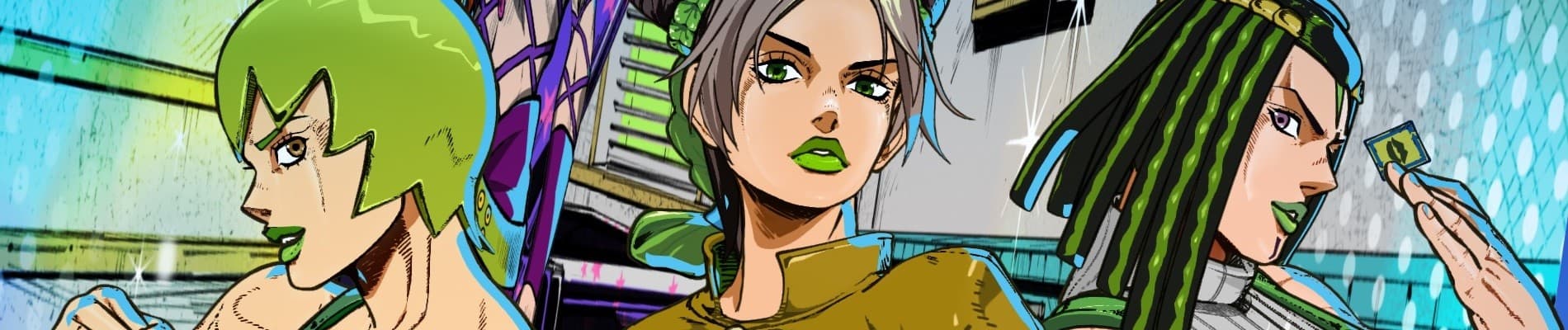
Stone Ocean follows Jolyne Cujoh. As you could probably guess, she’s the estranged daughter of Jotaro Kujo (so estranged, in fact, that she spells her name “Cujoh” instead of “Kujo” to distance herself from him). In her teenage years, she largely became as much of a delinquent as her father was in his youth, making it all easier for her to be framed for a crime she didn’t commit. While being transferred to the high-security prison, Green Dolphin State Prison, she’s given her belongings, including a pendant from her father. Upon pricking her finger on it, she’s given the power of a Stand, Stone Free. This turns out to be a great help, as the prison is absolutely crawling with hostile Stand users. As Jolyne tries to free herself from prison, she makes allies and stumbles upon a conspiracy involving her father and an evil he defeated in Egypt years ago.
Since the beginning, JoJo’s Bizarre Adventure has been enhanced by its colorful cast of characters and since Battle Tendency, the rich relationships between those characters have elevated the series further. The relationship between Jonathan and Caesar was the highlight of Battle Tendency and the latter’s presence was sorely missed after his death. The bond between the eponymous Stardust Crusaders is compelling enough to get viewers through the lull periods of the part they’re featured in. The same goes for Diamond is Unbreakable — even if the cast isn’t as close-knit as the Crusaders, they play off each other well. Even though I’m not the biggest fan of Golden Wind, I can admit that Bucciarati’s Gang is fun to follow.

With all that came before, it’s hard not to find the cast of Stone Ocean — or at least their implementation — a mixed bag.
The characters themselves are fine enough. Going in, I was ready to have Jolyne be my favorite JoJo and while she’s not quite there, I can definitely say she’s in the top three or four. She has a forceful and entertaining personality that’s more engaging than Jonathan and Giorno. She’s cool without being stoic, unlike her father during Stardust Crusaders. While subtle, she also has character development that I enjoy, gaining a sense of justice and purpose as the series goes on. Jotaro isn’t as prominent here as he is during Diamond is Unbreakable (it’s kind of hard to be when you’re comatose), but when he’s active, he still makes for a great mentor. Hermes is a fine Jobro, not boring, just not particularly notable, either. I absolutely love Foo Fighters and the zany energy she brings to the cast. Like Caesar before her, you can really feel it when she’s gone. While Weather Report makes for a compelling character and Emporio becomes Stone Ocean’s MVP, these occur either near or at the very end of the part. Throughout most of the part, Weather Report is kind of cool if not shallow while Emporio may as well be Smokey or Poco in how he’s used. The only person I out-and-out dislike in the group is Anasui, as he just comes across as a violent creep. I do enjoy his gender-bending design, though.

My biggest problems with the protagonists of Stone Ocean are their interactions with one another, or lack thereof. There isn’t a moment during the part where the entire group is together. This means that it doesn’t really feel like a group of friends. If they feel like allies, it’s mostly only through them having roughly the same goals and less because they’re actively helping each other achieve those goals. The only three that feel like friends are Jolyne, Hermes, and Foo Fighters because they spend the most time together. Once Foo Fighters dies, it feels like the connective tissue of the group dissolves. Weather Report, Anasui, and Emporio are largely doing their own thing throughout the part. The final battle is the only time everyone is together and it doesn’t feel particularly cathartic. By the time it happens, both Foo Fighters and Weather Report have become golden clouds and the final battle doesn’t last long before everyone-not-named-Emporio is wiped out. It just feels odd that the previous part’s group of professionals feels closer than this group. And I guess you could make a point of prison not being a great place to foster friendships, but an explanation doesn’t make the situation any more satisfying.
Speaking of which, we have our first JoJo part that takes place primarily in America and it just so happens to mostly be set in a state penitentiary. There’s probably a joke here. Anyway, Araki gets points for uniqueness but I have to stop far short of giving our wacky mangaka a gold star because wholly hell is the setting drab. As bizarre as it is, a prison’s still a prison and doesn’t make for a visually compelling setting. And again, I’m sure that’s largely the point, as prison’s no pleasure cruise, but it doesn’t change the fact that it’s a bit boring. But beyond that, it’s a bit amorphous and undefined. It’s a bit of an unfair comparison as it’s literally the best setting in the series, but I can’t help but think of Morioh. The quirky town gave Diamond is Unbreakable a sense of place that no other part quite had. Even if not realistic thanks to its inhabitants, it felt realized and believable — I can still picture it as if it were real. Even if he didn’t paint it as a place I’d want to go to, Araki still could have put more work into making Green Dolphin State Prison feel real. He could have given it more notable locations, and gone more into the daily life of the prisoners. The locales of Stardust Crusaders and Golden Wind, even if not cozy, are at least beautiful. The setting of Stone Ocean is about as compelling as the setting of Phantom Blood. Things feel more lively once the characters bust out of prison (because duh) but by that point, the part’s almost over.
As always, the Stand powers were a treat and made for some pretty creative fights. It’s hard not to appreciate the zaniness of Weather Report summoning frogs to rain from the sky. And even if it’s a bit hard to follow (though obtuse abilities are nothing new for “JoJo’s Bizarre It-Just-Works Adventure”), you have to at least respect the interesting use of feng shui in the Dragon’s Dream fight.

Yugo Kanno’s score is still terrific, with standout tracks being Jolyne and Pucci’s theme. Both openings are great and it's nice to see the CGI models return even though I didn’t mind the traditionally-animated openings of Parts 4 and 5. The ending theme, “Distant Dreamer” by Duffy is beautiful and encapsulates the feelings of wishing for a better future perfectly. It’s gone on to be one of my favorite endings of the series. I wish the accompanying animation had a bit more effort put into it. And yes, ocean waves are a good contrast to prison, but again, even if it fits doesn’t mean it’s not disappointing.
Prior to its final arc, Stone Ocean, is just good. And if it sounds like I’m damning it with faint praise, I am. It’s wild and unlike the vast majority of things you’ve seen before, but it’s nothing to write home about in the context of JoJo. It’s fun, yes, but even the worst of JoJo’s Bizarre Adventure is fun.
But then something magical happens.
It ends.
And it ends with a bang, one louder than any we’ve heard in the series thus far.
Stone Ocean can be seen as a pretty direct sequel to Stardust Crusaders, not just in terms plot, but in structure. Even as someone who likes Stardust Crusaders’ monster-of-the-week format more than most, I can admit that Part 3 was backloaded to the nth degree. I found it good throughout, but it really only hit it out of the park during its final arc, DIO’s World. Similarly, Stone Ocean is fairly middling until the gang breaks out of prison.
Besides the refreshing change of scenery, Stone Ocean improves thanks to having more energy injected into it as the heroes race against time to find the villain. Stone Ocean becomes even more compelling when we’re treated to the backstories of main villain Enrico Pucci and Weather Report, his twin brother.

Pucci’s backstory is the most detailed of all the villains thus far barring possibly DIO and it’s much better for it. Unlike Diavolo, Pucci feels like an actual person and unlike Kira — as much as I love the bastard — it’s easy to empathize with him. His backstory draws us in and shows us that he has an understandable reason for doing what he does, though this isn’t to say his reason is necessary good. Pucci and Weather’s backstory is tragic in a way that nothing else we’ve seen before can top — in part because we experience it with them. Their flashback is much longer than, say, each of the flashbacks used to introduce the Golden Wind cast. This draws us into their struggles and makes the flashback feel more like an important part of the story instead of an aside. Pucci’s desire to split apart his siblings to stop their unknowingly incestuous relationship while keeping his vow of secrecy as a priest, only to have his plans unravel horribly once he realizes he’s made a deal with the Devil in the form of the Ku Klux Klan (it’s really crazy how Araki handles the horror and ridiculousness of racism as an aside better than Murao does while having his entire manga center around it), helps us empathize with his plans. His plan to create a “Heaven” where people know their fates, as immoral as it may be, certainly makes sense when you’ve experienced just how much Pucci feels he’s been screwed by fate. And I appreciate Weather more due to how tragic his own life has been.
I’ve said it before, but JoJo, up to this point, hasn’t been what I’d consider “deep.” The backstory might not be particularly deep either, but it’s certainly arresting in a way that nothing before has quite been and gives Pucci more layers than I thought possible for the series.

Pucci/Weather’s backstory and the ensuring arc would be enough to elevate the part for me, but like an overexcited infomercial host, Araki says “but wait, there’s more!” While not quite measuring up to DIO’s World in terms of actual combat, the final battle of Stone Ocean made my jaw drop thanks to its spectacle. Made in Heaven’s speed makes it one of the most terrifying Stands we’ve seen. It’s hard to fight because of how hard it is to hit, exemplified by us hardly getting a good look at it once it’s in motion. It’s like a horror movie monster. Beyond that, its collateral damage is ludicrous — it makes DIO wrecking Cairo or Green Day and Oasis’ rampage through Rome look like minor mishaps in comparison. Made in Heaven is the most destructive Stand when it comes to affecting the world around it. We’re treated to scenes of time rapidly accelerating, causing dentures, clothing, and food to rot. We watch people freeze within seconds of entering a walk-in fridge. Glasses fly to the ground and shatter as soon as they’re out of people’s hands. The sun is rendered a streaking comet in a sky that rapidly changes from light to dark and back again. Mangaka cannot make their deadlines — except for Rohan Kishibe, of course. All this would be enough to cement the ending for me, but no. In the bloodiest final battle since Stardust Crusaders, our heroes fail. One by one, they’re picked off by the monstrous power of Made in Heaven until Emporio is the only one left standing. He eventually defeats Pucci using Weather Report’s stand in what’s probably the most satisfying beatdown in JoJo so far. After, Emporio finds himself in a new universe, one where analogs of all his allies (barring Foo Fighters) survive. Despite this, the preceding deaths don’t feel cheap because the people he knew are gone — even if Irene is similar to Jolyne, she doesn’t have quite the same history or personality. Emporio, and Emporio alone, will be witness to what happened in the original universe. To drive this point home, images of the original cast are depicted in the sky as the show draws to a close.

The new universe is the perfect ending to the original run of JoJo, because it marks the end of the “Joestar” line. Or, at least, the need for the Joestars. In this new universe, Jotaro “JoJo” Kujo’s daughter isn’t Jolyne “JoJo” Cujoh, she’s Irene Last-Name-Not-Given. She may have the Joestar birthmark, but she doesn’t need to be “JoJo,” she doesn’t need to devote her life to fighting evil. With the last of DIO’s flunkies erased from existence, the Joestars can lead a bizarre, yet relatively peaceful existence. The anime drives this point home further than the manga did. During the final credits sequence, we see snippets of iconic scenes from previous parts followed by the final scene of Stone Ocean, meaning that the series as we know still happened, just with a happy ending. And speaking of the credits, the use of “Roundabout” is absolutely wonderful and ties everything together, reminding us of how far we’ve come.
Curiously, while Stone Ocean mirrors Stardust Crusaders as a good part that was elevated to greatness in its final arc, Stone Ocean contrasts Golden Wind due to how different they are in consistency. Golden Wind was consistently “good,” not “bad” nor “great.” The final arc didn’t elevate the show for me unlike DIO’s World or Bites the Dust before it. All in all, Golden Wind is enjoyable, but ultimately disappointing for me. I expected a lot from Golden Wind, what with the main character being DIO’s son and the main villain having a split personality. I felt that there was the potential to do more with Golden Wind but it just coasted by. Meanwhile, I expected very little from Stone Ocean by the time I approached the end. Yet it broke consistency to deliver something great, something that stretched the series in a way Golden Wind hadn’t. It felt like a proper sequel; introducing exciting new elements while honing in on what made the predecessor great.
But that’s the ending — the vast majority of the show is merely great. Taken as a whole, while enjoyable, Stone Ocean is nothing special in the context of JoJo. Your thoughts on Stone Ocean are ultimately determined by how important you find the destination compared to the journey. Endings make or break shows for me, so this breathtaking, exciting, and beautiful ending that honors all before is enough to make Stone Ocean one of my favorite parts. But if you find the journey more important, you’ll see Stone Ocean for its more middling traits, as they describe the vast majority of the show. Either way, Stone Ocean is a show I’d recommend, but with the caveat that it doesn’t get great to the end. It’s not a big deal but I always hate being the guy to say “wait, I know you didn’t like these twenty episodes but I promise you it gets so much better!” That said, the ending is so amazing that I’d be hard-pressed not to recommend it.
It’s been a bizarre ride, but I think this is where my journey ends. I won’t be waiting for anymore JoJo anime, so I’m glad I ended on a high note.


Fortunately, Araki has made other manga and I’ve decided to read those. The first one I’m reading is about horse-racing, I think?
149.5 out of 156 users liked this review
