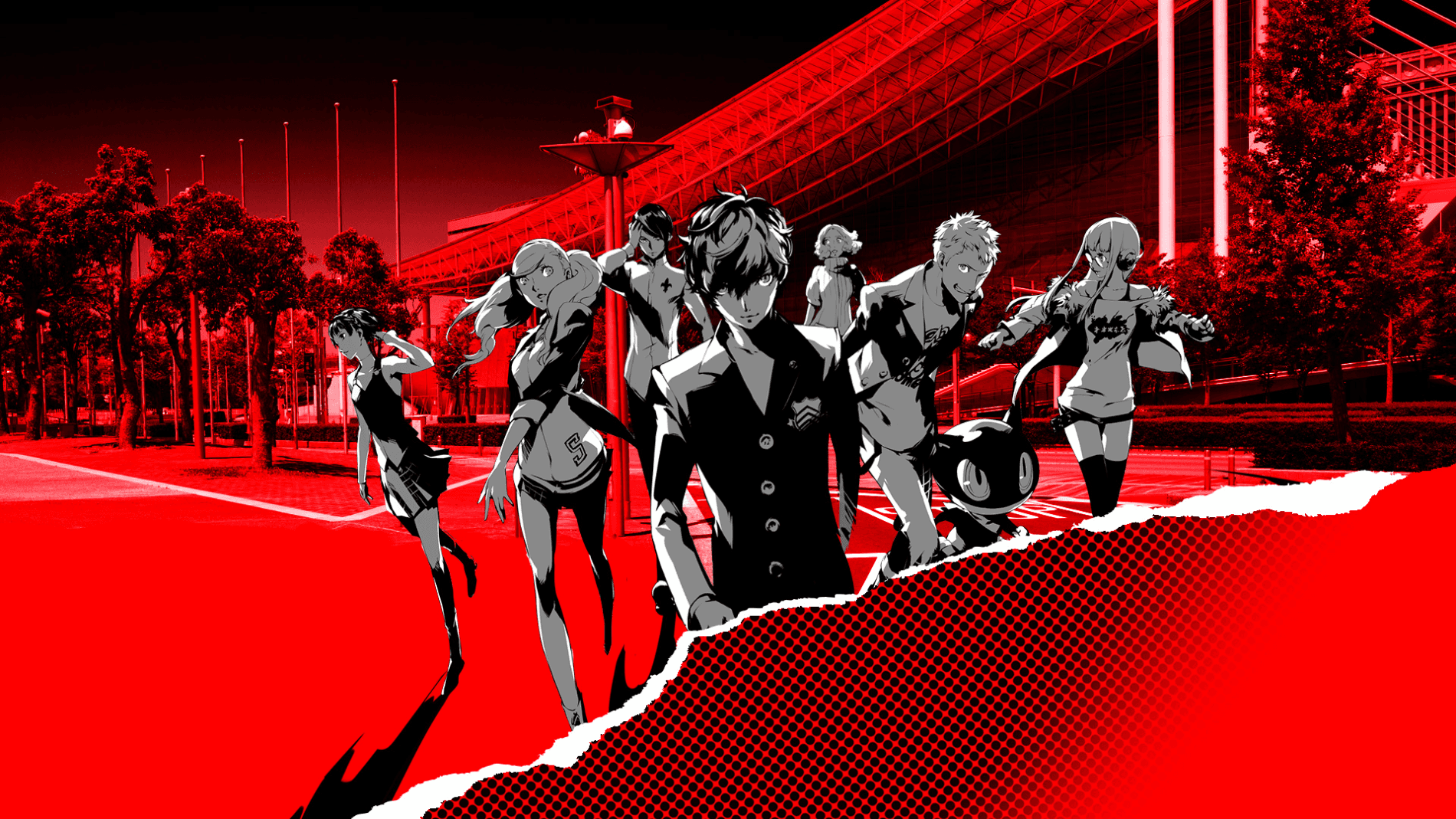
This review discusses many topics across the P5 story. If you are here, I'm assuming you've either finished the Persona 5 | Persona 5 Royal game, or completed this anime, or both. As of such, there will be major spoilers. YOU HAVE BEEN WARNED
This review will cover the following content
If I want to cover the OVAs I will do so in another review. With that being said, let's get to the actual review.
"First of all, let me get this straight: This is a HIGHLIGHT REEL, not an anime. I know what it says on the cover, but when Atlus went out to make this thing our fandom SPECIFICALLY told them it wouldn't work out well. "
The Persona 5 base game is approximately 75-85 hours long. Including bonus content in Royal's 3rd semester, the entire thing equates to roughly 80-100 hours of gameplay. To cram all that content into 11 hours of screentime (9 hours in the original series and 2 hours in the following episodes) seemed like a suicide run to many. And for the most part the results were as expected.
P5 the Anime suffers from horrible pacing. The palaces and their respective bosses are zoomed by in the blink of an eye while the filler episodes drag on and on. Content is barely covered and small-scale timeskips are used galore. Much like the fate of the original Phantom Thieves in the games, one slip-up caused our entire world's perception of them to change.
However, when you look at the finer details, you see little tidbits here and there that builds on the pre-established world and characters; tiny morsels of worldbuilding wedged into the chaotic rush of the entire anime. On top of this, this entire anime was done with recognizable and consistently good animation and interesting takes on the soundtrack that we're familiar with.
Characters
Easily the strongest aspect of the p5 anime. In the Anime, The Phantom Thieves in the anime are rounded, fleshed-out characters that use what current knowledge you may have about their personalities to build new innovative ways to tell that character's story.
One of the first things you'll notice is obviously the main protagonist. Given the name Ren Amamiya in the anime, the protagonist is given a distinct and vibrant personality that deviates from the blank canvas silent protagonist of Atlus's game. He is shown to be both cool and calculating and also a bumbling, joking idiot depending on the situation, giving him much-needed emotions aside from the 3 whole sentences of voices he's given in the game.
While the Protagonist's personality is decided by the player, many of the most memorable dialogue options come alive due to the hilarious voice acting (Xander Mobus's depiction of Ren in the English Dub is beyond a spectacle to watch), and the fact that the Protagonist seemingly switches personalities while within the metaverse to become The Pompous Man in the Black Coat is a hilarious concept as well.
Ren aside, attentive viewers will notice that many of the filler episodes follow the phantom thieves along their natural confidant stories, albeit slightly altered. This means that because Ren and the respective character is taking different approach to their story, you get to see a slightly different side of them that still largely coincides with your mental opinion of the character, creating a more rounded personality. Furthermore, the characters' backstories are also developed exceptionally well. While we get brief tidbits about the characters' pasts in the original games, the anime goes all-out when it comes to their backstories, creating visual depictions of their child lives as well as deepening their established backstories.
For example, we're given a series of flashback still frames depicting a young Madarame teaching the child Yusuke how to paint. Despite the fact that we now know Madarame was doing this to simply exploit him, the frames given depict a happy Yusuke joyfully painting on the lap of a happy and supportive Madarame. Then the frame cuts back to the present, with Shadow Shogun Madarame in the same pose with the same ear-to-ear grin. Immediately juxtapositioning Yusuke's gleeful childhood with revelations of truth, and giving us viewers an automatic, unstoppable hatred for Madarame for doing such a cruel thing to Yusuke.
In a different vein, Haru, who's story development was widely memed in the community for being shafted due to being introduced so late, was also given an uplifting in her backstory. While we know that Okumura Foods originally began as a humble coffee chain that Haru was very fond of before Kunikazu took the reins thanks to the original game's story, in the anime, we physically see a smol Haru visit the coffee shop and enjoy a nice warm cup of coffee. Giving us an additional reason why she is so saddened by what Okumura Foods has become. This type of character development creates an additional level of realism instead of leaving the character to infer what exactly happened in their pasts. The fact that their stories largely parallel their confidant stories also creates a nice sense of familiarity for the viewer to bounce off of.
Main characters aside, P5A chooses to largely ignore Joker's non-playable confidants, I was thoroughly disappointed to find the likes of Chihaya, Yoshida, Hifumi, and Kawakami largely ignored, or with little to no interactions. Hell, Iwai literally only says one line in the entire anime and it is when they pawn off the olympic medal. This is exceptionally poor on the anime's part because Iwai becomes someone capable of talking to other people and being relaxed around Joker, but that bond was shafted, so even if Iwai appears in the Qliphoth world to cheer the Thieves on beside Mishima, you don't get the reason why he's there. Same thing with all the other confidants.
That being said, the anime doesn't totally forgo minor characters. We are given an incredible amount of detail following the story of Shiho Suzui as she attempts to grapple with her situation. We are given multiple insights into her mind, a shot of what exactly Kamoshida does to her in his abuses, and also flashbacks that complement both Ann's backstory and hers as she contemplates jumping. It is an odd detail that the anime focuses so much on her in particular, but I certainly don't mind.
Plot
Alright. Let's address the ~~elephant~~ grimekhala in the room.
Let's start off by addressing a minor but glaring issue: the focus on Akechi and Shido. As people who have played the game know, Akechi and Shido are related and play a part in being the big bad of persona 5 before all the end-of-the-world business. This dynamic is largely possible because of Akechi dropping subtle hints that only an attentive viewer would notice, and Shido keeping his name hidden but his face somewhat recognizable. As of such, when the big revelation happens in the original games, you as the viewer already know via dramatic irony that these two are the big bads who screwed over Joker and caused him all this trouble in the first place, but the game makes an excellent way of slowly revealing it to the protagonist in a way that would be progressive.
P5A does none of that.
Not only is Shido's bald face thrown in the TV multiple times in the anime, but there is no coverup to address the fact that he is the guy who screwed the protagonist over, and they even blatantly tell you that the SIU is affiliated with Shido with the TV broadcasts, while in the game you were doing mostly guesswork. The aspect of surprise is completely lifted. The same case is with Akechi. You see him smack dab in episode 1 driving somewhere as the protagonist is captured, immediately revealing that he is the big bad. On top of this, what was originally an exceptionally subtle hint dropped by him is now blown wide open with him blatantly saying the role-revealing line in an isolated manner so that we the viewers immediately latch on to it. Sure, throughout the show he is still your glamorous ace detective, but we knew from the start something was up about both Akechi and Shido, which just ruins the mystery aspect for me.
Now let's talk about the thing you probably clicked on this review to see me rant about: the pacing.
Let's take Kamoshida's castle as an example of the pacing comparisons.
In the game, it would take roughly 45 minutes alone for all of the tutorial stuff to happen, with up to an additional 1-3 hours for all the exposition for the protagonist to reach the Palace. The entire palace would probably take approximately another hour or two to beat. So let's just highball it and say that from the start of the game to the collapse of Kamoshida's castle, it takes roughly 6-9 hours.
The anime takes 5 episodes to cover Kamoshida, keeping the OP and ED in mind, they compressed a 10-hour palace journey into 1 hour and 40 minutes. You clearly see the problem here right?
So many things are rushed through and through. From the palace visit itself, to the concept of personas, to how Joker learns to use these powers, to how guns work in the metaverse, to the actual storyline itself, and even Shiho's attempted suicide was glossed over because they cut and snip away meaningful pieces of story development. Hell, they were so rushed to complete the Palace that they introduced Ann's awakening AFTER the thieves already secured an infiltration route. And speaking of, much of the puzzles in the palace were ignored, dimming reasoning behind why the protagonist would be a good leader (since he's the guy who figures out most of the puzzles in palaces), and preparation for the palace, such as buying meds from Takemi, are very rushed. All you get are these cuts of the thieves moving through the palaces without any regard for their puzzles and whatnot.
If anything, its the same dynamic as a streamer or a YouTuber saying "so I did some grinding off-camera". Very disappointing to see. That is not even to mention that Joker actually did "grind off-camera". By Shido's boss fight he's so broken that he has access to Alice, Yoshitsune, and Beelzebub, who he each brings out to do one attack against Shido and there he goes.
Animation
This is quite a divisive topic in the community. While many argue that the battle animations are completely trashed and whatnot. I actually think that the animation is quite charming. First of all, its done in Atlus's style, so its actually virtually indistinguishable from any of the in-game anime cutscenes you see. Secondly, they do take creative liberty in reimagining recognizable battle scenes like all-out attacks and persona abilities, but I think its quite nice that they still at least partially adhered to the recognized all-out attacks before adding their own spins to it. It's not for everyone, but given that the persona 5 fanbase loses their mind over P5 Royal adding a fade in to the all-out attacks I think I can go ahead and say that these criticisms are largely unfounded.
Music
I think this part of the anime is also quite nicely done, though there are some sections that I have some major complaints about, they largely adhere to the acid jazz style of the original games, and they use a lot of the iconic OSTs in the anime as well. However, to fit it with their rushed battles, many of these themes, and especially the battle themes, are cut short. In one battle, the beat drop in Last Surprise arrives without sufficient buildup, and it isn't even allowed to fully complete before being cut short because the battle already ended. On top of this, it doesn't even time with the all-out attacks, which is just painful to hear.
All in all, the persona 5 anime is clearly intended as a highlight reel of the most notable moments in the games, with the added touch of personality to all of these characters but completely ignoring the game mechanics the anime assumes we the viewer would be willing to ignore. It may be poorly paced, but when it slows down, it becomes an anime depicting the best of the Phantom Thieves we all know and love
11 out of 12 users liked this review