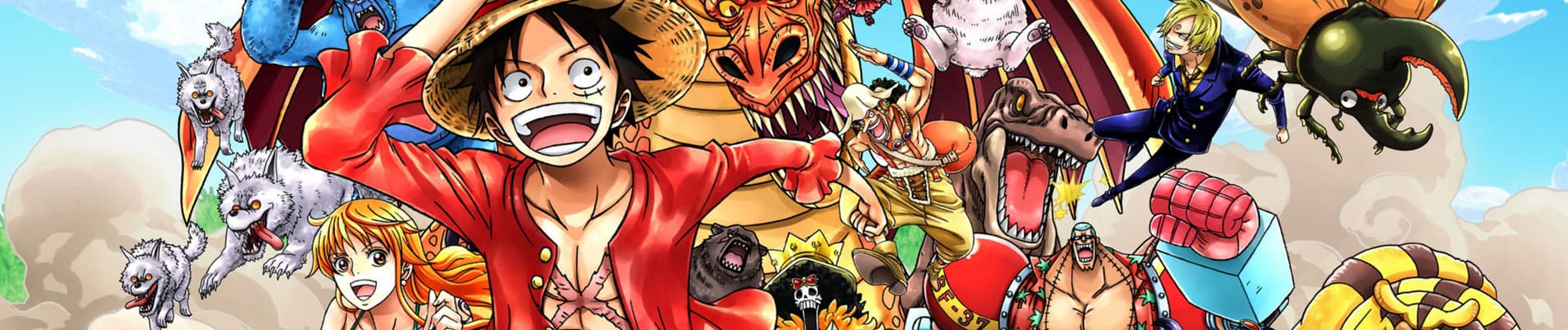
Let me preface this review by stating that it will be informal; few citations will be given, subjective opinions will be shared, it will be rife with personal testimony and conspiracy, and will focus on the aesthetic achievements One Piece and therefore Oda have so gloriously attained. I will also say briefly that One Piece single handedly cured my solipsism, which may in part be due to the infamous Doctor Chopper, who is the wonder medicine, and that my sundry other mental illnesses have also been alleviated by One Piece - it is the greatest escapist fantasy in anime. My thesis is simply this: One Piece is a postmodern myth, and exceedingly great in both aspects, and that since myths are necessarily theological, One Piece also is theological - but that will not be our focus...
One Piece as postmodern - what I want to emphasize is its appropriation of real life culture, history, people - with no singular ideology to espouse, but with a gradient and subtle commentary, one ethical and personal, so that it is post modern aesthetically but not philosophically. Postmodern ideology might say, there is no grand narrative, sequences of history are disparate parts which only coincidentally coincide, and unravel, such that Fate would be late to the party. Indeed, one may contrast the Black Beard and Straw Hat crew with one another, Black Beard being obsessed with destiny and the Straw Hats owing their adventure to serendipity. They foil each other in other ways, too, of course, but this aspect captures the plurality of One Piece's themes.
Let me give some details to show the postmodern aesthetics found in One Piece; its characters which are known to be great - Gan Fall in Skypeia, based on Don Quixote from that famous novel, the arc where Straw Hats chase a dream island, and find it, much like Don Quixote chasing a dream in the book. Let us not forget also the reference to the legendary city of gold, and the Shandians, whose history resembles the Native Americans, and Eneru - being a lightning God, and a Buddha - contrasted with the aesthetic of Heaven in Skypeia. Indeed, Eneru even builds a ship out of gold, the same thing the annunaki attempt to do. Just in this one arc it may be observed the myriad influences which are taken from myth or history and given new context in the world of One Piece.
The postmodern artist is most like an orchestrator, or conductor. Stealing various parts, ie; the many instruments or sections - old and gold stories or ideas and making them his own - all for his own masterpiece, symphony. This sort of aesthetic is what I am describing and praising One Piece for doing so well. Another example can be found in Drum Island. This arc is based on the fascist regime in Cuba, while also mixing the Wests secular Christmas tradition. Chopper is Rudolf, Doctorina santa. Our two example arcs both have a somewhat anti authoritarian theme, yet One Piece is not singularly anti authoritarian.
Almost every kingdom in the One Piece world is a monarchy yet it is not anti authority. The main characters are pirates sure, and liberty/freedom is exalted and chased, yet, look at Alabasta for example, Crocodile corrupted the nation and the Monarchy there are true hearted, noble, good. Baroque Works has the real world antithesis to many secret societies, and Alabasta much resembles France during the French Revolution, except in One Piece the Old World Order was not eliminated. This subtle treating of authority is what distinguishes One Piece from many other shounen series, in that its idea is not simply: 'authority bad' or 'japan good.' It has something deeper, in its spirit, something moral, where good is good regardless of circumstance, and so is bad. That is why some kingdoms the authority is shown as noble, and others as corrupt. This subtlety contrasts with the rather bold and straightforward characters, and is the salt of true literature. Many artists which to add this flavor to their works, but fall short with didactic aesthetics.
There are forces, non-human, such as fate and serendipity that I mentioned prior, which work furiously through Oda's hands into the grand narrative of One Piece - which take away from its postmodernity, but add a level of meta excellence to the work. Other meta aspects are commented on by characters within the world, such remarks could be seen at Luffy's luck, or the Will of D. This is what makes it theological; let alone the many references to God or Gods - Whitebeard, taking strays as his sons, Skypeia as already mentioned, Blackbeard representative of nihilism, the celestial dragons being considered actual gods. It would be a whole other essay to comment on the symbols and narrative metaphors in One Piece, but let me give one example; The Going Merry - which was a lamb, and named Mary, which carried the Straw Hats until the end of the great arc Enies Lobby, was replaced by the Thousand Sunny. If this is a reference to the Christian's idea of the thousand year reign, or the Sun itself, which Luffy also represents, quite literally, I do not know - but there is clearly a great meaning in even these small details. Lastly, devilfruits cannot allow you to enter water, ie; not be baptized. And Haki is very similar to Eastern Spirituality. I digress.
There are so many more examples of One Piece taking what has always made stories good and using it for its own, especially in characters, Mihawk as Dracula, Donquixote Doflamingo as Joke, yet the key part is that it really makes its own. That is why everything works and it doesn't feel cheap, or like plagiarism. Just like the world of One Piece which is hurdling towards a specific point, just like Luffy is chasing towards the One Piece, Oda too had purpose in using all these ideas. There is purpose - telos in it. Whether it be artistic, thematic, poignant - Oda has placed many pieces together and the pay offs work, they are insane. Marineford and Enies Lobby are peak examples of Oda's excellent story telling, where the emotions hit just right, where the fights are riveting, where the characters feel like real people.
There is much to say on so many other arcs, its themes are as broad as the sky, and its interpretation could be as deep as the ocean - where i mentioned symbols, theories, conspiracies. One could ramble on and on about its formal achievements, in comics recurring gags are common, and many recur in One Piece, Sanji with women, Zoro getting lost - which usually get subverted and add new humor, such as in Whole Cake Island. There are many not just emotional moments, or funny moments, but cool moments also. Luffy is at his best when he sticks to his cards, and gambles without a worry in the world. "If you pull out a gun, you put your life on the line."
I have not even touched on the sense of adventure, actual crazy adventure, like on Zou, or the feeling of being a part of the crew and forgetting lifes wiles for a bit. If i were to write a more comprehensive essay such things could be discussed and praised, since there is so much to this dumb show. It's goofy, serious - sometimes both at the same time, but always each at the right time. Sentimental but not overly. Creative but also steals. It is a masterpiece and we may not see something like it for a long time. I have a friend who used to say they would study One Piece in 500 years like we study the Bible. My pet theory is that the world of One Piece is actually Earth just in the future, there is Noah's Arc and Nuns and all this stuff, so maybe we won't only study it but also live it. I know I live the One Piece way of life, and it has inspired me to go on a neverending pirate adventure, and that is why i have all these felonies on my record (joke).
Thanks for reading.
52 out of 60 users liked this review
