Phoenix
a review by DrFlapJack
a review by DrFlapJack
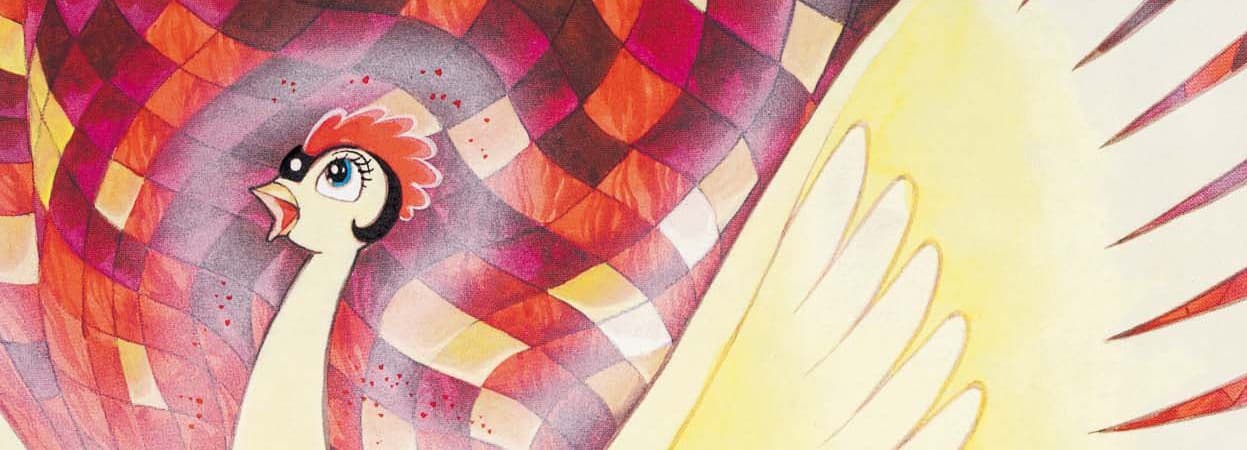
On a tiny island at the edge of the world, the Phoenix makes her nest in an active volcano. Legend says the fiery bird is immortal and that whoever drinks her blood will live forever. Kings send their countries to war over even a tiny chance to claim her, but none of them will ever succeed. The Phoenix belongs to no one, especially not to such weak, selfish beings. As the human race's domain expands across the Earth like a brush fire, the Phoenix waits and watches over their tumultuous progress. Whether humanity will learn to control its destructive ambition, or consume all until nothing but ashes remain, no one can say. But their future has yet to be set in stone, for as long as the sun continues to rise and fall each day, hope for a better tomorrow will linger on.
Phoenix is the keystone to Tezuka's body of work, the ultimate expression of his ability as a writer. It is an anthology of stories set from the bright dawn of humanity to its quiet, sullen twilight. While every arc is mostly self-contained, all have one thing in common: they all revolve around the so-called Bird of Fire in some way. The chapters alternate between the distant past and the far-flung future, slowly growing closer and closer on the timeline until they were intended to converge and conclude with one last chapter set in the present day. And even though that final story never saw the light of day, Phoenix boasts a wealth of intricately intertwined themes and characters within its pages.
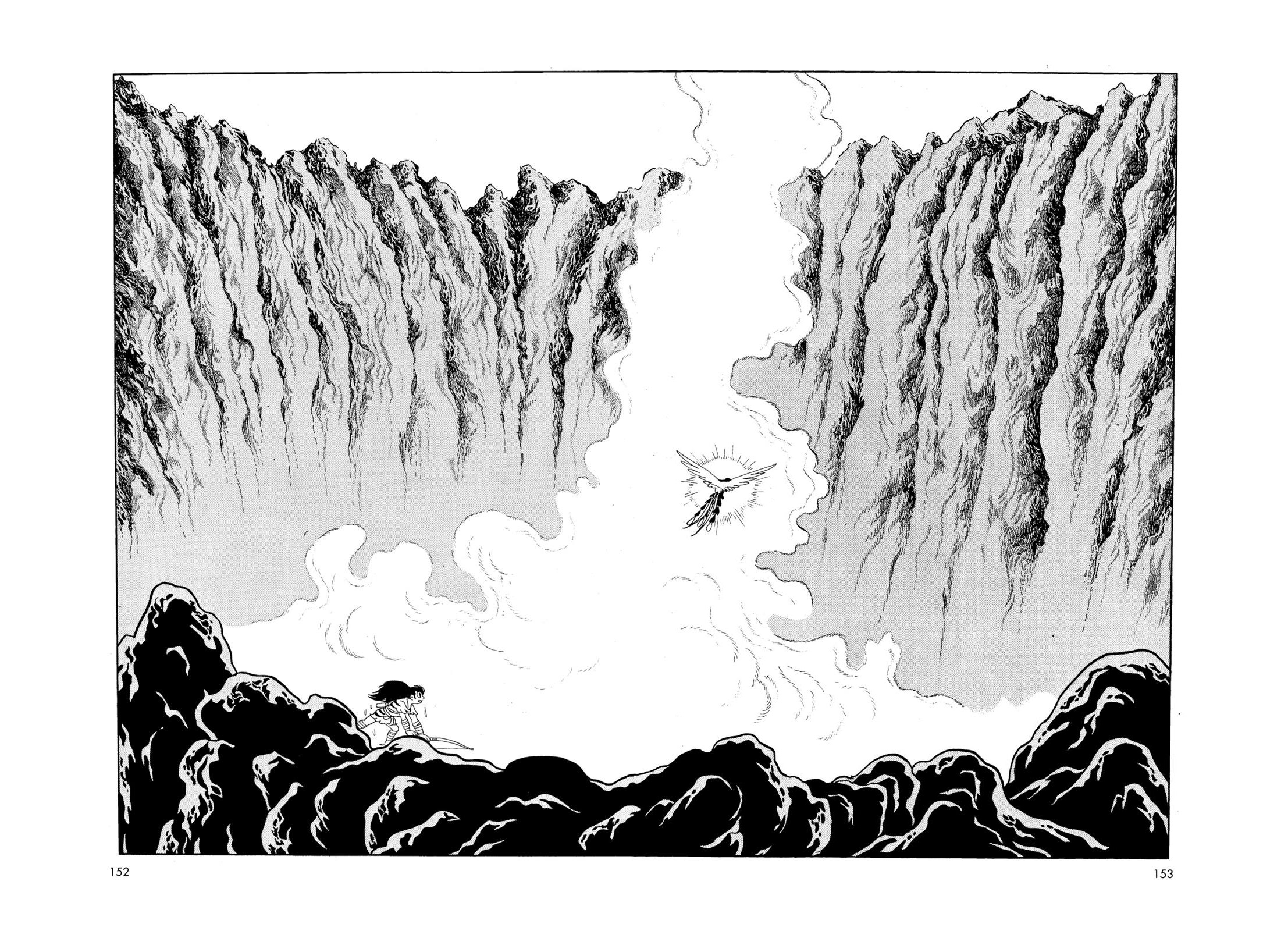
Pinning down just what the characters' goals are in Phoenix is trickier than it first appears, because even though they all technically want immortality, they don't all want it in exactly the same way. There is more than one way to pursue eternal life besides the age-old quest to be young and beautiful forever. For example, some characters seek immortality through memory, by carving out a place for themselves in the annals of history. If they can't live forever, they at least want to leave behind some proof that they existed. And if they have to suffer and die, they don't want their suffering to be rendered meaningless by being forgotten.
Many of the characters in Phoenix are driven by innate fears, such as the fear of change. Desiring immortality is not necessarily motivated by a hunger for more life, but a wish to avoid the discomfort and uncertainty that comes with change. They fear all sorts of things, such as losing control over their own fate, or being consigned to oblivion. And rather than make peace with their fears, they instead fight desperately to live just a little longer. Sadly, destroying themselves and others in a self-perpetuating cycle is all they ever seem to accomplish.
Phoenix does not content itself with simply telling us that immortality is a fool's errand and leaving it at that. It goes out of its way to demonstrate first-hand just how horrifying eternal life would be if it were achievable. It's quite telling that the "lucky" few who receive some form of immortality from the Phoenix all consider it to be a curse rather than a blessing, because it dooms them to never-ending lives full of loneliness. Think about it like this. How would you like to be barred from sharing in the one thing that all humans are supposed to have in common? To never be allowed to join your loved ones in the afterlife? To be guaranteed a front row seat to the final day of mankind? When you put it that way, living forever might very well be the cruelest fate imaginable.
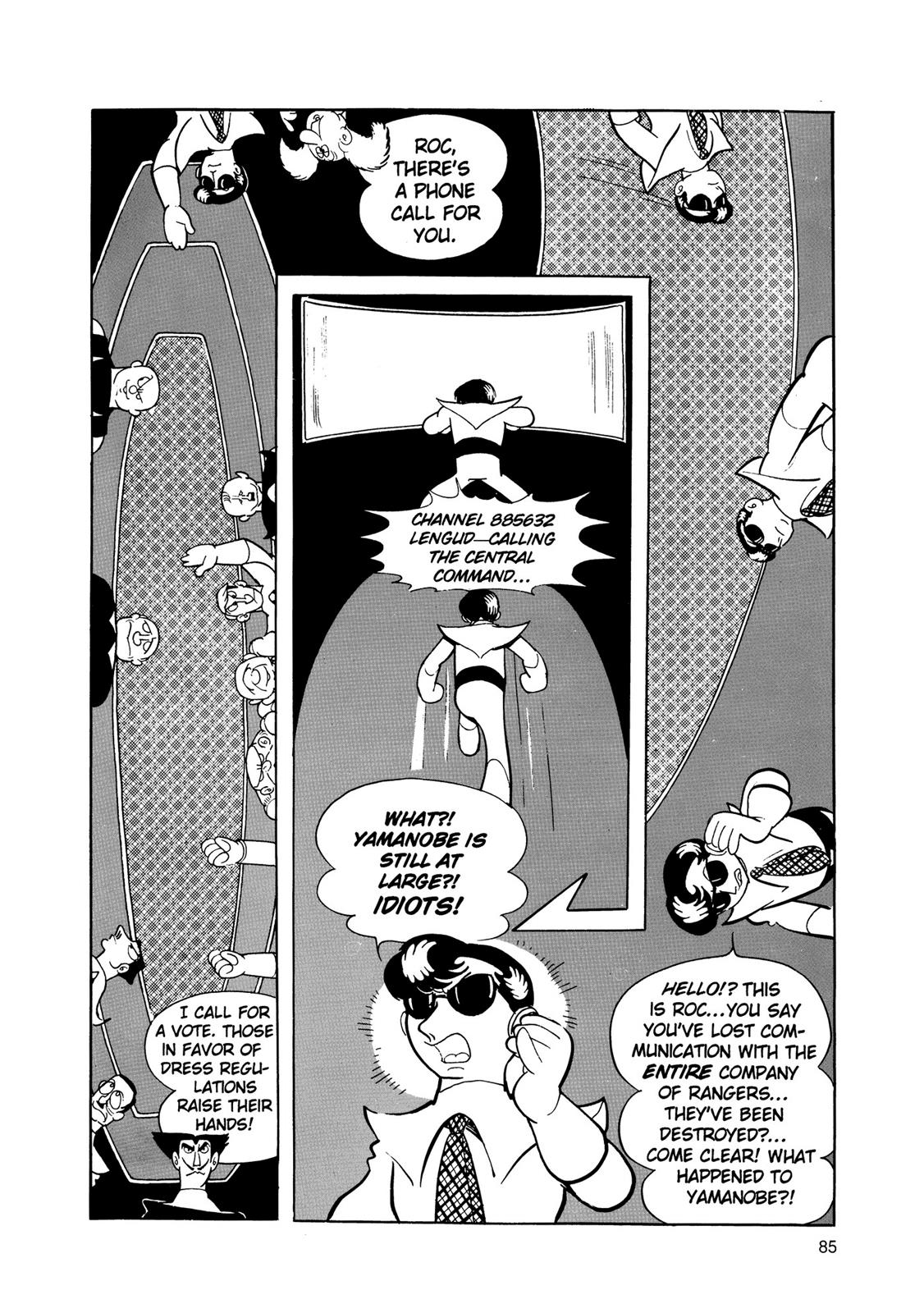
As the setting jumps back and forth between past and future, the balance between serious and silly fluctuates. The future chapters are relatively straight-faced, while the past chapters are downright comical by comparison, with the exception of Karma. Non sequiturs, anachronisms, and fourth wall breaks are frequently interspersed between heavy drama and action. Mixing mass murder and slapstick comedy in the same volume may sound like an odd choice, and these tone shifts will undoubtedly put off some readers. Personally however, I welcome the wackiness, whiplash and all. Phoenix is an extremely weighty tragedy at its core, and if it didn't have an occasional screwball moment, I would find it much too depressing to read. Good comedians can write funny stories, good dramatists can write sad stories, but only a true artist (i.e. madman) can pull off both at the same time.
One of the tools of Tezuka's trade was a gallery of character designs called the Star System. He would reuse these different designs across all his many series and treat them as sort of illustrated actors, some of which even became typecast into specific roles just like real actors. Shunsaku Ban, Acetylene Lamp, Rock Holmes, and the omnipresent Gourdski are just a few of the most commonly used "actors" that you'll find in his work. Tezuka takes this concept of recycling characters one step further in Phoenix and weaves it into the narrative as one of the central themes.
When a character dies in Phoenix, their soul is reincarnated into a new being in the cycle of rebirth. What determines their fate in each life is their karma, which are basically spiritual brownie points. Good deeds will yield good karma, while bad deeds will create bad karma. If their heavenly credit score is high enough, their next live will have a better chance of being a happy one. If it's low, the cards will be stacked against them before they're even born. In other words, what they do in one life carries over to the next. If they commit a sin, they will have to atone for it eventually, one way or another.
Saruta is the most prominent member of the Star System used in Phoenix, because he appears in every chapter as a different incarnation of the same battered soul. Sometimes he's the main character, sometimes he's not, but he always has an indispensable role to play. In a fit of jealousy, he committed an act of pure evil in a past life, which made him a veritable lightning rod of misfortune in all of his subsequent lives. He gets beaten down in every incarnation, partly by circumstances beyond his control, and partly by his own folly. In a way, Saruta is all of mankind's vices and virtues distilled into one unsightly curmudgeon, from his predisposition to cruelty down to his surprising capacity for compassion and self improvement. Therefore, it's only fitting that his relationship with the Phoenix mirrors her relationship with mankind as a whole. As pitiful as Saruta is, he's our biggest sign that humans are not a lost cause. If the Phoenix really thought Saruta was incapable of learning from his mistakes, then she would simply bar him from ever being reborn as a human again. Yet she never gives up on him, just as she never gives up on humanity as a whole.
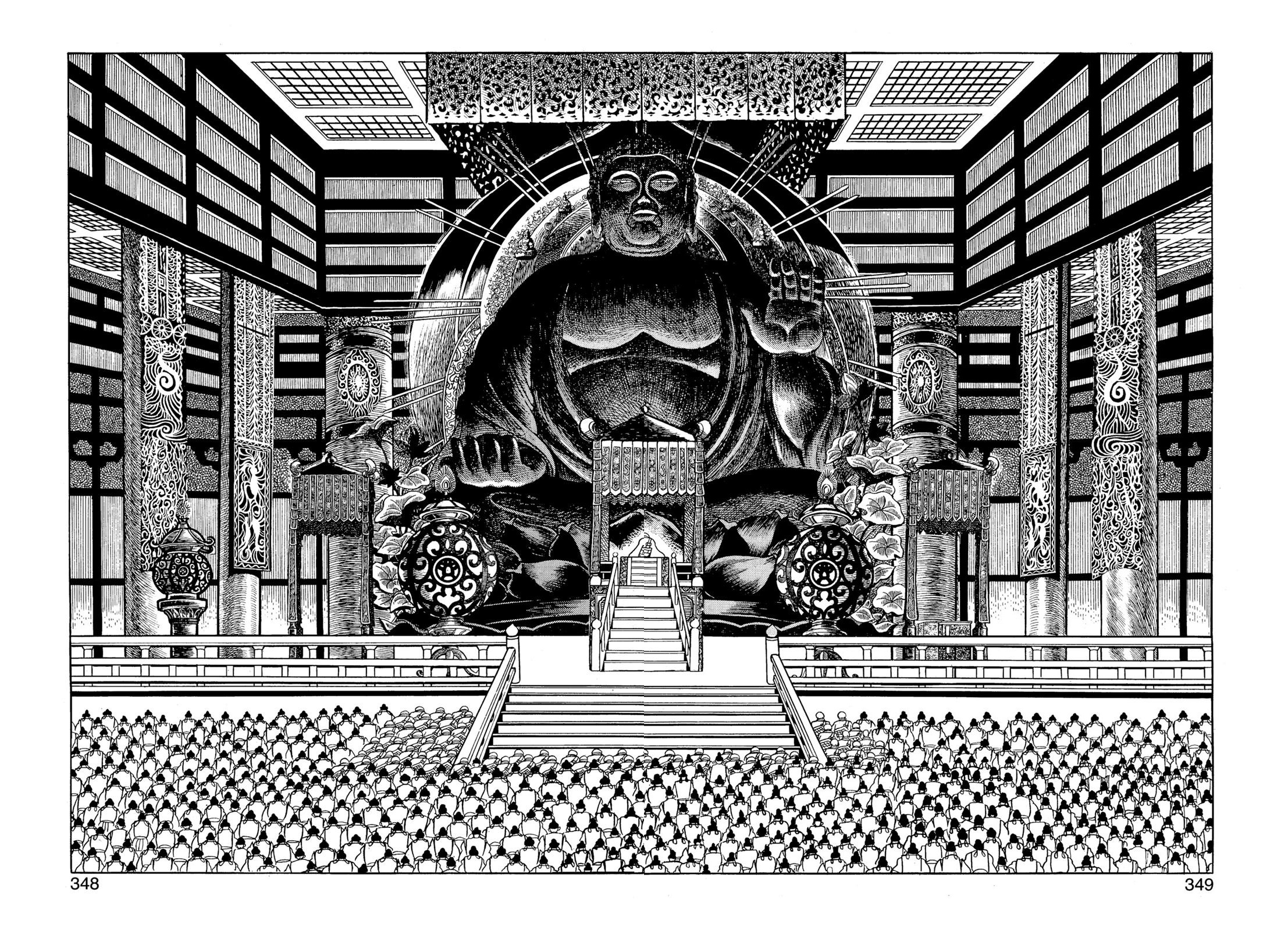
Buddhism plays a vital role in Phoenix as one of the most influential religions in the history of Japan. Tezuka himself was a Buddhist, so it's no surprise that he wanted to incorporate it into his work. Hilariously enough, when the Boddhisatvas appear in the flesh in Sun, they are portrayed the way they must have looked to the Japanese when Buddhism first made it to their shores: like frightening, unstoppable demons. When it comes to any kind of religion (or any cultural belief at all), how it is viewed hinges on perspective. A member of an old religion being forced out of fashion perceives the new ideas as merciless invaders dead set on tearing down and trampling every belief they'd ever held dear. A supporter of a new religious movement sees the old ways as outdated superstitions that have no place in an enlightened age. And of course, those who don't follow any religion see all of them as weapons used by the rich and powerful to subjugate the masses. Tezuka opts to walk the middle road in his portrayal of religion, in an approach that's both pragmatic and optimistic. Yes, it's true that for the morally bankrupt, religion is nothing more than a tool for political gain and domination. But for ordinary people, it's a way to comfort damaged souls and save sinners no matter how far gone they are. Religion is just like any other tool: completely neutral. The benefit or harm it causes is entirely up to the people who use it.
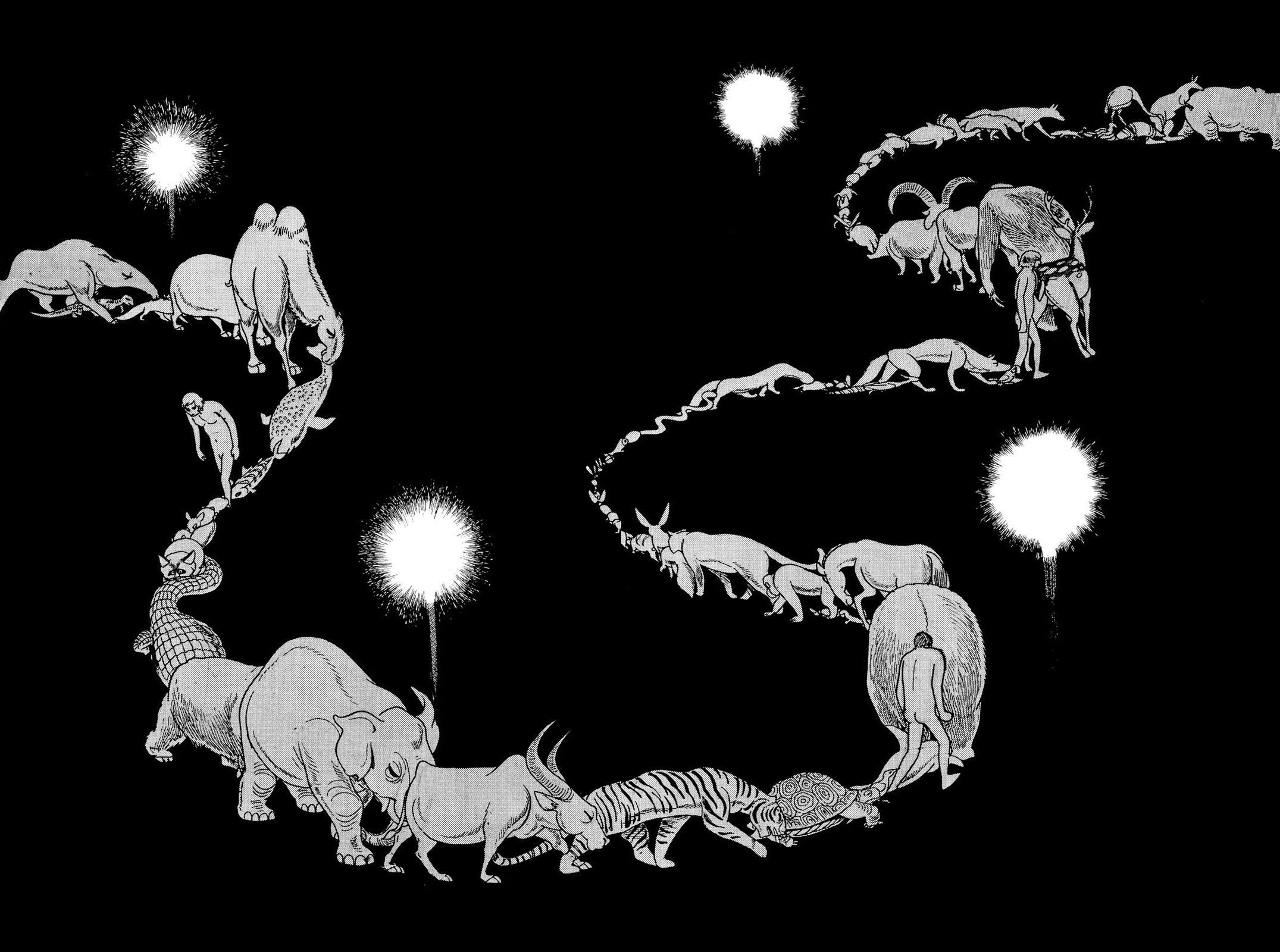
Despite each new chapter taking place hundreds or even thousands of years apart from the last, they're all connected by the repetition of similar themes and characters in an unmistakable pattern. In real life and in fiction, history tends to repeat itself. Countries rise and fall, religions flourish and die, wars ebb and flow leaving only corpses and bitter memories in their wake. Over and over and over again. As much as the characters want to believe that the time they live in is the most important and unique, the most prosperous, or the most full of misery; the present is just another page in the long, violent tale of existence. No matter what era they're born in, the inevitability of strife and suffering is simply their destiny as human beings.
The cycling in and out of new beliefs invariably leads to discord, and this process repeats itself in every generation. This vicious tug of war between the past and the future runs through every single chapter, with no end in sight. When one sees the same tired mistakes repeated over and over across countless lifetimes, it's hard not to think that it is simply humanity's fate to be locked into self-destruction, never learning from its many blunders. However, we do see small but far-reaching changes in Phoenix. Yamato Oguna and Kajika's tireless efforts ended human sacrifice in their homeland. Chihiro and Leon's undying love planted the seeds of human emotion in future generations of robots. Gao found peace and rose from the wreckage of his tattered karma as a redeemed man, and if Gao can change for the better, then anybody can. Three steps forward and two steps back may be painfully slow progress, but every little bit counts.
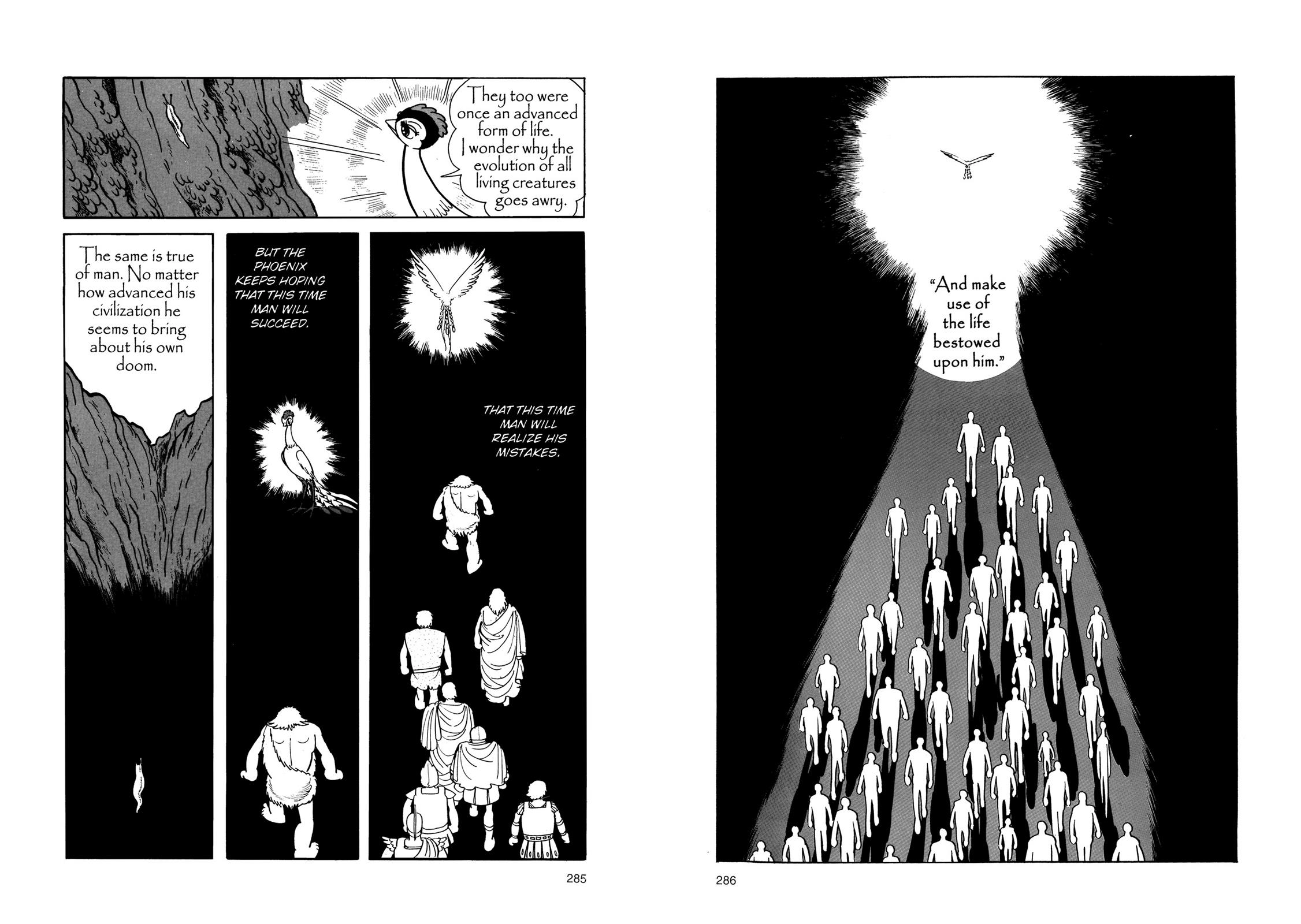
Osamu Tezuka unfortunately passed on before he was able to finish Phoenix, but it is by no means an unfulfilling read. It has a feeling of wholeness to it that even some series with definitive endings could not achieve. While disappointing, it's lack of a conclusion is actually quite thematically fitting, if you look at it from an optimist's point of view.
In Phoenix, there is no clean happily ever after to grant the audience or the characters closure. Disaster strikes, then the world picks itself up, nurses its wounds, and carries on like it never happened. It might seem tragic, maybe even cruel, but it also leaves room for hope. For no matter how difficult the characters' lives are, no matter how many times they fail, Phoenix never gives the impression that their struggles are meaningless. Their individual fleeting existences may eventually end, but life in a cosmic sense moves on, carrying their dreams and efforts along with it. The end of one character's life simply means that a new one is ready to begin in some other place, some other time, some other form. And every new life brings endless possibilities with it.
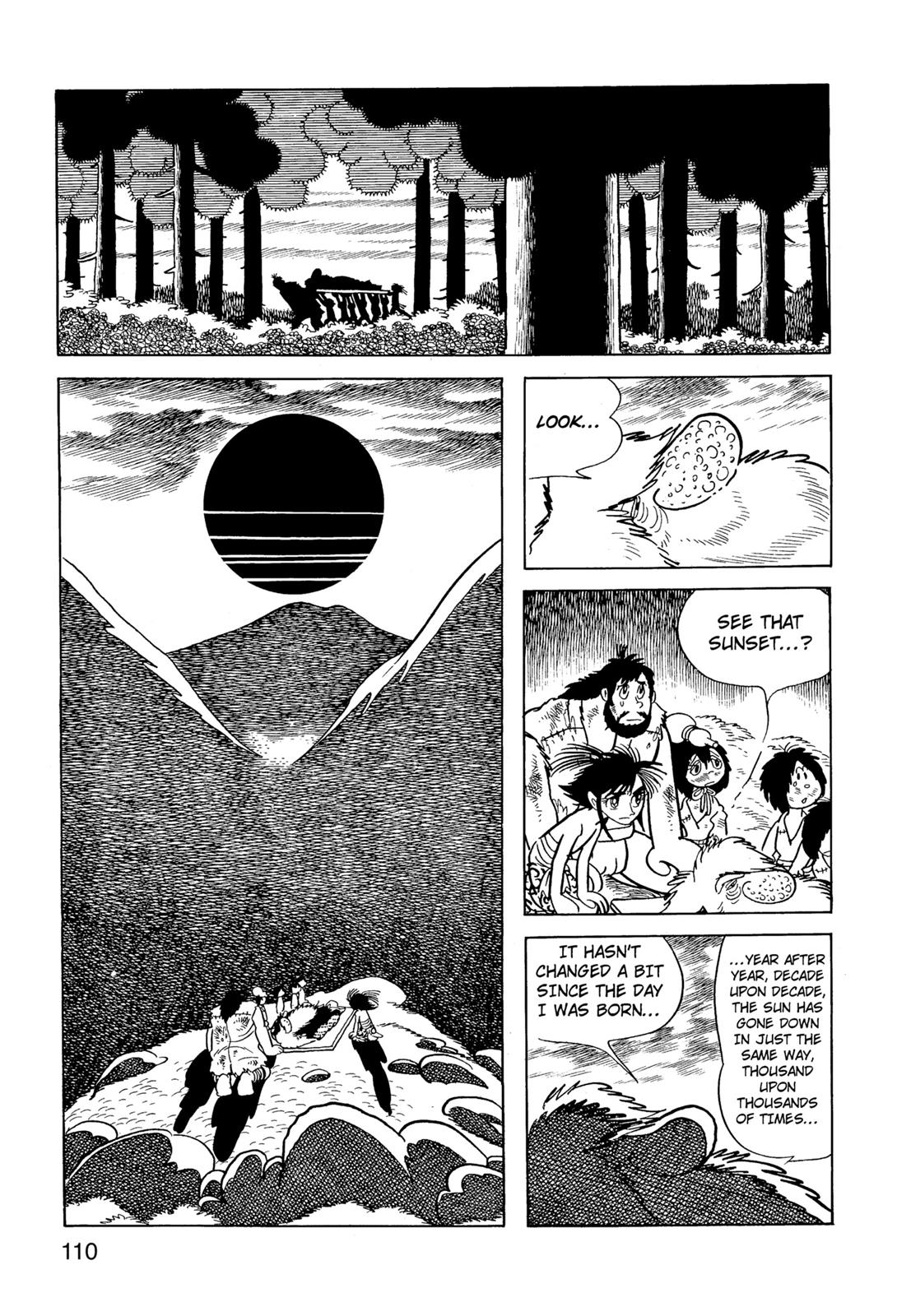
Phoenix is a story about many things, but more than anything else, it is a story about the journey rather than the destination. The love between a man and a woman, a pond reflecting a setting sun, a ladybug on a leaf are all treated with the same reverence as the calamitous end of a civilization. Every single character is a part of something much greater than any one person, and they don't have to be legendary heroes or genius scholars to do their part. History is not just the distant tales recorded in dusty textbooks. It's the little everyday struggles, failures, and victories of ordinary people that underpin their entire world.
And so, as the sun sinks below the horizon and yet another day comes to a close, I present to you the final harsh lesson that the Phoenix has for humanity: You are not the masters of your own fate. For your entire short existence, you will be at the mercy of powers beyond your control, same as every other living thing. No matter what time or place you were born in, we're all the same unfortunate creatures doing the best we can to endure in this vast, unforgiving universe. Even so, take pride in your fleeting nature, for your life is precious in its humble fragility. Even if not a single person remembers you after you're gone, it doesn't change anything. You were alive, and life for its own sake is beautiful. It's an impossible lesson to learn. It may take us an eternity, or it might take us several eternities to understand. But the Phoenix has faith in us. She's watched us rise and fall countless times, yet not once has her belief in us wavered. And if she thinks that we can do it, then it must be so.
16 out of 17 users liked this review
