Suzume
a review by Pockeyramune919
a review by Pockeyramune919

I have a predilection for anime movies. Shocker, I know. But they’re different beasts than anime shows, rife not just for analysis of the work itself, but of how that work exists in the larger culture of both fandom and popular culture itself.
Hayao Miyazaki and Studio Ghibli as a whole were the kings of feature anime films. Though the influence of John Lasseter as both an executive producer and distributor cannot be ignored, it's undeniable that the quality of Studio Ghibli’s films in and of themselves helped them break into the mainstream and leave the Anime Ghetto in a way that something like, say, Akira could not.
Yet, if you’ve been following anime for the past ten years, you’ve noticed that the king’s castle has long stood abandoned, the bricks beginning to crumble. Yeah, yeah, Miyazaki’s new film premieres this very summer and I’m sure it’ll be amazing, but that very quality will surely be the final nail in Studio Ghibli’s coffin, as I alluded to before.
Naturally, the question becomes who will fill Ghibli/Miyazaki’s shoes. Ponoc was the likeliest candidate, what with it being compromised of several Studio Ghibli alums. It had a decent enough proof-of-concept in 2017’s Mary and the Witch’s Flower, but not much since then.

In looking for what’s the most likely to simply be Ghibli, I, and others, I suspect, may have ignored the most likely candidate for the person or studio that’s done the best job of holding up its legacy: Makoto Shinkai.
Now, before you smash that dislike button, hear me out.
Shinkai isn’t the same as Miyazaki. No one is, nor will anyone be. Shinkai isn’t literally making Ghibli movies and as such, cannot fulfill their same niche. Yet he’s the biggest new name in the anime movie scene and his prominence is what earns him the comparison. Ignoring movies attached to television shows/manga and the juggernaut that’s Doraemon, Shinkai’s works are the only members of the top ten highest-grossing Japanese films that share the spot with Miyazaki’s. Your Name was massive, but it could have been a fluke. Weathering With You showed that Shinkai could play with the big boys, and if Suzume’s money printing is any indication, it codifies him as the big boy.

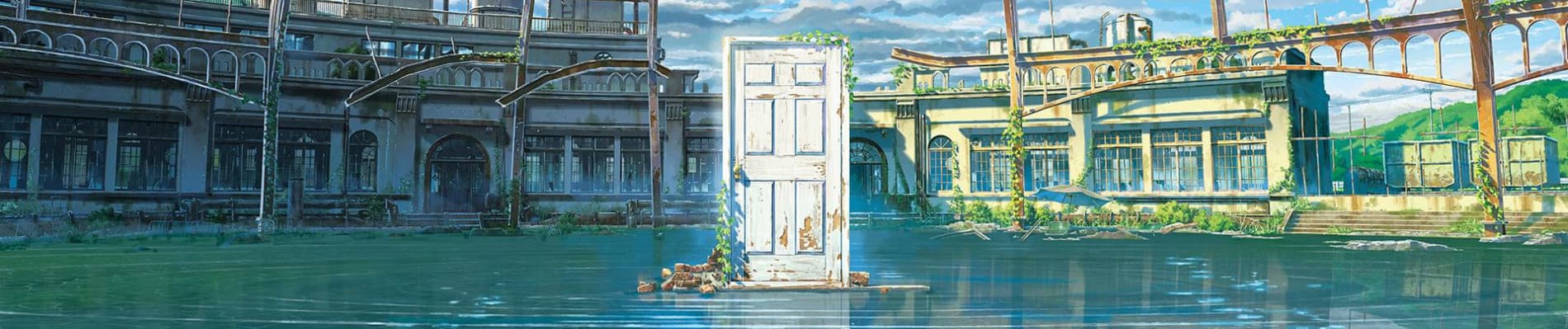
Suzume is an easy movie to love. Suzume, like its two predecessors spares few expenses when it comes to visual fidelity. It’s an absolute beaut to look at. I went in thinking I’d say that the ground is Ghibli’s domain, with its rolling, green hills, while Shinkai takes to the air, depicting the sky with beautiful meteors, sunsets, and raindrops. Suzume is no slouch in this regard — its marketing knows as much: you’ve likely already seen the Ever After’s violet sunset, dotted with stars and a spiral arm of the milky way. If the film’s supernatural antagonist, “The Worm” is supposed to be frightening, it fails only insofar is that it’s hard not to be mesmerized by its dark tendrils snaking across the sky. That said, I was surprised to see that Suzume landscapes give Ghibli a run for its money. Out the gate, we’re treated to some truly breathtaking establishing shots of the titular Suzume’s Kyushu home. It reminds me a bit of My Neighbor Totoro and the sparking blue water of the ocean looks so good that you’re liable to break the screen you’re watching the movie on to try and jump in. Suzume has “early summer vacation” vibes. The movie feels very cozy, which services its themes of showcasing places where normal people live their lives before disaster. You really get attached to these places; you want to see them saved and you really feel the losses of past disasters. There’s as much beauty and respect placed on “lonely places” as there are populated ones. It’s a movie more visually striking than Whisper of the Heart, which is saying something considering I couldn’t stop gushing about how beautiful Tama City was while watching, much to my friends’ chagrin.

Speaking of Whisper of the Heart, it’s referenced in this movie by name. It was a cute shoutout that was after my heart. What was even more after my heart was the reference to Penguin's Memory. Remember that? Of course you don’t, but I do and I had the stupidest grin on my face when I spotted its cover as one of the characters sings its song. There are references and product placements all over the place — McDonald’s, Twitter, Instagram, Nissan. To some, this might reek of shallowness; to me, it brings to attention how Shinkai’s movies are more down-to-Earth and real than most Ghibli movies. Ghibli movies are fairy tales while these feel a lot more interested in being perceived as being contemporary in time and place. In a way, that makes them feel more approachable.
Suzume is also indicative of the difference between Shinkai and Miyazaki’s cohort’s intended audience. Ghibli movies were generally family-oriented affairs. Not necessarily in terms of content (as something like *Princess Mononoke attests), but in tone. Even if they weren’t necessarily aimed at kids, it was something that kids, as well as other age groups, could get something out of. Shinkai’s films meanwhile feel more aimed at teenagers — you feel it in the dialogue, in the jokes, and its preoccupations. You also see it in the prevalence of romance.
And its in the romance where you see Suzume start to stumble.
Suzume’s romance, quite bluntly, didn’t need to be there. It probably subtracts more than it adds in that the ages (Sōta’s ill-defined “graduate school,” at the very least, places him older than 21 while Suzume is firmly established as being 16) make the endeavor a bit gross. Sure, you can read it as being a friendship, but there’s enough teases there that you can tell that it was intended to be a romantic pairing. Because that’s kind of Shinkai’s thing.

Suzume has more interest in being an adventure than Shinkai’s other breakout hits. The characters travel Japan in search of doors to stop the catalysmic “Worm” from escaping and wreaking havoc on the populace. We’re treated to two chase sequences and while Shinkai’s previous affairs aren’t what I’d call “gritty,” Suzume’s talking cat and lead-cursed-to-become-a-walking-and-talking-chair make the movie feel whimsical in a way that its predecessors aren’t. It’s not full-on adventure ala Castle in the Sky, but it certainly is more energetic than what came before. But Shinkai isn’t content to just have his chases, his supernatural escapades. No, he needs his slow moments, the moments that contribute to the movie being cozy. Yet they’re implemented oddly. Suzume has a bit of a weird pace — the movie itself seems to progress really quickly during its first two acts but its third feels slower to the point of whiplash; the end of the second act felt like a climax. Even during the first two acts, the action is much shorter than the “down time.” I like both elements but they don’t blend in that well.

This is also reflected in the more character-focused narrative not really sharing screen time with the supernatural elements. It’s a “never shall the two halves meet” situation and it’s very stark in just how separated they are. The first two-thirds, while having slower moments, doesn’t have many slow moments that further our understanding of the characters or what’s at stake emotionally. As a result, I thought it to be shallower than its predecessors. But then the third act hits and the movie becomes surprisingly deep and somber. No longer do I care about the antagonist’s seeming lack of motivation because I realize the movie isn’t really meant to be about them. The third act, more bereft of supernatural elements, shotguns the emotional gut punches. It certainly works, but in a way that doesn’t feel as satisfying as it could be. The narrative really would have been stronger if Suzume’s struggles with both her aunt and the memory of her mother were spread throughout the movie.
One of the movie’s themes seems to be about accepting that death is a part of life and not chasing those who’ve gone. Sōta is sacrificed in order to save Tokyo; Suzume chooses duty over love. But he’s eventually revived without much repercussion — Suzume essentially gets to eat its cake and have it too. After the backlash of Suzume’s direct predecessor Weathering With You — in which its protagonist essentially damns the citizens of Tokyo, if not the entire planet, by choosing love over duty — the decision certainly makes sense, though I can’t help but feel it hurts the narrative. For a movie whose central theme is about letting go, it really decides to politely decline the easiest slam-dunk.

Oh, right the third act involves the protagonist trying to save their love interest, just like the previous two Shinkai movies. Whether you consider this a mark of an auteur or a hack with one idea that he cosplays as unique stories is ultimately up to personal opinion. I err more towards the former, but I can’t deny that the samey-ness of Shinkai’s movies is beginning to wear thin. There’s enough different here that it doesn’t feel like a complete retread, but Shinkai’s next movie will really need to break his mold lest he be fully shackled with the “one trick pony” weight that’s been wrapping around his ankle since Weathering With You.
I wouldn’t go as far as saying that Suzume is an easy movie to hate, but it’s an easy movie to find fault with. It’s a messy movie — messier than Your Name, messier than *Weathering With You. Messier than pretty much any given Ghibli movie.
Yet I love it anyway.
Because despite its fault, there’s a lot of genuine heart in it.

Again, I love how cozy it is, how tender it is towards the people Suzume meets in her travels, how the movie finds just as much beauty in the bustling city as it does in the countryside. I love how the “lonely places” are revealed to be the sites of disasters. It hit hard when we figure out Suzume’s mother died as a result of the 2011 Earthquake and as a young girl she blacks out her diary following those days. It hits even harder hearing people say “goodbye” to their loved ones, not knowing they’ll never see them again, yet perhaps knowing that the possibility is always there and cherishing the moments that they have. I love the cat, as creepy as it is, I love the music. I love the whimsy, which I feel expands the demographic in a way its predecessors couldn’t. This might not be as good as most Ghibli movies, but it’s certainly as enjoyable.
Shinkai isn’t a perfect director and Suzume is the perfect movie to encapsulate this fact. Even if he’s this generation’s Miyazaki, he’ll never be a Miyazaki. There won’t ever be an animation director like Miyazaki again. And maybe that’s a good thing. Because it’s always fun to root for an underdog, to analyze what shortcomings he needs to vault over in order to beat the odds. Shinkai has a lot of heart; a drive to press on despite his shortcomings and make something beautiful with those imperfections. And Suzume encapsulates this fact, too.


50 out of 55 users liked this review
