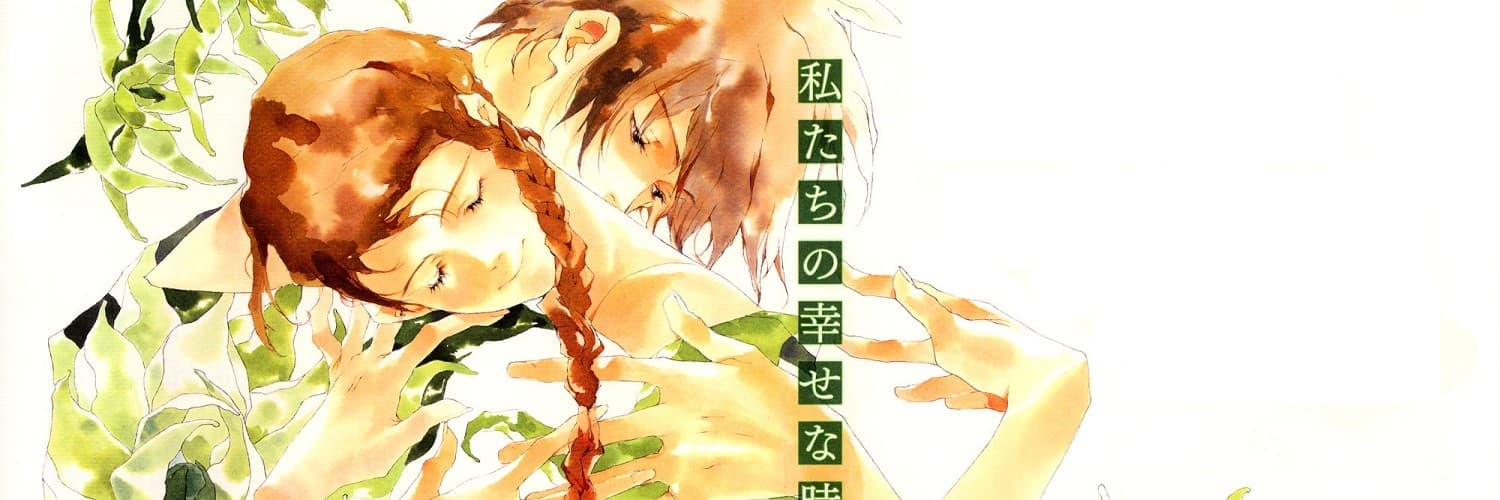
In my previous review I commented at the end that, in my opinion, fixation on scores can often lead people to feel pressured into taking a specific position. This can often lead to two different outcomes, depending on how little capacity the individual has to stop giving a shit about public opinion: in one, the person evaluating the specific work can end up taking an extreme position, considering it’s a naturally divisive work, in order to fit into the group that shares that position. The other outcome, however, is something that I find even more worrying: it can create around certain works the status of “untouchable”. In these instances, the work is so wildly agreed as being a masterpiece that disagreeing with the consensus is nothing short of heresy.
So, I think this little diatribe can give a good idea of how I felt going into Watashitachi no Shiawase na Jikan (stupid long-ass names! I’ll call this one Happy Time for the sake of convenience) and suddenly finding it not as good as I was expecting. In fact, not finding it good in general!
Story and Characters
Sometime ago I was discussing with a friend about a certain series we both had problems with and he mentioned that from his point of view it seemed that the characters in that series were not really representations of humans, but personifications of problems. When I began reading Happy Time, I suddenly recalled that specific statement.
But what necessarily would mean a character being just a personification of a problem? Well, the issue in this case is that, before we have any idea of how the characters can be generally perceived as human beings, the source of characterization is simply the problems that define their struggle. Being Happy Time a drama, it’s understandable that the personal issues and traumas faced by the characters would be the focus of the story, but even for a drama, it’s important to first of all, establish what traits the characters have outside of those issues. The problem with letting their traumas and struggle define them is that if they are supposed to be relatable or likeable figures, the audience is left with little ground to identify or attach to them, and if they are not supposed to be likeable or relatable, the lack of defining traits leaves them without solid foundation for their development.
I’d like to make a parallel to better explain my points, but before that let’s get to know the unfortunates that compose the story of Happy Time.
Mutou Juri is a former pianist that has already tried suicide 3 times and holds a deep grudge against her uncaring mother. She begins visiting prisoners sentenced to death by influence of her aunt Monica, as a way of driving herself away from her depression.
Yuu is the prisoner on death row that is visited by Juri and with whom she begins to develop a bond, based on the understanding that both have deep grudges against the situations they were raised in.
Monica is Juri’s aunt and a nun who took the habit (no pun intended) of visiting the prisoners who don’t have anyone looking after them. In the past, she lost her son in an accident, but couldn’t bear the grudge after the killer committed suicide in prison.
Happy Time’s story already begins at what can be perceived as a conflict, with the main character, Juri, meeting her mother, who is visiting her in the hospital after her third suicide attempt and it’s clear in this scene that their relationship has not been the best for a long time. From then on, the plot dives into its main driving point, the relationship between Juri and Yuu, which follows the tried-and-true development: they first don’t see eye-to-eye, but due to the necessity of meeting each other end up finding similarities that lead them to bond and improve each other’s mindset and way of looking into life. Now, I’ll not simply disregard how the story develops and the changes they operate into one another, my point here is that, with such weak characterization on both parts, the foundation in which that developments stands on is flimsy and ultimately creates a disconnect between what the characters were and what they become.
The parallel I’m going to make here is with another manga, Bitter Virgin. Yeah, I know, it’s my favorite, call me guilty on that, but the parallel is still valid! Point being: in the first chapter of Bitter Virgin, there’s a superficial but effective work in giving up the basics about the main characters; Aizawa, the main girl, is generally shy and seems uncomfortable in interacting with men and Daisuke, the main boy, gives on the slight vibe of being a womanizer, while still being a well-centered teenager. When the bomb-shell about the main girl is revealed, there’s clear understanding of how that might have shaped her current persona and subsequently how that affects Daisuke’s perception of her. From then on, the manga goes on top explore her backstory, how she transitioned from her old-self to the individual she is during the main events of the narrative and how her experiences affect the people around her.
I like to always keep characters under a microscope, exactly because I don’t like to carelessly throw around words like “bland”, but that in reality is what the main characters of Happy Time are, bland, their characterization is restricted to the bare minimum to make them realistic, but there’s no three-dimensional figure around that. They act very according to their respective traumas, but what kind of people they were before such traumas shaped them, how their change was perceived by others, or even how others react to the kind of people they are currently is not show to the reader. Most of this problem comes from a fundamental issue on how their backstory and characterization is handled, in that it’s in blatant disagreement with the rule of Show, Don’t Tell. What kind of people they were in the past is not shown to the audience, but simply spelled out, how they change as characters is not an easily observable change progressively displayed throughout the story, it’s simply stated by other characters. It’s a principal that boils down to Robot Devil’s words:
“You can’t just have your characters announce how they feel, that makes me feel angry!”
That is not exclusive to how characters feel, how they act, how they interact with others, how they change has to be observable by the audience, otherwise it’s all restricted to Inferred Attributes. I’m willing to recognize that these issues are a result of the manga’s short length, being it just 8 chapters long. However, understanding how these problems came to be does not make them forgivable, if anything it just highlights poor planning on the writer’s end. More time should be given to fleshing out the characters and reshaping the writing in a manner that could allow the audience to read into the narrative themselves, not be force-fed the development.
In general, these issues would only be enough for me to classify a work as mediocre, but not straight up bad. The first point where Happy Time gets the rating of “BAD” is when it decides to pull of the Rape Card. For the sake of clarity, pulling the rape card is when a work attempts to sell itself as mature and serious by utilizing rape as a plot point, either in backstory or in the current events of the story. The problem is that you can’t simply pull off a rape card, you have to earn it, and again, that is something that Bitter Virgin managed to pull off with much more efficiency. In that manga, the event in question is displayed tastefully but with no sugar-coating, giving full context of how it affected the characters at the time and how it ties in to the current state of things. With no understanding of what kind of person the character was prior to the event and no context of how it happened though, as it happens in Happy Time, it loses its connection with the current events in the story and ultimately becomes a superfluous plot-point, and you simply can’t have rape in your story just for the sake of having it.
Beyond that, Happy Time is also a story that didn’t have the guts to work its characters darker moments to the full extent, something observable on the revelation of Yuu’s backstory. Besides being almost completely exposited in the very dry and audience-unfriendly fashion like I explained before, Yuu’s past and crime are the textbook definition of a generic Woobie-backstory: it does everything possible to exempt the character from any guilty while still pulling the most clichéd but poorly developed sympathy-inducing elements, from growing on an orphanage to dead brother and, worst of all, dead cat. I’m not arguing that actually giving the character full guilt would be enough to save the story, but would be one point where the characterization in Happy Time could have been truly commendable, it would actually lead the audience to understand the extent of how much he had buried himself before coming back to his senses, making his current state much more fitting and the development he receives more meaningful.
Presentation
This will be considerably shorter in comparison to my previous reviews, as a manga features fewer elements up for judgment in its presentation than an anime.
Happy Time’s visuals are generally fairly average. There’s nothing particularly disagreeable on how the figures are built and, if I’m actually free to cut the manga some slack, it manages to present a few design choices that have relevant symbolic meaning within the story: Juri leaves her fancy, “stay away from me” hairdo, adopts a subdued dressing style and ties her hair tighter giving the idea she has become less hostile to interaction, while Yuu accepts cutting the long hair that hid his face and symbolically manifested his unwillingness to get close to others. There’s also solid pacing in between frames, so there are no instances where how the action went from one image to another looks disjointed or unfocused. The one point the manga could use improvement is on the variation between shades, which would help bring more detail to the expressions.
Gods, I sound like a boring twat now!
Personal Ramblings
Happy Time is currently the 10th highest rated manga on My Anime List, which is sufficient to give it untouchable status to some extent. The danger of a show or manga achieving that kind of status is that it makes general consensus unfriendly to criticism of any type, especially if it’s harsh criticism like what I proposed to do here. Deviation from the common opinion is disregarded often as “you simply watched/read it wrong”, which I’m willing to admit might happen but either way is not a worthwhile form of counter-argument. I for once believe that every work should face scrutiny to some extent, even if it’s something regarded as “The Greatest of All Time”, like Fullmetal Alchemist, Berserk or Legend of the Galactic Heroes. It’s by exposing or discussing a show or manga’s shortcomings that we can get to an understanding of what truly makes a Greatest of All Time.
As you might have guessed, the question that I would like to ask now is: How did Happy Time become so acclaimed? In art, and especially in fiction, objectively defining the quality of a work is near impossible (unless we’re talking about Metroid: Other M, whose story objectively sucks!), but I think it’s possible to have a good understanding of the general quality of a work by looking at its audience. Now, I’ll not pretend I have a deep understanding of the audience of a manga I just read, I can only theorize. Considering that the most popular manga on MAL tend to be shounen, it’s possible to pull out of my ass the idea that this title, having achieved some initial praise, might have been a gateway into drama-centered manga for many readers, who were likely tired of shounen or drifting into other genres and ended up finding an appeal on its quirks. But this is all conjecture.
I’ll not lie, I find disheartening that a title like this is so acclaimed, in front of works far more nuanced and respectful to the audience, like Vinland Saga or Parasyte (or even some shounen!). I don’t maintain hopes that this review will somehow “enlighten the masses”, but I hope to throw some perspective into the discussion and challenge some notions about what qualifies a good drama. Feel free to post any angry comments on my profile, I have popcorn ready and a brand-new keyboard, so you are welcome.
119.5 out of 188 users liked this review