Your Lie in April is a series that I first experienced via its anime adaptation, after which I picked up the manga. This experience was back during my first year of high school. Now that I’m about to enter my final year of college, I figured that I would go back and revisit it since I remember having a lot of complicated feelings about it when I first watched and read it. Revisiting the manga was a very interesting experience, one where some of my old opinions remained while others stayed the same. All in all, my feelings on this series are still very conflicted, although not for the exact same reasons they were when I was younger.
For the past two years, Kosei Arima’s world has been gray and monotone. When he was younger, he was a renowned piano player known for playing the score right down to the very letter-an ability that led to people labeling him the “Human Metronome” and thinking of him as his mother’s puppet. Kosei’s mother Saki wished to be a pianist herself, and decided to teach her son so he could fulfill her dream of going overseas. As she started to get sicker however, she began to be much harsher towards Kosei, often physically beating him until he got the score perfect and making him spend all his time on his piano lessons. After her death and a performance where he stopped playing part way through due to a breakdown, Kosei walked away from the piano altogether. But one day in April, Kosei meets Kaori Miyazono, a brash and spirited violinist who demands that he must be her accompanist at her next performance. Color slowly starts to come back into Kosei’s life, and he begins to return to music again.
The beginning of this series (Approximately the first three volumes, as I read this series physically) was probably the part of it that I enjoyed the least. Tsubaki and especially Keori’s attitudes towards Kosei in regards to him getting back into piano were just far too pushy and abrasive for my liking. The slapstick at the expense of Kosei (Which unfortunately persists throughout the series) doesn’t really vibe with me considering the physical abuse he went through as a child, and it’s particularly prominent at this point in the story. It’s clear from his admiration of Kaori and her music that Kosei still very much cares about the art form and possibly even wants to go back to it. Maybe if he was inspired to return to the thing that previously hurt him so much by Kaori and her unusual playing style on his own terms instead of her basically strong-arming him into it, I wouldn’t feel as uneasy as I do. Once Kosei actually returned to music around the fourth volume however, I started to get more invested in what was going on.
The introductions of Takeshi and Emi and their personal rivalries with Kosei were honestly more interesting to me than the romance storyline. In general, my favorite parts of the story were the parts focused on music. I really enjoyed the competition aspect, and both of Kosei’s rivalries with Takeshi and Emi are entertaining to read about. You really can feel the passion the characters have for their craft, and the applause from the audience at the end of their performances is properly cathartic. Of particular note is the storyline involving Nagi Aiza, which I remember hating the first time I experienced this story but found myself enjoying quite a bit this time around. I think that I was a lot more sympathetic to her frustration with her brother for spending all his time obsessing over Kosei at the expense of his relationship with her. It’s also a chance for Kosei to display all that he’s learned since returning to piano and passing that onto another person. Would’ve been nice without the Kosei torture at the beginning, though.
The characters are probably what contribute to my mixed feelings on this series the most. Kosei has gone through a lot of trauma in his life that has shaped who he is as a person. The way the story handles said trauma is a bit shaky in my opinion. I’ve already mentioned how the slapstick at his expense undermines the serious attention they give to his abuse, and the way they ultimately resolve it doesn’t fully sit right with me. The fact that the majority of the female cast of this series have motivations that ultimately revolve around him is something I don’t particularly like. He is the main character so the attention is focused on him a lot of the time of course, but I believe that having pretty much the entire relevant female cast revolve around him is emblematic of how female characters often tend to be written in shonen series. Despite my misgivings with how parts of him are written, I do like Kosei and was rooting for him to succeed and be happy throughout the manga and afterward.
I’m gonna get the other supporting cast members out of the way before I get to our two female leads. Watari is fine. I don’t have any particular strong feelings towards him, positive or negative. I briefly mentioned Emi and Takeshi earlier, and I really like both of them. Takeshi initially comes off as a hot-blooded shonen rival type, but after his first performance it’s pretty clear that that isn’t really the kind of boy he is and he and Kosei genuinely seem to get along okay outside of their piano rivalry. I like Emi a lot, and I wish we could have seen more performances from her outside of her big one after her introduction. She does fall into the “Every female character in this series revolves around Kosei” problem that I mentioned earlier, but if I’m being honest I was kind of rooting for her to get with them even though I know it’s completely hopeless. Maybe, just maybe, they’ll get to know each other more in the future. Nagi was a character I disliked at first due to her torment of Kosei, but I grew to like her a lot more because her struggle was understandable to me.
I’m going to put my thoughts on the main two girls under spoiler tags because I really do have a lot to say about them.
Back to not talking about spoilers, I will say that I did really like the ending. It is part of the reason I gave the series a re-read in the first place, as it is something that practically begs you to go back and look for any hints of foreshadowing. Re-reading it at a different part of my life is what I believe has allowed me to be more understanding towards certain characters actions as well. The ending is what I remember enjoying the most from my first readthrough of this series, and while it was not my definitive favorite part of this readthrough it was still something I highly appreciated and enjoyed.
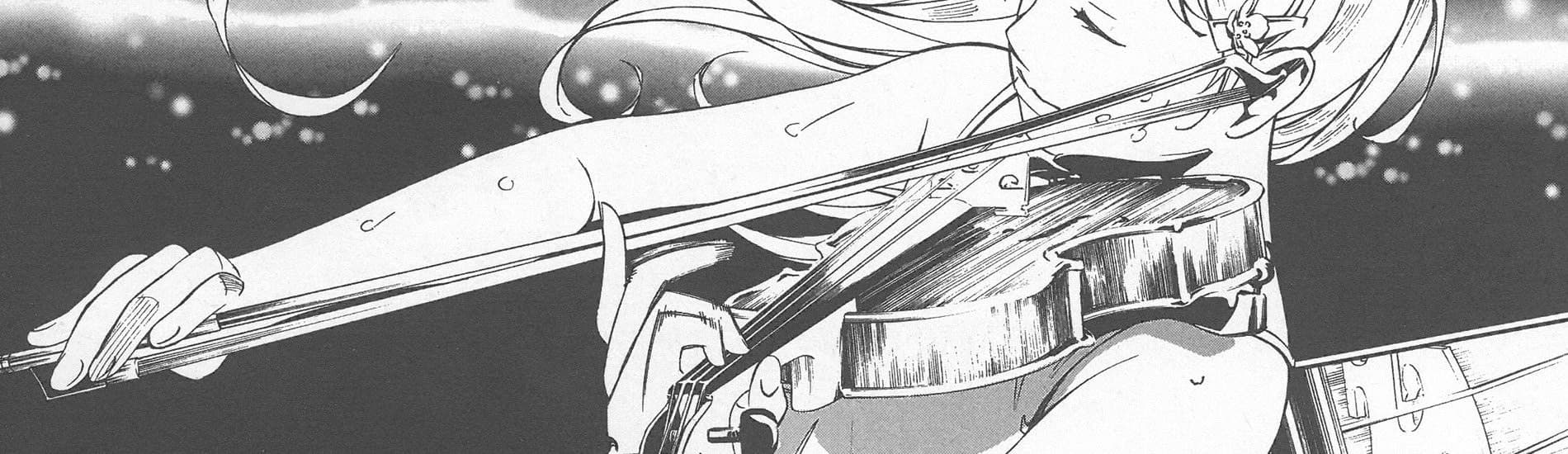
I really like Your Lie in April’s art style. Naoshi Arakawa does a great job at conveying the emotions the characters are feeling, especially during the scenes when the characters are playing music. I can practically hear them playing the music as I read the pages. The manga takes place over the course of about a year, and the change of seasons is very evident in the art. While the actual style does not really change that much between seasons, Arakawa’s art conveys the feelings of each season perfectly, from the breeze of spring to the youthful energy of summer to the uncertainties of fall to the melancholy of winter. I will surely be checking out his other works in the future.
It's been a while since I've seen the anime, but I honestly think it might be the superior version of this story. The beautiful animation and the fact that you can actually hear the characters playing their music really helps elevate it (Hikaru Nara is a Top 10 op for me as well). While I cannot say that I love this series, it is not something that I regret reading at all, and the good points ultimately make it worth experiencing even if it’s not perfect. I have seen a wide variety of opinions on this series over the years, and I am sure that many people who read this will agree with me and that many won’t. Ultimately, I would encourage people to read the series themselves and form their own opinion.
13.5 out of 18 users liked this review