Minor spoilers for the setup, watch the first episode if you want a fresh experience. I try to avoid major plot points later on though.
Yona of the Dawn really stands out for me among all the fantasy adventure series that seem to flood the modern lineup of anime. Granted, it’s almost a decade old by now and the manga is closer to 15 years. I also have to admit, I dislike the isekai genre for the most part, so seeing an original fantasy anime that doesn’t rely on isekai is already a big plus for me. Sometimes a fictional world is more believable if you don’t take the initial detour. But generally, Yona of the Dawn manages to be unique for me personally. It doesn’t fall into any tropes I’ve grown sick of over the years. Maybe that’s just my experience but considering the plethora of RPG-style isekai fantasies with a generic magic system my point of view might not be unique.
What distinguishes Yona of the Dawn from other fantasy adventures is that it is very conservative with its fantasy elements and especially magic. The world itself is fictional, which is enough to qualify the series as fantasy. Even then, it is clearly inspired by feudal Japan or more generally east Asia. Instead of throwing elemental attacks at each other, characters actually have to use weapons and combat arts to fight. This makes for a much more realistic and therefore immersive setup, as mistakes are unlikely to be wicked away by magic. We eventually do get some magical elements though, but it takes around 10 episodes until we actually see anything supernatural. If I had a complaint about the series’ fantasy elements, I’d have to point out that it uses a legend/prophecy that simply turns out to be literally true. I would have wished the legend to be more abstract or metaphorical.
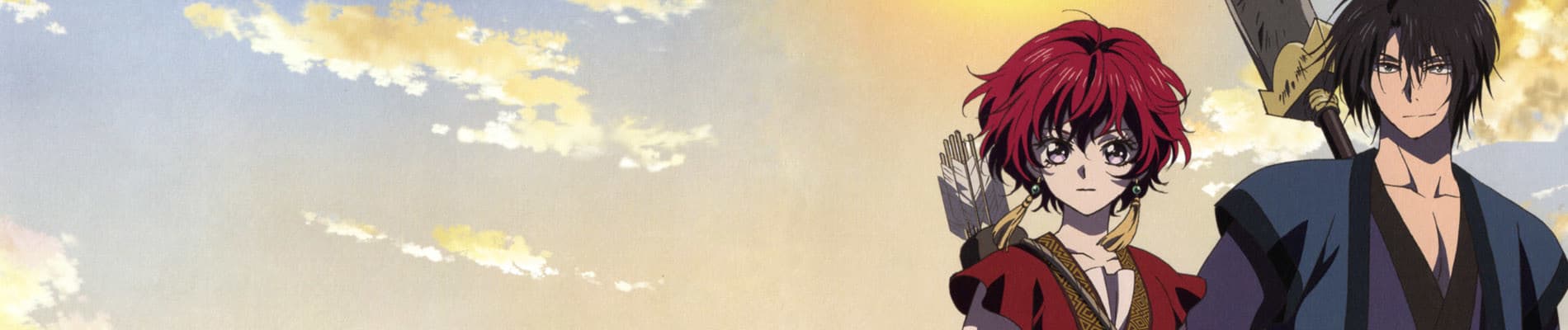
Our main character Yona starts off as a princess who doesn’t know anything about the world. She is forced out of her relatively peaceful life when her childhood friend and love interest Soo-Won kills her father, usurping the king. She flees the castle with the help of her bodyguard and betrothed Hak. Where the series really shines is in showing how Yona struggles with this situation – she doesn’t want to comprehend that her love interest killed her dear father, and even after grasping the situation, she can’t bring herself to get rid of the hair pin he gifted her, showing she still loves him. That’s just human, you can’t erase love or any livelong bond that easily, even when the other person betrays you. We get a similar moment later on, showing the other side of this relationship a bit more clearly. Yona breaks down emotionally after the encounter, which again gives her depth as a character.
On the other hand, Yona also isn’t debilitated by her experience but manages to grow as a person. She doesn’t want to be the damsel in distress, but to learn and be useful, so Hak doesn’t need to protect and save her all the time. This gives her emotional strength - while not physically very capable, Yona shines with her determination and willingness to work for her goals. Even her enemies recognize the fire in her expression, which makes her somewhat intimidating at times. And since this series doesn’t overly rely on magic or stereotypes, Yona doesn’t fall into the magic healer or supporter archetype either.
While we don’t get a whole lot of the main villain Soo-Won, he actually is developed as a character and not just some stereotypical chaotically evil antagonist. He is two-faced, sweet on the outside and secretly cunning. A comparison that comes to mind for me is Aizen from Bleach, who also is introduced as a good-natured person until his true identity is unveiled and he is just evil for the most part. Soo-Won in contrast states right away what his reason for killing the king was, giving him a believable point of view. What makes him so interesting is that he doesn’t just have an evil side. He comes across as carefree and incompetent. His actions don’t seem to make sense strategically, but it becomes clear that he does have a bigger plan. We just can’t decide how much of him is an act or real, keeping some mystery even after knowing what he’s up to. Without the manga I can’t tell if he reverts to being a cunning supervillain or if he keeps this complex dualism, but so far, he’s one of the more interesting villains I have seen.
The deuteragonist Hak is my personal favorite, mostly because he falls into the type of personality I enjoy, and he manages to act very believable. He obviously is in love with Yona, and frequently hits on her. If the series is guilty of any trope, it’s the main character being oblivious to these approaches. This is made up by their entertaining dynamic, these kinds of situations give the series some much needed comedic relief.
Starting with the love triangle between Yona, Soo-Won and Hak, the series technically builds a harem with the rest of the main cast, each character to be sought out either supernaturally infatuated by Yona or actually having a crush on her. It stays very subtle about it though, which gives it a somewhat mature tone unlike so many series that feature harems.
The anime manages to take all the time it needs to spotlight any new characters it introduces and develop them as a person before adding them to the main adventure party. Usually, similar series will rush to complete its main cast as early as possible. Yona of the Dawn takes the full 24 episodes to complete its cast, which is quite remarkable. Though I do have a minor issue with the opening sequence prominently showing the last character who only gets introduced in the very last episode. Not the series’ fault technically though.
It took me weeks to watch the full 24 episodes, which is partly to blame on real life catching up to me, but usually I wouldn’t consider a series I only manage to watch one or two episodes a day as particularly entertaining or great. Yona of the Dawn does invite to take your time though, as it gradually builds up its characters, world and plot over many episodes and taking its time. There wasn’t a whole lot that happened in the first season, but it didn’t feel boring either.
All in all, Yona of the Dawn was a welcome refreshment for me. It manages to stand out from the general muddy mainstream of anime productions and is unique in most ways I find relevant. The only series I can think of that remotely resembles Yona of the Dawn is Inuyasha, other than that I think it has more in common with western fantasy than other anime. It avoids most tropes, at least those that stand out as annoying to me. It’s a shame there is no trace of a second season after 8-9 years, so I’m probably going to read the manga at some point. I can recommend Yona of the Dawn to anyone who wants a break from their usual anime formula.
23 out of 25 users liked this review