FLCL: Grunge
a review by Pockeyramune919
a review by Pockeyramune919



It was dead on arrival.
While many an analysis has been written on the themes of the original FLCL, I'd say that the animation is the biggest draw of the 2000 cult classic. The animation shifts, from the rapid-fire manga panels where we find out just what the hell a "fooly-cooly" even is, to the South Park homage gave the show its signature zany energy and served as a distinct vehicle for the show's coming-of-age story, a story I'm certain many wouldn't give a second glance to if it was attached to a more generic style.

Much ado had already been made of Progressive and Alternative’s art styles and animation. By the time Grunge entered the picture with its CGI, the well had been thoroughly poisoned. When the show premiered a year later and showed that, no, the teaser trailer wasn't an early April Fool's joke, many wrote it off immediately.
Reviews rolled in after Grunge's final episode aired and the prevailing sentiment is somewhere between "FLCL Grunge shat in my cereal" and "FLCL Grunge disemboweled my dog."
And I can't help but find it all a little bit unfair.
Was the teaser trailer bad? Yes, but if we're being honest here, there's little it could have done to make FLCL fans not hate it. The only new FLCL content most fans want to watch is a box set of the original series. FLCL Progressive and FLCL Alternative certainly have their fair share of problems, but the criticism of them is often either flimsy or overwrought. Many hate the sequels by the simple virtue of being sequels and that extends to FLCL Grunge.
Other reviews paint FLCL Grunge as having no reason to exist and having nothing to say when this just isn't true; there's genuinely something here. Whether or not there's enough to justify a watch is another question I'll have to answer entirely.

And before we get started, know that I'm not gassing up Grunge just because I've become the de facto leader of the "FLCL Sequel Defense Squad" (DM for details on how to join). If I'm being perfectly honest, I didn't want to like this show. Not because I was tired of FLCL sequels, but because when the trailer released and the first episode aired, I thought I could finally be in lockstep with the rest of the fandom. Because as it turns out, it's not fun being a contrarian. I'm not paid, I don't have a cheerleader for my absolutely nuclear FLCL sequel takes, and I don't discuss them in a friendly environment. It's exhausting when you feel like you're the only fan of something. So I thought Grunge would be a safe zone for me. But nope, once again, I'm the outlier. Hopefully knowing that I went in looking for as many blunders as I could makes it easier to believe that it’s not that bad.
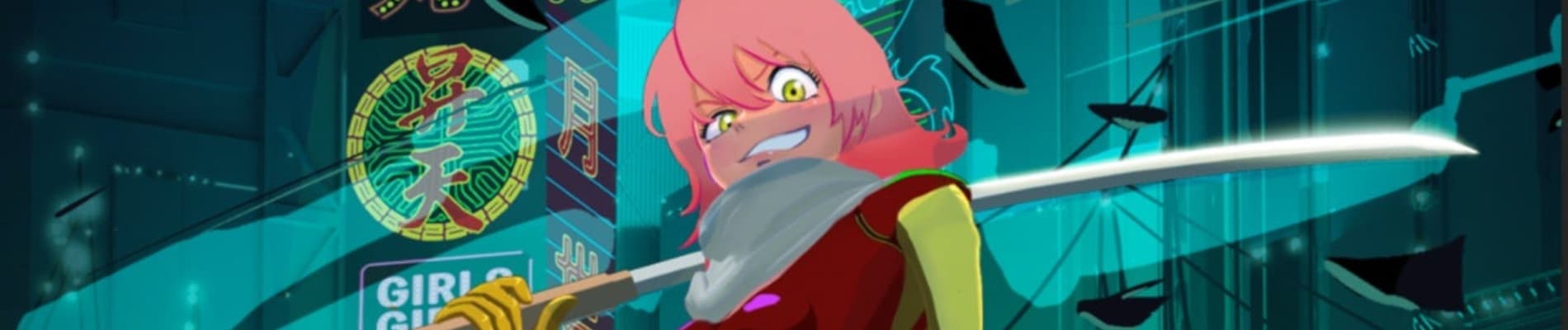
When discussing FLCL: Grunge, you have to address the elephant in the room — the animation. It's one of those times when one particular element of a work looms so large over the rest that it feels like beating around the bush to not immediately address it.
And I'll make no bones about it, it's bad.
It's really bad, in fact. And I'm not one to just write off CGI. The Spider-Verse series shows that, if done well, CGI can rival hand drawn animation. Disney-Pixar's hypercompetent animation over the past decade shows that, even if not phenomenal, a studio with a budget and care can make CGI that looks fine.
With budget taken out of the equation, you get TV anime like FLCL: Grunge.

Grunge's CGI fails at a fundamental level — the models. As a result, you can tell it's a hot mess by looking at a single frame. The most glaring issues are the colors. FLCL: Grunge is the first time I felt the "FLCL sequels are too bright" complaint is warranted. Then there's the texture. A common complaint of bad CGI is that models seem "plastic-y." If anything, Grunge's models are downright "doughy", but even that feels a bit too generous. Plastic is at least something tangible. It’s something you can imagine the physical sensation of even if it's not what you'd want a character to feel like. You don't get this with Grunge's models — they don't look solid. This feeling of intangibility isn’t helped by the simple shadows. The result is CGI that looks unbelievably cheap.
And that's before you see them move, which takes them from "bad" to “downright uncanny." The movement is choppy and stilted — they look less like independent characters and more like marionettes being pulled along a stage. Even something as simple as head movement looks off.

An argument could be made that these are stylistic choices, that the models and movement look so unnatural to make this world seem more bizarre and like a comic book. Assuming this is true (which I don't think it is), you can conduct a simple test to determine if a stylistic choice is worth it. Does it make the work more enjoyable or enhance it in any way? The answer in Grunge's case is a resounding “no.” Bad animation doesn't really aid Grunge in any way. It actively hurts it in that most action scenes are glorified slideshows. I guess the animation sets Grunge apart from other anime solely in a "let's point and laugh at this trashfire" way.
There are visual elements in Grunge that work, but these are more despite the CGI rather than because of it. For one, the backgrounds are much better than the models. A lot of the time we're subject to nondescript closeups but there are moments when we're treated to the beautiful sunsets and establishing shots that FLCL is known for. It's largely thanks to these that the visuals of Grunge aren't a complete bust.
The series' animation switchups which often feature a few frames of more traditional animation also help. They’re a breath of fresh air and, to Grunge's credit, they're a crafty trick up its sleeves that other bad CGI anime don't have.

Yet it's a bit sad that what made FLCL fun is now reduced to what makes its fourth season bearable. It helped propel the first season into the upper echelons of 2000s anime and now it's the foruth's get-out-of-jail-free card.
I think the original FLCL is a smidge overrated and even I'm a bit sad to see what its animation has come to. It was hard for other shows to hold a candle FLCL Classic's animation; if I want to see better CGI than Grunge, I just have to watch whatever children's show my niece is watching on Disney+.

I know I've harped on the animation a lot, but it's just that distracting, that crucial to Grunge’s overall perception, even if not its overall quality.
There's no honest discussion of FLCL Grunge where someone doesn't bring up the animation being garbage. There's no honest response where I don’t immediately say "yeah, that's fair."
If you think animation is the most important part of an anime and you dislike FLCL Grunge because of that, that's fair.
If you think high-quality animation is intrinsic to the identity of FLCL and you don't think Grunge measures up, that's fair, too.
Even if you don't find animation particularly important but you find this animation distractingly bad all the same, that is fair.
If someone's sole reason for considering Grunge absolute dogshit is because of the animation, I'm not going to argue. I can't.
But the negative reviews don't just focus on the animation.
They say the story is bad, they say the characters suck, they say that the sum of Grunge's parts don't fit the spirit of FLCL. I disagree. If you're looking past the animation, you have to admit that there are genuine highlights.
The music is perhaps the most obvious. The OST is once again provided by The Pillows and once again, it's awesome. There's not much to say here; we're four seasons in at this point — you know the deal. If you're at all a fan of rock, "The Pillows" makes for a great soundtrack and hell of a vibe. Fortunately, Grunge doesn't have the mixing issues of Progressive and, like Alternative, the signature songs are saved for notable moments, giving them more impact. Nothing quite measures up to Kanna unleashing N.O. while "Thank You My Twilight" plays, but Haruko fighting her way through baddies in the final episode as "LAST DINOSAUR" and "I Think I Can" play in quick succession is pretty cool.

Speaking of Haruko, she's another vital aspect of the series and one that proved the biggest question mark for me going in. One underrated element of the sequels was Haruko, or rather, the throughline between her appearances. Her behavior subtly differed from season-to-season, though never in a way that felt out-of-character. Haruko's characterization is strong enough that you can create timelines of the series solely based on it. Haruko's personality is a delicate balancing act and I was curious to see if they'd manage to walk the tightrope.
And they do, for the most part. Again, she certainly feels in line with what we'd expect of the character, though perhaps a bit too much. Her appearances in the previous sequels each brought something new to the table that made her feel distinct from her debut — Progressive saw her at her most antagonistic while Alternative saw her at her most helpful. If I had to distinguish her Grunge appearance from her Classic appearance, I'd say she's mostly on the side of the protagonists here. She's still mysterious and alluring, but mostly without the air of danger. There's a point where Haruko playing both sides earns her the ire of Shonari, but nothing comes out of it. Haruko is a bit whelming in Grunge and less compelling than her co-stars.

The plot is where Grunge puts in the most work in proving that it's more than its bad CGI. The setting is described as a town where everyone has given up hope for a better tomorrow, resigning themselves to shuffling through the daily grind of life. FLCL at its core is a coming-of-age story and this is perhaps one of the compelling takes the series has had on this concept. How does one come of age in a place that has no future? What does it do to someone growing up? Grunge also leans into environmentalism, showing the long-term impacts of Medical Mechanica, which include the mutation of fauna. It makes an even more compelling reason for the three protagonists to wish for escape. This wish is physically manifested via a space shuttle with only one seat available.
The first of our characters is Shinpachi or "Shin" and he's
okay?
He's not a bad character, just a bit of a nothingburger. There's really nothing that makes him distinct, though this fortunately means there's nothing that particularly hurts him as a character. Sure, Hidomi being a quiet recluse makes her more unique than Shin, but this makes her execution extremely flawed while Shin is at least serviceable. His biggest problem is that he's shown up by his two friends.

Shonari came as a pleasant surprise seeing as he was one of the most eyebrow-raising aspects of the trailer. It's hard to say that this "Thing-ass motherfucker" doesn't belong in FLCL (this is the same series that has featured a giant bird alien since the beginning), but it's fair to say his design is a marked departure from anything we've seen before. Despite my skepticism, he ended up being one of the strongest parts of Grunge. His appearance isn't just to characterize Grunge as wacky but to raise questions of what it means to be Othered in a dead-end word, compounding marginalization even further. Shonari comes from a race of species called Rockiens who are distinct from humans due to their stony appearance and durability. He's bullied due to his appearance and when he fights back, he's thrown in jail. We're then treated to this exchange.
Dainari, Shonari’s brother: Cut him some slack, he's just a kid!
Officer: How is anyone supposed to know that? Look how big he is.
Shonari's Brother: Are you kiddin'!? Anyone with eyes can tell he's in grade school!
As someone whose identity also comes with the stark reality of law enforcement seeing obvious children as adults, this resonated with me. No matter who you are, I'm sure it's hard not to be a bit shaken when Shonari's brother, once his protector, sinks into a life of organized crime to make ends meet. As a result of head trauma and constant drinking, his mind is addled and Shonari is increasingly forced to get him out of binds. There are scant opportunities for Rockians; Dainari is a glimpse into what could be Shonari's future.
`

Our third lead, Orinoko, is sandwiched between Shonari and Shin in terms of compellingness. She's the daughter of a widowed blacksmith and it's becoming harder and harder to do business thanks to the scarcity of the metal that's the heart of her father's livelihood. Orinoko trawls through scrapyards to find the materials her father needs. What's worse, she has to wrestle with her anger over her father's robot assistant trying to take the place of her mother. All in all, Orinoko's situation is less grim than Shonari's, but still bad enough that you can clearly understand why she'd want to leave, unlike Shin.
It's a testament to Grunge's character work that I genuinely rooting for these characters and felt actual sadness when two of them had to stay. If nothing else, Grunge does right by FLCL by bringing genuinely compelling characters to the screen, ones that viewers can relate to and place their hopes and dreams onto.

The way the story is told is ambitious — barring flashbacks, FLCL Grunge takes place in the span of one evening, with the three episodes showing a different character's perspective of the night as well as advancing it a bit further along the timeline. It's not exactly Rashomon — all the characters are reliable narrators and no perspective contradicts each other — but it's still interesting nonetheless. Hyperfocusing on one specific time and place through the eyes of many is an easy way to make a story feel more fleshed out and I wish more works attempted this.
FLCL: Grunge's animation is a black mark on the anime. It's understandable if you can't quite wipe it away to see what else the show has to offer. If you can, you'll find strong characters, a compellingly bleak setting, and ambitious storytelling. There is good here.
There just isn't much of it.

It's time to address the other elephant in the room (how did it even get in here): the show's length.
Since FLCL Classic, the series has had six-episode seasons. They're short enough to be concise, but long enough to ensure the pacing never suffers even as episodes are set days apart. You might be expecting me to say that the six-episode length is too short for what FLCL Grunge attempts. Au contraire, dear reader, six episodes sound just fine for FLCL Grunge.
Damn shame it has three.

FLCL Grunge has the same standard TV anime episode length of its predecessors — 22 minutes if you don't count the ED — meaning it clocks out at just over an hour.
Many will say "size doesn't matter as much as how you use it," but it's hard to effectively use an hour and change for the story told. The aforementioned Rashomon, for example is an hour, 28 minutes.
It's a small miracle that I was able to connect with the characters at all in such a short time. I suspect this was only possible because the showrunners decided to highlight the characters over the plot and setting.

The result is an anime that feels lacking — it's not rushed, persé, moreso "sparse." We get a lot about who these characters are (or as much as you could ask for given the short length), but not much about what's going on. While "take names, ask questions later, answer them never" has arguably been FLCL's modus operandi since day 1, it's seldom been a detriment since the atmosphere and characters were intriguing. We're not around Grunge's protagonists enough for them to make up for the rest of the show's shortcomings.
The short format actively hurts what the show is attempting to do. While multiple perspectives should make the evening Grunge depicts more fleshed-out in theory, in reality, the short runtime means that the events depicted aren't developed in interesting ways. We see more things happening, sure, but there's no depth to them. The setting is compelling, but ultimately very simple. This extends to most of the supporting cast — the reason Haruko doesn't stand out here is probably because she doesn't get much focus.
The decisions made are probably for the best. A sparse show is mediocre while a rushed show tends to be bad, so it's better that Grunge opted not to have much information at all rather than shove it into a container that couldn't properly fit it all. Focusing on the characters was also a good call since FLCL's strength has always been in its characters more than its wild setting and plot and it falters when it moves away from said characters.

I don't fault the showrunners by the decisions they made, I'm just baffled as to why these calls had to be made in the first place. Why did Grunge have to be 3 episodes? If it's because Adult Swim only commissioned six episodes to be made, why not just make another, standard six-episode season instead of having a double season again? The Studio made the most of the bad hand, but as admirable as it is, you have to call a spade a spade. We don't fault ambition here, but we do ultimately have to be honest about the final product. And FLCL Grunge isn't very good.
Is it awful? No. As usual, I think the discourse about this FLCL sequel is drowned out by hyperbole. The CGI is genuinely awful but to say there's nothing good about the show is ridiculous. Yet by the time you realize you're watching something decent, it's practically over.
It's a show, much like Progressive, that I feel compelled to defend even if I can't recommend it. It's not as bad as haters say but that doesn't mean it's very good, unfortunately. If you can stomach bad CGI, you just might find a compelling coming-of-age story...that slips through your fingers just as quickly as you found it.


15.5 out of 18 users liked this review
