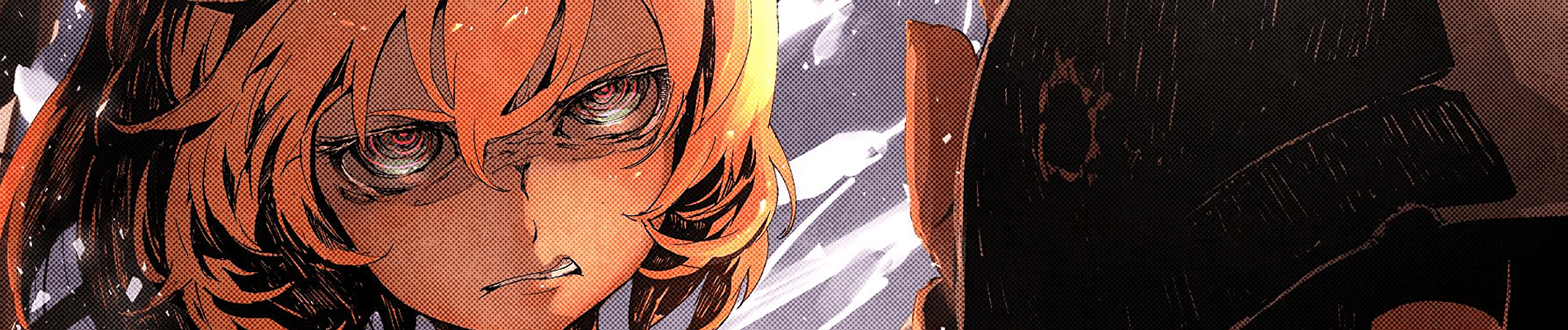


Considering my expectations, I'd say Youjo Senki was a pleasant surprise. For starters, it's got some of the most evocative audiovisual presentation in its genre, fully in line with the tone it's looking for. The series is full of ambitious layouts, the animation is smartly distributed and the art direction is consistently stellar--a blend of wartime darkness and the romantic, mythical quality of the art you'd imagine Tanya's side appropriating and worshipping.
And what is Tanya's side? Well, they're not the nazis, but if someone were to give you a correct, smugly detailed explanation of why they aren't, I'd advice suspicion. Tanya is meant to be a monster and the show's immediate appeal is in the sort of sick thrill you get from watching the worst person in the world do equally fucked up things, so the choice of setting reflects it. By imagining a version of WWI that begins in the 1920s, it suggests the evil of nazism through aesthetic flourishes while (theoretically) sidestepping the ideological weight of having the main character adscribe to it in name. It's a bizarre compromise, given the "point" of Tanya as a character. Atop that, a second layer: we're talking about an isekai.
Tanya starts out as a salaryman of the worst kind. Psychopathically pragmatic; a social climber with no regard for human communication beyond its use as a tool to creep into a comfortable position. Their rebirth is brought about by two events: a worker they just joyfully fired pushes them into a coming train and capital G God gets SO mad at their staunch deathbed atheism that they decide to also push them, now into the war-torn alternate Europe from the previous paragraph. A clear line is drawn between Tanya's corporatist, utilitatian thinking and fascism, to the point where high-ranking officials from this alternate German Empire are seriously disturbed by their approach. It's immediately effective, I think, but the same can't be said about the whole god stuff. Being X (as Tanya calls them) is an angry, egotistical child; old testament god without the world-shaking power. Besides direct threats to Tanya via inanimate objects, their influence typically comes in the form of divinely inspired soldiers that make it their life's purpose to kill the devil child. They're inefficient, evil and completely disinterested in mankind, which I assume it's intentional (god seems to only manifest in hate and submission) but feels more like a vague gesture than the sort of pointed commentary Tanya's personality brings about. Criticism rings hollow without any resemblance to the real world conception of what god is supposed to be, but it has room to grow along with the story.
Fleshing out being X and leading to a situation where humanity alone is Tanya's undoing would put a satisfying end to every arc at once, but I can't see it happening yet. Right now, the series is a bit too caught up in the minutia of moment-to-moment wartime politics and balancing the characters' humanity with their inhuman actions to venture into ideological specifics, which makes for kind of a nihilistic mess that feels tonally reminiscent of chan board political discussion. I hope it can outgrow that influence and become as good as its foundation allows for, but I remain cautious.
Thanks for reading! you can comment on the review here. This is a very quick blurb and I've left out a lot of things, but I'd like to hear thoughts on this show. Ive' seen the worst people (internet nazis) latch onto it and, while I'd love to say they just don't get it, my reading of the show may be comically charitable and factually wrong in the face of later volumes. If that's the case, I'd like to know before I commit.