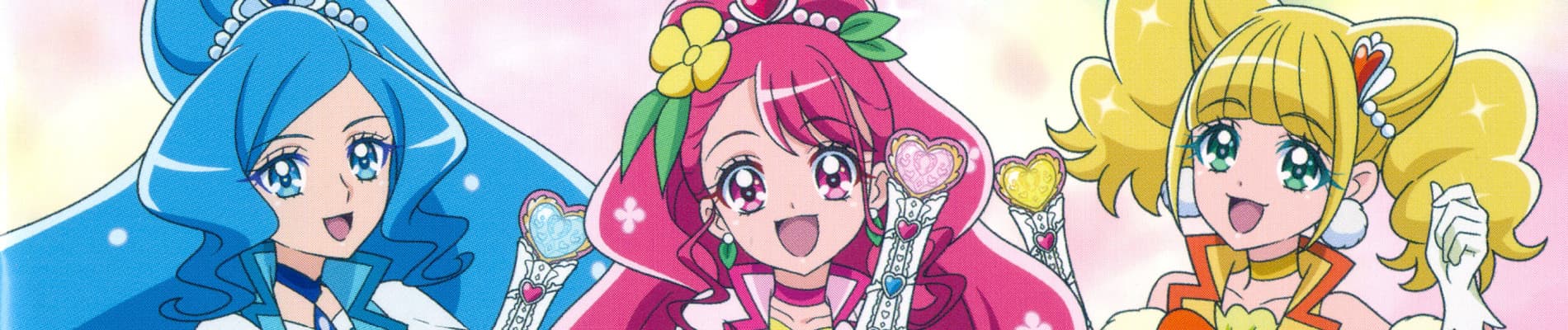

When I started Healin' Good, I started with relatively low expectations, given the conditions in which this series was produced and the not great opinions I read about it. Well, it obviously has its flaws, but my opinion of the series is absolutely positive.
The chemistry between the three protagonists is very good, especially in the first episodes. Later, Asumi was introduced: I don't dislike her as a character, but, besides the the fact that her introduction was far too sudden, I think she brought little to the series, especially outside the episodes dedicated to her. I would have preferred the series to remain focused on this trio of Cure and fairies, plus Latte.

Her presence, I fear, has negatively affected Hinata; Chiyu and Nodoka have always had dedicated episodes, but she, after the initial part, received less and less focus and, in fact, one of the cancelled episodes is officially confirmed to be Hinata-related. Despite the fact that her arc has not been treated in the best way, I find her very likeable, capable of enriching the series with her personality and the dynamics she has with the other girls and Nyatoran, whom I appreciated for the same reasons as her partner.

Chiyu is the one I like the least of the trio, but I still think she's absolutely good. I liked the relationship she has with Pegitan and her dual arc, focusing on both high jumping and working as a hotelier; not focusing too much on the fact that Blue Cure is academically smart is a good thing.

Nodoka has been my favourite since the first episodes. Unlike other Cures, her growth is strongly connected to her own past, which is explored as much as possible (within the limits of Precure), even psychologically. It is a very strong and unique story. In fact, this experience gave a clear origin to her kindness (an element also present in her name from Cure), which led her to become for other people what her parents and doctors were for her for all those years. Part of her kindness also has a selfish component, such as when she wanted to help the elderly, because she did not want to believe her promises were false and end up like them; moreover, she continually affirms her willingness to fight to live, despite repeatedly acknowledging the pain that living by nature entails. Episode 42 and her refusal to help Daruizen, asserting her individuality and freedom from an absolutely toxic relationship, is her absolute peak and one of Precure's best moments. The relationship with Rabirin, especially in that episode, is also very cute.

All the antagonists are entertaining thanks to their personalities; in terms of complexity, however, Shindoine is the blandest, while Guaiwaru and Batetemoda are a little better in this respect. The best is definitely Daruizen, and I'm glad he wasn't redeemed and died. The episodes with him and Nodoka are some of the most interesting in the series (6, 28 and 42 above all); the idea behind the relationship between them is very incredible and strong. Daruizen is a virus, a parasite that has made Nodoka's life terrible and continues to do so, exerting constant pressure on her psychologically and physically and whose only purpose is to survive by harming others, and this is what makes him an incredible antagonist and one that must not be forgiven and saved.

The physical fights are present, but this series never excels in animations, with rare exceptions (episode 9 I think?), and in certain episodes the level is really low (episode 41). I like the character designs, among the Cure in particular Sparkle and among the villains Daruizen and Shindoine.
In summary, very interesting series with one of the best leaders, a great antagonist, a more than good cast, but with some frailties, accentuated by its difficult production.