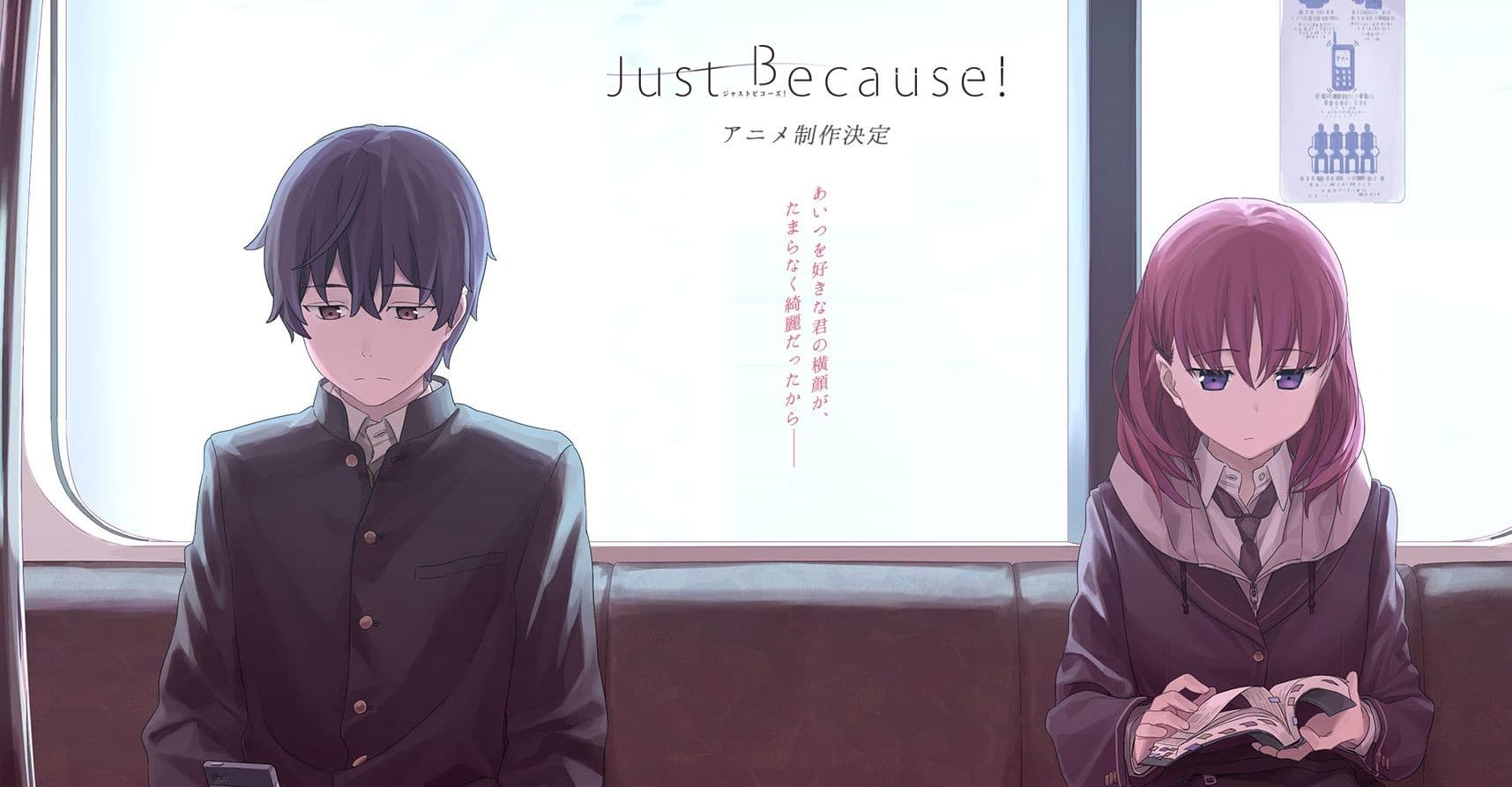
Just Because!
a review by Scheveningen
a review by Scheveningen
Just Because! is an excellent drama and romance that feels far more true to life than most anime. Though it is still a little rough around the edges at times in terms of the animation and some of the voice acting, it still pulls through, with the roughness even adding to its charm in certain ways. Combining subdued yet visceral character performances and a concise, focused story, it makes for an endearing show about relationships, nostalgia and the transition from one stage of life to the next.
The primary way Just Because differentiates itself from many of its peers in how grounded it remains in its tone and atmosphere. Romance and dramas set in high school tend to take an over-the-top, anime-esque approach to their plot and dialogue to keep the viewer engaged. This often relies on the ability of animation to exaggerate its subjects to create this sense of heightened reality where extreme or unrealistic behaviour and happenings become believable. But in the back of the viewer's mind, there is always this awareness that they are watching something that can never translate anywhere close to real life, thus sapping at least that little bit from its emotional punch. Being a part of some ill-defined, wacky afterschool club filled with eccentric personalities or in some absurd situation is a hallmark of most shounen romances. While these shows can still make for an entertaining watch, there is this missing sense of a visceral connection to the characters or their circumstance. Despite being far more mundane as the story of a group of people who bond together, Just Because has a strong sense of realism that anchors the audience in its characters and their relationships. It makes for a powerfully down-to-earth show that does not rely on exaggerated situations or responses to convey the meaningfulness of the situation.
As a character-driven story in its truest form, the setting and circumstances the cast find themselves in only serves as a catalyst for them to come out of their shells. Again, Just Because differentiates itself from most high school dramas by setting itself in the final term before graduation. It is the conclusion of a massive chapter in people's lives, which creates this atmosphere of bittersweet nostalgia, melancholy, and even anxiety since everything is about to change drastically. In fact, it is a wonder that so few stories focus on this period with how pivotal it is and how many themes can be explored. For characters like Soma, it feels like the end of his youth, with him going off to work straight from high school. But even for the rest of the cast going on to university, there is this understanding that higher education will not be the same, both for good and bad. And with all periods of significant change, there is this subdued but pervasive anxiety throughout the show. Whether it is due to uncertainty in Natsume's case because she still needs to sit for her entrance exams or because some of the cast see it as their final chance to do something before the chapter closes. The atmosphere created by this setting grounds everything and ties it all together into this mellow story of closing out their adolescence and moving on to becoming young adults.
The arrival of Izumi is what brings our cast together and delves into the themes the show is trying to explore. Prior to his arrival, everyone was more or less in their own bubble, attempting to cope with the impending change on their own. It gives the initial episodes this mellow, almost melancholic tone as the cast steadily grows out of their isolation and forms a bond with each other. Although they have been with their previous friend groups throughout high school, none of them can really understand their situation anymore because of the different paths they have chosen for their post-high school life. Alone, they feel continuously smothered by the impending change, and although they all interacted with each other throughout high school, they never hit it off until Izumi appeared. It is in this element that the show starts to take on its hopeful, optimistic tone with the idea that you can build bonds with people even in the most uncertain times and that it's never too late.
Izumi's return to Kanagawa goes beyond being the simple inciting incident of the plot and also brings up many of the themes and dynamics the show explores. For characters like Natsume and Soma, he is from their past and brings up the nostalgia of the end of schooling, pushing them to tie up loose ends. On the other hand, Izumi is quite literally the future for Komiya since he is a means for her to save the photography club. Although there is some conflict with how all their personalities, circumstances and dreams for the future intersect, it is never melodramatic and all refreshingly subtle. There is this realistic level of subtext and even passive-aggression when the characters push against each other during conversations instead of the usual "subtext is for cowards" approach that makes a lot of anime so hamfisted and unbelievable in their interactions. Even the character with the most forthcoming personality, Soma, does not simply bluster through everything and shows a great deal of self-doubt and anxiety before he can finally push himself to be direct. It succeeds in balancing the melancholy and uncertainty of high school ending with this optimism of starting a new chapter in their lives and finding a way to maintain their current relationships.
Still, the worries and difficulties of the cast are always presented in proportion to what they really are. Being rejected by someone, never reconnecting with a friend, or having one's club shut down are painful moments, but the characters nor the framing of the show ever portray them to be end-of-the-world moments. Even the challenges of maintaining a long-distance relationship or moving away from family, prime conflict fodder for many shows, are not melodramatised in a bid to create a cheap flash point. The cast all have their worries, but being true to life, it is something they try to manage instead of it instantly or cheaply boiling over into a big row for entertainment. While there are some minor red hearings regarding potential love triangles within the group, they never become obstructive and are quickly dropped. Instead, it is played off more as fondness, with the cast establishing a convincing chemistry from there. The rest of the interactions and activities the cast share outside these points of tension are appropriately light-hearted but never go overboard to become saccharine like some other slice-of-life shows. And even with the subdued cast, there is still that spark of eccentricity and energy through Komiya's performance, which helps to balance things out and gives the audience something more anime-esque in tone.
As mentioned, some rougher elements in voice acting and animation exist. At times the tone and line delivery can feel just slightly off with it forgoing the usual anime exaggerations but still not quite being something you would hear in real life. But perhaps this can be explained by the relative inexperience of the cast, with it being many of their first major roles aside from Lynn and Murata Taishi. While the cast's collective performance is still good overall, it is perhaps no surprise that Komiya and Souma tend to steal the show, both because of their more lively personalities and their voice actors having the most experience. But as a debut performance for Izumi and Natsume's voice actors, Ichikawa Aoi and Isobe Karin, it is definitely impressive, with the subtler expressiveness coming through.
The cinematography is still excellent, lingering on characters' expressions to drive home their feelings without the need for dialogue. The use of text messages and how they appear on screen is also one of the better instances in anime. Instead of sticking out, it feels like an integrated part of the visual narrative and adds to that sense of realism with how accurately they capture chatting on LINE with the many stickers they animated. It also creates a strong visual juxtaposition between the character's usually subdued expressions and the highly emotive stickers, feeling exceptionally true to life with how people can send these while looking completely deadpan. However, some of the backgrounds and more niche animations have suffered. While the smudged oil painting style backgrounds are a distinct stylistic choice, they are sometimes too dominating, with only the characters being sharply defined in the scene. It gives the feeling that everything is in an out-of-focus blur and draws unnecessary attention to itself on occasion. And though brief, the more technical animations, such as the trumpet playing, come off as incredibly stiff or lack proper synchronization with the music. There are other minor instances, like the poor compositing of the CGI Shonan Monorail, but all these are forgivable since this is one of studio PINE JAM's earliest productions. While the animation quality still cannot match the industry leaders and could use some additional polish, it is more than adequate.
Overall, Just Because! is an excellent drama that feels far truer to life than most other anime ever come close to. A solid 8 out of 10 for anyone looking for a more grounded drama that deals with themes and problems far closer to home. It is easy to believe that the characters are just as real as any classmate you might have had in school. And while it does not break new ground, it is a solid performance that covers its theme of the end of adolescence excellently. With so much other anime content to be set in high school but never dealing with its conclusion, it is hard not to see the uniqueness in Just Because!.
11 out of 13 users liked this review
