
La siguiente reseña está en Español e Inglés (traducida con el apoyo de DeepL)
La versión leída es la traducción al español por Shinra-kyun, Haruhi, Dessor y MichiHime perteneciente a “Nisekoi Fansub Scan”
Una comedia romántica harem que tuvo especial popularidad sea en su adaptación animada como en la publicación semanal del capítulo en el manga, cuyos puntos fuertes estaba en sus personajes arquetípicos, divertidos de ver e interactuar unos con los otros, junto al misterio de la chica prometida para Raku, el protagonista. Sin embargo, conforme pasó el tiempo decrecía su popularidad, cada vez era más olvidado y actualmente poco se le menciona.
El gran enemigo de Nisekoi fue la duración. En principio son divertidos los arcos y la situación semanal cualquiera con alguna de las chicas, teniendo de vez en cuando algún avance respecto a la misteriosa chica de la promesa, y entonces los capítulos pasan la centena y se diluye el encanto, los sucesos se repiten, arcos decaen de interés y cada nueva revelación es más ridícula que la anterior; se empieza a cuestionar los elementos de la propuesta sea el desarrollo de los personajes o el secreto de la narrativa.
El One Shot es corto y funcional, lo que parecía una propuesta interesante de ser extendida se convierte en la mejor versión de la premisa, y es debido a que en sus pocas páginas llega a la misma conclusión que su contraparte serializada tras más de 200 capítulos. En su día hubo interés en deducir quién podría llegar a ser la desconocida compartiendo teorías y discutiendo las pistas, más una vez finalizó el lector sopesa “¿Hacía falta?” Efectivamente, no hacía falta. Es un agregado para dar un “algo” a la narrativa y ser capaz de extenderla, que podía ratificarse de llegar hacia un objetivo interesante, precisamente lo que no consiguió.

Todos los personajes son sencillos, cada chica es una caracterización de los arquetipos comunes de los 2010s y carece de otro elemento que le distancie en el subgénero, con Raku siendo el típico galán inconsciente de comedia romántica harem. No hay complejidad para un desarrollo de A a Z, más si lo tienen para A a B, un mínimo que podía haber sido utilizado a su favor.
El mejor ejemplo está en el mejor arco de Nisekoi, el primer festival escolar. Hay una demarcada evolución de los personajes en una situación típica con todo lo que ofrecía la obra sea drama, comedia y romance. Al finalizar las cosas cambiaron y sientes que se aproxima hacia una consolidación, desgraciadamente no le faltaban 20 o 40 capítulos, aún quedaban 200.
Hubiera bastado con que cada chica tuviera ese momento dedicado hacia ella, y tampoco era necesario seguir agregando nuevas competidoras, con 4 era más que suficiente. De ahí que mientras avanza, cansa repetir los mismos valores enfrentados, situaciones similares llegando a consecuencias conocidas, Raku llegando a los mismos términos que unos 20 capítulos atrás y etcétera. En la simpleza estaba su mejor carta, más al ser apartado provocó que su final respecto al misterio principal careciera de fuerza, al contrario, lo hizo parecer insignificante e innecesario.

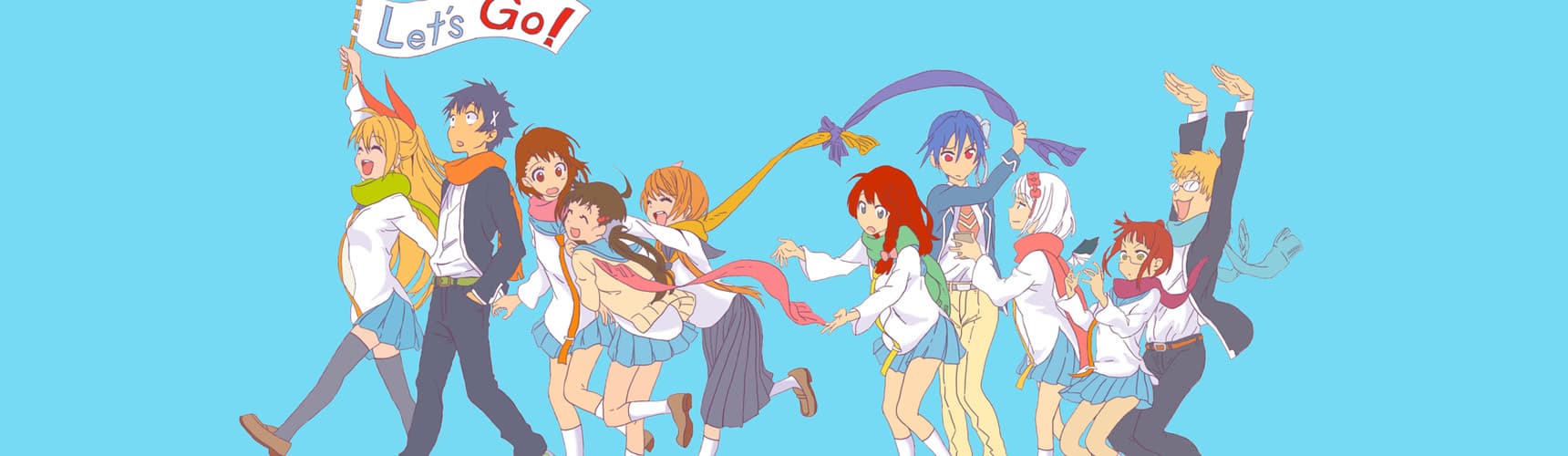
El arte es una genialidad, las doble páginas son especialmente hermosas, una lástima que el diseño de personajes sea un poco simple, otra razón por la que poco han trascendido las chicas protagónicas. Komi sensei tiene un buen ojo, o un buen consejero, en cómo administrar las escenas de acción, en las situaciones normales consigue paneles ampliamente vistosos para los momentos apropiados, y en el ritmo, más allá de la narrativa, es fácil sumergirse en la propuesta semanal.
Nisekoi aún tiene reimpresiones de tanto en tanto aunque se menciona menos, todavía mantiene cierto aura de importancia histórica especialmente porque en lo referido a sus dos personajes principales si hubo una marcada división entre los fanáticos, más a su vez ellos también aceptan y lamentan que tan interesante premisa se fuera diluyendo mientras crecía la cuenta de capítulos. Presenciado como lo que había captado tu atención poco a poco dejar de serlo aunque parece que es lo mismo, o puede que sencillamente de tanto verlo dejó de tener esa forma que creías tenía.
English
A harem romantic comedy that was especially popular both in its anime adaptation and in the weekly publication of the chapter in the manga, whose strong points were in its archetypal characters, fun to watch and interact with each other, along with the mystery of the girl engaged to Raku, the protagonist. However, as time went by, its popularity declined, it was increasingly forgotten and nowadays it’s rarely mentioned.
The great enemy of Nisekoi was its length. At first the arcs and the weekly situation with any of the girls are fun, having from time to time some progress regarding the mysterious girl of the promise, and then the chapters pass the hundred and the charm is diluted, the events are repeated, arcs decay of interest and each new revelation is more ridiculous than the previous one; it begins to question the elements of the proposal either the development of the characters or the secret of the narrative.
The One Shot is short and functional, what seemed like an interesting proposal to be extended becomes the best version of the premise, and it’s because in its few pages it reaches the same conclusion as its serialized counterpart after more than 200 chapters. At the time there was interest in deducing who might turn out to be the girl of the promise by sharing theories and discussing the clues, but once finished the reader ponders "Was it necessary?" Indeed, it wasn't needed. It’s an addition to give a "something" to the narrative and to be able to extend it, which could be ratified if it reached an interesting goal, precisely what it didn’t achieve.

All the characters are simple, each girl is a characterization of common 2010s archetypes and lacks another element to distance it in the subgenre, with Raku being the typical oblivious harem romantic comedy heartthrob. There is no complexity to an A to Z development, more if they have it for A to B, a minimum that could have been used to its advantage.
The best example is in the best arc of Nisekoi, the first school festival. There's a clear evolution of the characters in a typical situation with all that the drama, comedy and romance had to offer. By the end things changed and you feel that it’s approaching towards a consolidation, unfortunately it didn't have 20 or 40 chapters left, there were still 200 to go.
It would have been enough for each girl to have that moment dedicated to her, and it wasn't necessary to keep adding new competitors, 4 was more than enough. Hence, as it progresses, it gets tired of repeating the same confronted values, similar situations reaching known consequences, Raku reaching the same terms as 20 chapters ago and so on. simplicity was its best card, but being set aside caused that its ending regarding the main mystery lacked strength, on the contrary, it made it seem insignificant and unnecessary.

The art is genius, the double pages are especially beautiful, a pity that the character design is a bit simple, another reason why little has transcended the leading girls. Komi sensei has a good eye, or a good advisor, in how to manage the action scenes, in the normal situations he gets amply showy panels for the appropriate moments, and in the pacing, beyond the narrative, it's easy to dive into the weekly proposal.
Nisekoi still has reprints from time to time although it is less mentioned, it still maintains a certain aura of historical importance especially because regarding its two main characters there was a marked division among fans, but in turn they also accept and regret that such an interesting premise was diluted as the chapter count grew. Witnessing how what had captured your attention gradually ceased to be so, although it seems to be the same, or maybe it simply stopped having the shape you thought it had after so much watching.