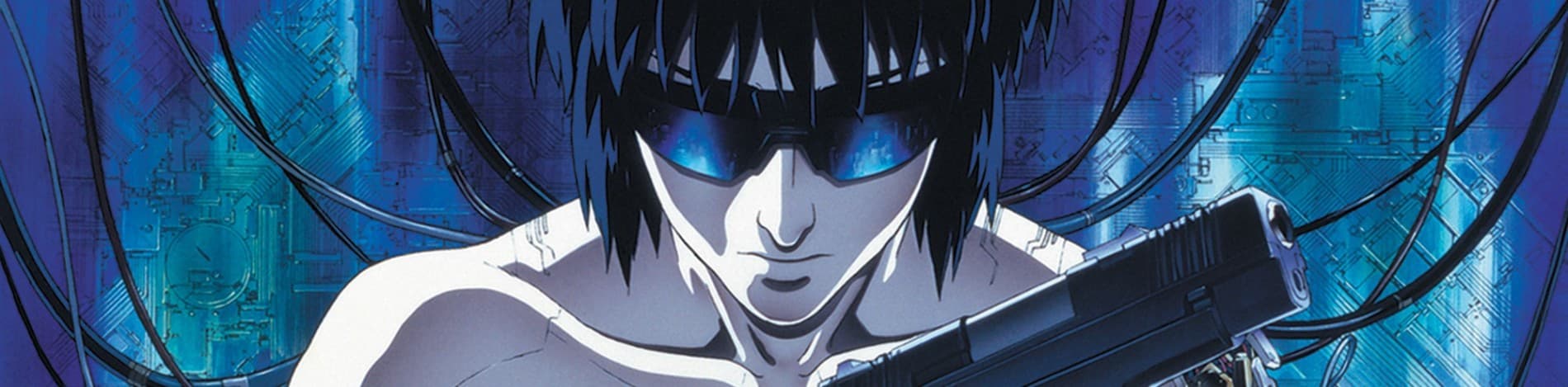
(The following review is based on an essay I wrote for an English course on international science fiction in 2022, with light revisions made in 2023 and 2024.)
From the opening credits scene of Mamoru Oshii's Ghost In The Shell, themes of dehumanization and blurred identity are present. This sequence is accompanied by a music cue with a title summarizing the scene itself: “Making of a Cyborg”. During the scene, we are shown the construction of a female cyborg, presumably the protagonist Motoko Kusanagi herself. The process of assembling a cyborg is akin to a product on a factory assembly line, rather than a human being who is born. This sequence establishes a sense of dehumanization of full-body cyborgs, who inhabit bodies that are products to be factory assembled and maintained instead of natural human bodies.
Memories are shown to be an indicator of humanity in the film, and the ability to alter the memories of cyborgs in the film’s futuristic universe creates uncertainty of whether they can truly be considered human. During the film’s first act, Section 9 are pursuing a low-level thug and garbage truck driver, both of whom are cyborgs, connected to the case of the Puppet Master, a mysterious hacker wanted by international law enforcement. When Motoko and Batou apprehend the thug, he defiantly declares that he refuses to talk. Batou refutes him by asking him “what would I ask a guy who doesn’t even know his name?” Motoko further accosts the thug, asking him if he can remember things such as his mother’s face, where he grew up, and memories of his childhood. As they confront him, the thug’s expression gradually turns to horror at the realization that he has none of the memories that a human should have, sending him into existential crisis. In the next scene, the garbage truck driver is interrogated. Togusa informs him that his memories of having a wife and daughter, as well as an affair and divorce, were falsified by the Puppet Master hacking into his “ghost”. When shown evidence proving this, the driver attempts to rationalize and hold on to the illusion. However, the illusion crumbles when Togusa shows him the purported picture of his daughter he showed to his partner in crime earlier in the film; the picture does not show a daughter and in fact, only shows himself, a realization that causes an emotional breakdown. As the interrogation draws to a close, Motoko stares at her reflection in the window, lost in thought and pondering her own existence and identity. It's worth mentioning that in the original manga, Motoko is more outgoing and less serious, only shifting to a more pensive and philosophical state of mind as the series progresses and the Puppet Master case goes on. By making her later personality her default one, Oshii explores the themes of identity, memory, and existence much earlier and more prominently. In fact, the entire scene of the garbage truck driver learning his memories are fake was originally a quick gag in the manga, further illustrating the film's more somber and contemplative tone (which has carried over into nearly all subsequent takes on the franchise).
Ghost In The Shell posits a world where one’s self-identity is uncertain and amorphous because of cybernetics. During one scene (which is brilliantly underscored by Kenji Kawai's score), Motoko is out in the city when she passes by and notices another woman with an identical cyborg body as her own. After noticing her doppelganger, Motoko turns away with a startled expression, underlining her uncertainties about her own identity. Later on the film, the Puppet Master, revealed to be a sentient A.I. residing on the Internet, has been caught inside in a cyborg body and apprehended by Section 6, another government agency. Motoko notices how the Puppet Master’s body is also a female body made at the same factory that produced her own body. Notably, the Puppet Master speaks with a masculine voice and is referred to with male pronouns, blurring the gender identity of the character. While talking with Batou about the case, she ponders to him if the real her died long ago and if she is merely a replicant with an artificial body and brain, or if a real Motoko ever existed to begin with. It is worth mentioning that in the original manga by Shirow Masamune, Motoko Kusanagi is explicitly stated to be “obviously an alias”. If one interprets the film version as also having an alias, Motoko’s identity is even more muddled.
At the end of the film, Motoko merges her own consciousness with that of the Puppet Master into one single consciousness. She is also now inhabiting a new physical body after her previous one is wrecked in the climax. In this final scene, Motoko declares that she is now neither the Puppet Master nor the Major and ponders her next move, musing “The net is vast and limitless”. This raises the question of whether she can truly be Motoko Kusanagi now if she no longer has her old organic body or even her old cyborg body, as well as having merged her own consciousness with another one. While her partner Batou still thinks of her as Motoko, her last words in the film indicate that she does not consider herself as such and embraces it as a solution to her existential crisis.
Ghost In The Shell is a deeply important film for me. When I was a high school freshman still not fully immersed in anime beyond Pokémon and developing my own taste in movies, Ghost In The Shell was a film I fell in love with. The stunning visuals, atmospheric score by Kenji Kawai, and blend of action with philosophical themes all left an impact with me. Even after rewatching it several times on various formats, the most recent being the theatrical reissue under Anime Expo Cinema Nights last year, Ghost In The Shell has lost none of its power.
30 out of 31 users liked this review