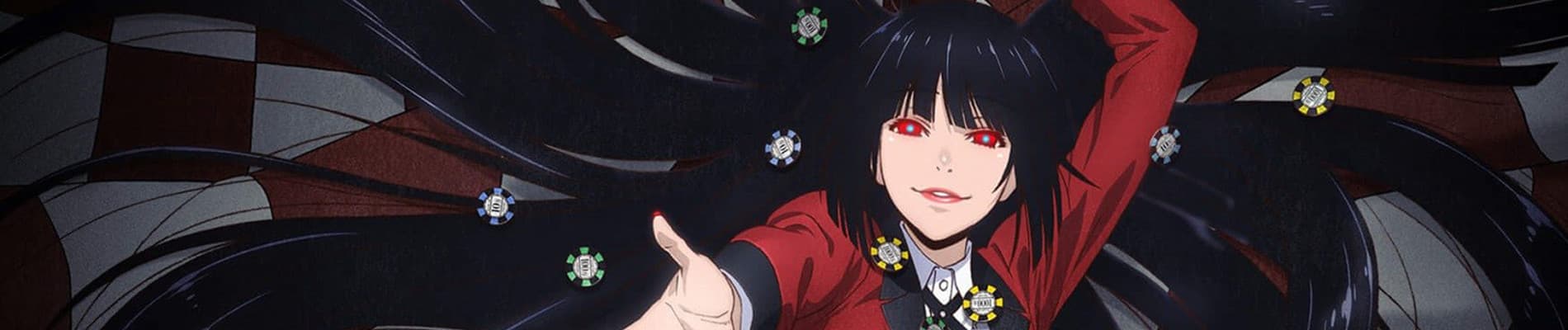
Suffocating editing immerses the viewer in the intoxicating highs and devastating lows of gambling addiction: relish in the winners' life-affirming gambles as they wager unimaginable wealth that equates their livelihood — a thrill and pleasure so overwhelmingly great it can only get expressed in sexual pleasure — while losers dabble in debt and loans to desperately win back their status as human. Kakegurui depicts the school's lawless capitalist power structure as one of dehumanization and exploitation, comprised of children of corrupt politicians and CEOs at the top of Japanese society — of which the show is severely critical. The ones with financial muscle and the ability to deceive are successful in this world.
The variable that this capitalist structure cannot account for, however, is that of chaos: the sleek, long black-haired Jabami Yumeko enters the first episode as a picturesque madonna, whose soft expressions cast in warm lighting make her seem like another cow for the slaughter; an innocent to be exploited for depraved pleasure. As the first episode progresses, it becomes clear that she loses all reason when gambling, creating a vortex that turns aggressors into victims of Yumeko's idiosyncratic lawlessness. With her eyes glowing red and hair flowing as if she had just climbed out of a television, she comes to suffocate the frames as a horrifying presence: a nightmare to these rich, arrogant pieces of shit who had always paid and cheated their way out of the consequences of their behavior.
"Marry a politician, have his children, and live as his wife. Living a long and warm life with my beloved husband, surrounded by my children and grandchildren, and then dying of old age. Saotome Mary will have achieved the truest happiness a woman can find. There was nothing more she could've asked for in life. Your programme can eat shit! My life belongs to me! No one tells me what to do! I'm going to win my life back! Raise! Three chips!"

Kakegurui's chaotic — arguably revolutionary — spirit comes not just in the form of Yumeko, but also the women around her, as she counteracts the capitalist structure by helping liberate them, such as by settling their debts in thrilling gambles or encouraging them to revolt against their male bullies and oppressors. Her actions motivate an entire oppressed student body/lower caste to come into action, ultimately resulting into the school council's disbandment and thus collapse of the governing body — further unwinding the capitalist structure into a more anarchic one.
The women conspiring to unsettle this structure amidst the excitement of high stakes gambling reach literally climactic heights: herein depicting a confusing yet delightful (and fetishistic) queerness. These thrills reach their high point in episodes 6 and 7, where Yumeko and the masochistic Midari put their lives on the line in a literal life-and-death Russian roulette game. This sequence effectively serves as a 50-minute long femdom session, wherein Yumeko becomes gradually disillusioned with their supposed mutual agreement and rejects Midari the climactic pleasures of gambling with her life. This is effectively the perfect synthesis of Kakegurui's deranged script, life-and-death fetishism, and gratuitous directing: a literal interpretation of living on the edge.

Of course, whether the viewer loves or hates it is up to their own discretion: though the series (accidentally) extremely cogently depicts the dehumanization of mass-sum monetary transactions under unregulated capitalism and the exploitation of those outside the highest caste — and how the upper-middle class will perpetuate this structure by dehumanizing and exploiting in increasingly depraved, twisted pleasures and political machinations — while depicting the give-and-take nature of sadomasochism & sexual relations through intricate game theories and exhilarating gambling, it is also of course a gratuitously sleazy, fetishistic, and — if uncharitably interpreted — politically confused and/or malignant. If anything, Kakegurui is a master of dragging the viewer into the sordid atmosphere of all the places in Kabukicho you don't wanna go; the dangerous yet heart-poundingly thrilling world of self-destruction, because what's sexier and more vulnerable than putting literally everything on the line?
"How beautiful does a person look after giving everything they have? No matter how many times I see it, this is the one thing I never get tired of."
"The sight of someone's life burning up is beautiful. That is a reasonable proclamation, but what you truly want to see is your own life, burning up and disappearing even more beautifully."


17 out of 18 users liked this review
