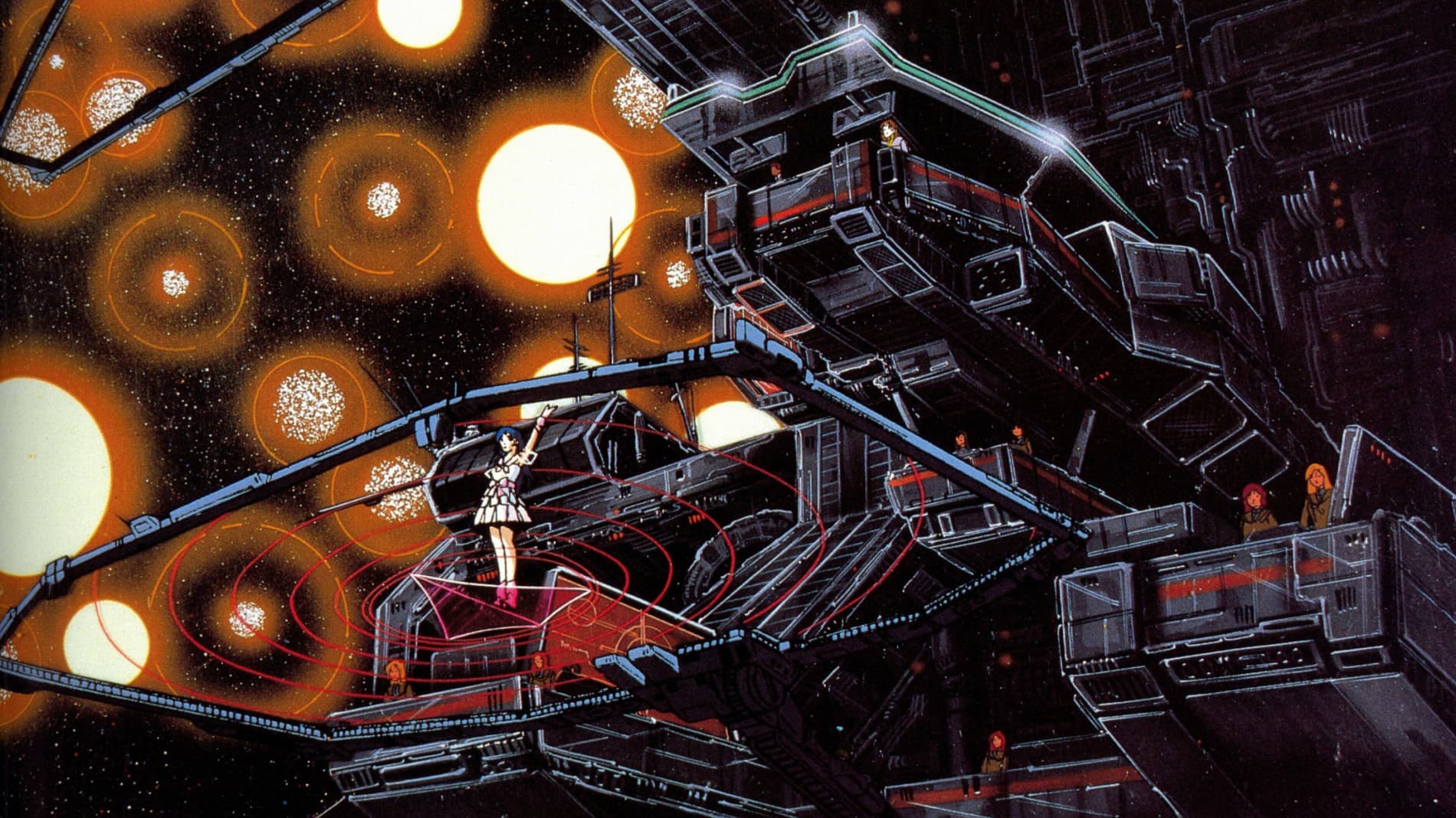

Macross movie version: Do You Remember Love? – A timeless masterpiece
I knew in my heart, sooner or later, that this moment would come. But then again it was inevitable that it would arrive, assuming I would have followed what my heart advised me to do. And how could I not follow my (same) heart? To be honest, heart has effectively to do with the main theme of this work: love. Oh yeah. Because if I really had to choose the works that inspired me the most, struck me deeply, moved me (and still continue to move me today) and why not also partly shaped me, I couldn't help but mention that splendid, wonderful one (why say it's a work of art is an understatement) Japanese animation film, timeless masterpiece (ageless conveys the concept rather well), eternal and immutable, entitled “Chōjikū Yōsai Macross: Ai Oboete Imasu ka” (超時空要塞マクロス愛・おぼえていますか), also known by the international title of “Do You Remember Love?” and dated 1984. Ah, what wonder and what splendor. For years, Japanese animation has been one of my main passions and, I think in all honesty, it was also thanks to it that I discovered I had a "hidden" side; a side of me of which I previously had no knowledge, who knows perhaps at the time, only dormant and anxiously waiting for something or someone, sooner or later, to exhume it to the surface. And this profound sensitivity (enough to make me cry) was undoubtedly also influenced by that (no small thing) Superdimensional Fortress Macross, to which I owe so much, together with its compelling and exciting story, its characters and the his battles. But since I don't like simple stories, I have to tell a story within a story. Who knows, maybe life is beautiful thanks also to its countless surprises. Those so-called unexpected events (both positive and negative indeed), and this was certainly a flattering unexpected event. Maybe it will surprise you to know that before seeing this film I had not too high expectations, indeed one could say that I experienced it almost as a "burden" due to my "busy" life. The original Macross animated series, with a total duration of 36 episodes and dating back to two years earlier, had me slightly bored in its second part: a stagnant second block of episodes, which almost seemed like a (useless) extension of the swill, after an almost perfect first part which had already told everything that could be told. Of course, even with some interesting ideas: showing the integration of the exponents of the Zentradi race, certainly resolving the issue of the romantic triangle between the three protagonists (in the guise of a touching soap opera à la The Bold and the Beautiful, and please don't misunderstand me too much in an ending which, ultimately, I also appreciated) but with decidedly monotonous and repetitive tones. "What will this film be", I believed and thought to myself like a poor fool. And, de facto, having finished watching it for just two hours, I was enchanted, with a hint of surprise, lost in the meanders of that wonder I had just witnessed it. And from that moment it was first love (in one way or another love will always come back into this discussion). To think that a film, in its expressiveness, can be so evocative and capable of bringing genuine tears to your eyes is, a in my opinion, truly incredible. On the other hand, it is a masterpiece not by chance, also for these aforementioned reasons. And therefore it is also in homage to him that I write this (probably delusional) rant, in an immense tribute that I pay him with great joy (and) in which I will talk and analyze a little this film, which I like and pleases so much (by little I mean dissected in detail, ergo spoiler alert).


One of the trailer released at the time
A Look at History: Why Macross Was Important
Masterpieces are sometimes such thanks also to those who work behind them. And this film can definitely boast an immense production staff: starting from the "father" of Macross (today one of the most important franchises in the sector and now forty years old) Kawamori Shōji; Miyatake Kazukata, illustrator and mechanical designer (considered one of the most important pioneers) who also worked on the '82 animated series, as well as one of the founders of Studio Nue; Mikimoto Haruhiko, excellence in character designers and among the best of all time (Macross, Super Dimension Century Orguss, Megazone 23). In addition to Kawamori himself, the director is Ishiguro Noboru (also director and screenwriter of the first series, as well as the first television series of another immense masterpiece, Uchū senkan Yamato) and Tomita Sukehiro and Haneda Kentarō complete the picture. to the screenplay and music respectively. In short, it's not a small thing. Although revisited in a different light, Ai oboete imasu ka still remains the son of the original Macross. And the latter represented, in its own way, an important turning point for Japanese animation, in many respects. First, Macross was the first anime entirely made by fans of Japanese animation; not indifferent novelty (the elusive "Otaku"): it is with it, in fact, that the homonymous citationism which is still the most popular today was born. It is no coincidence that the creator of the work himself, Kawamori Shōji, used to call his colleague Mikimoto as such and vice versa; nor it was that from Kawamori's own mecha design came to light what is probably the most iconic fighter plane of the entire franchise: the VF-1 Valkyrie. Legend would also have it that the aforementioned word was born precisely in this context, in which young technology and weapons enthusiasts addressed each other with this name. Even one of the female protagonists of the story, the starlet Lynn Minmay, will use it during the anime. But not only that: because another amazing individual also worked as an animator on the TV series, future director and father of another of the most important and influential series of all time: none other than Hideaki Anno, the mind behind Shin Seiki Evangelion. Staying on the subject of innovations, the most important was undoubtedly from an aesthetic-graphic point of view: the reflections generated by light sources on the faces and hair of the characters were introduced in detail; those ones, in particular, will then move based on their orientation; the cockpits of the mechas used become detailed, with levers, buttons and monitors of all kinds. Finally, how can we forget those abstruse three-dimensional polygonal projections and with them as many technological inventions, developed subsequently over the years. In reality, to tell the truth, the novelties will also arrive narratively: the protagonist begins to no longer be a strong, tough man with a solid temper, with a previous exhausting training (like a Tetsuya Tsurugi, trained in order to pilot the Great Mazinger and transformed into a real warrior). But on the contrary, a simple civilian, who will find himself, by chance, piloting a military fighter and without any basic notions (Ichijo Hikaru will also differ in this sense from Amuro Ray, despite sharing with him the aspect of being a civilian; the historical protagonist of Kidō senshi Gundam, either due to his previous knowledge of computer science or due to his nature as a Newtype). Hikaru will enter the army and will have to adapt to his new life as a soldier, under the wing of his mentor (and big brother) Roy Fokker. And also with regard to the themes, the slice of life is introduced alternately with the space opera, allowing us to focus both on the daily life of the city within the Macross and on the love triangle between Misa/Minmay/Hikaru, the other central theme of the story . But, here too, it is a different love: no longer virile, romantic and tragic like those that appeared in the past in seventies works, but rather an adolescent love and with it everything that follows from it. So they make their appearance the paranoia, insecurities and disturbances typical of that age therefore make their appearance, of which the aforementioned Shin Seiki Evangelion will be the main supporter and promoter in the mid-nineties. And finally, at the conclusion of this digression and to close the discussion related to "otaku", there is a character who is the perfect synthesis of this subculture: exactly Lynn Minmay, Miss Macross (in the TV series) and pop idol of the history (coincidentally, the phenomenon of idols was in the limelight in those years) but also the one who embodies, par excellence, the ideal of the "bishōjo" (美少女 lit. beautiful girl), a key concept in the otaku subculture. I will focus extensively on her character below, for these initial phases it is sufficient to mention her.
 )
) 
Forgive me senseis but I notice some similarities...
Macross Ai oboete imasu ka?: a first retrospective on the film
Ai oboete imasu ka, as mentioned above, is an offshoot deriving from the original television series. We could define it as a "cinematic adaptation" (in Japanese "劇場版" or "gekijouban"), in a practice that is actually quite common in the Land of the Rising Sun (I'm thinking, for example, of the Uchuu film saga Senkan Yamato, but also Shin Seiki Evangelion as in many other numerous cases). The story undergoes (in some cases) revisions, improvements are made (also from a graphic point of view, as the budgets are usually higher) and (is) re-narrated through a different medium (the film) with all the consequences and (possible) variations that could derive from it, in light of a more limited duration (compared, obviously, to that which would be obtained by adding together the duration of all the episodes of the television series). It is not my interest to focus on the so-called continuity; indeed, I prefer to clarify my point of view regarding the relationship between the two products: I believe, in this regard, that it is almost useless to consider the original TV series and the cinematographic film as the exact same product (or as the exact same side of a coin) due to their total diversity with regard to the mediums used (in terms of narration methods, duration and many other variables). It might seem obvious but I think it should not be underestimated at all, since both versions, ultimately, are similar in terms of themes and present the viewer with the same characters. In essence, I believe it is wrong to consider them equivalent only by virtue of the fact that they share names and characters; they can, however, certainly be considered as two separate and (undoubtedly) related versions of the same work, each forged by its own medium of reference, with its own points of perspective and its own facets. And, precisely because these are two different versions of the same work, it makes perfect sense (as, I believe, absolutely normal) to carry out comparison operations between them (in the continuation of this discussion there will inevitably be some of them). Well, having made this long-standing clarification, Ai oboete Imasu ka focuses more on the trio of protagonists - Misa Hayase, Lynn Minmay and Hikaru Ichijo -, narrating their stories, their relationships and, fully towards the second half of the film, their love triangle from a different perspective than the original series. And it is on them that the story and the narration must focus: after all, via Kawamori himself, "it is a story centered on human drama" (and for those who have seen the film this is easily intuitable; just think about where it will end up towards the end of the same, but I will return to this extensively later). I will not summarize the plot here in full (it can be easily read on any site that talks about this film), however, for the purposes of my speech, I will directly introduce some parts or sections of it - which are the most relevant of the film itself -, as well as, very quickly, I will list some differences between the 1982 TV series and the film, always to give more context to my arguments. The core of many of those that will then constitute variations, in addition to the length of the small series itself, is the narrative method: the work begins in medias res, with the Macross fortress already departed from Earth and in the middle of its return journey to it while Minmay, from the beginning, is presented to us as a successful starlet (unlike the TV series where she will arrive there after a bit of apprenticeship); similarly the protagonist Hikaru has already joined the army (and has already acquired a fair amount of experience in it). The plot remains more or less the same: even in the film, in its very first part, the male protagonist and the idol Minmay, following some vicissitudes, remain trapped in a section of the spaceship, isolated from the rest of the crew and its inhabitants. However, the dynamics of their meeting, in a broad sense, are profoundly different: first and foremost because in the series the two had already met and already had the opportunity to bond on Earth; on the other hand in the film, when they remain trapped, they actually meet for the first time. Secondly, the timing is slightly different: in the TV series they remain imprisoned for about a couple of weeks, almost dying due to lack of supplies, here for a couple of days, about three if I remember correctly (not that they fare any better). All this, whether they like it or not, affects their relationship, which is significantly reduced (and the effects of this reduction will be seen later). What I personally consider the "point of no return" (after which events will be heavily influenced) is when the protagonist Hikaru, indulging the capricious Minmay, fed up with her monotonous life as a star and very tight schedules, decides to go out with his personal fighter to take her for a spin in space, in the area adjacent to the spaceship. Never was a choice more wrong since shortly after they will find themselves entangled in the middle of a Zentradi attack, which will culminate with the capture of each of them (plus those who came to their aid). The rescue operations - obviously - fail miserably -
Spoiler, click to viewclick to hide
forcing Lieutenant Fokker to a proud sacrifice to allow his companions to escapeSpoiler, click to viewclick to hide
At this point one of the most significant and important parts of the film opens: Hikaru and Misa (between whom there is bad blood due to their constant bickering) find themselves thrown onto what will later be discovered to be a derelict Earth, reduced to a wasteland by the Zentradi attacks and devoid of any form of life, with humanity entirely exterminated by the aliens. Abandoned to themselves in pitiful conditions, without any possibility of contact with the outside world and face to face with death, they will undertake a tough fight for their survival. Even Misa, whether due to her stubbornness or her prickly character, will fast for three days, only allowing herself, at the last moment, to be convinced by Hikaru to eat the little they had found. And it is always on Earth that the two will discover the existence of the "Protoculture", a highly advanced intergalactic civilization dating back thousands of years, the cradle of a series of races including the Zentradi and Meltlandi (the alien races antagonistic to humanity) but also the human one. In the midst of their discoveries, the two also manage - completely involuntarily - to set in motion the mechanisms that bring an ancient submerged city back to the surface from the waters, thus finding a protoculturian artefact in all respects. The exhumation of a lost civilization, in the wake of the myth of Atlantis; a city in ruins that serves as testimony to the latter, so much that it was built by the descendants of the Protoculturians as an ideal place to live in peace and in harmony with each other, without ever returning there (speaking of vestiges, similar to the First unit at the end of The End of Evangelion, designed to leave traces of human civilization in the universe by the protagonist's mother). And inside this city (I'm making it, mea culpa, a matryoshka), the sweet Misa finds a plate, on which it turns out to be engraved the lyrics of a song dating back to a long time ago... Yes, that sweet and wonderful song then sung by the pop idol Minmay in the final battle against the Zentradi, from which the film's homonymous title comes, is in reality a song of alien origin, found by Misa in the rubble of a torn-apart house. Not long after, still in the same house, Misa and Hikaru will give rise to a real "simulated meal", in one of the most touching, moving and sweet sequences (am I going out on a limb?) in the entire history of Japanese animation, perhaps to find a semblance of normality that has now been lost and whose climax will be a passionate kiss between the two young people. After being rescued by the Macross, we move towards the final phase of the film and with it to the decisive battle, with Minmay who will play a crucial role, interpreting the lyrics of the aforementioned song. In addition, shortly before it is consumed, the love triangle between the three protagonists will also be definitively resolved, with, clearly, winners and losers. The Zentradi patriarch at the end of the war will be defeated and annihilated while two years later, at the end of the events shown, Minmay, now devoted to her profession as a singer, will hold her last concert before leaving for the space colonies, saying goodbye to her Earth, now rebuilt, and at the foot of a grandiose Macross, elevated to guardian of all humanity. Finally, in the midst of the general festivity, the girl's spirit seems to ascend towards the sky. Thus ends this timeless masterpiece, elevating the feeling of love, broadly understood, as the feeling par excellence, common to all cultures of the largest galaxy, unifying, capable of creating and weaving bonds between people. Even an ancient alien warrior race, which had known nothing else in its long history except conflicts and wars, manages to regain and make its own that "culture" lost for time immemorial and, with it, love. Beautiful, right?Before concluding this paragraph I wanted to focus on the love affair between Hikaru and Minmay, undoubtedly one of the most relevant subplots of the story (both in the film and in the original series) and to examine it I will use a comparison between the two versions. In the TV series, Hikaru is madly in love with Minmay, at least until the moment of his confession (which I will return to shortly); despite this, in the second part of the story his feelings will change (and even though he has her approval and starts to live with her) he will understand that he is truly in love with Misa. The weakness I would like to focus on is this: in the series his love for Minmay was indisputable, objective. But can the same be said for the film version? In the film Ai oboete imasu ka, does Hikaru really feel something for her? So let's proceed in order: in the original he is in love with her but in the end it will not be reciprocated (at least initially): the girl will say no to his confession. At first, when he reveals his true feelings to her, she is caught completely unprepared: surprised and, probably, upset by this discovery, she runs away in a hurry. Then in episode twenty-seven, after thinking about it, she officially declines him, revealing that she has already fallen in love with her cousin Kaifun and sees him only as a friend. Perhaps Hikaru, given the confidential and friendly relationship between them that had developed from the beginning, before getting on the Macross, had deluded himself into thinking that she could like him, alas, making a mess of things. But this outcome was inevitable if you think about it: the boy, as she gained more and more notoriety in the company of her manager cousin, perceived her progressively more and more distant, in an ever deeper detachment. In short, he is jolted out of his "world": if previously he could be next to her and spend time with her normally, now he was no longer allowed to do so due to her growing fame, which made her busier every day. Here I stop with the original series, since it should have ended around episode twenty-seven, then being extended to the thirty-six canonical episodes that we know. Therefore, I will not take into consideration the entire second part (in which the waters are stirred). What can I say, instead, about the film? I return to the question I had previously asked: does Hikaru really feel something towards her in this version? In my opinion, no. From when they meet for the first time at the beginning until about halfway through the same, that is, until they are kidnapped and then separate, it would actually seem that he is in love with her. It is, however, undoubted that Minmay is in love with him: the very fact that after meeting him she decides to rely on him to hang around, can be a symptom of a primordial interest in him. But, I am convinced, the flame of her love will finally explode during the month of separation from Hikaru: only when we are far from what is truly dear to us do we finally understand our feelings towards that someone. Or at least the separation has sharpened these feelings towards him. Proof of all this is the moment of their reunion on the Macross, after Hikaru and Misa have been rescued: the girl, as soon as she sees Hikaru, runs towards him in tears of joy, hugging him. Too bad, however, that in his heart he has already made his decision (that is, to be with Misa). In a certain sense, the Hikaru that Minmay will find again after a month is an extremely different Hikaru from the previous one (let's also say shaped by the near-death experience he lived on Earth, in which his feelings for Misa suddenly quickened). And, we were saying, just as Minmay hugs him crying, not only does he not even return her hug but he even turns his head, as if to turn his back on her, turning his gaze, instead, to Misa. Upon his return, Hikaru shows no interest in Minmay, in fact he even treats her coldly at the moment of their reunion, which she had hoped for and longed for so much. This crucial watershed sequence simultaneously demonstrates both the girl's love, at its peak (also because shortly thereafter, just a few scenes later, Minmay would confess) towards him and, vice versa, his (almost) total disinterest towards her and how he is no longer interested in her as he was before, assuming he really was. Quid iuris, then? I have reason to believe, as I anticipated a few lines above, that in reality Hikaru never felt anything romantic towards Minmay but that it was a simple adolescent infatuation (they are still pubescent) due to his celebrity status. Probably what he felt towards Minmay was simple admiration, then mistakenly elevated to love when he started to trust her (and therefore having the impression that a mutual interest could develop, which is what actually happened on her part). It would make perfect sense: Hikaru – yes a soldier but still a common person like many others – found himself in front of the pop idol of the moment, so famous as to be almost unattainable, unreachable. And yet, despite this, in that situation she was in front of him, within his reach. Considering, then, how the relationship between a fan (which he is) and a celebrity could be experienced (even though this is not the case but in most cases idols are literally the object of desire of their fans) and the great sensuality and beauty of the girl (whose portrait throughout the film is very sensual), I don't find anything strange and it seems perfectly plausible to me that Hikaru was "captured by her beauty" (fascinated is very fitting, it conveys the concept very well). In short, a simple oversight that in youth is absolutely normal and allowed. And, always in this regard, I find the line uttered by the boy when he realizes he finds himself in front of Minmay quite significant: after having glimpsed the features of her face, he is so surprised and incredulous that first he drops the torch with which he was lighting his way and then exclaims: "Masaka... Honmono da!" (まさか… 本物だ), which can be translated as: “I don’t believe it… It’s really her!”, with that “It’s really her!” meaning it’s really the real one, the original one, the one and only inimitable Minmay Lynn. I would say that this line well explains the deep sense of amazement that overwhelms Hikaru when he finds her in front of him, proving how the event that just happened to him was of a truly rare occurrence. In conclusion of this part (damn me, really substantial), do you remember when before I mentioned the fact that I consider them two different works due to the different way in which they were packaged? There; what if I say that in reality they are different works also from a content point of view despite having similar events and the same characters and the same name? I would probably be taken for a madman (and there is a good chance that I am).
On the other side of the veil: from the TV series to the film
We have seen that the "otaku" phenomenon in a certain sense pervades Macross, starting from its own production staff to arrive in the series itself, where the character of the starlet Lynn Minmay embodies the characteristics of the "bishoujo" (and with it its "fandom, mainly represented by the Zentradi, who set themselves up as his fans by getting intoxicated with his sweet and angelic songs), a concept so dear to the Otaku’s subculture. Although hastily we also mentioned a difference between the protagonist of Macross and the protagonist of Kido Senshi Gundam, Amuro Rey; curious how Macross (with its TV series) and Gundam, in a certain sense, are almost contemporary (1979/1982). And these two works also have a theme in common: war, even if it is portrayed with completely different tones and purposes and with different circumstances. To get to what I meant earlier, where I stated the conceptual differences between TV series and films, we must necessarily necessarily go through the first to then get to the second. It is therefore time to draw some dots and put these concepts/themes together.
In Gundam, war is painted and represented masterfully, in the crudest way possible. The dramatic and existentially dark tones of the first Gundam are unique and, I believe, probably unrepeatable. Even in Macross there will be a conflict in which, for goodness sake, there will be no shortage of fallen on the battlefield with honor, sacrifices or victims but the theme of war, in addition to being portrayed with different perspective angles, is not the only predominant one in Macross in which, as we have understood, the relationships that are established between the trio of main protagonists and their evolution also take center stage. And here we come to the point: the main difference between the two works is not so much the intensity of the violence – completely absent from Macross (but for that matter not even from the film, in which, indeed, there are some rather crude deaths with splatter tones) – but rather the psychological aspect and the evolution of the characters, completely different. Amuro’s psychological evolution – the result and fruit, mainly, of the contrast between his hatred towards the conflict and his role as a soldier – has nothing to do with that of Hikaru’s character, in which there are no particular conflicts towards the conflict/war, so much so that he enlists without too many problems from the beginning of the series (I also point out, for the record, how one of Minmay’s most famous songs is actually entitled “My boyfriend is a pilot”). And, moreover, he will not suffer any particular traumas during the story, strictly speaking, such as to shake him deeply: a faint trace of it could be found, eventually, in the discovery behind the real origin of the Zentradi race (which will be discovered to have the same matrix/generic code as human beings), which will leave him disoriented but at the same time there will not be excessive consequences, since he will recover quite easily and return to fighting. The psychology and drama will concentrate and nest, instead, in what will then clearly become the love triangle between Hikaru, Minmay and Misa. In essence, the interpersonal events of the characters go beyond the ethical dimension of fighting. And actually, thinking about it, in Macross the war is not totally condemned (except in a specific moment on which I will return later), rather the mockery that the series moves towards the high command levels of the terrestrial military forces, convinced conservatives, retrograde and closed and isolated in their little world, is evident, which will lead them to refuse the truces with the Zentradi and to abandon the Macross in space, paying, finally, a very high price for their arrogance and stupidity. On the contrary, the Zentradi, embodying for a long time a policy of blind militarism and warmongering, will be those who will open up to culture, managing to put conflict aside and coexisting and cooperating with the survivors on Earth (as will be seen in the last block of episodes of the TV series, dedicated precisely to the integration and settling in of many of them). A similar argument could be made for the character of Kaifun, Minmay's cousin, who in the series will have a decidedly more prominent role than in the film (in which he will actually appear in very few scenes): a convinced pacifist, he opposes any type of military intervention, putting his cousin's life at risk several times, with his completely idealistic and in some ways increasingly absurd behavior, which will culminate in the second half of the story with his and her cousin’s capture as hostages. Even in this case the show itself will contradict him, giving him the lie countless times and demonstrating how his pacifism - now become dogmatism – is completely counterproductive. But in reality even the “culture” (as shown to us within the story, essentially Minmay’s pop songs) acquires a relatively ambiguous role: although at a certain point it allows – apparently – to conclude the conflict and bring about peace between the factions, in reality it does not properly conclude the war, since small (or less) revolts/reprisals will equally be destined to occur, with a good part of Zentradi that in the end will be destined to be suppressed by the army.
And precisely returning to the greater role that the love relationship between the three protagonists assumes, another interesting reflection is offered precisely by the contrast between the two female protagonists, Misa and Minmay, who symbolize the (not so veiled) contrast between military life – Misa – and civilian life – Minmay -. The latter, moreover, towards the end of the series will withdraw almost to private life, starting a relationship with the protagonist and starting to live with him. And, dictated by the fear of losing the man she loves, she will ask him to abandon the army, detaching herself further - and I add definitively - from the military dimension. Therefore, with a pessimistic streak, we could also venture to say that in reality Minmay and Hikaru, throughout the series, struggle to communicate with each other or, even worse, do not communicate or understand each other at all (just think back to the whole long misunderstanding concerning their relationship in the first half of the story) - something typically Pirandello-esque if you think about it -, almost as if they lived in two different and separate worlds (and this theme will also return, as we will see later, in a preponderant way in the film). And now we come to the film Ai oboete imasu ka: first of all, the war itself is represented in a different way and, I would dare say, almost normalized in some ways: due to the in medias res beginning, the war is already underway, almost taken for granted, while Hikaru is already firmly part of the army (and, in a specular way, Minmay is already a successful pop idol). And this clashes with the tradition of the "mecha genre", if you can call it that, where the protagonists are not already part of it but will then, following their respective vicissitudes, come to cover the roles assigned to them (many can be cited, the already mentioned Gundam, Ideon, the Macross series itself but it will also be valid for posthumous works, such as Gunbuster and Shin Seiki Evangelion). Now it may seem like a small thing, and certainly it is a direct consequence of the way in which the story is narrated, but de facto the passage - sometimes even troubled - from the civil to the military dimension disappears. Continuing, remember when, in describing Hikaru and Misa's experience on Earth, I mentioned the fact that the Earth has become a scraped tablet by the Zentradi attacks? Well, in the television series the viewer actually witnesses the mass extermination perpetrated by the warrior race; on the contrary, in the film it is not shown. In fact, most likely, no one in the Macross crew or fleet knew what happened on the blue planet, since when the two young people find themselves catapulted there they do not recognize it at first sight. Only Misa will realize the horrible truth after noticing the carcass of a flagship belonging to the now destroyed Earth defense forces. Ergo, even in this circumstance, the mass genocide, which in the original series was and how shown, remains here something very abstract, intangible both visually and in the soul (that is, you almost do not perceive it). And as for the portrait of civil life, of the city, what does the film offer us? Well, here the contrast is quite evident (but not surprising at all if you think about it carefully): the Macross City of the original series was a bit futuristic but quite anonymous in and of itself considered, without particular traits or peculiar characteristics. On the contrary, during the sequence of the date between Hikaru and Minmay (which chronologically takes place shortly before their reckless and unwary escapade in space; a sequence that I have deliberately omitted to mention until now in order to introduce it here) the portrait of the city is completely different: this one has an absolutely cheerful, electrifying atmosphere, with almost cyberpunk tones. The first and last scenes of the entire sequence are probably the most eloquent: respectively, a cross-section of the city, in which we see the street in the foreground and above it a multitude of bright signs and dazzling neon lights, arousing a lot of vitality; when the two, instead, run away to get away from prying eyes, following an annoyed Minmay, we see a host of billboards of all sorts – presumably shops and skyscrapers – that completely fill the background and, indeed, are even floating, as if to give the impression that they are really everywhere you move. And then French-style fashion shops, fast-foods, even love hotels. There really is nothing missing. And all this, however – listen up – without sinister atmospheres or dark skies, soaked in pollution, aesthetic elements that, instead, are normally found in cyberpunk scenarios. Some might say: wow, what you described really does look like a real utopia… And that is exactly what it is, since it is the perfect mirror reflection of the real well-being – both material and aesthetic – that existed in Japan at the time. The 1980s were the pinnacle of the Japanese economy since the end of the Second World War, in the wake of what had happened in the previous decades, in which Japan was already consolidating itself as a world superpower. In the midst of the speculative bubble – which would burst at the beginning of the following decade, leading the nation to what was later remembered as the “lost decade”, characterized by periods of economic stagnation and serious recessions – the Land of the Rising Sun flew on the wings of enthusiasm, with a level of well-being that skyrocketed and in which unbridled consumerism reigned supreme. Precisely that well-being that, in hindsight, would have been satirically criticized by that visionary director who answers to the name of Kon Satoshi, in that masterpiece of a film called Paprika (パプリカ), from the year 2006. In one of the perhaps most alienating animated sequences of the first decade of the new millennium, as well as one of the most crucial and significant of the film, the late director, who had lived those years firsthand, illustrates for us on the screen with superb mastery the unfolding of an immense parade, originally coming from the arid lands of a desert, where everything is silent, and whose landing will be a megalopolis, in the midst of civilization. This one, literally overflowing into the real world, contains everything and more, from objects of various kinds, world-class symbols such as the Statue of Liberty, to figures and objects belonging to Japanese folklore and traditions (daruma, maneki neko, shigaraki tanuki, torii/supernatural elements such as Momotarō, Kintarō and the oni). Well, in the first rows of this surreal parade, raised to a real matsuri (i.e. a festival) you can see some household appliances, among which it is curious to note how there are two out of three of those that in the 1950s were called "sanshu no jingi" (the three sacred treasures): the television, the refrigerator and the washing machine. But not only these, because, in fact, the so-called "shin sanshu no jingi" (the three new sacred treasures) of the Sixties, namely the color television, the air conditioner and the automobile, appear triumphant, and this time all three in full force. All obvious symbols representing material prosperity and emblems of the Japanese well-being achieved in the post-war period, emphasized by the name given to them, recalling the three sacred treasures of the Japanese emperor - sword, jewel and mirror - which in turn are an expression of Japanese prosperity. Even less can the way in which this parade opens be considered a coincidence: it begins with a series of Japanese salarymen who, smiling hysterically, commit suicide by throwing themselves in sequence off the roof of a building, shouting "It's a show time!", referring both to the show that will follow shortly thereafter and to that of the recent past, effectively managing to stun the unaware spectator. As mentioned earlier, Kon's life experiences dating back to the bursting of the economic bubble between 1991 and 1993, witnessed the sad results it produced, including an increase in the suicide rate in the immediate aftermath, due to the loss of accumulated savings and jobs and a traumatic and painful transition by people from an absolutely over-the-top lifestyle to an existence of constraints. Returning to the good Macross, we can therefore say that the Macross City in Ai Oboete Imasu ka portrays that capitalist utopia that were the Japanese eighties, here presented to us in a positive light: a prosperous and wealthy city, completely opposite to the animated counterpart, a fragile refuge for the inhabitants of the Macross and, in some ways, with dull and dark tones. And here the "culture", suddenly, no longer finds itself to include only the music of the idols and its otaku fandom but the whole of capitalism in itself, lato sensu.


This transition becomes even more evident with a very specific comparison: that between the final battles in the two versions of the story (episode twenty-seven/film). Both clearly involve the character of Minmay with her songs but there are some differences, even thematic ones, not insignificant between the latter, which completely distort the vision: in the TV series Minmay sings four songs, three of which are among her most famous: “My Boyfriend is a Pilot”, “Shao Pai Long” and “Silver Moon, Red Moon”. But it is the fourth – “Love Flows By” – sung during the final Zentradi defeat, that is definitely the most interesting: the lyrics of the song are clearly anti-war (this was the exact moment I was referring to before with regard to the obvious criticism of conflicts). Below I report the most significant passages – in my opinion: “I know you are going to fight / You are going to war, aren’t you? / All men, as if they were possessed / I will be left behind / Because of war and pride / I will surely be left behind / For the sake of war and pride / I hate war / (You) Will Return / Stop the war for the sake of life” (in original “Ikusa o yamete / Ikiru tame ni”). Furthermore, although she certainly accompanies the battle, this Minmay does not seem to have an active role in it at all: she never overlaps on screen with the images of the battle; she is always seen singing from afar (except for the last scenes of the battle, where the Macross, with her on board, enters the enemy fortress giving it the final blow). A real accompanying function, with the music in the background and the various images that scroll. On the other hand, the final battle in the film is literally Minmay-centric: the starlet is omnipresent in the sequences that follow, almost continuously overlapping with the images of the battle; it is as if Minmay, singing and from the height of her stage, was at the perfect center of the entire scene, with everything else revolving around her, in her function. The direction and composition of the scenes do not lie: the obviousness of this is during Hikaru's final sortie aboard his fighter, ready to deliver the final blow to the Zentradi chief. When the fighter heads towards the mother ship, there is a first overlap with Minmay, making her practically complementary to what is about to unfold; once she has penetrated beyond the last layer of the spaceship and is face to face with the enemy, the popstar stays behind the boy's Valkyrie, standing out in the background and occupying the entire screen, thus making it seem as if it is she, in reality, who is indirectly conveying the final blow through Hikaru. Minmay, in this version, is in the heart of the battle, she is the absolute protagonist of it and, ultimately, she will be the real winner, de facto rising to the status of a real heroine and savior of humanity as a whole (and, in fact, she and her song were the last hope). There is a gulf in between compared to what we saw in the animated series. And the song itself is also significant: let us remember that Ai Oboete imasu ka is not written by the girl but is a real alien song, a relic from the past, of which only the lyrics have been deciphered. Consequently, the effect that is obtained is significantly different: in both cases we have a bloody final war but on the one hand this is accompanied by a pacifist song; on the other what stands out is essentially the salvation of the human race, of which Minmay rises to protector, supported and incited by a pop song. Culture, in short. Culture, I add, that also changes conceptually in this film: if in the original series the Zentradi described it more as a "disease", with a veil of mysticism and incomprehensibility, here it is described as a "sonic weapon", almost as if it were a brute force: in short, a real weapon possessed and operated by human beings.
Spoiler, click to viewclick to hide
And, surprise, perhaps you might be pleased to know that this is exactly the conclusion reached by today's Macross, with its latest series of the franchise. Is it a coincidence or was it all already foreseen in 1984? Who knows.Excerpt from ep.27 - regarding the final battle, note how Minmay appears relatively few times on screen
▶ VideoConversely, in the film she is always at the centre of the scenes: she is the one who enjoys the attention of both the viewer, constantly standing out on the screen, and of all those who find themselves on the battlefield.
This, instead, is the frame in which he stands out against the background during the final attack
I believe that everything just stated makes it clear why I said that the original Macross and Ai Oboete Imasu ka are thematically two different works, despite sharing characters and name. In the film all the ambiguities have been eliminated and a perfect synthesis between war and "culture" is achieved. Culture, representative of capitalism and consumerism at the present time at their peak, has become both an ideal and a tool. And the otaku, the film's main audience, cannot help but be the front-line users of this new type of consumerism, for which their appreciation for both war and the concepts surrounding it, which for idols was a perfect fit.
A Focus on Lynn Minmay
And finally, we come to what I have reason to believe will be the longest section of this speech (and I would also say one of the most relevant). Speaking of how “culture” is portrayed in the film and the role that this character occupies in it, we have already had the opportunity to examine the starlet – who rose to heroine – Minmay Lynn (リン・ミンメイ / but being of Chinese origins the original writing would be the following “鈴明美” - Líng Mingmĕi). Well, in this section we will examine the character in question in detail, starting from her origins, to then focus on her importance both within the series but also outside of it, in the history of animation, to finally arrive at her existential path and growth with regard to and within the film by Ai oboete imasu ka. It goes without saying – and I will not dwell on it excessively – how the idol phenomenon is one of the most influential and important in the country of the Rising Sun. This one began to develop and take root in the seventies, and then finally exploded in the decade following, the eighties, remembered as “aidoru no ōgon jidai” – the golden age of idols -: it was, therefore, a phenomenon absolutely at the center of the scene in those years, and in fact they built a brand and a world – even a television one – around it. We already know about the otaku culture behind the creation and birth of this work and how it is pervaded by it and the idols are, in fact, one of the main points of attraction and articulation around which this subculture develops; so the question could arise spontaneously: the authors of the series, from what we know, conceived the character of Minmay Lynn taking as ideas or points of reference, if you will, idols that really existed? Because that Macross, as a work considered in itself, has captured this phenomenon and made it its own, is established: Minmay is one of the protagonists of the story and her role as a starlet is crucial in all its versions. Well, apparently, yes: the character designer from whose pencil Minmay was born, Mikimoto Haruhiko, would have shaped her by drawing inspiration from one of the most famous and famous pop stars of the time: Matsuda Seiko (real name Kamachi Noriko). Thanks to her immense fame, she was nicknamed by the Japanese media as "Eternal Idol" (and that says it all). To tell the truth, putting the 1982 TV series under a magnifying glass, we can also trace a second source of inspiration: Nakamori Akina, another great singer of the eighties and whose image was put in contrast with that of Matsuda by the media. And, in fact, the two could, at the time, consider themselves rivals from a professional point of view. But not only that: because Nakamori was also taken as inspiration for the creation of another character, that very tantalizing and sensual Ayukawa Madoka, then the protagonist of another wonderful work - and among my favorites - Kimagure Orange Road, together with the American actress Phoebe Cates (the author Matsumoto Izumi - sadly missed - said in this regard: "When I started working on KOR, in 1984, a singer named Nakamori Akina was achieving great success. Until then, all the singers had always shown off good-girl faces and fashions, but this one had the look of a little rascal. It was precisely her diversity that struck me" and, as they say, the rest was history). We were left with the TV series, right? Let's take a look, what do you think? First of all, some historical data: Nakamori's debut took place on May 5, 1982, months before the series began broadcasting on television; Matsuda's on April 1, two years earlier, in 1980. Episode 11: Minmay is seen walking through the streets of Macross City in the company of two girls, who strongly resemble the two aforementioned singers. Just a coincidence? Episode 17: During his recovery in the hospital, Hikaru has a dream in which he imagines a hostile Kaifun "stealing" the woman he is in love with. And on the side of his Valkyrie, quite imperceptibly, there is a writing with both names of the artists accompanied by two hearts. Seeing is believing. Episode 18: In the midst of a fight between Max and Miria that took place in the city, you can notice the names of the two singers inserted in the background: one on a sign, the other on the facade of a building. Episode 24: Also in the background you can notice, printed in large letters and above the entrance of a building, the writing "Himitsu no Hanazono", the title of the twelfth single released by Matsuda Seiko. From this "clue" alone, it is easy to understand how it cannot be a mere coincidence: inserting something so specific was evidently something wanted. And, the other rather overwhelming evidence, is episode 27, already mentioned: during the final battle against the Zentradi, Minmay wears a dress extremely similar to the one worn by Nakamori during her first musical tour "Akina Milkyway '83", which took place from February 27th to June 19th, months before the broadcast of the episode in question. And I have only listed the ones that seemed most relevant to me: many other examples could be made, both from the series (including writings placed here and there in the backgrounds, other clothes worn by the character that clearly resemble or recall others actually worn in reality) but also from official illustrations of various kinds. In short, it seems that the authors of the series were so passionate about these figures that they mentioned them several times in the story through various "easter eggs", as if to tribute them.


In the first two images some of the many tributes to the two singers in the background; in the last one at the bottom right there are Nakamori and Minmay with very similar clothes.


This is Nakamori during the "Akina Milkyway '83" tour; note the obvious similarity (in fact they are practically identical) between the two skirts.
Let's now turn to its historical relevance: why is this character so important in the evolutionary path linked to the representation of the world of pop stars and idols? Here we have to take a step back: more precisely to "Wandering Sun" (さすらいの太陽 Sasurai no Taiyō), a manga serialized starting in 1970 and then transposed into anime the following year. In short, it tells the story of two girls, Kōda Miki and Mine Nozomi, who as newborns were switched shortly after their birth by a nurse, moved by revenge against the parents of one of them, and who, therefore, end up in totally opposite contexts: Miki, who should have been born in a poor environment, will grow up, instead, in a rich and well-off context; Nozomi, on the contrary, will have the opposite path. Both, after having found themselves at school coincidentally and following various vicissitudes, will find themselves, unexpectedly, sharing a common goal and dream: to become successful singers. It was quite a revolutionary work for its time and, most likely, the very first anime to deal with the entertainment industry and the mechanics behind it. Both manga and anime simultaneously portray the charm of these figures as well as the dazzle they can cause, making the protagonists tragic and dramatic characters, in a narrative leitmotif typical of works from the seventies. Clearly the picture that is given here of the "singers" is undoubtedly distant from what will later be the notion and conception of "idol" in the modern era, but it is undeniably a first wave in a sector that will then be widely explored. The years pass and the anime industry evolves: in seeking new markets and forms of expression, attention begins to be paid to the real world and with it to the real singers active in those periods. Thus, works of the caliber of Pink Lady Story: Angels of Glory, from 1978, were born, a television series that focused on the real duo of the same name performing at the time and at the peak of its popularity, formed by Nemoto Mitsuyo (Mie) and Masuda Keiko; other works developed along this line, including, for example, the "weird" Sue Cat. But this strategy proved ineffective: many animated series, including the two just mentioned, failed quite miserably in presenting idols based on real existing counterparts, since these singers could already be considered "virtual entities" separated from reality, and these did nothing but add a further layer of fiction. In the following years this concept was abandoned and a further method was developed in the animated industry, based on paying more attention to the character itself and in employing debuting idols or at least beginners as seiyū (i.e. as voice actresses), both to actually lend their voice to the characters and to sing their characteristic songs. The voice, therefore, became one of the most relevant components; they tried, therefore, to focus more on "virtuality" than on verisimilitude to reality. And the first piece of this sort of "Copernican revolution" was precisely the Superdimensional Fortress Macross, together with its starlet Minmay Lynn. What is most striking, however, if you think about it in more detail, is precisely her appearance, her character design, much more evolved and sophisticated than the previous ones (but it is no coincidence that Mikimoto Haruhiko is considered one of the pioneers in his field). The idea of conceiving a young singer who sings the main songs within an anime and/or who plays a character within the story, will then make its way in the following years, becoming one of the main marketing strategies. It should not be surprising, then, by virtue of her novelty and freshness, that Minmay is called by some as "the first virtual idol" nor that she is universally considered by the fanbase - even Western - as the very first animated idol ever existed, according to this declination; There is no doubt, however, that she was the very first fictional singer to gain great popularity and worldwide success. Her peak was reached thanks to the animated film, with the cover single "Ai oboete imasu ka?" which that year reached seventh place in the Oricon charts (a company that provides statistics and information on the Japanese music industry).
And with the popularity and fame of Minmay came, by extension, that of her own seiyū: Ijima Mari, at the time very young - nineteen years old -, who was literally launched by the popularity of her own character, obtaining numerous successes. I recommend watching, for those who are interested, an interview with her easily found on YT, in which she tells some behind the scenes related to the anime of Macross and her character.

I do not hide it (and I do not see why I should) she is a woman towards whom I feel great respect: kind and grateful towards those who have helped and supported her over time; I also appreciate the great courage shown in pursuing a project like that of Macross, whose success was anything but a given. No work is born with the title of masterpiece, but it is a title that is acquired, eventually, over time. And from the way he talks about it, it seems quite clear to me that at the time, making the choice to believe and dedicate oneself to a project like this was not an easy choice at all: it would have been a far-sighted and ambitious decision, which was not necessarily guaranteed to lead to success, since it was still a leap into the unknown, without any guarantees and as such undoubtedly risky. But today we know, with hindsight, that it turned out to be the right and right choice. Who knows, maybe Ijima will serve as a warning to young people who are today intimidated, undecided whether to take the plunge or not; it reminds us of how in life sometimes we also have to dive in, gather our courage and take risks, determinedly following our goals. Finally, I take this space to remember and pay tribute to Hikaru Ichijo's seiyū: Arihiro Hase, who sadly and tragically committed suicide in 1996; figure at the time of the first television series very close to Ijima and with whom he shared the fact of being a student, being also very young.


Will continue in part two.