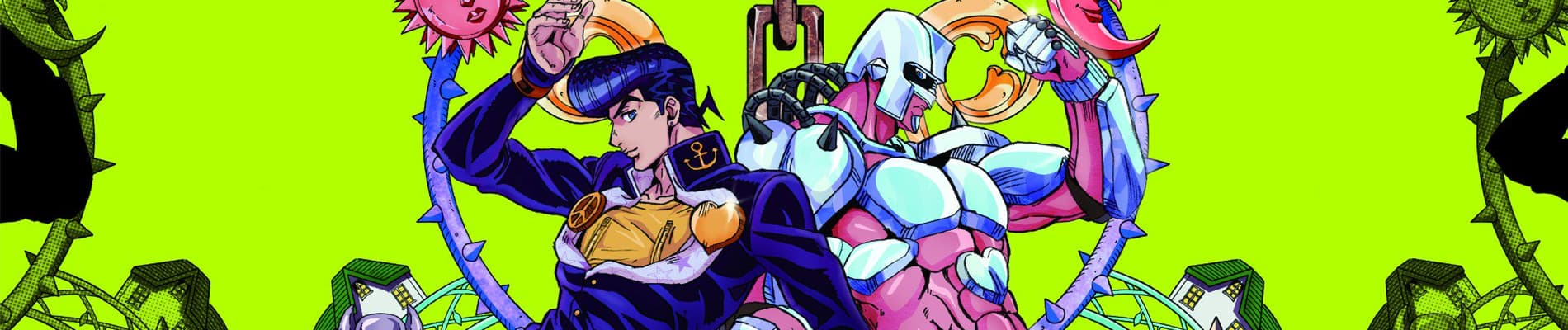
But just as stands empower Morioh's honest civilians, so do they let potential villains commit heinous violence more grotesquely and/or discreetly. So many of Part 4's fights are set in enclosed spaces, and predominantly in houses. There is foremost the severe, palpable fear that bad actors like Angelo could prey upon and intrude homes to violate their projection of safety, but the core of Part 4's violence centers around terrifying individuals leveraging the safety of society for their own means of destruction. Kira is incalculable and invisible: a man who, by adopting a strict self-imposed persona, successfully blends in with other civilians in society. He could be you, he could be me; he could be anyone clocking out from their 9-5, returning home to their wife and kids. There is but one universal truth: he will, inevitably, strike again. This violence, the sort of which leaves no remains nor closure for relatives -- Reimi witnessing Shigechi's extremely painful death is maybe the series' most upsetting moment -- disturbs the community, whose notion of safety further becomes shattered, as Kira weaponizes collective anonimity to cause further distrust and paranoia. A terrifying monster whose propensity towards evil for his own satisfaction will tear apart several families and the quotidian equilibrium unless we collectively decide to do the right things, even if it's scary or dangerous, because that's what heroes do and heroes always win. And if not, they are liberated in the end.


There's that classic spirit of communal justice, but it isn't borne out of a mystical sense of heroism, nor is every villain a grotesque monster: sometimes making the world a better place includes beating up a shitty loan shark, some incel, and other annoying people that prey upon and upset others -- maybe you'll even knock some sense in them! While the entire Kira arc is certainly Part 4's most memorable event, what stuck with me most on this rewatch is how the exploration of Morioh and its characters that surround give form to villainy and the subsequent justice. Kira cannot exist without the homely nature and rich tapestry of characters and situations in Morioh: a town cannot exist of only heroes and villains, but there must also be girls developing their first crush, petty otaku teenagers, gang members on the fringes of society, oddities, and adults who don't fight but socially contribute in other ways. Are they heroes or villains (they're often both)? How do they navigate Morioh with their stands, and how does Morioh respond back to them?

As a tangent, it cannot be understated how casually weird this always is. At one point Jotaro -- who himself already is an accidental eccentric giant, whose entire hair/hat situation we've just kind of given up on, and hilariously apparently wrote an entire paper on Morioh's starfish population offscreen -- goes to investigate a clothes store with Koichi (this parts' closest thing to a normal character), at which point a seasoned shopowner holding a cup of coffee offers Koichi one of his animal crackers, except for the camel because he likes eating that one last. After Koichi thanks him down the series continues and the shopowner dies a minute later. There's so much 'just doin shit' going on that almost feel entirely like impulses of Araki's scattered mind, yet its so synchronized with the series' overarching structure that you don't even question there being a cook, an alien, three tiny people, and a blob at Reimi's emotional sendoff in the finale.
It is just too much fun to not meet Diamond is Unbreakable on its own messy terms: even weaker episodes become recognizable through insane twists or overall vibes so that they become indispensable elements to the series (see: the 'invisible baby episode' anecdote); occasionally weaker animation direction can be excused when its construction of images through comic-like editing and vibrant yet playfully unstable color scripts lets it look unlike anything else in the world -- even other JoJo parts -- and to put it simply, its overt personality is just disarming. What this is is the near-perfect realization of a work so insistent upon and hopeful in its belief of justice and the liberation of the souls who remain haunted by the spectre of violence, that it is impossible not to become emotionally attached to what happens in that bizarre summer of 1999 that happened to beautiful Morioh and its strange people.

59.5 out of 61 users liked this review
