
La siguiente reseña está en Español e Inglés (traducida con el apoyo de DeepL)
La versión leída es la traducción al español por Julio perteneciente a “Btoom Translations”
Me es imposible separar al manga de la experiencia que tuve al leerlo puesto que lo considero una anomalía tanto en mí como en el público (entendiéndolo como círculos de anime en Twitter y Facebook), cada capítulo generaba teorías, reacciones y expectativa, como no había visto en una obra harem en varios años y todavía menos en esa intensidad. Sabía que el anuncio del anime era cuestión de tiempo, y al suceder finalmente decidí embarcarme en su lectura.
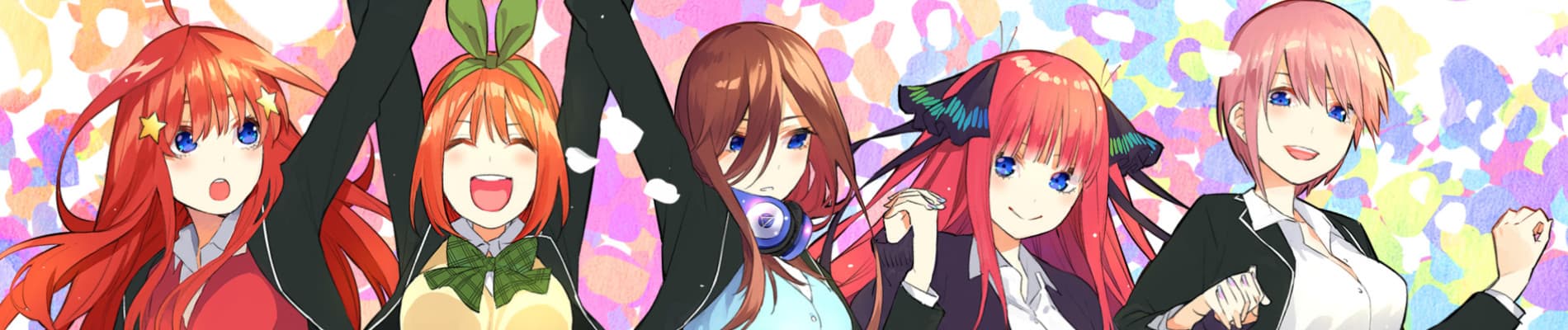
Conforme leía entendí las cualidades detrás de su popularidad, sus personajes. Fuutarou es un protagonista más serio y denso que similares del género, su principal cualidad es su férreo sentido del compromiso, ideal para el contexto de profesor y estudiante. Las chicas son el alumnado del protagonista, unas quintillizas como implica el nombre, parecidas en lo físico y personalidad, diferentes en los detalles.
Difieren en sus respectivos intereses y dinámicas relacionales, sean la pastelería, actuación, interés en historia, deportes o comida, constituyendo una variedad de particulares que serán de utilidad para la creatividad situacional de capítulo a capítulo; aunado con la relación Maestro-Estudiante que, en principio, facilita un escenario propicio para conocerlas gradualmente. El desarrollo grupal es distribuido hasta que alguno de los múltiples pequeños arcos de la historia en que alguna(s) de las mellizas será especialmente enfocada. Constituyendo una sólida estructura narrativa que sabemos compensará porque se intercala, de vez en cuando, con una retrospectiva, en la cual confirman que pase lo que pase, Fuutarou se casará con alguna de ellas.

Contrario a los prejuicios del arquetipo, los particulares del planteamiento asociados intrínsecamente al harem sí que permiten un sólido desarrollo en cada chica, constituida con el intercambio de roces, experiencias, discusiones, enfrentamiento de obstáculos, lidiar con sus sentimientos o la interacción fraternal de una chica hacia la otra; un conjunto que en su interacción definen el camino de su vida.
De esta manera, en cuánto a nivel temático, ninguna es menos significativa que las demás, tenemos a la construcción del autoestima, consideración hacia el otro, no rendirse en la búsqueda de sueños y uno de mis preferidos, la celebración de la juventud. Líneas narrativas conseguidas por el cuidado desarrollo narrativo (a excepción del último cuarto) que desembocan a que en la mayor parte de la historia ninguna parece tener “ventaja” en su relación con el protagonista a comparación de las demás, al contrario, cada cuál tiene sus momentos únicos, al punto que cualquiera de las 4 parecía perfectamente la “ganadora”.
A destacar que pese a ser una obra harem no cuenta con momentos explícitamente Fanservice, una comparación sería Nisekoi pero siendo aún más recatado. De ahí que cuándo el contexto lo permite, se aprecie esos momentos como el memorable capítulo de playa. A su vez es destacable los constantes aportes de los demás personajes secundarios, consiguen que nunca parezca un universo narrativo encerrado.

Así que, en general, su desarrollo constituido de capítulos individuales junto a uno que otro arco estaba bien escrito, estructurado y medido, especialmente el emocionante tramo final del tercer arco principal, sentía vértigo antes de leer el capítulo. Y entonces llega el último acto.
Lo que comienza siendo un arco de sorpresas y revelaciones se fragmenta en diferentes puntos de vista, demasiado complejo para su propio bien, consiguiendo la confusión en vez de la intriga. Agravado en que el cuidado ritmo previo es reemplazado por una acelerada aparición de sucesos, una ráfaga de revelaciones e instantes claves que poco tiempo dejan a la asimilación, cayendo en el olvido. Es un compromiso forzoso hacia el lector de seguir leyendo por lo que se ha invertido para llegar a ese punto.
Negi es un muy buen dibujante, el diseño de personaje de cada chica siendo similar y diferente permitió juegos en las narrativas, y hermosas postales en las ilustraciones de doble página o página completa, los momentos de revelación son la mejor versión de su trabajo. Las chicas tienen variadas expresiones, un puñado son bastante divertidas que siguen siendo icónicas aún fuera del manga. Los fondos tienen un buen detalle y más de una vez serán esenciales para darle viveza a esos paneles de revelación tan memorables, y el maquetado se dirige a lo efectivo, como debería esperarse de un autor joven, que en el transcurso mejora y experimenta, aún si en el final experimento demás.

En mis recuerdos, las quintillizas es un trabajo equivalente a una montaña rusa de emociones. El talento de Negi en utilizar todo tipo de cliffhangers, que alimentaba al sinfín de teorías en Twitter y Facebook, los agridulces sentimientos mientras se acercaba el final y la embriagante alegría en que mi equipo sea el victorioso.
¿Podría haber sido mejor? Sin lugar a dudas, bastaría que el tramo final tuviese doble de duración para una reestructuración enfatizando el control. Pero lo que ha pasado, ha pasado y ha sido bastante bueno. Las extrañaré a todas, y les recuerdo con una sonrisa, como a los recuerdos de la juventud.
English
It’s impossible for me to separate the manga from the experience I had reading it since I consider it an anomaly both in me and in the public (understanding it as anime circles on Twitter and Facebook), each chapter generated theories, reactions and expectation, as I hadn’t seen in a harem work in several years and even less in that intensity. I knew that the announcement of the anime was a matter of time, and as it happened I finally decided to embark on reading it.
As I read I understood the qualities behind its popularity, its characters. Fuutarou is a more serious and dense protagonist than similar in the genre, his main quality is his steely sense of commitment, ideal for the context of teacher and student. The girls are the protagonist's students, quintuplets as the name implies, similar in physique and personality, different in details.
They differ in their respective interests and relational dynamics, be it baking, acting, interest in history, sports or food, constituting a variety of particulars that will be useful for situational creativity from chapter to chapter; coupled with the Teacher-Student relationship that, in principle, facilitates a propitious setting to gradually get to know them. The group development is distributed until some of the multiple small story arcs in which some of the twins will be specially focused. Constituting a solid narrative structure that we know will compensate because it’s interspersed, from time to time, with a flashback, in which they confirm that whatever happens, Fuutarou will marry one of them.

Contrary to the prejudices of the archetype, the particulars of the approach intrinsically associated with the harem do allow a solid development in each girl, constituted with the exchange of frictions, experiences, discussions, facing obstacles, dealing with their feelings or the fraternal interaction of one girl towards the other; a set that in their interaction define the path of their life.
Thus, in terms of themes, none is less significant than the others, we have the building of self-esteem, consideration for others, not giving up in the pursuit of dreams and one of my favorites, the celebration of youth. Narrative lines achieved by the careful narrative development (except for the last quarter) that lead to the fact that in most of the story none seems to have “advantage” in their relationship with the protagonist compared to the others, on the contrary, each one has its unique moments, to the point that any of the 4 seemed perfectly the “winner”.
It should be noted that despite being a harem work, it does not have explicitly Fanservice moments, a comparison would be Nisekoi but being even more demure. Hence, when the context allows it, it’s appreciated those moments as the memorable beach chapter. At the same time, the constant contributions of the other secondary characters are remarkable, making it never seem like an enclosed narrative universe.

So, overall, its development made up of individual chapters along with the odd arc was well written, structured and measured, especially the thrilling final stretch of the third main arc, I felt giddy before reading the chapter. And then comes the last act.
What starts out as an arc of surprises and revelations fragments into different points of view, too complex for its own good, achieving confusion rather than intrigue. Aggravated in that the previous careful pacing is replaced by a rush of events, a flurry of revelations and key moments that leave little time for assimilation, falling into oblivion. It’s a forced commitment to the reader to keep reading because of what has been invested to get to that point.
Negi is a very good cartoonist, the character design of each girl being similar and different allowed for playfulness in the narratives, and beautiful postcards in the double page or full page illustrations, the moments of revelation are the best version of his work. The girls have varied expressions, a handful are quite funny that remain iconic even outside of manga. The backgrounds are nicely detailed and more than once will be essential to liven up those memorable reveal panels, and the layout aims for effective, as should be expected from a young author, who along the way improves and experiments, even if in the end he experiments too much.

In my memories, the quintuplets is a work equivalent to a roller coaster of emotions. Negi's talent in using all kinds of cliffhangers, which fed the endless theories on Twitter and Facebook, the bittersweet feelings as the end approached and the intoxicating joy that my team is the victorious one.
Could it have been better? Undoubtedly, it would have been enough to double the length of the final section for a restructuring emphasizing control. But what happened, happened and it was pretty good. I will miss them all, and remember them all with a smile, like the memories of youth.