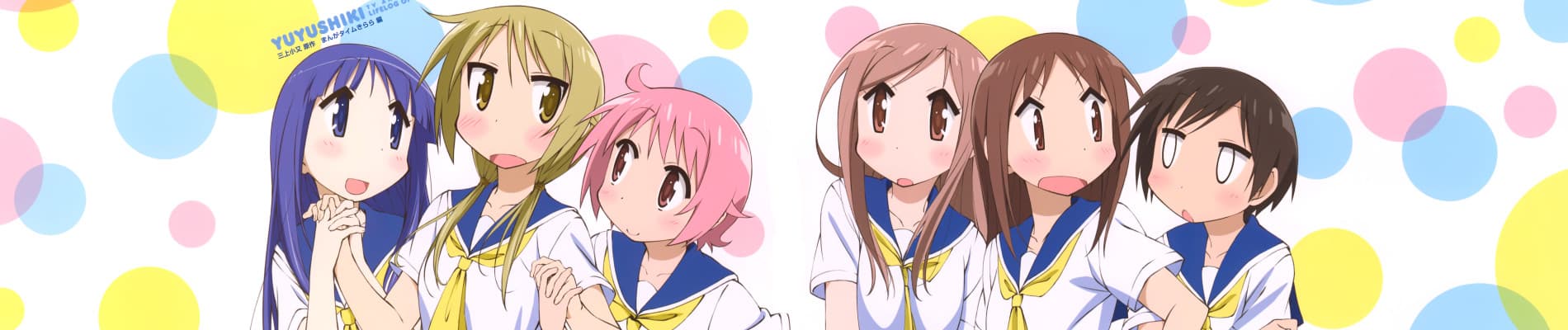
There isn't much to say as a synopsis for this anime. There's no deeper premise than the Data Processing Club; the show relies entirely on its quirky humor and how that results in specific dynamics between the characters (in addition to being a CGDCT with yuri undertones).
Apart from Yui as the "straight man" and Yuzuko as "the funny man", Yukari is an interesting and functional addition to the typical manzai (漫才) style present in the show. By being a bit of a bakadere who goes along with Yuzuko's antics, while not having herself the same eloquence and mania, she acts as an "instigator" that enables Yuzuko's rants to run just long enough until they meet Yui's necessary pullback to reality. She also often plays the whole of the heart that ties together the two more opposing forces of the trio, pacifying their eventual conflicts when they verge on seriousness.
This setup works fine, but it will inevitably get repetitive over time. Fortunately, later episodes introduce a few side characters (Aikawa Chino, Okano Kei, Hasegawa Fumi), who, in a way, mirror the main trio, although they display enough idiosyncrasy to not come across as redundant (the first is a shy and kind girl; the second, a tomboy who easily gets jealous for Aikawa; the third a more sober, yet sardonic type). More background is also added to Yui and Yukari's childhood, as we learn that they became friends before meeting Yuzuko, which is a nice touch for characterization and opens up new jokes where Yuzuko acts jealous of their unique bond.
Lastly, we have "Okaa-san-sensei", or Matsumoto Yoriko, who is the advisor for the Data Processing Club to which the main trio belongs. She is conscientious, is easily frightened, is warm and attentive with her students, and has oppai. Despite the previous comment, Aikawa does feel a little redundant to Yoriko, although the two characters rarely interact and have different motives for interacting with the main trio (i.e. Aikawa has a secret "crush" on Yui, which often drives her jokes).
It should definitely be interesting to revisit this anime a few years later, having learned more Japanese. There is a lot of wordplay and references to personality clichés (I say "personality" instead of "character" because sometimes they partially play with real world stereotypes. E.g. Yuzuko's monologue as Yukari's "father" in ep. 12). Many of Yuzuko's leads for jokes are phonetic similarities between words, category errors, and attempts to connect vaguely related topics, which make it a hard — if not impossible — anime to translate. Some cultural awareness (such as of Japanese dishes or of the aforementioned tropes/clichés) is necessary for other jokes as well, but the Data Processing Club scenes help the anime feel somewhat grounded even for the foreigner viewer, due to the "googling random stuff" element being universal. The characters' quirks are also a main source of amusement, and those can manifest purely through behavioral traits.
At the end of every "research activity," the Yuyushiki trio gathers to summarize what they’ve learned, often delivering a punchline for their skits and thus manifesting their quirks through how off-topic and out-of-the-box some of their “summaries” are. This is yet another moment where some knowledge of Japanese can be key for appreciating the comedy (although not always required), by observing how they transform the research topic into the most random, most irrelevant まとめ.
As for the moe, it can get too much at times, and the occasional "characters laughing at their own jokes" moments are always cringeworthy to watch. But, overall, it didn't feel like the humor was trying too hard; the flow is very natural. In fact, it's able to put you in the scene with these characters' erratic way of connecting ideas, to the point you being to question why it's starting to make sense. Fortunately, in this regard, the imminence of Yui's retorts and the presence of normal side characters also help in keeping this usage of nonsense and randomness moderate.
The last ~3 episodes fell off a little in terms of creativity. I cannot imagine enjoying the manga for 13 volumes without getting sick of it, but as a 12-episode anime it was a rather pleasant experience. It has a certain coziness and banality (in a good way) that can evoke memories of one's own school days, along with the silly "strategies" we would employ to escape monotony in a world not yet so afflicted with the internet (or with our current hectic pace of life). In a way, this type of play and banter can be seen as the very essence of adolescence — or the fight against boredom in general. That's sort of the experience with Yuyushiki. Simple fun, one moment after another.
8.5 out of 9 users liked this review
